
Privacy Coins 101: Types and Anonymity Features
Explains how Monero, Zcash, and Dash hide senders, receivers, and amounts, plus practical limits and safe-use tips.
Most crypto is public. Privacy coins try to hide the sender, the receiver, and the amount instead.
If I had to sum up the whole topic in a few lines, it would be this:
- Bitcoin, Ethereum, and most public chains are pseudonymous, not anonymous
- Privacy coins use built-in tools to hide payment details on-chain
- Monero uses privacy by default
- Zcash offers optional shielded transactions
- Dash uses opt-in mixing, but amounts and addresses stay visible
- Off-chain data still matters: IP addresses, exchange records, timing, and wallet habits can still expose you
- Usage rates matter: Zcash saw about 59.3% shielded transaction activity, and around 30% of circulating ZEC was in shielded addresses, up from 11% in early 2025
In plain English: a privacy coin is only part of your privacy. The protocol may hide on-chain details, but your behavior can still give you away.
Here’s the short version of how the main tools map to each privacy goal:
- Ring signatures help hide the sender
- Stealth addresses help hide the receiver
- RingCT, CT, and zk-SNARKs help hide the amount
- Default privacy usually gives a larger anonymity crowd than opt-in privacy
If you just want the fast takeaway, it’s this: Monero hides more by default, Zcash can hide just as much when shielded mode is used, and Dash gives lighter privacy focused on transaction link obfuscation.
| Coin | Sender Hidden | Receiver Hidden | Amount Hidden | Privacy Mode |
|---|---|---|---|---|
| Monero | Yes | Yes | Yes | Default |
| Zcash | Yes, when shielded | Yes, when shielded | Yes, when shielded | Opt-in |
| Dash | Partly, via mixing | No | No | Opt-in |
So when I look at privacy coins, I focus on three simple questions: what is hidden, when it is hidden, and what can still leak outside the chain.
The Main Anonymity Features Users Should Know
Privacy coins aim to hide three things: who sent a payment, who received it, and how much was sent. Those are separate problems, and each one uses its own set of tools. Looking at them one by one makes it much easier to judge how a privacy coin works.
Hidden Sender Tools
The main tool for hiding the sender is the ring signature. It blends your input with decoys, so anyone looking at the blockchain can't tell which input was actually spent. Monero uses rings of 16 total inputs with an optimized setup called CLSAG.
Mixing systems try to do something close to the same thing. They pool funds from multiple users and send them back out in a way that breaks the link between the incoming and outgoing payment. Different method, same idea: make the sender hard to pin down.
That same logic carries over to the receiver and the amount too.
Hidden Receiver and Hidden Amount Tools
Hiding the sender is only part of the job. Stealth addresses hide the receiver. Confidential Transactions (CT), RingCT, and zero-knowledge proofs (ZKPs) hide the amount.
Here’s the plain-English version. Instead of putting your public wallet address directly on-chain, the sender creates a one-time destination address for each payment using the recipient’s public keys and random data. Only the recipient can spot and spend that output with a private view key. So even if the same person gets paid many times, those payments don’t show the same visible address on-chain, which makes them much harder to link together.
CT hides the number itself by replacing it with cryptographic commitments. The network can still check that inputs equal outputs, but the amount stays private. Monero’s RingCT pairs that with ring signatures, so the system hides the amount while also helping blur the sender. Zcash uses a different method with zk-SNARKs, which allow the network to confirm that a transaction is valid without showing the sender, receiver, or amount.
| Goal | Primary Tool | What It Hides |
|---|---|---|
| Hidden sender | Ring signatures, mixing | Which input was actually spent |
| Hidden receiver | Stealth / one-time addresses | Link between on-chain output and your wallet |
| Hidden amounts | RingCT, Confidential Transactions, ZKPs | The numeric value transferred |
The level of privacy you get depends a lot on one thing: whether these features are on by default or only used when someone chooses them.
Privacy by Default vs. Optional Privacy
This split matters more than most people think at first. Privacy by default means every transaction uses the full privacy setup automatically. There’s nothing to turn on and no private mode to pick. Monero follows this model. Because almost every transaction on the network looks alike, your payment blends into a much larger crowd of similar transactions.
Optional privacy works differently. Systems like Zcash’s shielded pool or Dash’s mixing feature ask users to choose the private route themselves. That sounds fine on paper, but there’s a catch: if only a small share of users opts in, the anonymity set gets smaller. And when fewer private transactions exist, the ones that do stand out more and become easier to cluster and inspect, even when the cryptography underneath is strong. Put simply, when only a few people use the private lane, that lane gets easier to study.
sbb-itb-0796ce6
Major Privacy Coin Types and How They Work
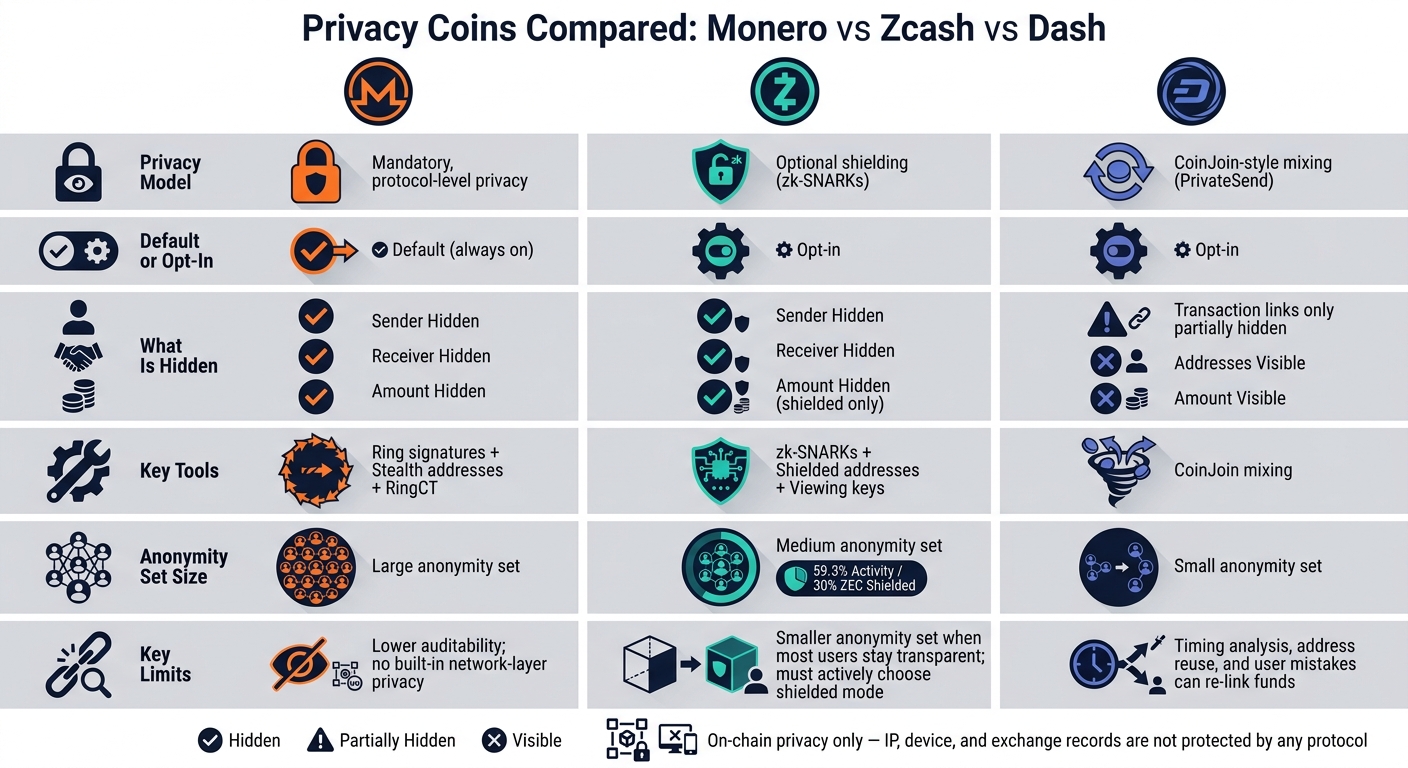
Privacy Coins Compared: Monero vs Zcash vs Dash
Monero, Zcash, and Dash all aim to protect the sender, receiver, and amount for those seeking easy crypto purchases with enhanced privacy. But they don’t do it the same way. Monero makes privacy automatic, Zcash lets users choose it, and Dash only covers part of the picture.
Monero and Privacy by Default
Monero uses privacy by default. Ring signatures, stealth addresses, and RingCT hide the sender, receiver, and amount on every standard transfer - always on.
Since all three layers run together in standard transfers, routine blockchain analysis is much less useful on Monero than it is on transparent chains.
Zcash and Shielded Transactions
Zcash supports both transparent addresses and shielded addresses. Shielded transfers hide the sender, receiver, and amount. A z-to-z transfer hides all three. But when funds move between transparent and shielded addresses, only some data stays private.
That means Zcash privacy depends not just on the tech, but also on how many people use shielding. Recent data shows that about 59.3% of Zcash network activity involved shielded transactions, and around 30% of circulating ZEC sat in shielded addresses, up from 11% in early 2025.
Zcash also supports viewing keys. These let a user share read-only access to shielded transaction history with an auditor, accountant, or tax preparer, without handing over spending control. For U.S. users, that can be a practical middle ground: privacy on one side, reporting access on the other.
Dash and Other Privacy Approaches
Dash uses a narrower privacy model. Dash's PrivateSend is an opt-in CoinJoin-style mixing system that breaks input-output links, but it still leaves addresses and amounts visible.
That difference matters. It shapes how much privacy a user gets, how easy the system is to use, and what kind of risk remains in day-to-day use.
| Coin | Privacy Model | What It Hides | Opt-In or Default |
|---|---|---|---|
| Monero | Mandatory, protocol-level privacy | Sender, receiver, amount | Default (always on) |
| Zcash | Optional shielding | Sender, receiver, amount (shielded only) | Opt-in |
| Dash | CoinJoin-style mixing | Transaction links, not transaction data | Opt-in |
These models vary in privacy strength, network coverage, and ease of use.
Privacy Tradeoffs, Limits, and Safe Use
Protocol privacy can hide what happens on-chain, but it doesn't hide everything around a transaction. It does not hide off-chain identity data. Your IP address, your device, and your exchange account are all part of a different layer of risk.
Comparing Privacy Strength and Usability
Each model makes a different tradeoff between privacy, ease of use, and auditability.
| Asset | Privacy Method | Default or Optional | What Is Hidden | Key Limits |
|---|---|---|---|---|
| Monero | Ring signatures, stealth addresses, RingCT | Default | Sender, receiver, amount | Lower auditability; no built-in network-layer privacy |
| Zcash | zk-SNARK shielded transactions | Optional | Sender, receiver, amount (shielded only) | Smaller anonymity set when most users stay transparent; users must actively choose shielded mode |
| Dash / CoinJoin-style mixing | Transaction mixing | Optional | Links between inputs and outputs | Timing analysis, address reuse, and user mistakes can still re-link funds |
Best Practices for Better Transaction Privacy
Even private transactions can leak through the way you use them. On-chain privacy won't hide your IP, device, or account data.
A few habits help a lot:
- Use fresh receiving addresses
- Avoid immediate address reuse
- Keep wallet activity separate from exchange activity
- Avoid spending right after receiving funds
The biggest leak is often a regulated service. Once funds pass through one, its records can point back to you no matter how much on-chain privacy you used. In practice, investigators often trace funds to regulated services and then use those records to identify the owner.
Those limits shape how privacy coins are bought and used in practice.
Getting Started and Key Takeaways
Buying Crypto Through a Regulated Entry Point
After the privacy limits above, the next step is practical: how do you buy crypto and move funds without adding more exposure than you need to?
A regulated fiat-to-crypto on-ramp gives you a clean purchase record and a simple way to get started. It’s the most direct first move for many people. After the purchase, don’t rush to move a large amount. Test your wallet first.
Start with small test transfers. Then move up only after you understand how your wallet handles addresses, fees, and privacy settings. Just as important, know what each transfer looks like on-chain before you send more. Keep USD records and follow local rules.
Your first transfer matters more than it may seem. It sets the privacy baseline for everything that comes next. A regulated on-ramp creates a clear audit trail from your fiat purchase to your first crypto, so it helps to plan before you move funds. In plain English: decide how identity-linked funds and privacy-focused wallets will stay separate.
Summary of Core Points
These privacy models differ most in what they hide by default.
Monero hides the sender, receiver, and amount by default using ring signatures, stealth addresses, and RingCT. Zcash uses zk-SNARKs to support optional privacy through shielded transactions, while its transparent and shielded modes let users choose. Dash uses optional, CoinJoin-style mixing through PrivateSend on an otherwise transparent blockchain, which gives lighter obfuscation aimed more at the sender side.
The gap between privacy-by-default and optional privacy has direct effects in practice. When only a small share of users choose private transactions, the anonymity set gets smaller. That can make those transfers easier to isolate. With optional systems, consistency matters just as much as the tool.
Protocol-level privacy is only one part of the story. IP address exposure, device security, wallet habits, and the way you move funds between identity-linked accounts and privacy-focused wallets all shape how private you are in practice. The core questions stay simple: what the protocol hides, what your behavior reveals, and what rules apply.
FAQs
Are privacy coins legal in the U.S.?
In the United States, privacy coins aren’t banned under one blanket federal law. That’s the key point.
Instead, the rules are split across different layers. State privacy laws can come into play, and federal anti-money laundering requirements are enforced by FinCEN.
Scrutiny around privacy-focused tools is still shifting. Even after the U.S. Treasury lifted sanctions on Tornado Cash in 2025, that didn’t mean all concerns vanished overnight. Authorities may still step in if they see suspicious activity or if a tool comes up during a legal investigation.
Can privacy coins be traced anyway?
Yes, in some cases.
Privacy coins use advanced cryptography to hide the sender, receiver, and transaction amount. That gives users a much higher level of privacy than most other cryptocurrencies. But it doesn't make them untouchable.
The weak spot is often human behavior, not the coin itself. If someone reuses wallet addresses or creates patterns across transactions, those clues can be tied together. Bit by bit, that can make analysis easier.
There's also the off-chain side of the story. If you use a regulated platform that requires identity verification, your real identity can end up linked to your on-chain activity. So while the transaction data may be hidden, the path around it can still tell a story.
Which privacy coin is best for beginners?
For beginners, privacy-focused wallets like Zashi are often a good pick. They make sending and receiving simpler, and they take a lot of the friction out of shielded transactions.
When you're ready to buy the cryptocurrency these wallets use, Kryptonim offers a secure, EU-regulated platform with a user-friendly, no-account setup for fast fiat-to-crypto purchases.