
ZK Privacy in Crypto Wallets: Why Your Transaction History Should Be Yours
Zero-knowledge proofs let crypto wallets hide transaction details, enable selective disclosure, and preserve privacy without compromising security.
Your financial history should stay private. Public blockchains expose every transaction detail, but zero-knowledge (ZK) privacy changes this. ZK technology allows you to prove your transactions are valid without revealing sensitive information like sender, receiver, or amounts. Here's why it matters:
- Privacy Protection: ZK wallets encrypt transaction data, keeping details hidden while ensuring security.
- Selective Sharing: Use viewing keys to share specific data with auditors or tax authorities without exposing your full history.
- Improved Security: ZK technology prevents fraud while safeguarding your financial data.
- Privacy-First Wallets: Options like Zcash, Aztec, and Railgun offer shielded transactions and selective disclosure tools.
ZK privacy balances confidentiality and compliance, putting you in control of your financial data. Keep reading to learn how it works, its benefits, and the best wallets to use.
What Are Zero-Knowledge Proofs?

zk-SNARKs vs zk-STARKs: Key Differences in Zero-Knowledge Proof Systems
Zero-knowledge proofs (ZKPs) are cryptographic tools that let you prove something is true without exposing the details behind it. Introduced in 1985 by Goldwasser, Micali, and Rackoff, ZKPs have become essential for privacy in crypto wallets.
"A zero-knowledge proof is a cryptographic method that allows one party to prove that a statement is true without revealing the underlying data that makes the statement true." - Zero Knowledge Proof (ZKP) Project
ZKPs rely on three key properties: completeness (valid claims are accepted), soundness (false claims are nearly impossible to verify, with error rates as low as 1/2^100 or 1/2^1000), and zero-knowledge (no extra information is disclosed).
How ZK Technology Works
ZKPs are built around a simple interaction between two parties: the prover, who holds secret information, and the verifier, who checks the claim. The prover uses a "witness" (their private data) to respond to a challenge from the verifier. This exchange confirms the prover's knowledge without revealing the secret itself.
Picture this: you want to prove a card's color is red without showing the card. You could present all 26 black cards from a deck. Since all black cards are accounted for, the hidden card must be red. However, its specific suit and value remain unknown.
Modern crypto wallets often use non-interactive ZKPs, which only require a single proof message. This is ideal for blockchains, where the prover and verifier don't need to interact in real-time. These proofs must also be succinct - smaller than the original data and quick to verify. For instance, verifying a zk-SNARK on Ethereum typically costs around 500,000 gas.
There are two primary types of ZKPs in crypto: zk-SNARKs and zk-STARKs. SNARKs are compact but need a "trusted setup" phase and are vulnerable to quantum computing. STARKs, on the other hand, don't require a trusted setup, are resistant to quantum attacks, and handle large datasets better, though they generate larger proofs.
| Feature | zk-SNARKs | zk-STARKs |
|---|---|---|
| Setup | Requires a "Trusted Setup" | Transparent (no trusted setup) |
| Proof Size | Compact and small | Larger proof sizes |
| Quantum Security | Vulnerable to quantum attacks | Quantum-resistant (uses hash functions) |
| Scalability | Slower for large computations | Scales well for large datasets |
These efficient proof systems are the backbone of privacy features in today's crypto wallets.
ZK Technology in Crypto Wallets
Now that you know how ZKPs work, let’s see how they protect transactions in crypto wallets. ZKPs allow wallets to verify transactions without exposing sensitive details. When you make a shielded transaction, your wallet encrypts the data and generates a proof that confirms you followed the network's rules - like having enough funds, avoiding double-spending, and providing a valid signature.
The blockchain only records the proof, not the transaction details. This means anyone can verify the proof without accessing your private information. For example, wallets like Zcash use ZKPs to enable "shielded addresses" (z-addresses), which keep your financial activity private while ensuring network security.
ZKPs have already secured billions of dollars in transactions, showcasing their ability to handle real-world demands.
Some wallets also offer "viewing keys" for selective data sharing. Say you need to share transaction details with your accountant for taxes - you can provide them a viewing key, giving access to specific transactions without exposing your entire financial history. This feature puts you in control of your data, deciding who sees what and when.
sbb-itb-0796ce6
How ZK Technology Protects Your Transaction History
ZK technology safeguards your transaction history by concealing sensitive details, enabling selective information sharing, and maintaining overall network security. Let’s break down how it works, starting with how it hides your transaction details.
Hiding Transaction Details
Your wallet encrypts key details like the sender, recipient, and transaction amount. Instead of recording this information, the blockchain only stores a cryptographic proof, ensuring privacy while preventing fraud.
"Zcash uses zk-SNARKs to verify transactions without exposing the sender, receiver, or amount. The network checks that payments are valid without seeing private data." - Zcash
By validating the mathematical proof rather than the actual transaction data, the network ensures your financial activity stays private without compromising the blockchain's integrity. This prevents issues like double-spending while keeping your personal details hidden.
Sharing Information Selectively for Compliance
ZK-enabled wallets go beyond simply masking details - they let you share specific transaction information when needed. This means you don’t have to choose between complete privacy and meeting regulatory requirements.
For example, you can provide a viewing key to trusted parties like auditors or tax authorities, granting access to select transactions without exposing your entire financial history. Alternatively, you can use payment disclosure to reveal details of a single transaction.
Need to prove a payment for tax purposes? You can disclose just the transaction’s value and memo field while keeping your wallet balance, other transactions, and identity private. Encrypted memo fields can even include compliance-related data, such as information required by the Bank Secrecy Act "Travel" rule, which remains accessible only to authorized individuals.
Maintaining Security While Protecting Privacy
ZK technology doesn’t just protect your privacy - it also ensures transaction legitimacy without revealing unnecessary details. It uses advanced cryptographic properties to strike this balance:
- Completeness: Ensures valid transactions are always approved.
- Soundness: Prevents fraudulent proofs for invalid transactions.
- Zero-knowledge: Guarantees the verifier learns nothing beyond the transaction’s validity.
These principles are essential for blockchain security. The network can confirm you have enough funds, aren’t double-spending, and have a valid signature - all without decrypting your transaction data. Thanks to non-interactive proofs, a single message can be verified independently by anyone.
While verifying a zk-SNARK on Ethereum costs around 500,000 gas, this computational effort is the trade-off for keeping your financial history private. With this cryptographic approach, your financial actions remain confidential while fully adhering to network rules.
Benefits of ZK Privacy for Crypto Users
Zero-knowledge (ZK) technology doesn’t just protect your transaction history - it also enhances how you interact with cryptocurrencies daily. With ZK privacy, you gain control over your financial data while still meeting essential security and compliance standards. It strikes a balance between transparency and anonymity, letting you decide what to share.
Main Advantages of ZK Privacy
One of the biggest perks of ZK privacy is protection against financial surveillance. On traditional transparent blockchains, anyone can monitor your spending habits and wallet balances. ZK technology, however, conceals transaction details - like amounts and counterparties - keeping your financial activity private without sacrificing blockchain security.
Another advantage is compliance without overexposure. For example, you can verify your age on a DeFi platform without sharing personal details. This allows you to meet KYC requirements while safeguarding your privacy.
"Zero-knowledge identity operates on the principle of 'proving without revealing.'" - Chainlink
ZK-enabled wallets also improve transaction speed and reduce costs. Layer-2 rollups, such as Loopring 3.0, batch transactions efficiently, achieving over 2,000 trades per second at costs as low as $0.0001 per trade. Compare that to Ethereum’s $5–$50 transaction fees during peak activity, and the difference is clear.
Additionally, ZK privacy protects the fungibility of your assets. Without it, coins can be traced and potentially blacklisted if a prior owner engaged in suspicious activities. ZK technology ensures that transaction histories don’t taint your assets.
Here’s a quick breakdown of these benefits:
Comparison Table: Privacy Impacts of ZK Technology
| Benefit | Description | Privacy Impact |
|---|---|---|
| Transaction concealment | Hides amounts and counterparties using zk-SNARKs or Bulletproofs | Prevents public exposure of financial activity and wealth profiling |
| Selective disclosure | Uses viewing keys to prove specific facts without revealing full data | Enables compliance and auditing without leaking personal details |
| Verifiable integrity | Confirms transaction validity on-chain via mathematical proofs | Maintains blockchain security without accessing private data |
| Sybil resistance | Verifies "unique humanity" for DAO voting | Ensures fair governance without revealing real-world identities |
These features give you the tools to safeguard and manage your transaction history with confidence and autonomy.
Crypto Wallets Using ZK Privacy Features
Several cryptocurrency wallets now integrate zero-knowledge (ZK) technology to keep transaction histories private. While the approaches differ, the goal is the same: giving users control over who can see their transaction details. This level of control highlights the potential of ZK privacy to protect users' financial data.
Zcash Shielded Transactions
Zcash was one of the first cryptocurrencies to focus on privacy, using zk-SNARKs to enable confidential transactions. When you send funds through a shielded address (z-address or Unified Address), details like the amount, sender, and receiver are encrypted on the blockchain but remain verifiable.
"Money in the digital world should work like money in the real world - useful, fast, and private when needed." - Zcash Wallet Documentation
Zcash offers two address types: transparent (t-addresses) for public transactions and shielded addresses for private ones. For users needing to comply with regulations, Zcash allows sharing of a viewing key to selectively disclose transaction details. With a trading volume of $496.87M and a market cap of $6.11B, Zcash has proven its relevance in the crypto space. Another privacy-focused solution is the Aztec Protocol built on Ethereum.
Aztec Protocol on Ethereum
Aztec takes a different approach by using local proof generation. Here, your wallet processes transactions and creates a zero-knowledge proof locally, ensuring sensitive data like amounts and participants never leave your device.
The Aztec Alpha network launched on March 31, 2026. Unlike Ethereum's account-based system, Aztec uses a "Note" model (similar to UTXO) for transactions. When funds are sent, old notes are destroyed, and new ones are created. ZK proofs ensure the transaction balances without exposing any actual amounts.
"Aztec is the only Layer 2 built from the ground up to be fully privacy preserving." - Jon Wu
Developers can build smart contracts in Noir, a programming language inspired by Rust, where they decide which functions remain private or public. Railgun offers another way to integrate ZK privacy into decentralized finance.
Railgun Privacy System
Railgun extends ZK privacy to decentralized finance (DeFi) across platforms like Ethereum, BSC, Polygon, and Arbitrum. Using zk-SNARKs and smart contracts, it shields ERC-20 tokens and NFTs within private "0zk addresses".
One standout feature is "Private Proofs of Innocence", which lets users prove their funds haven’t interacted with blacklisted addresses - without exposing their identity or full transaction history. This strikes a balance between compliance and privacy. Wallets like Railway Wallet and Terminal Wallet are popular examples of Railgun's implementation.
Sui zkLogin Wallets
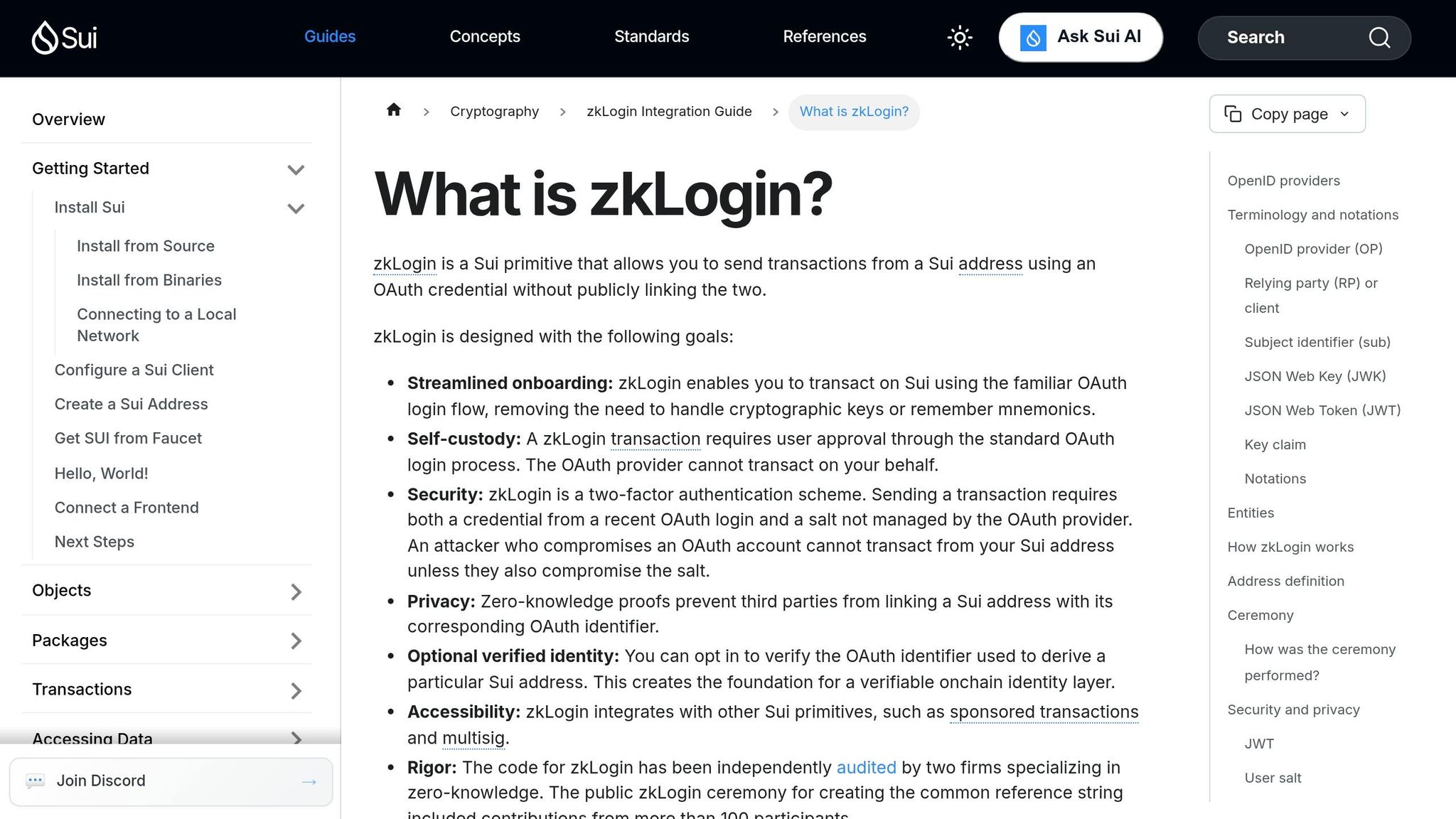
Sui zkLogin combines zero-knowledge proofs with user-friendly authentication. It lets users access wallets through familiar credentials - like Google or Twitch accounts - without sacrificing security or linking their social identity to their blockchain address.
This approach removes the need for complex private key management, making it easier for newcomers to navigate crypto wallets while still benefiting from strong privacy protections.
Together, these wallets demonstrate how zero-knowledge technology can keep transaction history firmly under user control.
Choosing a Privacy-Focused Wallet with Kryptonim
Why Choose Wallets with ZK Privacy
When it comes to protecting your financial data, wallets that use Zero-Knowledge (ZK) technology take privacy to the next level. These wallets often default to shielded transactions, employing ZK-proofs to hide sensitive information while still maintaining on-chain verifiability. This means your data stays private, but the integrity of the transaction is never compromised.
Privacy doesn’t stop at the blockchain. Network-level security is just as important. Look for wallets that offer features like Tor or I2P routing to mask your IP address. Tools such as coin control and UTXO management are also crucial for preventing address clustering, which can expose patterns in your transactions. For added peace of mind, opt for open-source wallets. These allow the broader community to verify privacy claims, ensuring transparency and trust.
"Privacy is about giving honest participants control over what is revealed, to whom, and under what circumstances." - Ayo Akinyele, Senior Director of Engineering at Ripple
Now, let’s see how Kryptonim applies these privacy principles to create a secure and user-friendly experience.
How Kryptonim Ensures Secure and Transparent Transactions
Kryptonim strikes a balance between privacy and compliance by adhering to EU regulations, offering users both institutional trust and operational transparency. The platform’s pricing is straightforward: a 2% transaction fee for EU users and 4% for others, with no hidden charges.
Its interface is designed to make advanced privacy features accessible to everyone, even those new to crypto. Kryptonim doesn’t require account creation, enabling quick fiat-to-crypto transactions while supporting local payment methods across the EU. This approach ensures you maintain full control over your financial data, all while enjoying a seamless and secure experience.
Common Limitations of ZK Privacy and Solutions
Scalability and Performance Issues
Generating zero-knowledge proofs is no small feat - it demands a lot of computational power. The process involves millions of arithmetic operations, including complex tasks like Fast Fourier Transforms and Multi-Scalar Multiplications. If you're using a phone or laptop, creating just one proof can eat up hundreds of megabytes of RAM and drain your battery quickly.
Proof size is another hurdle. zk-SNARKs are known for their compact proofs, around 200 bytes, with verification times as quick as 10 milliseconds. However, zk-STARKs produce much larger proofs, ranging from 100 to 500 KB, which can slow down network performance. For example, during Aleo's testnet phase, the large proof sizes caused severe bandwidth issues. To address this, the team managed to optimize and shrink proof sizes by 80% before launching the mainnet.
Hardware acceleration offers a major boost. Specialized ASIC provers can generate zk-SNARK proofs 20 to 50 times faster than a standard CPU. For everyday devices, using smaller 31-bit fields, like Mersenne 31 on Apple’s M3 chips, can increase throughput by over 100 times compared to the standard 254-bit BN254 field. In January 2026, benchmarks showed client-side GPUs running smaller fields achieved 146.0 GOP/s using Metal, compared to just 7.9 GOP/s for larger fields.
Smarter proof techniques are also helping. Recursive proofs, for instance, allow multiple ZK proofs to be combined into one smaller proof, reducing computational strain. Zcash showcased this with its Orchard upgrade in May 2022, introducing the Halo 2 system, which eliminated the need for a trusted setup by leveraging recursive proofs. Additionally, Layer 2 scaling solutions batch transactions off-chain and submit a single proof to the main blockchain, easing congestion and cutting costs.
User Adoption and Education
Beyond the technical challenges, making ZK privacy accessible and understandable is crucial for wider adoption.
One of the biggest obstacles isn’t the technology itself - it’s simplifying it for everyday users. Many people misunderstand "zero-knowledge", thinking it means "no data", when it really means proving something is true without revealing the underlying information. This confusion can discourage beginners from using privacy features designed to safeguard their financial data.
Wallet developers are addressing this with better user interfaces. Unified Addresses, for example, let users share a single address that works seamlessly for both shielded and transparent transactions. This eliminates the need to understand different transaction pools. Mobile-first wallets like Zashi also streamline the process with simple send-and-receive flows, making advanced privacy features easy to use, even for non-technical users.
Hardware wallet support is still catching up. As of early 2026, popular hardware wallets like Ledger and Trezor mostly support transparent transactions for Zcash, leaving shielded transactions less accessible. However, some wallets now offer "watch-only" modes, allowing users to pair hardware wallets with software wallets. This strikes a balance between strong security and the ability to view shielded balances.
Educational efforts are improving as well. Clear explanations of features like selective disclosure - where users can prove compliance or share specific transaction details with regulators without exposing their entire transaction history - help demystify privacy tools. This transparency reassures users that privacy doesn’t equate to illegal activity. Additionally, fast syncing features using "lightwalletd" backends enable quick scanning of shielded transactions, ensuring a smooth mobile experience and encouraging ongoing use.
Conclusion: Taking Control with ZK Privacy
Your transaction history is yours alone - it shouldn't be an open book for the world to see. Public blockchains, however, often function like "glass buildings", where anyone can observe the flow of transactions. While many blockchains are pseudonymous, not anonymous, blockchain analysis can still group addresses into "entities" and piece together profiles of your activity based on patterns like address reuse.
Zero-knowledge proofs flip this script entirely. They allow the network to confirm your transaction's validity without revealing sensitive details like the sender, recipient, or amount. This disrupts the linkability that traditional blockchain surveillance relies on, reducing vulnerabilities in your privacy. With this technology, you gain the tools to make smarter decisions about protecting your digital assets.
"Anonymous in crypto isn't a wallet setting, it's a system you build." - Jibran Mirza, Analysis, Coin Bureau
To strengthen your privacy, consider wallets supporting shielded addresses, such as those utilizing Zcash Orchard or Unified Addresses. These wallets help keep transaction participants and amounts confidential. Additionally, practice coin control by manually selecting UTXOs to avoid mixing "clean" coins with those tied to your identity. Avoid reusing addresses to prevent someone from tracing your on-chain activity.
When you're ready to purchase cryptocurrency for use with privacy-focused wallets, Kryptonim provides a secure, EU-regulated platform. They offer transparent pricing - 2% per transaction for EU users and 4% for other regions. With no account required and competitive exchange rates, you can quickly acquire crypto and transfer it to your non-custodial wallet. Remember, privacy goes beyond the wallet you use - it’s about the habits you adopt to protect your financial autonomy.
FAQs
Does using a ZK wallet hide my balance too?
Using a ZK wallet helps protect transaction details such as the sender, receiver, and transaction amount. However, it doesn’t automatically shield your total wallet balance. If you reuse addresses or follow patterns that can be tracked, some information could still become visible. To improve privacy, try not to reuse addresses and stick to best practices for keeping your activities anonymous.
How do viewing keys work without giving full access?
Viewing keys provide a way to grant selective access to transaction details or account balances without compromising spending authority. By sharing a cryptographic key - such as a private view key - third parties can securely examine transactions. This approach is particularly useful for purposes like auditing, as it ensures transparency while keeping full control over funds. Importantly, this key does not allow the holder to create or spend transactions.
What’s the trade-off between zk-SNARKs and zk-STARKs for wallets?
When it comes to zk-STARKs and zk-SNARKs, the key differences boil down to proof size, computation demands, and security.
zk-STARKs offer better scalability and stronger security, including resistance to quantum computing. However, they come with the trade-off of producing larger proofs and needing more computational resources.
On the other hand, zk-SNARKs generate much smaller proofs, which makes them ideal for storage and quick verification. That said, they are less scalable and do not provide protection against quantum threats.
Wallets need to weigh these trade-offs carefully, prioritizing either performance or security based on their specific needs.