
How to Buy Crypto in Ecuador with Local Methods
Guide to buying crypto in Ecuador with cards, bank transfers, or P2P—wallet setup, fees, and safety tips.
Yes - you can buy crypto in Ecuador, usually with bank transfers, cards, or P2P, but bank blocks and network mistakes are the two main things I’d watch for.
If I were starting today, I’d do this first: set up a wallet, finish ID checks, make a small $10–$20 test buy, and double-check that my wallet address and network match. In Ecuador, most people buy with USD, and many new buyers start with BTC or USDT. Card fees often land around 2%–4%, while P2P prices for USDT may be about 0.8% above the global price.
Here’s the short version:
- Cards are often the fastest for a first buy, but declines can happen.
- P2P can cost less, but I need to check seller history and keep the trade on-platform.
- Bank transfers work, though same-bank transfers are often faster than interbank ones.
- USDT network choice matters: ERC-20, TRC-20, and BEP-20 are not the same.
- My wallet comes first: if I lose my recovery phrase, I can lose my funds.
Quick Comparison
| Method | Usual speed | Typical cost | What I’d watch for |
|---|---|---|---|
| Debit/Credit Card | Minutes | 2%–4% plus possible bank charges | Card declines, foreign transaction fees |
| P2P Marketplace | 5–15 minutes | Often lower; price markup varies | Seller risk, name mismatch, off-platform scams |
| Bank Transfer | Same day to 1 business day | Often low/fixed | Bank review, transfer delays |
| Mobile wallet for P2P | Under 2 minutes in some cases | Varies by trade | Account limits, seller terms |
My bottom line: buying crypto in Ecuador is not hard, but I’d keep it simple - use a wallet I control, start small, and treat every address and payment detail like it matters, because it does.
sbb-itb-0796ce6
Set Up Your Wallet, ID, and Payment Method First
Before you buy crypto in Ecuador, get three things ready: your wallet, your verified ID, and a payment method that works in Ecuador. If you skip one, delays are common. This applies whether you plan to use a bank transfer, a card, or P2P.
How to Set Up a Wallet Before You Buy
Set up your wallet before you make a purchase. If you're new to crypto, Trust Wallet and MetaMask are simple starting points. They’re free and easy to use. If you plan to hold a larger amount for a long time, a hardware wallet like a Ledger Nano S/X or Trezor Model T keeps your private keys offline.
That matters no matter how you pay.
When you create a wallet, you’ll get a 12–24 word recovery phrase. Write it down on paper and keep it offline. Don’t save it in your notes app or email. If someone gets that phrase, they get access to your funds.
Use a wallet that matches the network shown at checkout. That part trips people up more often than you'd think. Also, always copy and paste your wallet address instead of typing it by hand, then check the first four and last four characters twice before you confirm.
Once your wallet is set, move to ID verification.
What to Expect During Identity Verification
KYC usually asks for your full name, date of birth, home address, government ID, and a selfie check. In Ecuador, you can use your cédula or passport.
Verification can take as little as 15 minutes, but some cases take up to 48 hours depending on document quality. The same issues tend to slow things down:
- Blurry ID photos
- Expired documents
- Name mismatches between your ID and your payment method
Make sure the name on your bank account or card matches your verified name exactly.
After that, check your bank or card settings before you try to buy.
Check Your Card or Bank Account Settings Before Buying
Before you place an order, make sure online and international payments are turned on. Check your daily card limit too. You also want to confirm that your Ecuador-issued card or bank account can process online crypto payments.
A small test payment can save you a headache. Start with $10 to $20 to make sure the payment goes through before you buy more. It’s also smart to turn on payment alerts in your banking app, so if a charge gets declined, you’ll see it right away.
With your wallet, ID, and payment method ready, you’re set to place your first order.
How to Buy Crypto on Kryptonim from Ecuador
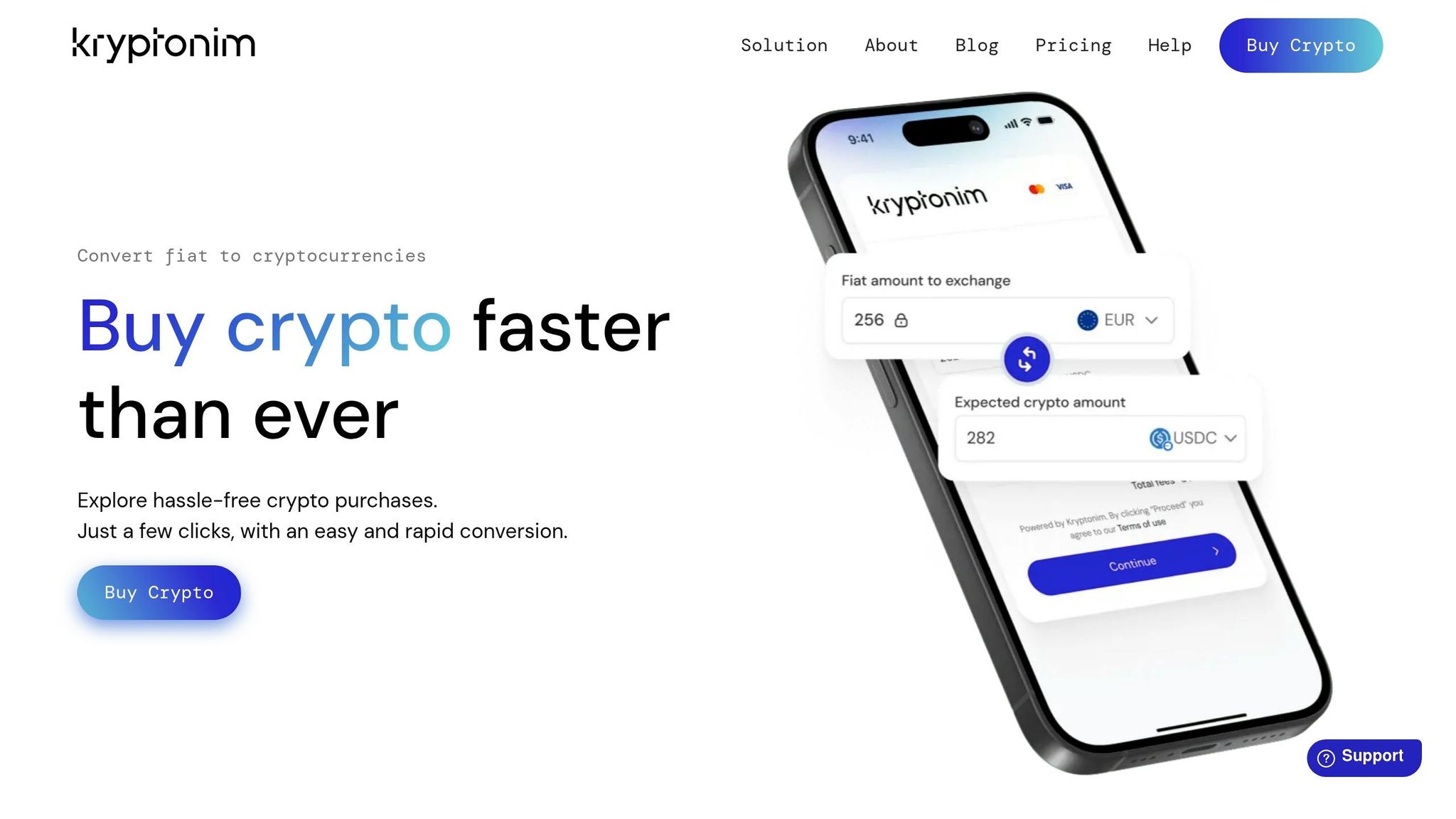
Now you can buy crypto directly on Kryptonim.
Why Kryptonim Works Well for First-Time Buyers
Kryptonim makes the process simple for first-time buyers. You can purchase crypto directly without creating a signup account first. The service fee is 4% per transaction, with no hidden charges added at the end.
Once your payment method is set, the rest moves pretty fast.
Step-by-Step Purchase Flow in USD
Here's the purchase flow.
- Select your asset - choose BTC, USDT, or another supported cryptocurrency in the Kryptonim converter.
- Enter your amount in USD - type how much you want to spend.
- Paste your wallet address and confirm it matches the coin and network - crypto transfers can't be reversed.
- Choose your payment method - pick a supported option, such as a debit or credit card or a local payment method.
- Complete identity verification - submit your cédula or passport photo and a selfie.
- Check the final price, fee, and crypto amount - review everything before you move on.
- Confirm and receive - once confirmed, the crypto is sent straight to your wallet.
Delivery time depends on verification and blockchain congestion.
Before you hit confirm, check the final quote so you know exactly how much crypto you'll get.
How to Read Fees and Calculate Your Final Crypto Amount
Before you confirm, the Kryptonim converter shows a full breakdown. For example, a $100 purchase with a 4% fee leaves about $96 in crypto before any network cost. Your final amount reflects the quoted rate plus the 4% service fee.
If you want to compare bank transfers, cards, and P2P trades, the next section breaks down those local methods.
Local Payment Methods Available to Buyers in Ecuador

How to Buy Crypto in Ecuador: Payment Methods Compared
Because Ecuador uses USD, the main things to compare are speed, fees, and bank support - not exchange rates. That makes the choice pretty simple: pick the mix that gives you the best balance of cost and convenience.
Bank Transfers and Cash Deposits
Bank transfers are one of the most common ways to fund crypto purchases in Ecuador, especially in P2P trades. In that setup, the markup is mostly a trading fee, not a currency conversion cost. For USDT, that markup is often about 0.8% above the global market price.
Common banks for P2P trades include Banco Pichincha, Banco Guayaquil, and Produbanco. In most cases, transfers within the same bank are the fastest. SPI inter-bank transfers take longer.
| Method | Typical speed |
|---|---|
| Same-bank transfer | 5–30 minutes |
| Inter-bank transfer (SPI) | A few hours to up to one business day |
| Mi Vecino cash deposit | Variable |
A simple way to avoid delays: filter P2P ads by your own bank. If you pick a seller who uses the same bank, you can often skip the wait that comes with inter-bank transfers.
If that still feels slow, cards are usually faster - but you’ll usually pay more for that speed.
Using Ecuador-Issued Debit and Credit Cards
Cards are usually the fastest route for first-time buyers. You enter your card details, complete card authentication, and the crypto can arrive within minutes once the payment is approved. Visa and Mastercard cards issued in Ecuador are generally supported.
The catch is cost and the chance of declines. Card processing fees for crypto purchases in Ecuador usually fall between 2% and 4%. On top of that, some issuers add an international transaction surcharge. Some Ecuadorian banks also block crypto purchases outright, so a declined payment often means the bank flagged the merchant category - not that there’s a problem with your order.
| Feature | Small Purchase (~$50) | Larger Purchase (~$500) |
|---|---|---|
| Speed | Instant after KYC | Instant after KYC |
| Typical fees | 2%–4% | 2%–4% |
| Friction | Lower if the card is authorized | Higher because declines are more likely |
| Best for | Testing the flow | Smaller buys before moving to P2P |
A smart move is to check that international transactions are turned on, then start small - say $50 - to make sure the card works before putting through a bigger order.
For people who want local payment options without dealing with card declines, mobile wallets and P2P can be a better fit.
Mobile Payments and P2P Marketplace Trades
If you want local payment rails and fewer card headaches, Deuna is a mobile wallet in Ecuador that can settle P2P payments in under 2 minutes. Standard Deuna accounts are capped at $500 per transaction and $2,000 per month.
P2P platforms work by holding the seller’s crypto in escrow until your USD payment is confirmed. When picking a seller, look for a completion rate above 90% and at least 100 completed orders. And before you mark a payment as sent, check your banking app and confirm it went through.
| Feature | Mobile Payments (Deuna) | P2P Marketplace Trades |
|---|---|---|
| Speed | Under 2 minutes | 5–15 minutes |
| Fee visibility | High | Variable, built into the trade markup |
| Risk from the other party | Low | Medium, with escrow protection |
| User effort | Low | Medium |
One rule matters more than it may seem: the payment account name on a P2P trade must match the exchange-verified name exactly. Using a family member’s card or bank account can lead to frozen funds or even account suspension.
Compare Your Options and Store Crypto Safely
Which Method Fits Your Speed, Cost, and Comfort Level
Once you understand how each payment method works, the next step is simple: pick the one that fits your budget and how fast you want the crypto.
If speed matters most, cards are usually the fastest option. If you're trying to keep total costs down, P2P often comes out cheaper. Bank transfers can work too, but only if your bank clearly allows the payment. Some banks may reject crypto-related transfers or flag them for review.
| Method | Speed | Typical Fees |
|---|---|---|
| Debit/Credit Card | ~10 minutes | Higher (2%–4% + bank fees) |
| P2P Marketplace | 5–15 minutes | Lower, but includes local transfer costs |
| Direct Bank Transfer | 1–2 days | Low/Fixed, but review risk applies |
How to Store BTC and USDT Safely After Buying
After you choose a method and finish the purchase, move the crypto to a wallet you control. Once your USD purchase clears, keep it in your own wallet, not on the platform where you bought it, especially if you plan to hold it for a while.
For larger amounts, a hardware wallet like a Ledger Nano S/X or Trezor Model T gives the strongest protection. These usually cost between $50 and $200.
Before sending the full amount, do a small test transfer first - about $10–$20 - to make sure the wallet address and network are correct. That small step can save you from a painful mistake.
With USDT, this matters even more. Check whether you're using ERC-20, TRC-20, or BEP-20 before you send anything. If you send funds on the wrong network, the loss is usually permanent.
A few things are best treated as red flags:
- Guaranteed-return offers
- Off-platform trades
- Unsolicited investment tips
Key Takeaways for Buying Crypto in Ecuador
Crypto can be owned and traded in Ecuador, but it is not legal tender or an authorized means of payment. Most buyers use USD-based methods such as cards, P2P, or mobile wallets to make purchases. After that, safe storage and careful address checks matter more than the payment method itself.
FAQs
Is buying crypto legal in Ecuador?
Yes. Buying, owning, and selling cryptocurrency is legal in Ecuador.
That said, crypto is not legal tender and it's not an approved payment method. Ecuador’s Central Bank has said it can’t ban private ownership or trading. But local financial institutions can’t process crypto-related transactions, and digital assets can’t be used to pay for goods or services in the country.
Which USDT network should I choose?
Choose a USDT network that both your platform and wallet support. If you send USDT on the wrong network, your funds can be lost for good.
In Ecuador, TRC-20 (Tron) is usually the top pick. It’s widely used and often the simplest option. You may also see ERC-20 (Ethereum) and BEP-20 (BNB Smart Chain).
Before you transfer, double-check that the network matches on both sides. That one small detail can save you a big headache.
Why is my card payment declined?
Most of the time, Ecuadorian banks decline crypto-related card transactions because of their own internal policies. Since the Central Bank of Ecuador does not recognize cryptocurrency as a legal payment method, regulated financial institutions may limit or refuse these purchases.
Contact your bank to check whether the transaction was blocked and whether crypto purchases are allowed on your card. It also helps to review your card’s security settings, alerts, and spending limits before you try again.