
How to Buy Crypto in Peru: Methods and Fees
Buying crypto in Peru is straightforward — choose the right payment method, cut fees, and secure your keys to avoid costly mistakes.
Buying cryptocurrency in Peru is straightforward, but understanding the methods, costs, and regulations is crucial. Here's what you need to know:
- Payment Methods: Use local options like Yape and Plin for quick, low-cost transactions. Bank transfers are ideal for larger amounts but take longer. Debit and credit cards are fast but come with higher fees (around 4.5%).
- Platforms: Beginners can start with regional exchanges like Buda.com for simplicity or global platforms like Binance for variety. Peer-to-peer (P2P) marketplaces offer direct trades with minimal fees.
- Regulations: Crypto is treated as a digital asset in Peru, not legal tender. Profits are taxed at 6.25% for individuals starting in 2026, so keep detailed records for your tax returns.
- Fees: Watch out for deposit fees, spreads, and network costs. Bank transfers are the most cost-effective, while cards can be expensive. Platforms like Kryptonim simplify pricing with a flat 4% fee.
- Security: Avoid storing large amounts on exchanges. Use hardware wallets for long-term storage and enable two-factor authentication for added protection.
Whether you're buying $5 or $500 worth of crypto, choose a method that balances cost, speed, and convenience while prioritizing safety.
Crypto Regulations and Basics in Peru
Legal and Tax Status of Crypto in Peru
Peru doesn't have specific laws dedicated to cryptocurrencies. Instead, the country's tax authority, SUNAT (National Superintendency of Customs and Tax Administration), applies its existing income tax rules to digital assets. Cryptocurrencies are classified as intangible assets for tax purposes, not as legal currency. This means any profits from selling or trading crypto are treated as capital income. Starting in 2026, individuals will pay an effective tax rate of 6.25% on their gains, while businesses are taxed at the corporate rate of 29.5%.
| Taxpayer Type | Tax Classification | Tax Rate |
|---|---|---|
| Individuals | Capital Income (Second-category) | 6.25% |
| Businesses | Corporate Income | 29.5% |
If you're dealing with crypto in Peru, it's mandatory to include all transactions and holdings in your annual tax return. To ensure accuracy, maintain detailed records - this includes purchase dates, amounts converted into Peruvian Soles (PEN), and sale prices. If you're unsure about how your gains are classified, a local tax expert can provide guidance.
Crypto exchanges operating in Peru must comply with Anti-Money Laundering (AML) regulations. This is why most reputable platforms require identity verification before allowing users to trade.
Understanding these rules is an important first step if you're considering entering the crypto space. Once you're clear on the regulations, it’s time to learn some basic crypto terms.
Key Crypto Terms for Beginners
Getting started with crypto can feel overwhelming, but knowing these common terms will help:
- Exchange: A digital platform where you can buy, sell, or trade cryptocurrencies using fiat currencies like Peruvian Soles or U.S. Dollars.
- Wallet: A tool for storing and managing digital assets. Think of it as a bank account for your crypto.
- Private Key: A unique cryptographic code that gives access to your wallet. Losing this key means permanently losing access to your funds, so protect it carefully.
- Stablecoin: A type of cryptocurrency tied to a stable asset, often the U.S. Dollar. Popular examples include Tether (USDT) and USD Coin (USDC).
- Custodial vs. Non-Custodial Wallets: A custodial wallet means a third party holds your private keys, while a non-custodial wallet gives you full control over them.
sbb-itb-0796ce6
How to Prepare to Buy Crypto in Peru
Before diving into crypto purchases, it's essential to set up a payment method and pick the platform that aligns with your needs.
Setting Up Your Payment Methods
Peru offers several ways to pay for crypto, ranging from mobile apps to traditional bank transfers.
Digital wallets are a favorite among locals. Apps like Yape and Plin dominate the scene, with Yape alone boasting over 20 million users and handling more than 750 million transactions every month. These apps let you send money instantly through phone numbers or QR codes, making them ideal for peer-to-peer crypto transactions.
Bank transfers are a better fit for larger sums. Popular banks like BCP, BBVA, Interbank, and Scotiabank are widely accepted on local platforms. While the fees are low - around 1% - you’ll need to wait 1–3 business days for the funds to clear.
Debit and credit cards (Visa or Mastercard) are the fastest option, often completing transactions in under 10 minutes. However, convenience comes at a price, with fees typically around 4.5% per transaction. This makes them less appealing for frequent buyers.
| Payment Method | Speed | Typical Fee | Best For |
|---|---|---|---|
| Yape / Plin | Instant | Low/Variable | Small to medium P2P purchases |
| Bank Transfer | 1–3 Business Days | ~1% | Large, secure investments |
| Credit / Debit Card | Under 10 minutes | ~4.5% | Speed and convenience |
Keep in mind that most platforms require KYC (Know Your Customer) verification for transactions over $150. To avoid delays, have your DNI and a selfie ready for verification. Once your payment method is sorted, the next step is choosing how to buy crypto.
Choosing a Buying Method Based on Your Needs
Your buying method will depend on what you value most - simplicity, cost, or variety.
For beginners, fiat-to-crypto on-ramps are the easiest way to get started. Platforms like Changelly allow you to begin with as little as $5 and even accept Peruvian Sol (PEN). The process is simple and beginner-friendly.
"A bank transfer is a secure option to buy cryptocurrency, especially if you are thinking of purchasing large amounts of virtual currency." - Changelly
If keeping expenses low is a priority, peer-to-peer (P2P) marketplaces are worth exploring. They connect buyers and sellers directly, often with zero platform fees. However, exercise caution - always check the seller's reputation and trade history before making any payments.
For those seeking access to a broader range of cryptocurrencies and advanced trading features, global exchanges are the way to go. These platforms support multiple payment methods, including cards and digital wallets, and typically offer hundreds of crypto options. The downside? They can be a bit trickier to navigate for newcomers.
Regional exchanges strike a balance between simplicity and functionality. They enable direct PEN deposits through local banks, making them user-friendly for Peruvians. However, their selection of coins tends to be more limited.
Ways to Buy Crypto in Peru
Using Regional Exchanges
Regional exchanges such as Buda.com are tailored for Latin American users, making them a convenient choice for Peruvians. These platforms allow you to deposit Peruvian Soles (PEN) directly through local bank transfers.
Here’s a quick overview of the process:
- Sign up: Create an account using your email and password.
- Complete KYC verification: Submit a photo of your DNI and a selfie. This step usually takes less than 30 minutes.
- Deposit funds: Transfer PEN to the exchange’s local bank account.
- Buy cryptocurrency: Choose your desired crypto, make the trade, and decide whether to store it on the platform or move it to a private wallet.
Buda.com charges trading fees between 0.4% and 0.8%. From registration to buying your first crypto, the process can be completed in about 30 minutes. For enhanced security, enable Two-Factor Authentication (2FA) using an app like Google Authenticator instead of SMS codes.
If you're looking for a wider range of cryptocurrencies, global exchanges might be your next stop.
Buying on Global Exchanges
Global exchanges offer access to a broader selection of cryptocurrencies. For example, Binance provides Peruvian users with over 350 crypto options. However, these platforms often don’t support direct PEN deposits. Instead, they facilitate transactions in local currency through Peer-to-Peer (P2P) marketplaces.
The setup process is straightforward: sign up with your email, complete the KYC verification, and link your preferred payment method. Then, use the "Buy Crypto" feature to select your payment option - such as Yape, Plin, or a bank transfer - based on the available P2P listings.
Peer-to-Peer (P2P) Marketplaces
For those who prefer direct transactions without intermediaries, P2P trading is a solid option. On Binance’s P2P marketplace, you can trade directly with other users. Filter offers by currency (PEN), payment method (Yape, Plin, or bank transfer), and price. Binance typically charges no commission on P2P trades.
To ensure a secure transaction:
- Check the seller’s reputation and completion rate before proceeding.
- Use the platform’s escrow feature, which holds the seller’s crypto until you confirm payment.
- Complete all steps within the platform, and never share your wallet credentials or make payments outside the platform.
Using Fiat-to-Crypto On-Ramps
Fiat-to-crypto on-ramps are a simple option for beginners. Services like Kryptonim let you buy crypto using a credit/debit card or bank transfer. The purchased crypto is sent directly to your wallet, eliminating the need to create an exchange account. Kryptonim charges a flat 4% transaction fee for users outside the EU, with no hidden costs.
This method is ideal if you want to skip the complexities of exchange order books. Just make sure to check the FX conversion rate and the final amount before confirming your purchase.
Fees and How to Lower Your Costs
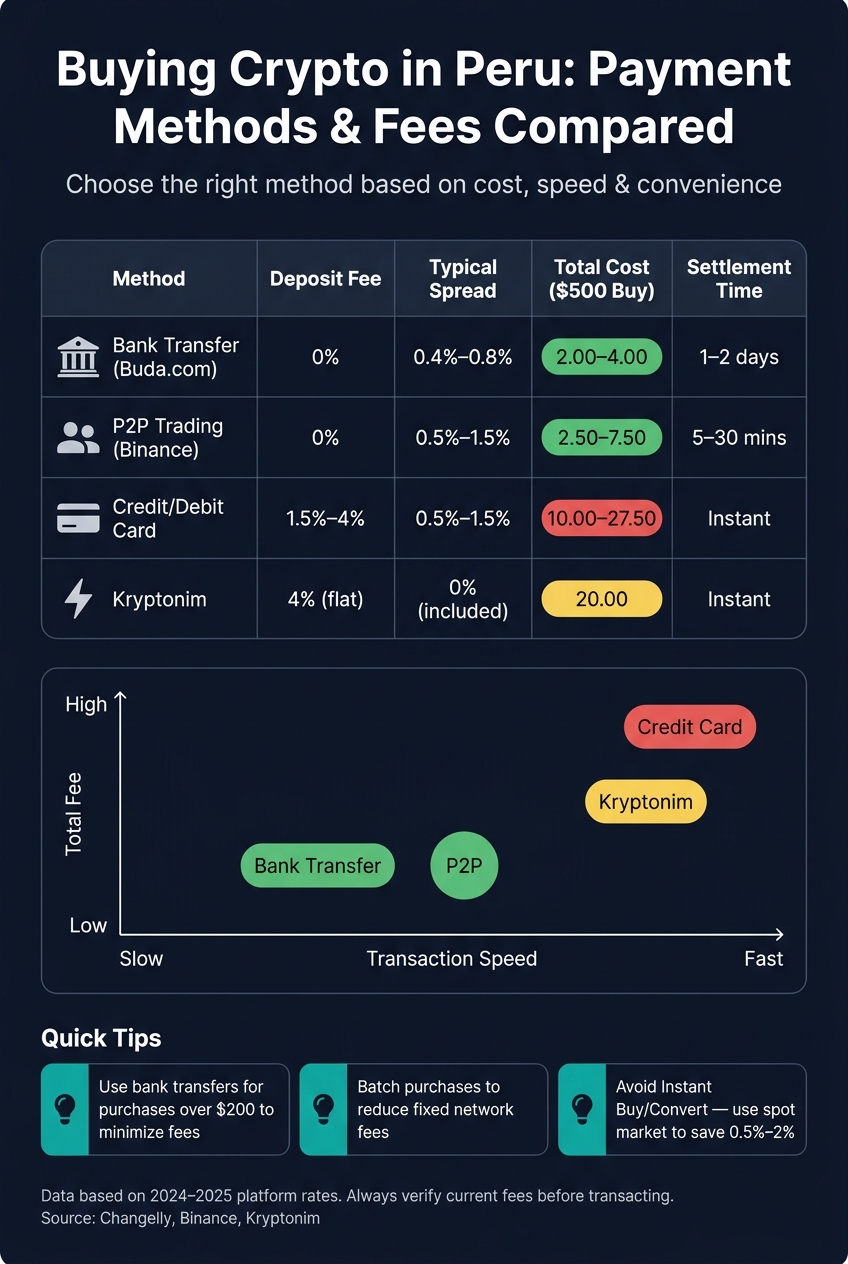
How to Buy Crypto in Peru: Payment Methods, Fees & Speed Compared
Understanding Fees and Hidden Costs
Knowing how fees stack up can help you pick the most budget-friendly way to buy crypto. When purchasing crypto in Peru, there are typically three main costs to consider: the deposit fee (what the platform charges to receive your funds), the spread (the difference between the market price and the price you pay), and FX conversion fees (the cost of converting PEN to USD or directly into crypto). Overlooking any of these can lead to higher-than-expected expenses. Let’s break these down.
Your payment method plays a huge role in the fees you pay. For instance, card fees range from 1.5% to 4%, and that’s before factoring in the spread. On the other hand, bank transfers are much cheaper, usually costing between 0% and 0.5%. To put this into perspective, on a $500 crypto purchase, your total fees could range from as little as $2.00 to as much as $27.50, depending on how you fund your account.
Another cost to watch out for is network fees, which can catch beginners off guard. For example, transferring USDT on Ethereum might cost anywhere from $5 to $25, while doing the same on BNB Chain could cost as little as $0.29.
How Kryptonim Offers Clear Pricing
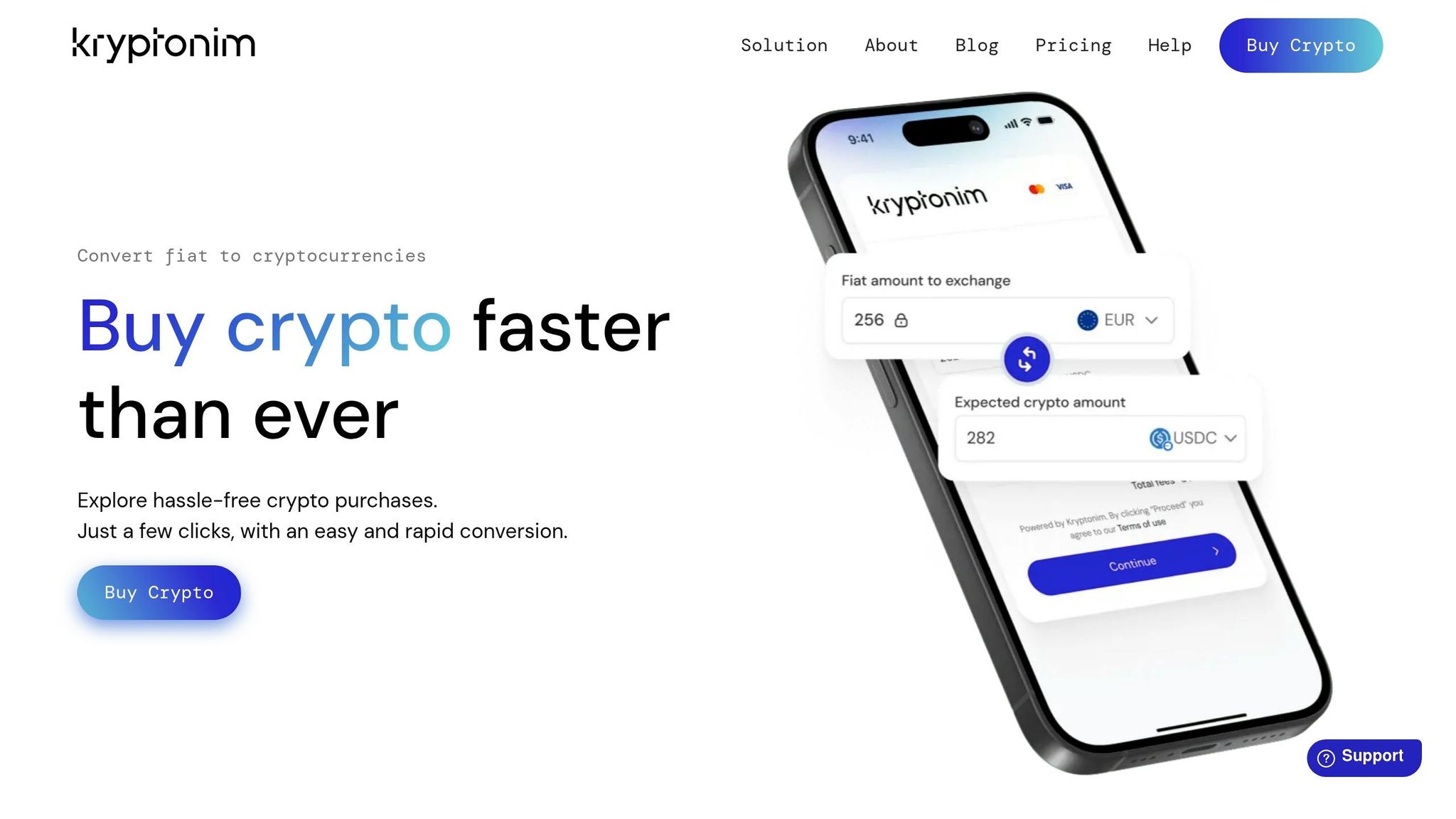
Kryptonim, an EU-regulated fiat-to-crypto platform, keeps things simple with a flat 4% fee for users outside the EU, including those in Peru. There are no extra spreads, deposit fees, or hidden charges. What you see is what you pay.
Here’s how Kryptonim stacks up against other methods for a $500 purchase:
| Method | Deposit Fee | Typical Spread | Total Cost ($500 Buy) | Settlement |
|---|---|---|---|---|
| Bank Transfer (Buda.com) | 0% | 0.4%–0.8% | $2.00–$4.00 | 1–2 days |
| P2P Trading (Binance) | 0% | 0.5%–1.5% | $2.50–$7.50 | 5–30 mins |
| Credit/Debit Card | 1.5%–4% | 0.5%–1.5% | $10.00–$27.50 | Instant |
| Kryptonim | 4% (flat) | 0% (included) | $20.00 | Instant |
Kryptonim’s flat-fee approach offers peace of mind. You’ll always know exactly what you’re paying upfront, without needing to navigate complex order books or compare P2P offers. For many, this transparency is worth the slightly higher fee.
Tips to Cut Down on Fees
Once you understand the fee structure, there are several ways to keep your costs low. One of the simplest methods is to use local bank transfers instead of credit or debit cards. In Peru, platforms like Buda.com or Binance P2P allow PEN transfers via services like Yape or Plin, often with zero or minimal deposit fees.
If you’re using an exchange with a spot trading interface, steer clear of the "Instant Buy" or "Convert" options. These features often include spreads of 0.5% to 2%. Instead, place trades directly on the spot market, where fees are typically just 0.075% to 0.1%.
"The one-time effort to learn the spot trading interface saves you hundreds of dollars per year in unnecessary convenience fees." - Decentralised News
Another cost-saving trick is batching your purchases to reduce the impact of fixed network fees. For example, transferring $250 once is far cheaper than making five separate $50 transfers. Additionally, when withdrawing stablecoins, opt for TRC-20 (Tron) or BEP-20 (BNB Chain) networks instead of ERC-20 if possible. The savings can be massive - sometimes up to 15x per transaction.
How to Store and Manage Your Crypto Safely
Once you've decided how to buy crypto, the next step is protecting your investment. Keeping your crypto secure is essential, especially if you're aiming to safeguard your assets and make the most of tax advantages. Storing your crypto on an exchange for the long term can be risky. Centralized platforms are vulnerable to hacks, account freezes, or even sudden shutdowns without notice. Transferring your assets to a personal wallet gives you full control. In Peru, for instance, personal wallets are taxed only when you sell, as SUNAT only taxes realized gains.
Choosing the Right Wallet
The type of wallet you choose depends on how much crypto you own and how often you trade. Here's a quick breakdown:
| Wallet Type | Best For | Security Level | Examples |
|---|---|---|---|
| Exchange (Custodial) | Beginners, frequent trading, small amounts (<$100) | Low (platform-dependent risks) | Binance, Buda |
| Hot Wallet (Software) | Medium amounts ($100–$1,000), regular use | Medium (internet-connected) | Trust Wallet, MetaMask |
| Cold Wallet (Hardware) | Long-term storage, large amounts (>$1,000) | High (offline storage) | Ledger, Trezor |
The main distinction between custodial and non-custodial wallets lies in who controls the private keys. With non-custodial wallets, you alone manage the 12–24 word seed phrase, which is the only way to recover your funds if you lose access. Without this phrase, recovery is impossible - think of it as digital cash.
Here's a simple rule of thumb: if your holdings are under $100, leaving them on an exchange is generally acceptable. However, for amounts exceeding $1,000, it's highly advisable to switch to a hardware wallet like Ledger or Trezor. Once you've chosen your wallet, following proper security measures is critical.
Security Practices for Crypto Storage
To keep your crypto safe, follow these essential practices:
- Use an authenticator app like Google Authenticator for two-factor authentication (2FA). Avoid SMS codes, as they are prone to SIM-swapping attacks.
- Create strong, unique passwords for every platform you use.
- Write down your seed phrase on paper and store it in a secure location. Never save it digitally.
- When transferring a large amount to a new wallet, always start with a small test transaction (e.g., $5) to confirm the address and network are correct. Sending funds to the wrong network (e.g., TRC-20 USDT to an ERC-20 address) can result in permanent loss.
- Avoid using public Wi-Fi for wallet access or transactions.
Conclusion: Making Smart Crypto Purchases in Peru
Getting started with crypto in Peru is simpler than many beginners think. With as little as $5, you can dive in using familiar options like bank transfers or debit cards. Keep in mind that card payments are almost immediate but come with fees of about 4.5%, while bank transfers are slower - taking one to three business days - but cost around 1%. Knowing which method works best for you is key before spending even a single sol.
Once you've chosen your method, don’t overlook the importance of managing and securing your crypto. For added flexibility, peer-to-peer (P2P) marketplaces are another option, though their modest spreads can slightly increase costs. After completing your purchase, prioritize safety by transferring your funds to a secure wallet.
To protect your investment, avoid keeping large amounts on exchanges. If your holdings exceed $1,000, transfer them to a hardware wallet as soon as possible. Write your seed phrase on paper and store it offline, and always enable two-factor authentication using an authenticator app.
Kryptonim provides a simple solution for beginners: a clear 4% fee structure, no hidden charges, no account setup required, and an easy-to-use platform that takes you straight from payment to owning crypto.
"Buying cryptocurrency for the first time can feel overwhelming... but here's the truth: buying your first crypto is simpler than opening a bank account in most countries." - Alex Mercer, Crypto Analyst
FAQs
Which payment method is cheapest in Peru?
The most affordable way to purchase cryptocurrency in Peru is often through bank transfers or peer-to-peer (P2P) transfers on local platforms like Yape or Plin. These methods generally come with minimal or no fees. By paying in soles via local bank accounts or P2P systems, you can sidestep higher expenses, such as the up to 3% fees associated with credit or debit card transactions. Bank transfers, in particular, are typically free or come at a very low cost.
Do I need to verify my identity to buy crypto?
Yes, buying cryptocurrency usually requires identity verification. This process, called Know Your Customer (KYC), involves submitting a government-issued ID, a selfie holding your ID, and proof of address. After completing verification, most platforms allow trading limits of up to $10,000 per month, though this can vary depending on their specific policies.
How do I avoid losing crypto when withdrawing to a wallet?
When withdrawing cryptocurrency, it's crucial to double-check the wallet address before finalizing the transaction. A single mistake in the address can result in permanent loss of your funds. Always use secure and trusted platforms for withdrawals to minimize risks. Additionally, take note of any fees or withdrawal limits that may apply, so you're not caught off guard. Carefully verifying the address and being familiar with the platform's policies can save you from costly errors or unexpected complications.