
How to Buy Crypto in the Dominican Republic in 2026
Step-by-step guide to buying crypto in the Dominican Republic: platforms, payment methods, legal risks, taxes, and security tips.
Buying cryptocurrency in the Dominican Republic in 2026 is straightforward, but there are key steps and considerations to keep in mind. Here’s what you need to know:
- Platforms: Use global platforms like Binance or local services tailored to Dominican users. Kryptonim is a standout option with a simple process and transparent fees.
- Payment Methods: Fund your account via local bank transfers (Banreservas, Banco Popular) or credit/debit cards. Fees range from 0% to 5%.
- Legal Status: Crypto isn't banned but isn't legal tender. Regulations are still under review, so proceed with caution.
- Taxes: Crypto-to-cash conversions may be taxed as income. Keep detailed records of transactions to stay compliant.
- Security: Use two-factor authentication, avoid phishing scams, and consider a hardware wallet for long-term storage.
The process includes verifying your identity, funding your account, and choosing a wallet for storage. Always prioritize security and consult a tax expert to ensure compliance with evolving regulations.
Legal and Regulatory Considerations in the Dominican Republic
Current Legal Status of Crypto
Cryptocurrency exists in a legal gray area in the Dominican Republic. While it is not outright banned, it is not recognized as legal tender either. According to Monetary and Financial Law No. 183-02, the Central Bank (BCRD) has exclusive authority over the national currency, meaning all monetary debts must be settled in Dominican Pesos. This means crypto cannot be legally mandated as a form of payment.
As of June 2026, there is no regulatory framework for crypto exchanges or Virtual Asset Service Providers (VASPs). Regulated banks are also prohibited from trading or holding digital assets within the national payment system.
The Central Bank has made its position clear:
"Virtual assets... are not a legal tender and therefore do not enjoy the backing of the State." - Central Bank of the Dominican Republic (BCRD)
Currently, two bills addressing cryptocurrency are under review by the Chamber of Deputies' Finance Commission. These proposals, submitted by Jorge Frías and Carlos de Pérez, include a planned 60-day public consultation period before any potential legislation moves forward.
Given these limitations, individuals and businesses should carefully evaluate the risks before diving into the crypto space.
Risks of Using Crypto in the Dominican Republic
One of the biggest risks is the absence of consumer protection. If a platform collapses or funds are stolen, users have no legal recourse. The Superintendency of Banks (ProUsuario) has emphasized this point:
"The Central Bank does not regulate, nor supervise, nor guarantee in any way these assets as a means of payment through the Payment System in the Dominican Republic."
Other risks include market volatility, scams, and phishing attacks. Without deposit insurance, users must adopt strict security measures to safeguard their holdings. On top of that, Law 155-17 against Money Laundering applies to all entities involved in digital asset transactions.
Tax obligations also come into play, adding another layer of complexity.
Tax Rules for Crypto Gains
Understanding the tax implications of crypto transactions is crucial to avoid unexpected liabilities. The Dominican Republic follows a territorial tax system, meaning only income generated within the country is taxed. Currently, there is no specific crypto tax law. However, the Directorate General of Internal Taxes (DGII) considers converting cryptocurrency to Dominican Pesos as a "patrimonial increase", making it taxable income.
Here’s a quick breakdown of the tax rates:
| Tax Category | Rate |
|---|---|
| Corporate Income Tax | 27% |
| Individual Income Tax | Progressive, up to 25% |
| Crypto-to-Crypto Trading | Generally not taxed |
| Inheritance Tax | 3% |
While crypto-to-crypto trades are not typically taxed under the current system, converting digital assets into pesos does trigger tax obligations. Proposed legislation for 2026 aims to formally classify cryptocurrencies as "digital assets subject to taxes", requiring gains to be declared directly to the DGII.
Until these laws are finalized, it’s a good idea to consult a local tax expert and keep meticulous records of every transaction, including dates, amounts, and exchange rates. This will help ensure compliance and avoid potential penalties in the future.
How to Prepare to Buy Cryptocurrency
Documents and Accounts You Will Need
To get started with cryptocurrency, you'll need to complete KYC (Know Your Customer) verification. This process involves providing specific documents and information to comply with anti-money laundering regulations. Here's what you'll need:
| Requirement | Details |
|---|---|
| Primary ID | Dominican Cédula de Identidad y Electoral (11-digit) or a valid passport |
| Biometric Check | A real-time selfie or short video to match your face with your ID |
| Contact Info | A valid email address and a Dominican mobile number |
| Bank Account | Accounts with Banreservas, Banco Popular, or BHD León for local transfers |
| Payment Method | A credit/debit card enabled for USD transactions, or Apple/Google Pay |
Avoid using a VPN during registration. If your location is hidden during the KYC process, it could raise compliance flags and result in your account being blocked before you even make your first purchase.
Once your account is set up, the next step is figuring out the best way to convert your Dominican Pesos (DOP) into U.S. Dollars (USD) without excessive fees.
Currency Conversion and Fees
Since most international cryptocurrency platforms operate in USD, you’ll likely need to convert your DOP first. A common approach is purchasing USDT (a stablecoin tied to the USD) through a local platform or a peer-to-peer (P2P) marketplace. Use a bank transfer from Banreservas, Banco Popular, or BHD León to complete the transaction.
Here are the costs to keep in mind:
- DOP-to-USDT conversion spreads: Typically range from 0.5% to 3%.
- Blockchain network fees: These vary but are usually $1–$5 USD.
To save money, consider using low-fee networks like TRON or Polygon for transferring USDT. Start small - between $20 and $100 USD - to minimize risk as you get familiar with the process.
Once your funds are converted and ready, the next decision is choosing a wallet for storing your cryptocurrency.
Choosing a Wallet
Selecting the right wallet is essential for keeping your cryptocurrency secure. If you’re new to crypto, a custodial wallet might be the best choice. These are built into exchange platforms, which handle your private keys and offer customer support if you forget your password. The downside? You’re relying on the platform to safeguard your assets.
If you prefer full control, a self-custody wallet is an option. However, this comes with added responsibility. Losing your recovery phrase means losing access to your funds permanently, as there’s no support team to help. Here’s a quick comparison:
| Feature | Custodial Wallet | Self-Custody Wallet |
|---|---|---|
| Ease of Use | High - similar to online banking | Moderate to Low - requires setup |
| Key Management | Managed by the platform | Fully controlled by you |
| Recovery Option | Yes, through customer support | No - lost seed phrase means lost funds |
| Best For | Beginners | Experienced users |
Basic Security Tips
Once your wallet is set up, securing your account should be your top priority. Start by enabling two-factor authentication (2FA). Use an app like Google Authenticator instead of SMS, as SIM-swap attacks are a known vulnerability. App-based 2FA is much harder to compromise.
Always access your exchange through its official website or app store listing to avoid phishing scams. Fraudulent sites often mimic legitimate ones, with minor changes to the URL. If you’re using P2P markets and local bank transfers, never release your cryptocurrency until the funds are confirmed in your account. A screenshot isn’t enough proof.
"In crypto, the worst time to read the terms is when you already have the money trapped." - Gabriel Zarza, Author, Finantres
How to Buy Crypto Using Kryptonim
How to Buy Crypto in the Dominican Republic: Step-by-Step Guide (2026)
Why Use Kryptonim
If you're ready with your wallet and documents, Kryptonim offers a simple way to buy crypto. This EU-regulated exchange specializes in fiat-to-crypto transactions, and here's the best part: you don’t even need to create an account.
For users in the Dominican Republic, Kryptonim stands out with its flat 4% transaction fee for non-EU users. There are no extra or hidden charges, ensuring transparency. The platform operates as a fully regulated Crypto Asset Service Provider (CASP) and complies with MiCA regulations, AMLD6, and FATF guidelines. This means Kryptonim is bound by actual legal frameworks, not just vague terms and conditions.
Security is a top priority. Kryptonim employs biometric face verification during KYC, performs real-time sanctions checks against OFAC, EU, and UN lists, and stores the majority of its assets in offline cold storage. Additionally, all transaction records are kept for at least five years after your relationship with the platform ends.
Here’s a quick guide to help you make your first purchase on Kryptonim.
Step-by-Step Guide to Buying Crypto on Kryptonim
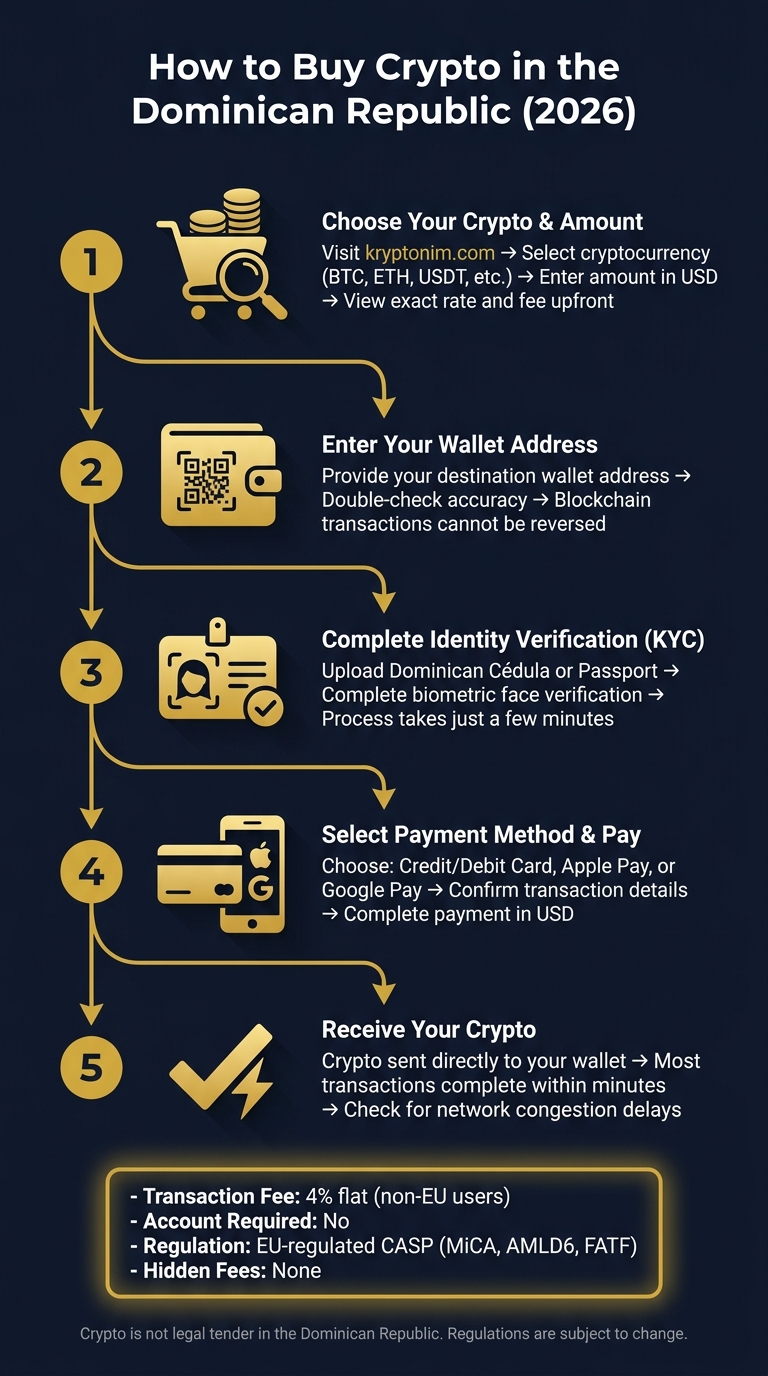
The process is quick and user-friendly, even for beginners. Follow these steps:
-
Choose your cryptocurrency and amount
Visit kryptonim.com and pick the cryptocurrency you want to purchase - whether it’s Bitcoin, Ethereum, USDT, or another option. Enter the amount in USD, and the platform will display the exact rate and fee upfront. -
Enter your wallet address
Provide the wallet address where you’d like to receive the crypto. Double-check for accuracy, as blockchain transactions can’t be reversed. If you’re using a custodial wallet from an exchange, copy the deposit address directly from there. -
Complete identity verification
Verify your identity using a government-issued ID, such as your Dominican Cédula de Identidad y Electoral or passport, along with biometric face verification. This step usually takes just a few minutes. -
Select your payment method and pay
Kryptonim supports credit and debit cards for USD transactions, as well as Apple Pay and Google Pay. Choose your preferred payment method, confirm the transaction details, and make the payment. -
Receive your crypto
After payment confirmation, your crypto will be sent directly to your wallet address. Most transactions are completed within minutes, although occasional network congestion could cause slight delays.
Platform Comparison Table
Here’s a quick breakdown of Kryptonim’s key features for users in the Dominican Republic:
| Feature | Kryptonim |
|---|---|
| Regulation | EU-regulated CASP (MiCA, AMLD6, FATF) |
| KYC Required | Yes - ID + biometric face check |
| Transaction Fee | 4% (non-EU users) |
| Hidden Fees | None - transparent pricing |
| Payment Methods | Card, Apple Pay, Google Pay |
| Account Required | No |
| Cold Storage | Yes - majority of assets offline |
| Sanctions Screening | Real-time (OFAC, EU, UN lists) |
sbb-itb-0796ce6
How to Manage and Secure Your Crypto
How to Store Crypto Safely
Storing your cryptocurrency securely is a top priority. When you opt for self-custody, you're in full control of your assets. This independence comes with added responsibility, but it's worth it for the peace of mind.
For everyday transactions, mobile wallets like Blink and Aqua are convenient options. However, if you're planning to hold a larger amount for the long term, consider investing in a hardware wallet like Tangem. Tangem is a card-based cold wallet that stays completely offline, offering an extra layer of security.
Protecting your seed phrase is critical. Write it down on paper and store it somewhere safe, like a fireproof and private location. Avoid saving it digitally to reduce the risk of hacking. As Bitcoin Dominicana emphasizes:
"It is fundamental to securely store the recovery phrase (seed phrase) of the wallet, which is the key to accessing funds in case of device loss."
Additionally, make sure to enable two-factor authentication (2FA) on all accounts. Use an authenticator app instead of SMS for better security.
Once your crypto is safely stored, the next step is knowing how to convert it into cash.
How to Sell Crypto and Convert to Cash
Selling cryptocurrency in the Dominican Republic requires navigating specific regulations. The Central Bank of the Dominican Republic (BCRD) prohibits regulated financial institutions from directly handling crypto transactions, so peer-to-peer (P2P) platforms are your best option.
On P2P platforms, you can trade directly with others using local bank transfers through institutions like Banreservas, Banco Popular, or BHD León. Before finalizing a trade, always verify the buyer's reputation and, most importantly, do not release your crypto until you’ve confirmed the funds have been deposited into your account.
For those who prefer a more traditional approach, services like Blocknance operate physical offices in cities such as Santo Domingo, La Romana, Punta Cana, and Santiago de los Caballeros. These offices allow you to sell crypto for cash in either DOP or USD.
Keeping Records and Meeting Tax Obligations
After selling your crypto, keeping detailed records is essential for tax compliance. While the Dominican Republic doesn’t have specific laws for crypto taxation as of 2026, digital assets are classified as intangible assets. Profits from crypto transactions may be subject to general income tax principles, with a potential 27% rate on gains. The Dirección General de Impuestos Internos (DGII) and the Superintendencia de Bancos are the key regulatory bodies overseeing compliance.
Maintain a clear record of all transactions, including:
- Dates of transactions
- Amounts and DOP equivalents at the time
- Platforms used
- Fees paid
Opening a dedicated bank account for crypto-related activities can help keep your financial records organized and simplify any audits. This practice aligns with good security habits by ensuring a transparent trail of your activities. As Juan Alberto Sierra Cruz from the DGII community pointed out:
"The purchase and sale of cryptocurrencies between individuals on Binance P2P could be classified as a financial intermediation economic activity. Therefore, it is important that the client register formally with the DGII."
Given the evolving nature of crypto regulations, consulting a local tax professional is highly recommended to stay compliant and avoid surprises.
Conclusion
Buying cryptocurrency in the Dominican Republic in 2026 is easier than ever, but it requires thoughtful preparation. From completing KYC verification to choosing the right payment method and securing your assets in a cold wallet, every step matters.
The legal framework for digital assets is still taking shape. As of May 2026, the Chamber of Deputies is reviewing two proposed bills aimed at formalizing regulations for the crypto space. Until these laws are finalized, it's crucial to use platforms that offer strong protections, like EU-regulated services with clear fees and no hidden costs. Kryptonim is one such platform, providing a simple fiat-to-crypto process with a flat 4% transaction fee and no account setup required.
Security should always be your top priority. Enable two-factor authentication, keep your seed phrase stored offline, and transfer larger holdings to a hardware wallet for added protection.
The Dominican Republic has seen a 52% rise in digital asset users in recent years, and this trend shows no signs of slowing down. Whether you're starting with a small Bitcoin purchase or exploring options like USDT or ETH, the infrastructure is ready to support your journey. Use these tools and strategies wisely to ensure your investments are both secure and positioned for growth.
FAQs
Can I use crypto legally in the Dominican Republic in 2026?
Cryptocurrency is not recognized as legal tender in the Dominican Republic and remains unregulated as of 2026. While people are allowed to trade or hold digital assets, they do so in a legal gray area without any government safeguards. Regulated financial institutions are prohibited from handling crypto transactions, and authorities frequently caution against the risks associated with these unsupervised markets. Although there are ongoing legislative efforts to establish regulations for the sector, users must currently navigate this space at their own risk.
What’s the cheapest way to buy crypto with Dominican Pesos (DOP)?
The cheapest way to purchase cryptocurrency using Dominican Pesos (DOP) is often through local bank transfers on peer-to-peer (P2P) marketplaces. These platforms allow you to trade directly with other users, helping you sidestep the higher fees that come with card transactions. Using banks like Banreservas, Banco Popular Dominicano, or BHD León for transfers is both quick and economical, making P2P trading a convenient and widely-used option for converting DOP into crypto.
How do I avoid getting my crypto account or funds flagged or frozen?
To keep your account safe and avoid issues like being flagged or having funds frozen, it's essential to follow a few important steps. Start by completing the required KYC (Know Your Customer) verification - this is often mandatory and helps establish your identity. Next, enable two-factor authentication (2FA) to add an extra layer of security to your account.
When using peer-to-peer (P2P) marketplaces, stick to trading with verified users and always keep clear proof of payment for your transactions. If you're dealing with traditional banks, use reputable local exchanges and ensure you withdraw funds only to verified bank accounts. These steps can help you avoid unnecessary complications and maintain smooth transactions.