
How to Buy Crypto in Panama in 2026
Step-by-step guide to legally buying crypto in Panama: payment methods, KYC rules, wallet setup, security tips, and tax recordkeeping.
Cryptocurrency is legal in Panama, and buying it is straightforward if you follow key steps. Panama City now accepts Bitcoin, Ethereum, and stablecoins for tax payments, showing crypto’s growing role in the economy. By 2026, around 59,500 Panamanians hold Bitcoin, with regulations evolving to ensure safer transactions. Here’s what you need to know:
- Legal Status: Crypto is legal but not official tender. Compliance with Know Your Customer (KYC) and anti-money laundering (AML) rules is required.
- Payment Methods: Use ACH transfers, credit/debit cards, P2P trading, or digital wallets like Apple Pay. ACH Xpress offers fast, low-cost transfers, while cards are better for small, urgent buys.
- Wallet Setup: Choose between custodial (easy but less secure) or non-custodial wallets (full control but higher responsibility). For long-term storage, hardware wallets like Ledger or Trezor are recommended.
- Buying Platforms: Platforms like Kryptonim allow quick purchases with transparent fees (4% per transaction). Ensure your wallet is compatible with the chosen crypto network.
- Security: Use two-factor authentication, safeguard your recovery phrase offline, and transfer large amounts to personal wallets to avoid exchange risks.
Start small, document your transactions, and prioritize security to protect your investments. Crypto adoption is rising, but staying informed is key to navigating this space confidently.
Legal Status and Requirements for Buying Crypto in Panama
Is Crypto Legal in Panama?
Yes, crypto is legal in Panama. You’re free to buy, hold, and use it, though it’s not officially recognized as legal tender.
As of June 2026, Panama doesn’t have a single, comprehensive law governing crypto. Instead, regulations are based on specific activities, with oversight spread across existing frameworks for anti-money laundering (AML), securities, and banking. Several regulatory bodies play distinct roles:
| Authority | Role |
|---|---|
| UAF (Unidad de Análisis Financiero) | Monitors AML/CFT compliance and handles suspicious transaction reporting |
| SMV (Superintendencia del Mercado de Valores) | Decides if tokens qualify as securities |
| SBP (Superintendencia de Bancos) | Manages banking access and policies for fiat-to-crypto transactions |
| DGI (Dirección General de Ingresos) | Oversees tax administration under the CARF framework |
| MICI (Ministerio de Comercio e Industrias) | Proposed regulator for VASP licenses under draft laws |
Two legislative proposals - Project 247, which would recognize Bitcoin, Ethereum, and stablecoins as valid payment methods, and Anteproyecto 314, a broader fintech framework - are currently under consideration. While neither has been passed, they indicate progress toward clearer regulations. Additionally, Panama has committed to international standards by signing the OECD’s Crypto-Asset Reporting Framework (CARF) in December 2025. This agreement requires the country to begin automatic tax data exchange on digital asset transactions starting January 2027.
Lawyer Oliver Muñoz emphasizes the importance of proactive regulation:
"Panama should not wait until 2027 to improvise a regulation... the country has sufficient time to develop regulation tailored to its needs."
Compliance and Verification Requirements
While crypto usage is legally permitted, compliance efforts focus heavily on identity verification and recordkeeping. Be prepared for a Know Your Customer (KYC) process that requires a valid government-issued ID or passport. For larger transactions, additional documentation, such as bank statements or salary records, may be necessary to meet AML requirements.
Panama operates under a territorial tax system, meaning income earned outside the country - including profits from trading on international exchanges - is generally exempt from local income tax. Simply holding or buying crypto isn’t considered a taxable event. However, keeping thorough records of all transactions is critical, especially with CARF-related data sharing starting in 2027.
To stay prepared, maintain organized documentation of purchases, sales, and transfers. This could include exchange-generated CSV files, wallet addresses, and transaction confirmations, ensuring you’re ready for any future inquiries.
Best Ways to Buy Crypto in Panama
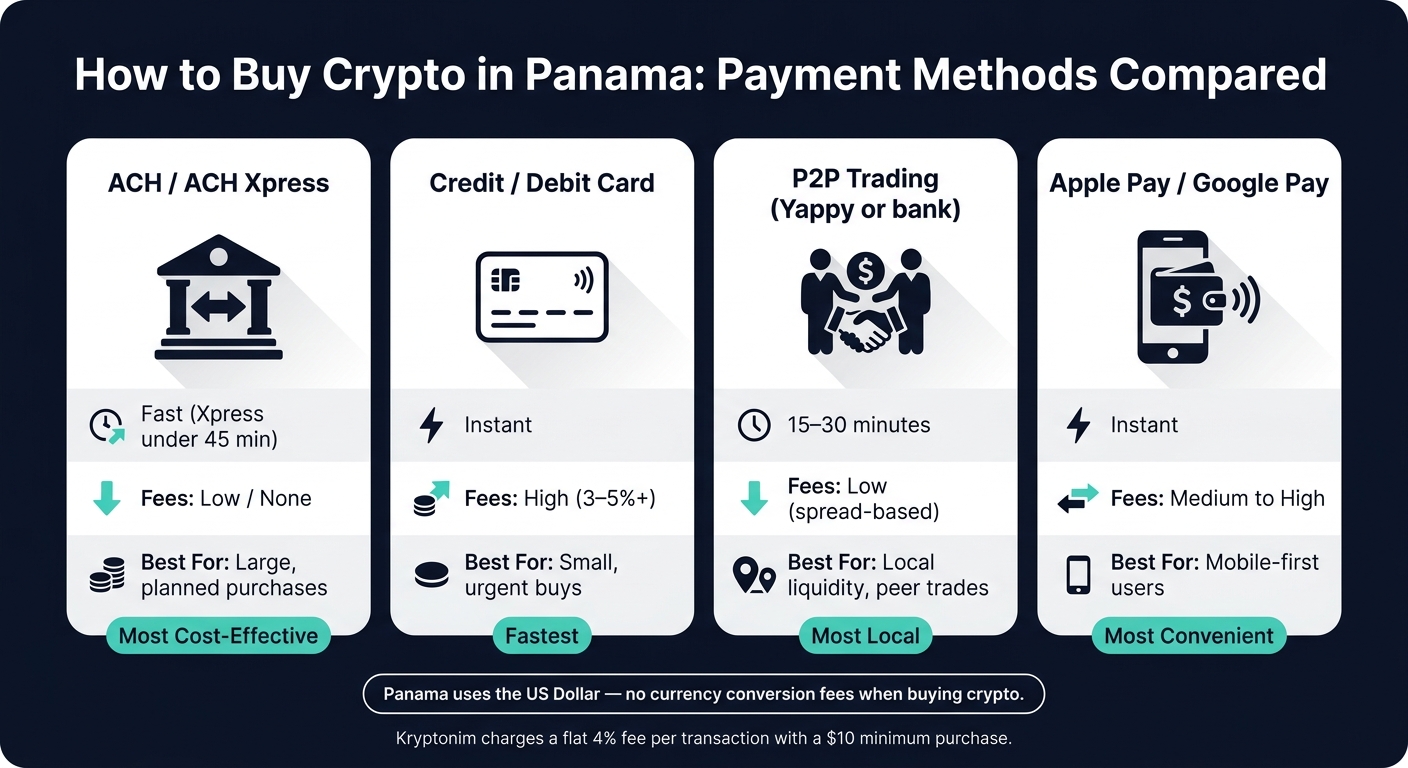
How to Buy Crypto in Panama: Payment Methods Compared
Payment Methods Available for Crypto Purchases
When buying crypto in Panama, understanding the payment options available can save you time and money.
Since Panama uses the US dollar, you won’t face currency conversion fees when purchasing crypto. The main payment methods include bank transfers (ACH and ACH Xpress), credit and debit cards (Visa/Mastercard), P2P trading, and digital wallets like Apple Pay and Google Pay.
ACH Xpress is a standout option for its speed. While standard ACH transfers may take 24–48 hours to process, ACH Xpress can complete transactions in under 45 minutes. This speed is especially useful during market volatility. Additionally, many local providers offer ACH Xpress with no deposit or withdrawal fees for Panamanian banks, making it ideal for larger, planned transactions.
For those who prioritize speed, credit and debit cards process transactions instantly. However, these often come with higher fees - typically around 3–5% - making them better suited for smaller or urgent purchases rather than regular investments. On the other hand, P2P trading has gained popularity in Panama, particularly with traders who use Yappy, a widely used mobile payment app in the country. This method is known for its fast and low-cost transfers.
Using Kryptonim to Buy Crypto
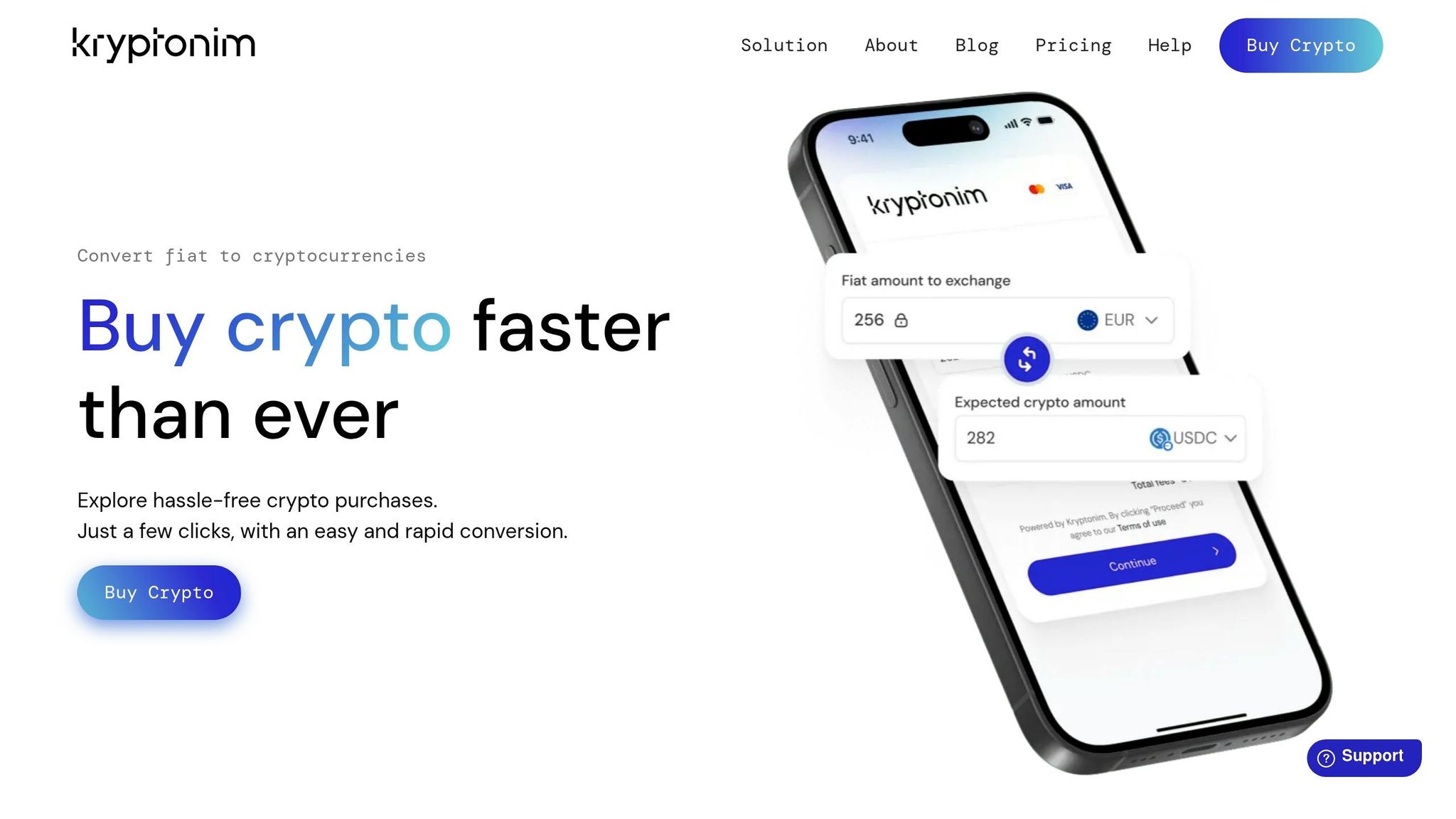
Kryptonim is an EU-regulated platform that allows users to buy crypto quickly without needing to register an account. It supports a variety of cryptocurrencies, including BTC, ETH, SOL, USDT, and USDC, across networks like Polygon, Arbitrum, and Avalanche.
For buyers in Panama, Kryptonim charges a 4% fee per transaction, with a minimum purchase amount of $10. The platform prides itself on transparent pricing, ensuring no hidden fees. It accepts credit and debit cards, as well as digital wallets, making it accessible for users with Visa or Mastercard issued by local banks. Before making a purchase, double-check that your wallet is compatible with the selected network to avoid any routing problems.
Payment Methods Compared
Choosing the right payment method depends on your priorities - whether it’s speed, cost, or convenience. Here’s a quick breakdown:
| Payment Method | Speed | Typical Fees | Best For |
|---|---|---|---|
| ACH / ACH Xpress | Fast (Xpress < 45 min) | Low / None | Large, planned purchases |
| Credit/Debit Card | Instant | High (3–5%+) | Small, urgent buys |
| P2P (Yappy or bank) | 15–30 minutes | Low (spread-based) | Local liquidity, peer trades |
| Apple Pay / Google Pay | Instant | Medium to high | Mobile-first users |
To ensure smooth processing, it’s a good idea to test your chosen payment method with a smaller transaction - around $20–$50. Once you’ve settled on the best option, set up your crypto wallet to complete your purchase securely.
How to Set Up a Crypto Wallet Before You Buy
Before diving into cryptocurrency purchases, you need a secure wallet. A crypto wallet stores your private keys - without these, you can't access your funds.
Custodial vs. Non-Custodial Wallets: What You Need to Know
The first big choice is deciding who will hold your private keys.
A custodial wallet is managed by a third-party platform. This option is beginner-friendly, especially in places like Panama, where custodial wallets often integrate seamlessly with local banking systems and peer-to-peer payment methods. However, there’s a trade-off: counterparty risk. If the platform gets hacked or runs into regulatory trouble, your funds could be frozen.
A non-custodial wallet, on the other hand, gives you complete control. No one else can access or freeze your funds, and you're not reliant on anyone else’s security measures. The downside? The responsibility is entirely on you. If you lose your recovery phrase, your funds are gone forever, with no customer support to help.
For larger balances (over $1,000) or long-term holdings, consider a hardware wallet like a Ledger Nano X ($149) or Trezor Safe 7 ($249). These devices keep your private keys offline, offering the highest level of security.
| Wallet Type | Who Holds Keys | Best For |
|---|---|---|
| Custodial | Third-party platform | Beginners, frequent trading, fiat access |
| Non-Custodial (Software) | You | DeFi users, intermediate experience |
| Hardware (Cold) | You (offline) | Long-term storage, large balances |
Once you’ve chosen a wallet type, follow these steps to set it up securely.
Steps to Set Up Your Crypto Wallet
The setup process is straightforward, whether you go with a custodial or non-custodial option. Here’s how to do it safely:
-
Download only from official sources.
Always use the manufacturer’s website or verified app stores. Phishing apps are a serious threat. For example, a compromised browser extension update in December 2025 resulted in $8.5 million being stolen from over 2,500 wallet addresses. -
Create and securely store your recovery phrase.
For non-custodial and hardware wallets, you’ll receive a 12-to-24-word recovery phrase. Write it down on paper or engrave it on a metal plate to prevent loss. Never take a screenshot or save it in the cloud - anyone with access to this phrase can take your funds. -
Enable two-factor authentication (2FA) on custodial wallets.
Use an app like Google Authenticator instead of SMS for 2FA. SIM-swapping attacks can compromise text-based codes, giving attackers access to your account. -
Run a small test transaction.
Before transferring a significant amount, send a test transaction of $20–$50 to ensure the wallet address and network are correct. Double-check that the network (e.g., TRC-20 or ERC-20) matches on both the sender and receiver sides. Sending funds via the wrong network can lead to permanent loss.
Once your wallet is set up, you’re ready to securely buy and store cryptocurrency.
sbb-itb-0796ce6
How to Complete Your First Crypto Purchase in Panama
Now that your crypto wallet is ready, it’s time to make your first purchase.
How to Choose the Right Cryptocurrency
The cryptocurrency you choose should align with your goals. For long-term growth, Bitcoin (BTC) and Ethereum (ETH) are solid picks - they're some of the most liquid and widely recognized assets in the market. If you prefer stability and less exposure to price swings, stablecoins like USDT or USDC are good options. These are especially practical in Panama's dollarized economy, where stablecoins are increasingly used for everyday payments and peer-to-peer transfers.
Interestingly, Panama City’s municipality accepts BTC, ETH, USDC, and USDT for tax and tribute payments, adding another layer of convenience. To start, it’s wise to test the platform with a small amount before committing more funds. This will help ensure that withdrawals are smooth and trouble-free. As Alon Shvartsman aptly noted:
"A cheap-looking exchange is a poor choice if moving coins out is slow, expensive, or unclear." - Alon Shvartsman
Once you’ve chosen your cryptocurrency, follow these steps to complete your purchase.
Step-by-Step Guide to Buying Crypto
Here’s how you can make your first crypto purchase on Kryptonim:
- Select your cryptocurrency and amount: Log in to Kryptonim’s platform and pick the cryptocurrency you want - BTC, ETH, USDT, or any other supported coin. Enter the amount in USD. Kryptonim provides a real-time quote with no hidden fees. For users outside the EU, the transaction fee is 4%.
- Enter your wallet address: Paste the wallet address you set up earlier. Double-check that both the wallet address and the network are correct, as mistakes here can lead to permanent loss of funds.
- Complete identity verification: Kryptonim has a straightforward Know Your Customer (KYC) process. You’ll need a valid government-issued ID (like a passport or national ID card) and may also need to complete a quick selfie verification. This is standard for compliant platforms in Panama.
- Choose your payment method and confirm: Select your payment option - Visa, Mastercard, or a supported bank transfer. Review the final quote carefully before confirming the transaction.
- Receive your crypto: Once the payment is processed, your chosen cryptocurrency will be sent directly to the wallet address you provided. Keep the transaction ID (TXID) as proof of purchase for any future banking or tax-related needs.
How to Keep Your Crypto Safe After Purchase
What to Do Right After Buying Crypto
Once your crypto purchase is confirmed, double-check your transaction history on Kryptonim to ensure the correct amount has been credited to your wallet. Save your transaction ID (TXID) as a record - it might come in handy for tax purposes, especially under Panama's OECD Crypto-Asset Reporting Framework (CARF), which began in 2026.
If you've bought a substantial amount (generally $500 or more), transfer your funds from the exchange to a personal wallet as soon as possible. Keeping assets on an exchange exposes them to platform risks - just look at the 2022 FTX collapse, which left customers billions of dollars in losses. Before moving your entire balance, send a small test transaction to confirm the wallet address and network are correct. When transferring funds, manually verify the first four and last six characters of the wallet address to guard against clipboard-hijacking malware.
Once your funds are safely in your personal wallet, focus on securing them with the steps below.
Key Security Practices for Crypto Holders
After moving your funds to a personal wallet, take these precautions to protect your investment:
- Upgrade Your 2FA: Replace SMS-based two-factor authentication with an authenticator app like Google Authenticator or Authy. SMS 2FA is vulnerable to SIM swap attacks, which caused over $68 million in losses in 2023, according to the FTC. For even stronger security, consider a hardware security key like YubiKey.
- Protect Your Seed Phrase: Your seed phrase (12 to 24 words generated when setting up your wallet) is the ultimate key to your funds. Write it down on paper or, for added durability, engrave it on a metal backup plate. Options like Cryptosteel or CRYPTOTAG typically cost $80–$110. Never store your seed phrase digitally, whether in apps or cloud services.
- Use a Hardware Wallet for Long-Term Storage: For long-term holdings, invest in a hardware wallet like the Ledger Nano S Plus or Trezor Model One, which usually cost $50–$79. These devices keep your private keys offline, away from online threats.
- Revoke Unnecessary Permissions: If you're actively using DeFi platforms or interacting with NFTs, periodically review and cancel unnecessary token approvals using tools like Revoke.cash. This helps minimize potential vulnerabilities.
Conclusion: Key Takeaways for Buying Crypto in Panama
Navigating the crypto landscape in Panama in 2026 is manageable when you're informed. While crypto is legal, the regulatory framework remains fragmented. New developments, like Draft Law No. 314, hint at stricter oversight for Virtual Asset Service Providers. Panama's territorial tax system still allows crypto gains earned abroad to remain untaxed. However, keeping detailed records is essential, as banks operating under SBP Rule 1-2026 may require proof of fund sources.
As financial writer Alon Shvartsman wisely said:
"Good records are boring until they become useful."
The fact that Panama City Hall now accepts Bitcoin, Ethereum, USDC, and USDT for tax payments highlights how integrated crypto has become. But with greater adoption comes increased risk. Be wary of services that promise guaranteed returns - they're often scams.
To secure your assets, transfer funds to a personal wallet, enable app-based two-factor authentication (2FA), and always verify wallet addresses before transactions.
Finally, start small, document each transaction, and view security as an ongoing responsibility, not a one-time task. Join the ranks of the approximately 59,500 Panamanian crypto users who manage their digital assets with the same care as any major financial investment.
FAQs
Do I have to pay taxes on crypto gains in Panama?
Panama uses a territorial tax system, meaning income earned outside the country is generally not subject to taxation. In the case of crypto gains from international exchanges, these are often treated as foreign-sourced income and are typically exempt from taxes. Furthermore, there’s no capital gains tax or VAT applied to such transactions. That said, it’s always wise to consult a tax professional to ensure compliance, as tax obligations can differ depending on the specifics of your income and its source.
What documents do I need to pass KYC in Panama?
To complete KYC in Panama, you'll generally need a valid passport or a Panamanian ID (cedula) if you're a resident. Foreign nationals may also be asked to provide a second form of identification, such as a driver's license. Additionally, you'll need proof of address (like a utility bill dated within the last six months) and income verification (such as tax returns or bank statements). Make sure all documents are either in Spanish or accompanied by a certified translation.
How do I avoid sending crypto on the wrong network?
When transferring cryptocurrency, it's essential to confirm that both the sender and receiver are using the same network, such as ERC-20 or TRC-20. Using incompatible networks can result in losing your funds permanently. Always double-check that the receiving address is compatible with the blockchain protocol you’ve chosen for the transaction. A little extra caution can save you from costly mistakes.