
How to Buy Crypto in Croatia in 2026
2026 guide to buying crypto in Croatia: use HANFA-listed platforms, pay in EUR (SEPA), complete KYC, track taxes, and secure your wallet.

Buying crypto in Croatia in 2026 is simple: use a HANFA-listed platform, verify your identity, fund in euros, buy, and send the crypto to your own wallet. Croatia uses the euro, so SEPA transfers are often the lowest-cost way to pay, while card payments are faster but often cost 1.5% to 3.5% more. And with MiCA fully active and a July 1, 2026 licensing deadline, I’d check compliance before sending a single $1.
Here’s the short version:
- Use only a HANFA-listed provider under MiCA
- Pay in EUR to avoid extra conversion costs
- SEPA often costs less; cards are faster
- KYC usually means ID + selfie
- Buying and holding is usually not taxed
- Selling within 2 years is taxed at 10% plus local surtax
- Holding more than 2 years can make gains tax-free
- Keep records of date, EUR amount, fees, and TXID
- Move funds to your own wallet and protect your recovery phrase offline
A few numbers stand out. About 183,000 people in Croatia, or 4.8% of the population, already own crypto. First tax reports under new EU reporting rules are due by June 30, 2027, so recordkeeping matters from day one.
If I were starting today, I’d keep my first buy small - around $55 to $110 in euro terms - test the wallet address, save the receipt, and double-check the network before confirming anything.
Croatia Rules, Taxes, and Safety: What to Check Before You Buy
In Croatia, HANFA supervises crypto-asset service providers. For most buyers, that public register is the first place to look. Before you deposit any money, check that the provider is listed there. That step matters because crypto is not covered by Croatia's Investor Protection Fund, so authorization carries a lot of weight.
Use this quick check before you fund an account:
- Authorization: Confirm the provider appears in HANFA's register.
- Fee schedule: Review the total cost in EUR - trading fee, spread, and any withdrawal fee.
- SEPA support: Confirm the platform accepts SEPA transfers to help keep deposit costs low.
- 2FA: Enable two-factor authentication with an authenticator app, not SMS.
Basic Tax Points for Crypto Buyers in Croatia
Once the provider checks out, the next thing to look at is tax. In Croatia, buying and holding crypto is generally not a taxable event. Tax usually applies when you sell the crypto or spend it.
The holding period makes a big difference. If you hold for more than two years, gains are tax-exempt. If you sell within two years, gains are taxed at 10% plus any local surtax that applies. That's why recordkeeping matters from day one. Save a record of each purchase, including dates, amounts, and prices, so you're not scrambling later.
Common Risks for Croatian Crypto Buyers
The big risk most people know is price volatility. Crypto can swing hard in a single day, and regulation doesn't change that.
But right before a purchase, the more immediate danger is often much simpler: scams. Phishing sites, fake support chats, and fake emails are common. Some scammers even use Croatian-language branding to look legitimate. It can look polished. It can look familiar. And it can still be fake.
A few habits go a long way:
- Type the platform URL directly into your browser instead of clicking links.
- Never share your seed phrase or private keys with anyone.
- If someone asks for either one, it's a scam.
- Use a hardware wallet for larger holdings.
This is the part many first-time buyers rush through, but it's worth slowing down. One wrong link or one copied wallet address can cost more than any trading fee.
sbb-itb-0796ce6
How to Choose a Compliant Crypto Service in Croatia
Once you've checked compliance, the next step is simple: compare how each service handles funding, custody, and fees. If you're buying crypto in Croatia, use a compliant EUR-to-crypto service that lets you purchase directly in EUR. Check HANFA's public register, make sure EUR is supported, and complete identity verification before you fund your purchase. In most cases, that means uploading an ID and doing a selfie check.
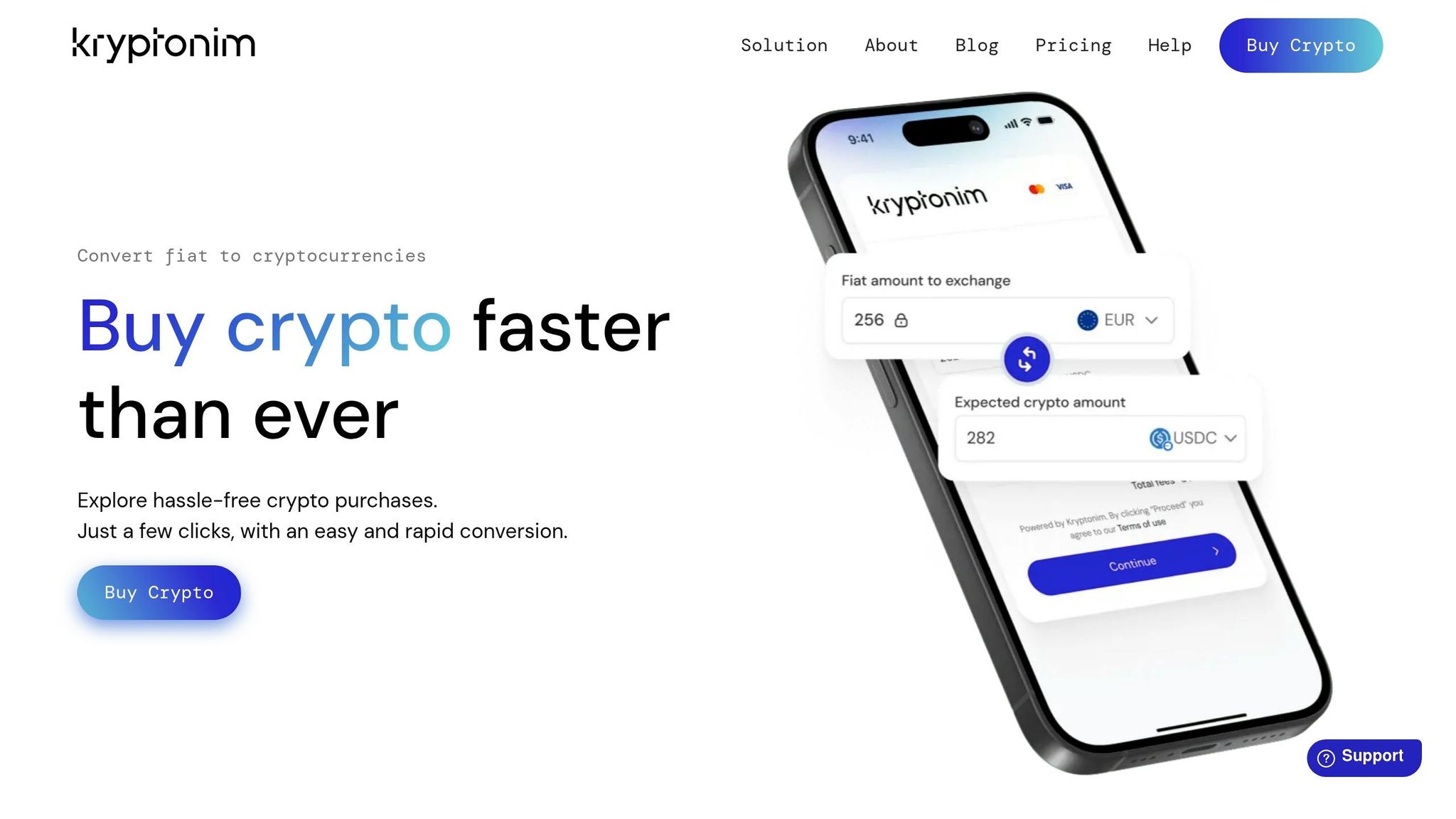
Kryptonim lets you buy crypto with EUR and send it straight to your own wallet. It doesn't require account creation, charges a flat 2% per transaction, and supports SEPA transfers, card payments, and open banking.
How to Compare Fees, Speed, and Custody
The headline fee almost never tells the whole story. Before you confirm a purchase, check three numbers: the transaction fee, the spread, and the network fee. Those three costs make up what you actually pay.
Use this table to compare services at a glance:
| Factor | What to Look For |
|---|---|
| Regulation | MiCA authorization and a listing in HANFA's public register |
| Fees | Transaction fee, spread, and network fees shown upfront |
| Speed | Instant or near-instant for cards and open banking; 1–2 business days for SEPA |
| Custody | Choose direct-to-wallet delivery if you want self-custody from the start |
| KYC | ID verification and a selfie check |
Payment Methods Croatian Residents Typically Use
Since Croatia joined the Eurozone, residents can fund crypto purchases directly in EUR. That helps avoid currency conversion fees when using EU-regulated on-ramps.
| Payment Method | Fee Level | Settlement Speed | Bank Transfer Limits | Refund or Chargeback Options |
|---|---|---|---|---|
| SEPA Transfer | Low / Free | 1–2 Business Days | High | Limited |
| Debit/Credit Card | High | Instant | Moderate | Chargeback available |
| Open Banking | Moderate | Near-Instant | High | Limited |
For buyers in Croatia, SEPA is usually the best fit for planned purchases. Card is the fastest route. Open banking sits in the middle, giving you a bank-linked option that tends to be fast without the higher card costs. Once you've picked a funding method, you're ready for the purchase steps below.
How to Buy Your First Crypto in Croatia Using Kryptonim

How to Buy Crypto in Croatia: Step-by-Step Guide (2026)
Once your wallet and payment method are set, the actual purchase usually takes just a few minutes.
Set Up Your Wallet and Choose a Starting EUR Amount
Before you buy, use a non-custodial wallet. Write down your recovery phrase offline, and keep it off your phone, laptop, and cloud storage. Don’t save it as a photo or file.
- Install the wallet app on your smartphone.
- Create a new wallet and write down the recovery phrase offline.
- Copy the receiving address for the coin you want to buy.
For your first purchase, keep it small: €50 to €100 is a good starting range. That gives you a simple way to test the process before sending more.
Step-by-Step: How to Complete Your First Purchase
With your wallet address ready, you can place the order.
-
Choose your asset and enter your EUR amount
Pick BTC or ETH, then enter how much you want to spend in euros. You’ll see how much crypto you’ll get after fees. -
Paste your wallet address
Use copy and paste or scan the QR code from your wallet app. Don’t type the address by hand. -
Review the rate and fees
Check the final exchange rate and total cost before you pay. -
Pick a payment method
Choose SEPA if you want a lower-cost option, or use a card if you want it done faster. -
Complete identity verification if prompted
If verification comes up, have your Croatian ID card or passport ready, plus a selfie. This step usually takes between 5 minutes and 24 hours. -
Approve the payment
If you pay by card, your bank may send a 3D Secure prompt. Approve it to finish the payment. -
Save your receipt and transaction hash
After the order is confirmed, save the receipt and copy the transaction hash (TXID). Crypto often arrives within minutes, but network congestion can slow things down.
Mistakes to Avoid on Your First Transaction
The most common beginner error is choosing the wrong network. If the network doesn’t match, your funds may be lost. It’s a small detail, but it matters a lot.
Manually typing a wallet address is also risky. One wrong character can send your crypto somewhere else, and there’s usually no way to get it back. Use copy and paste or scan the QR code instead.
Two other slip-ups are easy to miss. One is ignoring your bank’s 3D Secure prompt when paying by card. The other is skipping your recordkeeping. Save the euro amount and timestamp of the purchase so you have a clear record for taxes.
After your first buy, the next step is safe storage and clean recordkeeping.
How to Store Your Crypto Safely and Keep Records in Croatia
Once your first crypto purchase lands in your wallet, security comes first. After that, your next job is simple: keep clean records from the start. Those two habits can save you a lot of stress later.
Security Steps to Take After Your Purchase
Turn on app-based two-factor authentication (2FA) and skip SMS codes, since SMS is open to SIM-swapping attacks.
Next, write your 12- or 24-word recovery phrase on paper and store it in a safe physical place. Don't take a photo of it. Don't save it on your phone, computer, email, or cloud storage. If someone gets that phrase, they get your crypto. It's that simple.
If you're holding a larger amount, move your funds to a hardware wallet. It's the best option for long-term storage. Also, keep your wallet app and device firmware up to date so you're protected against known security issues.
Once your wallet is locked down, record the purchase right away while the EUR amount and TXID are still easy to find.
How to Track EUR Values and Save Tax Records
For tax purposes, record every purchase as it happens. Croatia uses FIFO, which means each purchase's EUR value matters when you later sell. A basic spreadsheet is enough, as long as you log the key details after every transaction:
- Date
- Asset
- Quantity
- EUR amount paid
- Fees
- TXID
Also save the receipt and TXID for each order. You'll need to report capital gains with JOPPD by the end of February for the previous year. Keep your records for at least six years.
One point that can make a big difference: if you hold a cryptocurrency for more than two years before selling it for fiat, the gain is tax-exempt in Croatia.
FAQs
How do I verify a crypto provider is legal in Croatia?
Check whether the company appears in the official register of virtual asset service providers (VASPs) maintained by the Croatian Financial Services Supervisory Agency (HANFA).
Also steer clear of platforms that don’t show clear business or contact details. Providers that require KYC verification are usually a better sign, since this is standard for regulated entities in the European Union.
What if I send crypto on the wrong network?
If you send cryptocurrency on the wrong network, your funds can be lost for good or become impossible to access. Crypto transactions can't be reversed, and blockchains don't talk to each other.
If the receiving wallet or exchange doesn't support that token or network, it may not detect the transfer or be able to recover it. Always double-check that the network you choose matches the destination address before you confirm.
Do I need to report crypto if I only buy and hold?
No. Simply buying and holding crypto does not create a tax payment or reporting duty in Croatia.
Tax usually starts only when you realize a capital gain. That can happen when you sell crypto for fiat currency like EUR, or when you use crypto to buy goods or services.
If you hold crypto for more than two years, any profit from the sale is generally exempt.
Keep detailed records.