
How to Buy Crypto in the Czech Republic in 2026
Legal 2026 guide to buying crypto in Czechia: choose a MiCA-licensed provider, pay in CZK, finish KYC, and secure your coins.
If I wanted to buy crypto in Czechia in 2026, I’d do four things first: use a MiCA-licensed provider, finish ID checks, pay in CZK to cut extra FX costs, and send the coins to my own wallet.
That’s the short version. The article shows that buying and holding crypto is legal in the Czech Republic, but crypto is not legal tender. It also points out the main cost drivers: platform fees, spread, and withdrawal fees. In many cases, CZK bank transfer is the lower-cost option, while card payments are faster but often cost about 1% to 3% more.
Here’s what I’d keep in mind before making a first purchase:
- Check the provider’s MiCA license
- Complete KYC with ID and a selfie
- Compare CZK vs. EUR funding
- Review the full cost, not just the posted fee
- Confirm I can withdraw to my own wallet
- Do a small test transfer first
- Save records for Czech tax reporting
Quick comparison
| What to compare | Lower-cost choice | Faster choice | What to watch for |
|---|---|---|---|
| Funding currency | CZK | CZK or EUR | EUR may add 0.5% to 1.5% in FX costs |
| Payment method | Bank transfer | Debit/credit card | Cards can add about 1% to 3% in processing fees |
| Storage | Personal wallet for larger holdings | Custodial account for short-term use | If withdrawals are blocked, I don’t control the coins |
| Tax records | Spreadsheet + PDFs/screenshots | - | I need date, amount, coin, fees, CZK value, and TXID |
One more point stands out: crypto prices can move hard in a short time. So I’d start small - something like CZK 500 to CZK 1,000 - check the wallet address and network, and keep every receipt and transaction record from day one.
sbb-itb-0796ce6
How to Choose a Legal and Practical Way to Buy Crypto
What to Check Before Using a Crypto Service
Once you've confirmed a service is legal, look at two things next: custody and total cost.
Before you send any money, check these four points:
- Confirm the provider has a MiCA license. You can usually find this in the platform's About or Legal section.
- Make sure KYC is required.
- Check that the coins can be sent to your wallet. If withdrawals are blocked, you don't control the coins.
- Review the common crypto trading fees before you commit.
That last point matters more than many people think. A low headline fee can still turn into a bad deal once spreads and withdrawal charges show up.
CZK or EUR, Card or Bank Transfer
If a provider clears those checks, the next step is simple: compare CZK vs. EUR and card vs. bank transfer.
Czech residents can pay for crypto in either CZK or EUR. Paying in CZK helps you avoid currency conversion and your bank's FX spread.
For many buyers, a CZK bank transfer is the lowest-cost option. It's often free or comes with only a small flat fee. The tradeoff is speed: settlement can take up to one business day.
Visa and Mastercard payments are instant. That's handy if you want to lock in a price fast. But speed usually costs more. Card payments often include higher processing fees, usually around 1% to 3%.
Payment Methods and Total Buying Costs Compared
Your total buying cost is made up of three parts:
Total cost = platform fee + exchange rate spread + any withdrawal fee.
Kryptonim charges a 2% transaction fee. Here's how the main payment methods stack up for Czech residents:
| Method | Speed | Convenience | Typical Cost | FX Impact |
|---|---|---|---|---|
| CZK Bank Transfer | Up to 1 business day | Medium | Low (0.1%–1.5%) | None |
| EUR SEPA Transfer | 1–2 business days | Medium | Low (0.1%–1.5%) | 0.5%–1.5% (CZK→EUR) |
| Debit/Credit Card | Instant | High | High (2%–5%) | Low to medium |
If speed is your top priority, a card makes sense. If you want to keep costs down, CZK bank transfer is usually the better pick.
How to Buy Crypto Step by Step with Kryptonim
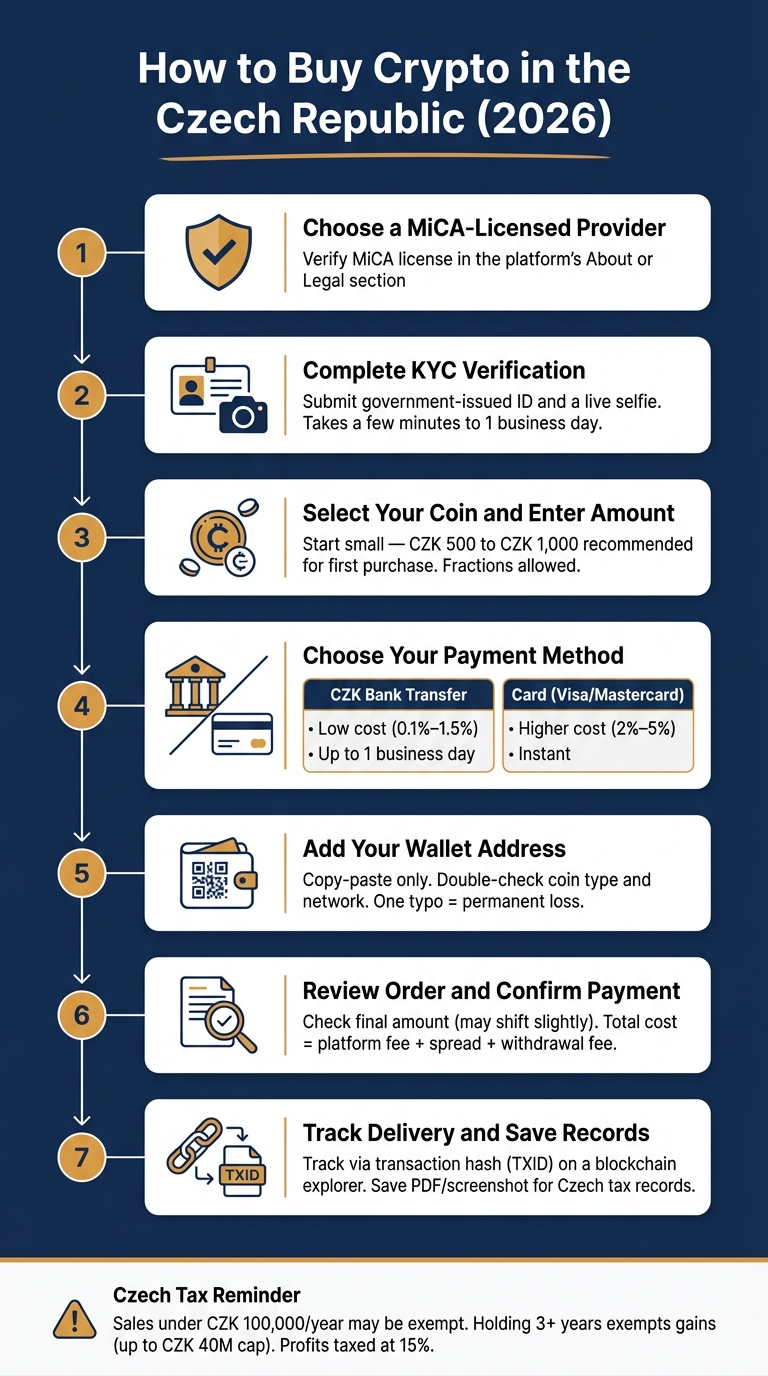
How to Buy Crypto in Czech Republic: Step-by-Step Guide (2026)
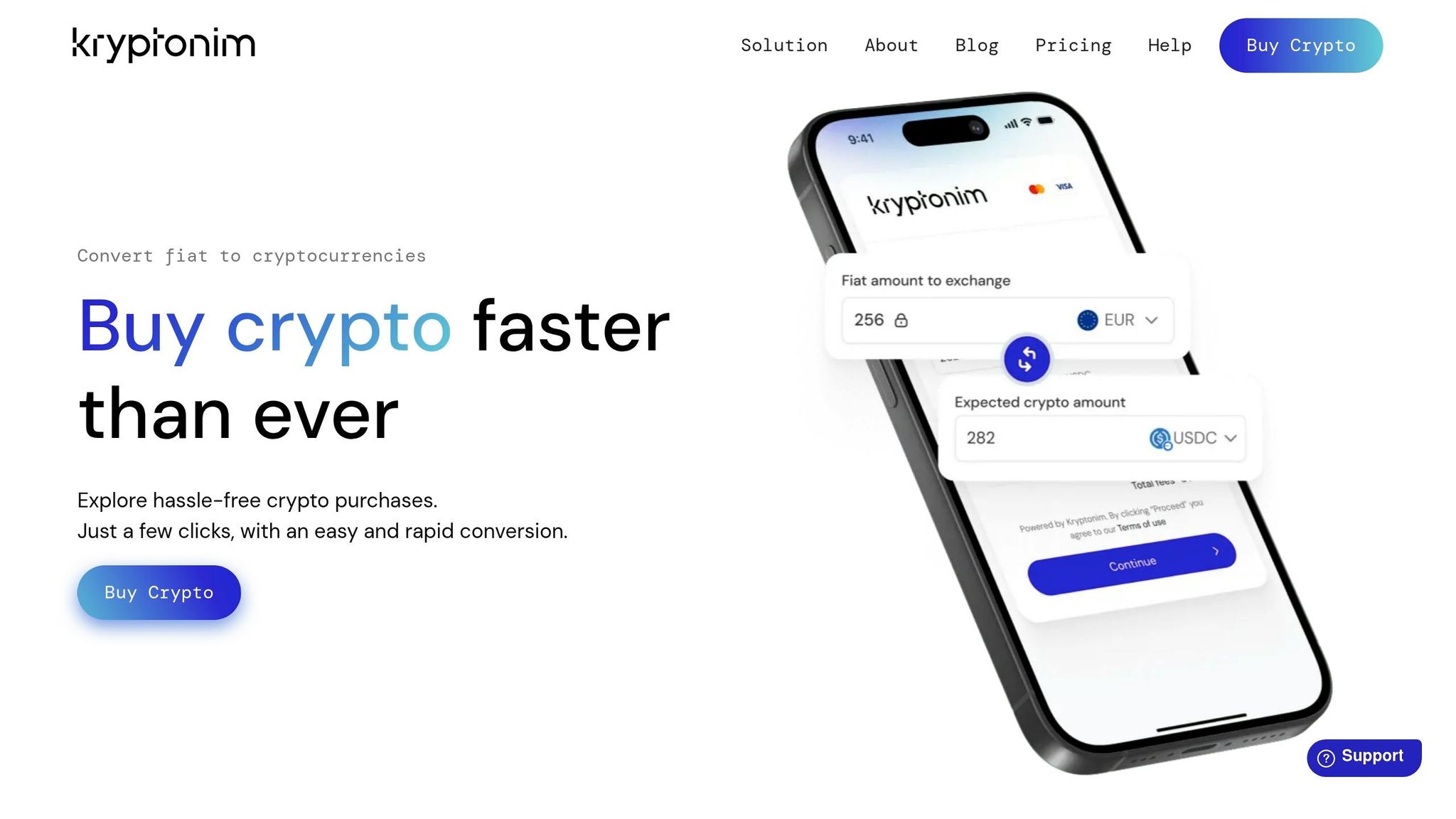
Kryptonim keeps this pretty simple: pick a coin, enter an amount, verify your identity, and pay. After you choose a payment method, the actual purchase comes down to three short steps.
Enter the Amount and Pick a Coin
Start by entering the amount and choosing the coin you want to buy. On Kryptonim, select the cryptocurrency, then type in your purchase amount in CZK or EUR. The platform shows the estimated amount after fees, so you can see what you’re getting before you move ahead.
You don’t need to buy a whole coin. You can start with a fraction, which makes it easier to test the process with CZK 500.00 or CZK 1,000.00 first.
Add Your Wallet Address and Complete Verification
Then add your wallet address and finish verification. Paste your destination wallet address into the form. It’s best to use copy and paste here, because one small typo can send funds to the wrong place, and that mistake can’t be undone.
Double-check that the address matches the coin and the network. After that, complete KYC with a government ID and live selfie. Verification usually finishes in a few minutes to one business day, depending on volume.
Confirm Payment and Track Delivery
At the last step, review the order, send payment, and track the delivery. Look over the order summary with care, since the final amount can shift a bit before you confirm.
Pay with your chosen method, then follow the transaction hash in a blockchain explorer until the transfer is confirmed. It’s also smart to save a screenshot or PDF of the confirmation screen for tax records.
How to Store Crypto Safely and Keep Records
Custodial or Personal Wallet After Your First Buy
After your first purchase, the next call is simple: where will your crypto stay, and how will you track it?
Use custodial storage only for small test amounts or short-term trading. If you're holding a larger amount, move it to a personal wallet to cut exchange failure risk. With custodial storage, the provider controls the keys. That means they control access too.
Hardware wallets are the standard option for long-term storage because they keep keys offline.
| Feature | Custodial (Exchange/App) | Personal Wallet |
|---|---|---|
| Control | Third party holds your keys | You have full control of your keys |
| Recovery | Possible via customer support | Only via your seed phrase - no "forgot password" |
| Security Risk | Exchange hack or bankruptcy | Personal error, phishing, or losing the seed phrase |
| Responsibility | Shared with the provider | 100% on you |
Security Habits That Prevent Costly Mistakes
Once you pick your storage setup, tighten security right away. This is where small habits can save a lot of money.
Store your 12- or 24-word recovery phrase offline in a physically secure place. Don't photograph it. Don't email it. Don't put it in cloud storage. If someone gets that phrase, they get your crypto.
Use an authenticator app for two-factor authentication instead of SMS. SMS 2FA is weaker because SIM-swapping can let someone intercept it.
Before sending a larger amount to a personal wallet, do a small test transfer first. It's the easiest way to check that the address and network are right. One wrong character can send funds to the wrong address for good.
Also keep your guard up for scams. Never share your private keys or seed phrase with anyone. And if someone promises guaranteed returns or tells you to send crypto to "unlock" a reward, walk away. That's a scam.
Keeping Transaction Records for Czech Tax Reporting
After your wallet is set up, save the records you'll need for taxes.
For every purchase, log:
- the date
- the coin and amount bought
- the total price paid in CZK
- all fees
Save order confirmations as PDFs or screenshots. For each transfer, note the wallet address and transaction hash (TXID).
These records matter because Czech tax treatment depends on your purchase price, holding period, and sale value. Sales below CZK 100,000 in a calendar year may be tax-exempt, and holding crypto for more than 3 years exempts the gain from tax, up to a CZK 40 million annual cap as of 2026. Crypto profits are generally taxed at 15%. If you can't show what you paid, proving your taxable gain gets much harder.
A simple spreadsheet is enough. Log each transaction right after it happens.
Checklist Before Your First Crypto Purchase
Once you’ve compared payment options and checked the provider, run through this list before you place your first order.
- Make sure the provider has a valid MiCA license.
- Use a CZK bank transfer if you want lower fees. Use a card if speed matters more.
- Finish KYC before you add funds. You’ll usually need your ID or passport plus a selfie.
- Check the total cost before you confirm. That includes the spread, deposit fee, and network fee.
One last step matters more than people think:
Send a small test transfer of about CZK 500–1,000 before sending a larger amount.
After your purchase goes through, write down the date, coin, amount, CZK price, exchange rate, fees, and the platform you used.
FAQs
How do I verify a MiCA license?
The simplest and most reliable way is to search the ESMA register, which lists authorized Crypto-Asset Service Providers across the EU. You can also check the public list from the Czech National Bank.
Search using the firm’s formal legal entity name, not its marketing brand. A valid entry should show the legal name, the authorized crypto-asset services, and the national regulator that issued the license.
Which wallet should I use first?
For your first purchase, a personal, non-custodial wallet is a smart pick because it puts you in control of your assets. Leaving your coins on the exchange where you bought them can be fine for a short time, but it comes with more risk.
For longer-term security, tools like Trust Wallet or a hardware wallet such as the Ledger Nano S are often recommended. If you go with a software wallet, write down your recovery phrase and keep it offline. Don’t store it on your computer, and don’t put it in the cloud.
What if I send crypto on the wrong network?
Sending crypto on the wrong network usually leads to permanent loss of funds. That’s because blockchain transactions are usually irreversible.
To avoid that mistake, make sure the sending platform and the receiving platform both support the exact same network. Then check the recipient address and the network you selected one more time before you confirm the transfer.