
How to Buy Crypto in Hungary in 2026
Step-by-step 2026 guide to buying crypto in Hungary: use licensed platforms, complete KYC, prefer SEPA, and track taxes.

If I were buying crypto in Hungary in 2026, I’d do four things first: pick a licensed platform, finish ID checks, use SEPA if possible, and keep tax records from day one. That’s the short version.
Here’s what matters most:
- Hungary uses both EU MiCA rules and local checks
- KYC is required before most purchases
- Selling crypto for cash or spending it can trigger 15% personal income tax
- Using an unlicensed service for deals above about $14,000 (roughly HUF 5 million) can create legal risk
- Card payments cost more than bank transfers in many cases
- BTC and ETH are still the main starting point for many first-time buyers
I’d keep the process simple: verify the platform in the regulator database, upload my ID, fund my account in HUF or EUR, buy, move coins to my own wallet if I plan to hold them, and save the receipt and transaction hash.
A few points are easy to miss. From January 1, 2026, providers may also ask for your tax ID number and tax residency details. And while buying, holding, and crypto-to-crypto swaps are generally not taxed in the way many people expect here, selling back to fiat is where taxes usually matter.
If you want the plain-English version, this guide comes down to one idea: use a regulated service, pay attention to fees, and document every step.
Rules, Verification, and Tax Basics in Hungary
EU MiCA and Hungary's Crypto Rules in 2026
Hungary now applies crypto rules on two levels: EU MiCA and a national validator regime that started on December 29, 2025. The MNB handles MiCA licensing, while SZTFH handles national validation. If an exchange wants to operate legally, it must pass SZTFH validation.
This part matters a lot: using an unlicensed service for exchanges above 5 million HUF can be a criminal offense for users as well as providers.
Before you deposit any money, check the platform’s status in the MNB institutional search tool. That should be your next move before funding an account.
KYC and AML Checks to Expect
In Hungary, regulated providers usually ask for:
- Full name
- Date of birth
- Hungarian address
- Government ID
- A selfie or liveness check
From January 1, 2026, providers must also collect your TIN and tax-residency declaration under DAC8 and CARF. Compliant platforms share transaction data with NAV.
It’s smart to finish KYC before sending funds. If you don’t, your deposit or purchase can get stuck in review. Once your verification is done, you can move on to a compliant purchase method.
Basic Crypto Tax Points for Hungarian Residents
Hungary’s basic crypto tax rules are pretty straightforward:
| Transaction Type | Tax Status | Rate |
|---|---|---|
| Buying crypto | Not taxed | 0% |
| Holding (HODL) | Not taxed | 0% |
| Crypto-to-crypto swap | Not taxed | 0% |
| Selling for HUF/EUR | Taxable event | 15% SZJA |
| Spending on goods/services | Taxable event | 15% SZJA |
Tax applies when you sell for HUF or EUR, or when you spend crypto on goods or services. Net annual gains are taxed at 15% SZJA. Crypto gains are exempt from the 13% szocho.
Keep records for each transaction, including the purchase date, crypto amount, HUF value, and the MNB exchange rate. That paperwork may feel tedious, but it can save you a headache later.
If you have a losing year, still report the losses. Hungary allows indefinite carry-forward of declared crypto losses to offset future gains, and that rule was expanded in 2025.
For your own case, it’s worth speaking with a local tax advisor who knows NAV’s crypto reporting rules. With the rules mapped out, the next step is picking a safe service to buy from.
sbb-itb-0796ce6
How to Choose a Safe Crypto Buying Service
What to Check Before Using a Service
If you're buying crypto in Hungary, don't fund an account just because a site looks polished. Take a minute to check the basics first.
| Criteria | What to Look For |
|---|---|
| EU Regulation | MiCA CASP license or MiCA passport; MNB registry listing |
| Local Compliance | SZTFH validation or listing |
| Identity Verification | KYC with government ID and a selfie/liveness check |
| Payment Support | HUF/EUR support, SEPA Instant, Visa/Mastercard |
| Fee Transparency | Total cost shown before checkout |
| Interface | Simple, beginner-friendly flow |
These checks can save you a lot of trouble later. A safe service should be clear about who regulates it, how payments work, and what you'll pay before you confirm anything.
Using Kryptonim for Purchases in Hungary
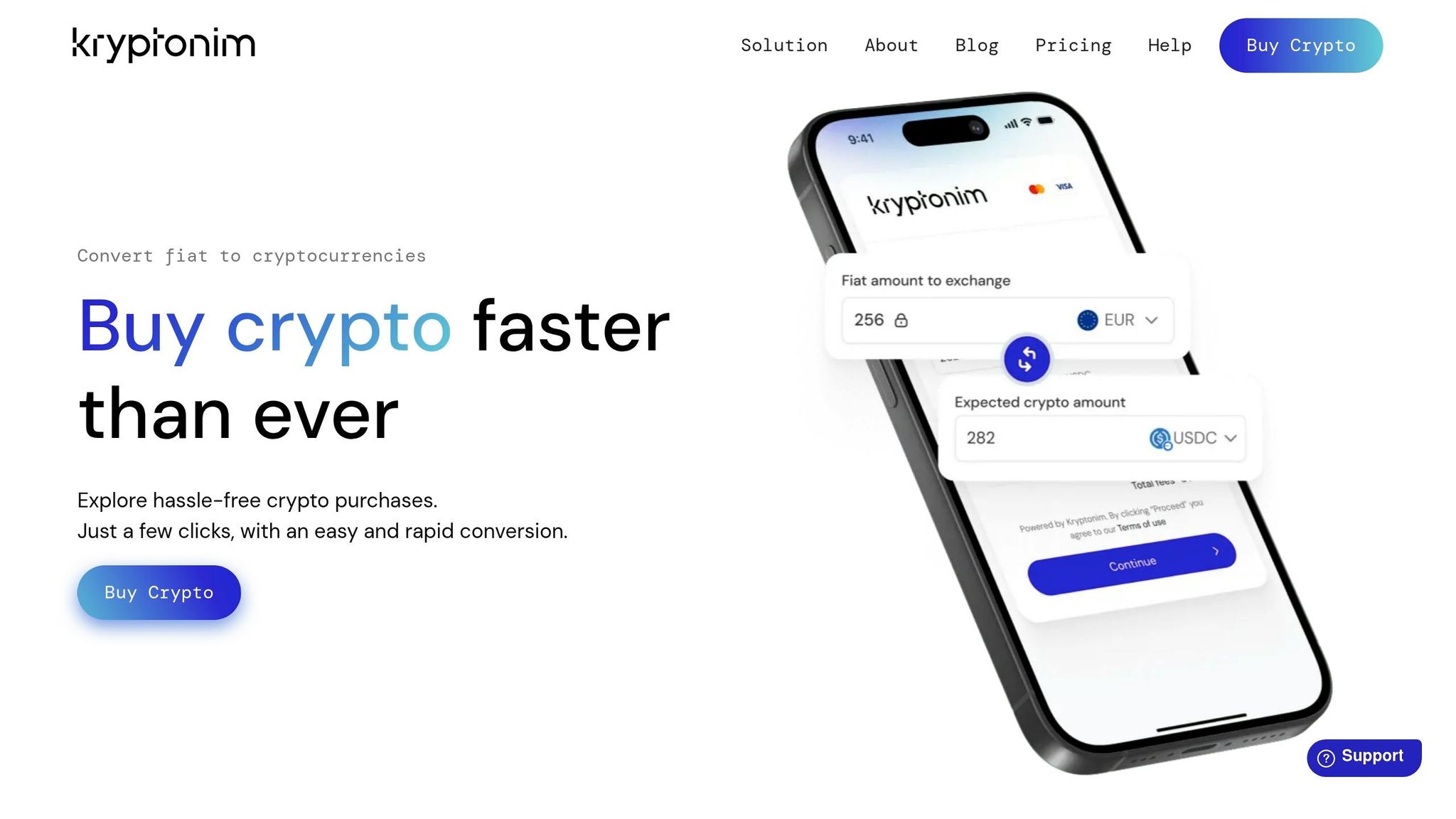
Kryptonim is the example used in this guide. It's an EU-regulated fiat-to-crypto service with a simple checkout flow.
The process is pretty straightforward: choose BTC or ETH, enter the amount, complete KYC, and pay by card or SEPA. The fees are shown before checkout, with pricing around 2% per transaction. The next section walks through the exact purchase flow.
When You Need Your Own Crypto Wallet
If the service sends crypto to your own address, set up and secure your wallet before you buy. If you plan to hold crypto, use a personal wallet. That's the big difference here: a custodial service controls the keys, while a self-custody wallet puts them in your hands.
"If you are buying Bitcoin to hold for more than a few months, transfer it to a hardware wallet like Ledger or Trezor." - Datawallet Team
For beginners, software wallets like MetaMask or Trust Wallet are free, easy to set up, and a good fit for smaller amounts. If you're holding more, a hardware wallet such as a Ledger or Trezor keeps private keys offline.
No matter which wallet you use, write down your recovery phrase on paper and store it offline in a locked place. Don't photograph it. Don't save it to cloud storage. If you lose that phrase, you lose access to your crypto for good.
When you send crypto from a service to your personal wallet for the first time, send a small test amount first. That extra step helps you confirm the address and network before you move the full balance.
Step-by-Step: How to Buy Bitcoin or Ethereum

How to Buy Crypto in Hungary 2026: Step-by-Step Guide
Prepare Your Budget, Documents, and Payment Method
Once your account is verified and your payment method is set up, you’re ready to go. Before you start on Kryptonim, make sure you have three things in place: your budget, your ID, and your payment method.
Start with your budget. Only use money you can afford to lose. Crypto is high risk, and prices can move fast in either direction. You can begin with as little as 5,000–10,000 HUF (about €10–€25).
Next, get your documents ready. Kryptonim may ask for your Hungarian ID or passport and a recent proof of address, so it helps to have both on hand before you begin.
Then choose how you want to pay. You can use Visa or Mastercard, or send a SEPA bank transfer. Cards are usually faster. Bank transfers often cost less. If you plan to send the crypto to your own wallet, copy your wallet address ahead of time so you don’t have to scramble for it during checkout.
How to Complete a Purchase on Kryptonim
Once verification is done, the actual purchase usually takes just a few minutes.
- Choose your asset. Pick Bitcoin (BTC) or Ethereum (ETH) from the list.
- Select your currency. Choose HUF for a HUF bank transfer or EUR for a SEPA payment.
- Enter the amount. Type in how much you want to spend. Kryptonim shows the final crypto amount after fees before you confirm.
- Add your wallet address. If you’re sending the crypto to your own wallet, paste the destination address exactly as it appears. Check it twice. Crypto transfers can’t be reversed.
- Finish KYC if it is still pending. Upload your ID and complete the liveness scan.
- Choose your payment method. Pay by card or bank transfer, confirm the payment, and wait for the transaction to go through. Card purchases usually settle within minutes, while SEPA transfers can take a bit longer depending on your bank.
How to Confirm Delivery and Secure Your Crypto
After payment goes through, check that the crypto reached the correct address. The simplest way is to use the transaction hash (TXID) and look up the status and destination address on a blockchain explorer.
If something seems off, like the wrong amount or a delay that feels longer than expected, check the wallet address and network first. After that, contact the platform’s support team. For larger balances or coins you plan to hold for a while, it may make sense to move them to a self-custodial wallet so you control the private keys.
One rule matters more than almost anything else: never share your seed phrase. And don’t store it digitally. Keep it offline.
Right after the purchase, save your records. Keep the receipt, date, fiat amount, crypto amount, and TXID for tax reporting.
Costs, Risks, Records, and Final Checklist
How Fees Affect the Total Cost of a Purchase
The price you see first usually doesn't include all costs. Fees and spread can chip away at how much crypto you end up with.
| Fee Type | What It Means | Who Charges It | Shown Upfront? |
|---|---|---|---|
| Trading fee | Commission for executing the trade | The exchange | Usually yes (e.g., 0.1%–0.6%) |
| Spread | Gap between the buy and sell price | The exchange/broker | Often embedded in the rate |
| Card Purchase Fee | Extra cost for paying by debit or credit card | Payment processor | Yes, but easy to miss (up to 3.99%) |
| SEPA Transfer Fee | Cost to move EUR to the platform | Your bank or the exchange | Yes (typically free–€1) |
| Blockchain transfer fee | Cost to move crypto on the blockchain | Blockchain miners/validators | Yes, shown at withdrawal |
If you want to keep costs low, SEPA bank transfer is usually the better move than paying by card. Card purchases can cost up to 3.99%, while SEPA deposits from Hungarian banks like OTP or K&H are often free or low-cost.
Once you've worked out the total cost, pause for a second. Check the transfer address and make sure your storage plan is right before you hit confirm.
Main Risks and How to Reduce Them
Price swings get most of the attention, but they're only part of the story. A more painful mistake is sending crypto to the wrong wallet address or using the wrong blockchain network. If that happens, the transfer is irreversible - there's no undo button.
That's why it pays to slow down. Double-check the destination address. Double-check the network. Then check both again. If you're moving a large amount, send a small test transaction first. It may feel annoying in the moment, but it's a lot better than losing funds over one bad copy-paste.
After that, storage becomes the next big call. You can leave funds in your exchange account for active trading, or move long-term holdings to your own wallet.
Use a compliant service to avoid legal risk in Hungary.
Summary and Buyer Checklist
Before you finish, make sure you've covered the basics:
- Use a compliant service available in Hungary
- Complete KYC with a valid Hungarian ID or passport and selfie
- Review the full fee breakdown, including the spread, before confirming
- Fund via SEPA where possible to keep costs low
- Send crypto to the correct wallet address, and store your recovery phrase offline for long-term holdings
- Save the purchase date, amount, fees, and TXID for NAV reporting
FAQs
Do I need a tax ID to buy crypto in Hungary in 2026?
No. You do not need a tax ID to buy cryptocurrency in Hungary, but you do need to complete KYC identity verification with the exchange you use.
The purchase itself doesn't require a tax ID. That said, licensed crypto-asset service providers in Hungary must check users' identities under anti-money laundering rules. So in most cases, you'll need a valid government-issued ID before you can start trading.
Is SEPA cheaper than paying by card?
Yes. SEPA bank transfers are usually cheaper than paying by card.
A lot of exchanges offer free SEPA EUR deposits. Card purchases, on the other hand, often come with added fees, such as 1.10% for Visa and Mastercard or as much as 3.99% on some platforms.
SEPA transfers are also less likely to get flagged by banks. That’s a big reason they’re often the preferred way to fund an account.
Should I keep my crypto on the platform or move it to my own wallet?
It comes down to what you want to do and how much crypto you’re holding.
Keeping crypto on the platform is often the easier path for beginners. It makes trading faster, and your funds are simpler to access. That setup can work well for smaller amounts or if you trade often.
Moving crypto to your own wallet gives you full control because you hold the private keys. That’s often a better fit for larger amounts or long-term storage. The trade-off is simple: you’re in charge of security, so you need to protect your recovery seed phrase.