
How to Buy Crypto in Costa Rica in 2026
2026 guide to legally buying BTC or USDT in Costa Rica — payment methods, fees, wallets, and safety tips.
Yes - I can legally buy and hold crypto in Costa Rica in 2026, but I can’t use it as legal tender. The colón is still the only official currency, and most crypto purchases are priced in U.S. dollars, not CRC.
Here’s the short version:
- I usually buy BTC or USDT first
- I pick a service, verify my identity, and pay by card, bank transfer, or SINPE Móvil
- My bank may convert CRC to USD before the payment clears
- Total cost often includes provider fees, FX markup, and network fees
- If I use a platform wallet, the platform holds the keys
- If I use my own wallet, I hold the keys - and the risk if I lose the recovery phrase
A few points matter right away:
- Crypto is legal to buy and hold
- It is not legal tender
- Costa Rica now requires some virtual asset service providers to register with SUGEF for AML supervision
- That registration is not the same as approval or a license
- Some banks may still flag crypto-linked payments
For most beginners, the first choice is simple: Bitcoin for long-term price exposure, or USDT for a dollar-linked option. USDT often feels easier for test transfers because it tends to stay near $1.00.
The buying path usually comes down to three options:
- Direct purchase services: simple flow, price shown before payment, crypto sent to my wallet
- Exchange accounts: lower posted fees in some cases, but extra steps and withdrawal costs may apply
- P2P trades: price gaps often run from 0.8% to 4%, with more scam risk if I don’t check the seller
I also need to watch the network I use. For USDT, TRC-20 is often much cheaper than ERC-20. In many cases, TRC-20 transfer costs stay around $0.80 to $1.00, while ERC-20 can run $5 to $20+.
Before I pay, I make sure to check:
- the final “you get” amount
- the wallet address
- the network
- the payment route
- whether the crypto goes to my wallet or stays on the platform
Start small. A $10 test buy can help me confirm the wallet, network, and payment flow before I send more.
Below, I’d walk through the buying methods, costs, wallet choices, and the scam risks to avoid.
How to Choose a Safe Way to Buy Crypto from Costa Rica
Before you send any money, take a minute to check if the platform looks safe. In Costa Rica, VASPs must register with SUGEF for AML supervision. But that registration does not mean the business is authorized to operate.
A few things matter most: regulation, total cost, support for Costa Rica payment methods, delivery speed, and whether the crypto goes straight to your wallet. If you pay with a Costa Rican card or bank account, your bank may convert CRC to USD first. That FX rate can change what you end up paying. And if the spread or fee shows up only after you enter your card details, that's a red flag.
With those basics covered, the next step is the purchase flow itself.
When Kryptonim Is the Simplest Option for Beginners
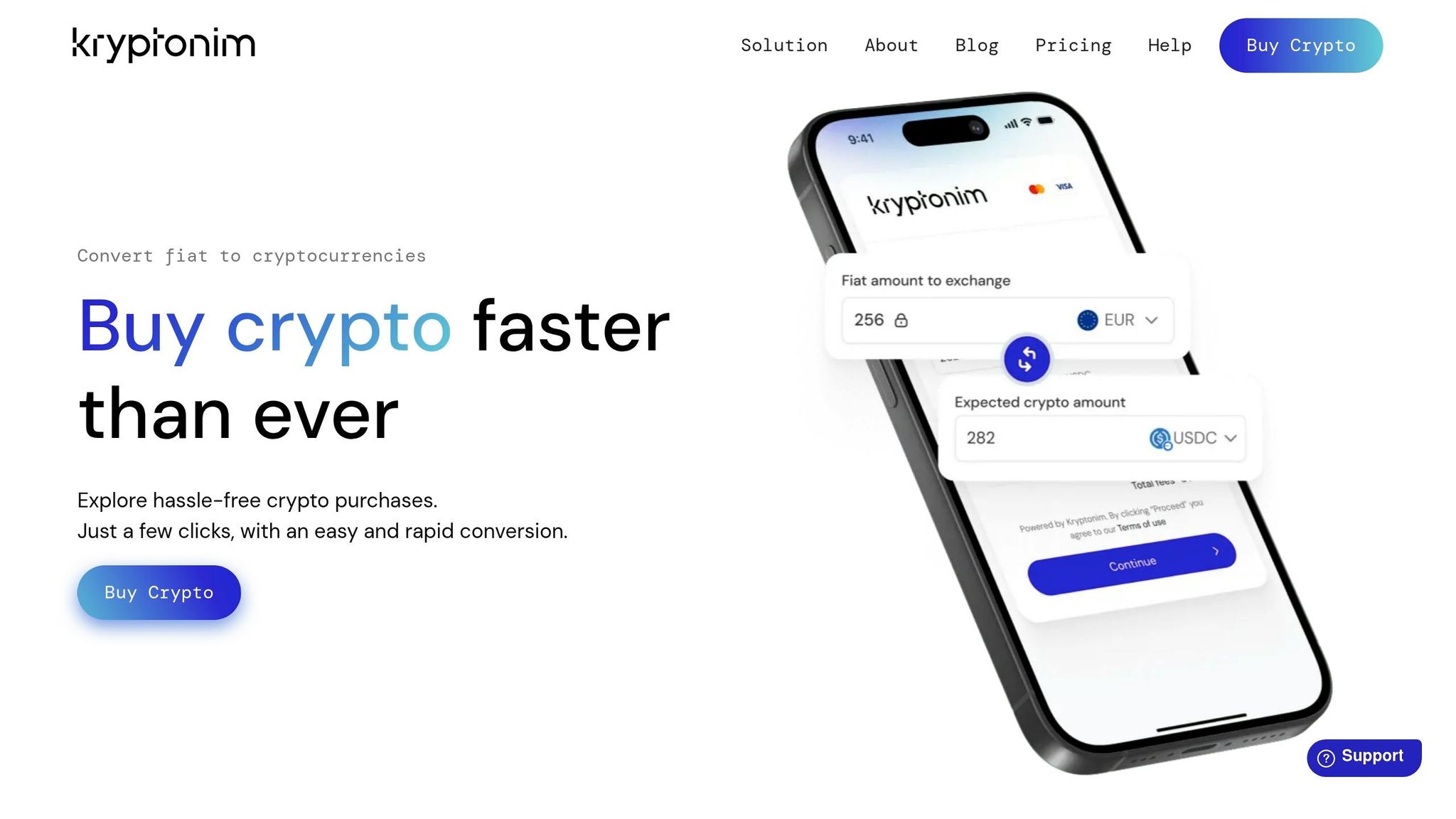
Kryptonim is an EU-regulated fiat-to-crypto service that doesn't require an account. You enter the amount, choose BTC or USDT, add your wallet address, and pay. The total cost shows up before you confirm.
For users in Costa Rica, the all-in cost is about 4%. No hidden fees. The crypto goes straight to your wallet.
How Exchange Accounts and P2P Purchases Differ
If you use an exchange account or a P2P marketplace, the trade-offs change.
Exchange accounts usually ask you to register and complete identity checks before you can buy with fiat. At first glance, the fees may look low. But card purchases often come with extra processing costs. On top of that, the crypto stays in the platform wallet until you withdraw it.
P2P marketplaces connect buyers with sellers. The gap between the seller's price and the market rate is often 0.8% to 4%, and it isn't always shown up front. Scam risk is higher if you don't check the seller first, so use escrow-protected trades and review seller reputation before you pay.
Once you know which path feels safest, the purchase itself is pretty simple. The next section shows how to buy BTC or USDT step by step.
sbb-itb-0796ce6
How to Buy Bitcoin or USDT with Kryptonim: Step by Step
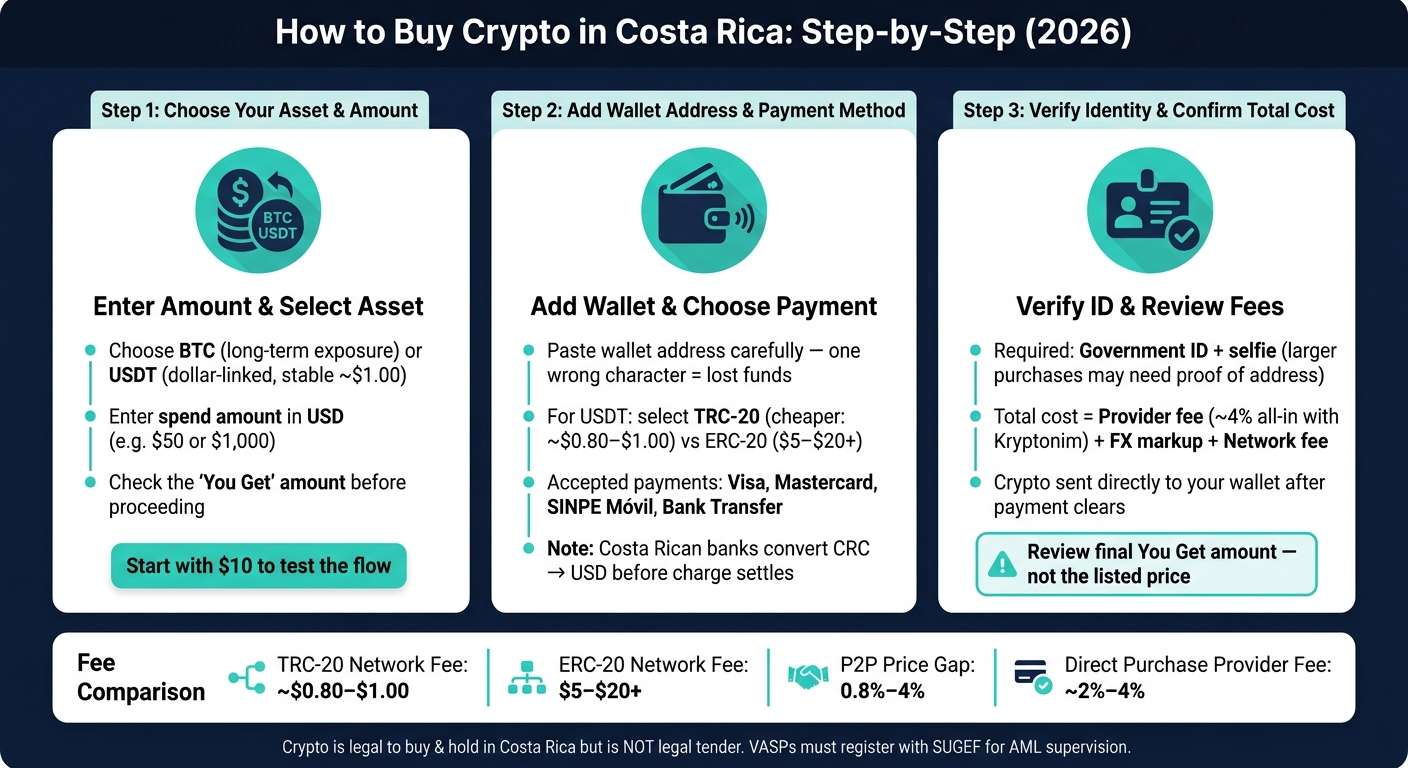
How to Buy Crypto in Costa Rica: Step-by-Step Guide (2026)
If you picked Kryptonim, the process is simple. It takes three short steps.
Step 1: Enter the Amount and Choose BTC or USDT
Open the Kryptonim converter and choose BTC or USDT as the asset you want to receive. Then enter how much you want to spend in USD - for example, $50.00 or $1,000.00. Before you move on, check the "You get" amount so you know what will land in your wallet.
If this is your first purchase, starting small, like $10, is a smart move. It lets you test the process and make sure your wallet address is correct before you send more money.
Step 2: Add Your Wallet Address and Payment Method
Paste your wallet address into the address field with care. A single wrong character can send your funds to the wrong wallet, and that mistake usually can't be undone.
If you're buying USDT, make sure you pick the right network. TRC-20 is often cheaper, while ERC-20 usually costs more.
After you confirm the address, choose your payment method. Kryptonim supports:
- Visa
- Mastercard
- Sinpe Móvil
- Bank transfer
If you pay from a Costa Rican bank account, your bank will convert colones to USD before the charge settles.
Step 3: Complete Verification and Review Total Cost
Costa Rica requires identity verification for AML compliance. You’ll need a government ID and a selfie. For larger purchases, you may also need proof of address.
Before you pay, review the full cost. That includes the service fee, FX markup, and network fee. Once your payment clears, the crypto is sent straight to your wallet.
Wallets, Fees, and Risks Costa Rica Users Should Know
After you buy, the next step is simple on the surface but important in practice: where will you keep your crypto?
Custodial Accounts vs. Personal Crypto Wallets
Once your crypto is purchased, it has to go somewhere. For beginners in Costa Rica, that usually means choosing between an exchange-held account and a personal wallet you control.
An exchange-held account means the platform keeps your private keys for you. It's easy to use. If you forget your password, support may help you get back in. A personal wallet you control means you hold the keys yourself. That gives you full control of the funds. But there's a catch: if you lose your seed phrase, your crypto may be gone for good.
| Feature | Custodial (Exchange-Held Account) | Personal (Non-Custodial Wallet) |
|---|---|---|
| Private Key Control | Held by the exchange | Held by you |
| Convenience | High - easy password resets | Moderate - requires seed phrase backup |
| Recovery Responsibility | Exchange support can help | You are responsible. |
| Typical Use | Short-term holding | Long-term storage |
| Security Risk | Exchange hacks or account freezes | Phishing or losing your seed phrase |
A good rule of thumb: keep only small amounts you expect to use soon on a platform. Move larger balances to a personal wallet.
If you go with a personal wallet, write your 12- to 24-word recovery phrase on paper and store it offline. Not in a screenshot. Not in your email. Not in a notes app synced to the cloud.
The Fees That Affect Your Real Purchase Amount
The price you see isn't always the amount you end up paying. Your final cost usually comes from three parts: the provider fee, FX conversion, and the network fee.
Direct card purchases often come with 2% to 3% provider fees. Network fees apply when crypto is sent to your wallet on the blockchain. If you're sending USDT, TRC-20 often keeps that cost around $0.80 to $1.00, while ERC-20 can cost $5 to $20+ based on network congestion.
For many buyers, SINPE Móvil plus TRC-20 is one of the lower-cost setups. Before you pay, check the final "you get" amount. That's the number that tells the real story.
Common Scams and Safety Risks to Avoid in Costa Rica
Crypto transactions can't be reversed. If money goes to the wrong place, or you approve a scam, fixing it can be hard or impossible. Here are the main risks Costa Rica users should watch for:
| Risk | Impact on Costa Rica Buyers | Practical Protection Step |
|---|---|---|
| Fake Payment Confirmation | Seller sends a fake SINPE confirmation to trick you into releasing crypto | Log into your own banking app to verify the balance increase |
| Wrong Network Transfer | Sending on the wrong network can lock funds permanently. | Confirm both wallets use the same network before sending |
| P2P Counterparty Pressure | Seller pushes you to release crypto before payment clears | Never release crypto until the money appears in your account |
| Fake links or address-swapping malware | Fake exchange login pages or malware steal credentials or redirect funds to a scammer's wallet | Bookmark official URLs, never click unsolicited links, and verify the first and last 5 characters of any pasted address |
One small habit can prevent a lot of trouble: use an authenticator app for 2FA instead of SMS-based codes. SMS can be intercepted in SIM swap attacks, while authenticator app codes are safer.
Before buying, use the final checklist below.
Final Checklist Before Your First Crypto Purchase
Use this last check to confirm the amount, wallet, network, and payment route before you pay.
| What to Check | Why It Matters |
|---|---|
| Platform is trustworthy | Check for KYC/AML, clear support, and public company details |
| CRC payment route is clear | Confirm how you'll fund the purchase in CRC before paying |
| Right asset for your goal | BTC for long-term exposure; USDT for lower volatility |
| Wallet address is correct | Match the first and last 4–5 characters exactly |
| Network matches on both ends | Confirm the same network on both sides |
| Fees reviewed before confirming | Check the final "you get" amount, not the listed price |
| Transaction records saved | Save the order, payment confirmation, and wallet receipt |
Start with a small test amount first. Then move forward only after it shows up in the correct wallet on the correct network.
FAQs
Do I owe taxes on crypto in Costa Rica?
It depends on whether your crypto income is treated as Costa Rican-source or foreign-source.
Costa Rica follows a territorial tax system. That means foreign-source income may sit outside local tax, while Costa Rican-source income can be taxed under general income tax or capital gains rules.
There isn’t a specific crypto tax law in place. So the tax outcome usually comes down to what kind of activity you’re doing. For example, the rules may land one way for personal investing and another for business operations.
How long does a first crypto purchase usually take?
In 2026, your first crypto purchase can often be done in under 15 minutes.
Here’s how that usually breaks down:
- Account creation often takes less than 3 minutes
- Identity verification tends to take 5 to 30 minutes
- The purchase itself takes only seconds once your account is funded
If you want higher limits, enhanced identity verification may take 1 to 3 business days.
Should I buy BTC or USDT first?
For beginners in Costa Rica, buying USDT first is often the simplest move on P2P marketplaces. It gives you a way to turn Costa Rican colones (CRC) into an asset that stays close to the U.S. dollar.
Once you have USDT, you can swap it for BTC or other cryptocurrencies on your exchange. That extra step can make price swings easier to handle while you get used to the platform and the SINPE Móvil transfer process.