
What Is ZK Proof? The Tech That Lets You Pay Without Revealing Who You Are
Explains how zero-knowledge proofs let you validate payments and identity without revealing data, plus types, benefits, and limits.

Zero-knowledge proofs (ZK proofs) let you prove something is true without revealing any details about it. For example, you can prove you have enough money for a payment without sharing your balance or account info. This cryptographic method ensures privacy while maintaining security, especially in blockchain systems like cryptocurrencies.
Key highlights:
- Privacy: Transactions can be validated without exposing sensitive details (e.g., wallet addresses, amounts).
- Applications: Used in privacy-focused cryptocurrencies like Zcash and identity systems like World ID.
- Types: zk-SNARKs (small proofs, but need a trusted setup) and zk-STARKs (larger proofs, but no trusted setup and quantum-resistant).
- Benefits: Enables anonymous payments, selective information sharing, and reduces blockchain transaction costs significantly.
ZK proofs are reshaping digital privacy and security, especially in cryptocurrency payments, by combining anonymity with trust through mathematical validation.
How Zero-Knowledge Proofs Work
Zero-knowledge proofs involve two main players: the Prover, who holds a secret (called the "witness"), and the Verifier, who needs to confirm that a statement is true without actually learning the secret itself.
Picture this: you’ve found Waldo in a crowded scene, and you want to prove it without giving away his location. You could use a sheet of paper with a small hole that only reveals Waldo’s face. The Verifier sees Waldo through the hole and knows you’ve located him, but they don’t learn where he is on the map. This is the essence of zero-knowledge proofs - validation without revealing any underlying details.
In the digital world, this concept is implemented through mathematical circuits. The Prover transforms their claim into algebraic equations and creates a compact cryptographic proof. While generating this proof requires significant computation, verifying it is incredibly fast. For instance, on Ethereum, a zk-SNARK proof can be verified at a fraction of the gas cost compared to executing multiple individual transactions.
Zero-knowledge proofs can take two forms: interactive and non-interactive. Interactive proofs involve a back-and-forth exchange, where the Verifier challenges the Prover multiple times. Non-interactive proofs (NIZKs), on the other hand, generate a single proof that anyone can verify later without requiring both parties to be online at the same time. This makes non-interactive proofs especially practical for blockchain systems.
Unlike traditional proofs, ZK proofs are probabilistic. They don’t guarantee absolute certainty but instead make it almost impossible for a false claim to slip through. For example, if a Prover is trying to cheat in a binary challenge repeated 20 times, the odds of them succeeding by chance are roughly 1 in 1,048,576 (9.54 × 10⁻⁷). This level of security is what makes ZK proofs so reliable.
3 Key Properties of ZK Proofs
Zero-knowledge proofs rely on three essential properties:
- Completeness: If the statement is true and both parties follow the protocol, the Verifier will be convinced. An honest Prover with the correct secret will always succeed.
-
Soundness: If the statement is false, a dishonest Prover has almost no chance of fooling the Verifier. As Shafi Goldwasser, Silvio Micali, and Charles Rackoff described:
A zero-knowledge proof is a protocol in which one party (the prover) can convince another party (the verifier) that some given statement is true, without conveying to the verifier any information beyond the mere fact of that statement's truth.
- Zero-Knowledge: If the statement is true, the Verifier gains no information beyond the fact that it’s true. The secret remains entirely hidden.
Together, these properties create a system where trust is established through mathematics rather than exposing sensitive data. This makes zero-knowledge proofs an incredibly effective tool for privacy-focused verification.
sbb-itb-0796ce6
ZK Proofs in Cryptocurrency Payments
In cryptocurrency, zero-knowledge (ZK) proofs make shielded transactions possible. This means the sender, recipient, and transaction amount stay completely confidential, while the network still verifies the transfer's validity and ensures there are enough funds - without revealing balances or transaction history.
ZK proofs also enable validity proofs, which confirm off-chain transactions have been verified. This allows the main blockchain to adopt the results without having to re-execute the transaction. On Ethereum, verifying a single ZK-SNARK proof costs 500,000 gas - a reasonable trade-off for maintaining privacy.
Another powerful feature is selective disclosure. Users can prove specific attributes - like confirming they're over 18 or a U.S. citizen - for regulatory purposes without exposing their full identity or any Personally Identifiable Information (PII).
"Zero-knowledge proofs change the trade-offs between verification and disclosure. By allowing facts to be checked without revealing sensitive inputs, they open new design possibilities for privacy-preserving finance." - Ellie M., Hexn
Privacy-Preserving Transactions with Kryptonim
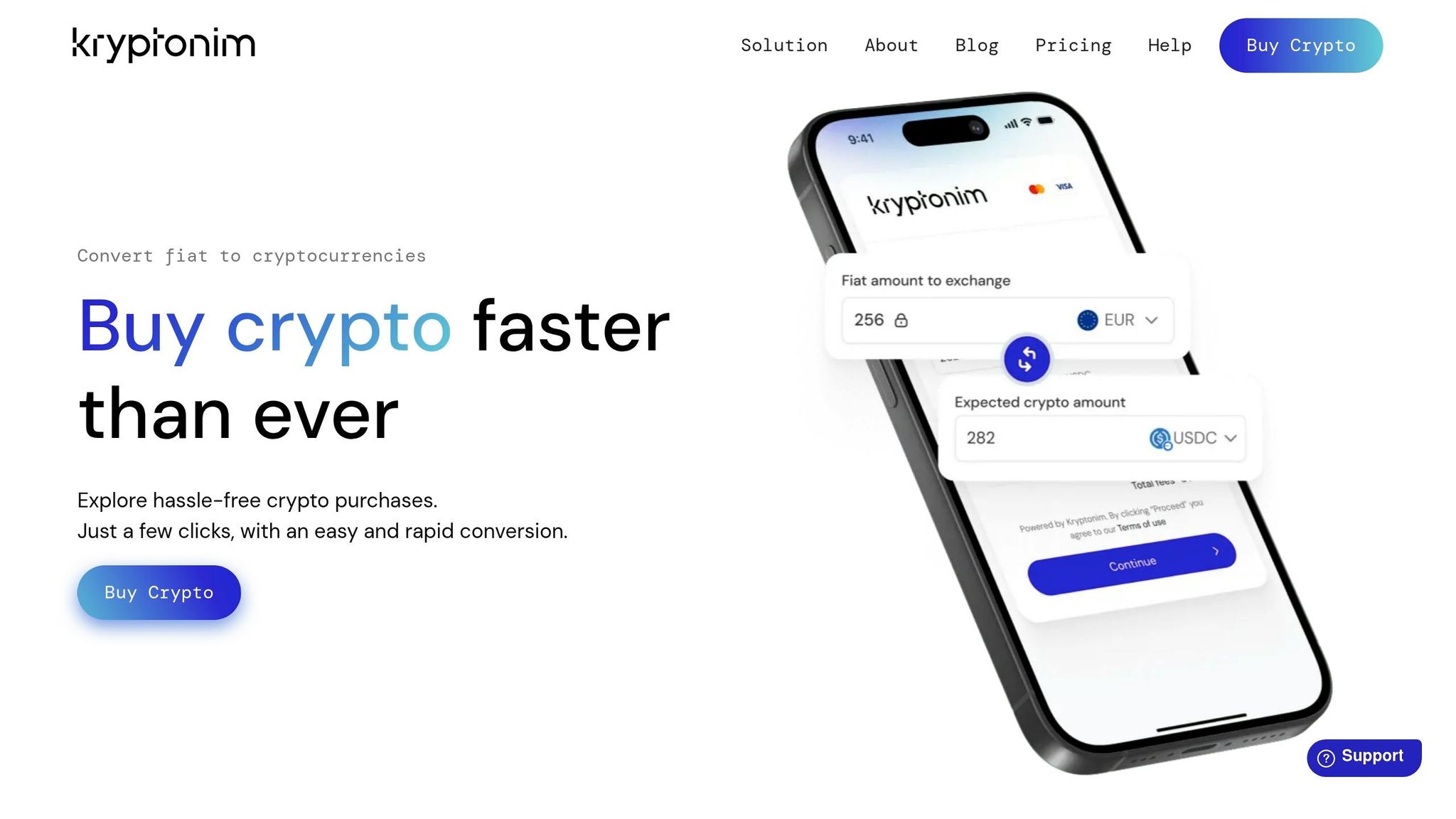
Kryptonim takes these privacy advancements further by integrating ZK proofs into its platform to enable secure and anonymous cryptocurrency payments.
The platform uses zero-knowledge proof technology to facilitate anonymous crypto payments while adhering to EU regulations. It allows users to perform fiat-to-crypto transactions without requiring an account, significantly reducing the need to share personal data.
With ZK proofs, Kryptonim ensures users meet regulatory requirements - such as verifying age or residency - while complying with Know Your Customer (KYC) and Anti-Money Laundering (AML) standards. Importantly, this is done without exposing unnecessary personal details to third parties, reducing risks like identity theft and database breaches.
Kryptonim also offers view keys, which let users provide selective read access to regulators or auditors when needed. This ensures compliance while keeping transaction data private from the public eye. By combining privacy with regulatory adherence, Kryptonim enables anonymous payments without compromising financial regulations.
Types of Zero-Knowledge Proofs

ZK-SNARKs vs ZK-STARKs: Key Differences in Zero-Knowledge Proof Technologies
Zero-knowledge proofs come in various forms, tailored to tackle specific challenges in cryptocurrency - whether it's about cutting transaction costs or preparing for quantum computing threats. Each type presents a balance between proof size and security, making it crucial to understand their differences.
The two most widely used types are zk-SNARKs and zk-STARKs, both offering distinct advantages and trade-offs. zk-SNARKs generate compact proofs (just a few kilobytes), which makes them inexpensive to verify on platforms like Ethereum. However, they rely on a "trusted setup" process, where cryptographic keys are created. If this setup's secret data isn't properly destroyed, it could allow someone to forge proofs and mint unlimited tokens. Zcash, launched in 2016, was the first major cryptocurrency to use zk-SNARKs for shielded transactions.
On the other hand, zk-STARKs eliminate the need for a trusted setup, making them "transparent." They leverage hash functions instead of elliptic curves, offering more resilience against quantum computing. The trade-off? zk-STARK proofs are significantly larger - sometimes hundreds of times bigger - resulting in higher gas fees when used on Layer 1 blockchains. Platforms like StarkNet use zk-STARKs to bundle thousands of transactions off-chain, which greatly boosts Ethereum's capacity.
ZK-SNARKs and ZK-STARKs
Here's a quick comparison of zk-SNARKs and zk-STARKs:
| Feature | zk-SNARKs | zk-STARKs |
|---|---|---|
| Cryptography | Elliptic curves | Hash functions |
| Trusted Setup | Required (risk if compromised) | Not required (transparent) |
| Quantum Resistance | No | Yes |
| Proof Size | Very small | Large |
| Gas Cost (L1) | Low | High |
| Verification Speed | Fast | Faster for large datasets |
"Zero-knowledge proofs are solving the blockchain trilemma, allowing networks to be secure, decentralised, and scalable while offering users privacy." - Benjamin Vitáris, Writer, VALR
Some implementations even combine the strengths of SNARKs and STARKs, aiming to balance proof size and security. These innovations continue to shape the future of zero-knowledge technology.
Zero-Knowledge Virtual Machines (zkVMs)
Building on the foundations of SNARKs and STARKs, Zero-Knowledge Virtual Machines (zkVMs) take things a step further. They allow developers to run entire programs or smart contracts off-chain while generating a proof that the computation was executed correctly. Instead of requiring every blockchain node to re-run the same transactions, zkVMs enable nodes to verify a compact cryptographic proof, drastically cutting down on redundant computations.
One standout feature of zkVMs is their ability to enhance privacy. Sensitive data stays on the user's local device, and only the proof is sent to the blockchain. This ensures raw data remains under your control. This "client-side proving" method is especially useful for private payments and confidential operations.
"A zkEVM is a virtual machine that is compatible with the Ethereum Virtual Machine (EVM) and enables zero-knowledge-proof computation. Unlike traditional virtual machines, zkEVM verifies the accuracy of program execution." - Hari Pandey, Blockchain Developer
Benefits and Limitations of ZK Proofs
Zero-knowledge proofs (ZK proofs) offer impressive gains in privacy and scalability, but they come with some notable challenges that developers and users need to consider. On the bright side, ZK technology can compress thousands of off-chain transactions into a single, compact proof for on-chain verification. This drastically reduces transaction costs - by up to 200 times in some cases. For users concerned about privacy, ZK proofs also allow for shielded transactions, where sender and receiver addresses remain hidden while still ensuring the network verifies that no double-spending has occurred. These features make ZK proofs a powerful tool for blockchain applications.
That said, these benefits come with trade-offs. Generating ZK proofs is computationally demanding and often requires specialized hardware, which can make it harder for smaller operators to compete. For example, verifying a single ZK-SNARK proof on Ethereum costs approximately 500,000 gas.
"ZK is not just about privacy, but about compression." - Ethereum Foundation
Another hurdle is the steep learning curve for developers. Building ZK circuits requires advanced cryptographic and mathematical skills, which are not common among most developers. Mistakes in circuit design can lead to vulnerabilities, such as enabling double-spending. Additionally, many ZK-SNARK implementations depend on a trusted setup ceremony. If the initial randomness from this setup is not securely destroyed, it could allow malicious actors to forge proofs and generate unlimited tokens.
Comparison of Key Aspects
| Aspect | Advantages | Disadvantages |
|---|---|---|
| Privacy | Allows anonymous payments and selective identity disclosure | Privacy tools are often "opt-in" and may be linked to illicit activities |
| Security | Provides trustless verification with mathematical certainty of validity | SNARKs rely on trusted setups; elliptic curve-based ZKPs are vulnerable to quantum attacks |
| Scalability | Significantly reduces on-chain data load through batching and compression | Proof generation is resource-intensive and slow for the prover |
These trade-offs highlight the difficulty of balancing privacy, security, and efficiency in blockchain systems. Despite these challenges, progress continues. Starknet, a ZK-rollup leveraging STARKs, has achieved a total value locked of $1 billion and processed over 108 million transactions. The move toward quantum-resistant ZK-STARKs and advancements in zkEVMs show that the technology is evolving, even as it faces hurdles like complexity and high costs.
Conclusion
Zero-knowledge proofs are reshaping how privacy and verification work in digital payments. They allow for proving the truth of a statement without revealing the underlying data. For cryptocurrency users, this means you can securely send and receive payments without exposing sensitive details.
ZK-rollups also play a key role in reducing transaction costs - by as much as 200 times compared to traditional on-chain verification methods. This not only strengthens privacy but also significantly boosts scalability.
"A zero-knowledge protocol is a method by which one party (the prover) can prove to another party (the verifier) that something is true, without revealing any information apart from the fact that this specific statement is true." - Shafi Goldwasser, Silvio Micali, and Charles Rackoff
FAQs
Do ZK proofs make crypto payments fully untraceable?
ZK proofs enhance privacy by allowing transactions to be verified without exposing sensitive personal or transactional details. However, they don't render crypto payments entirely untraceable. Certain information might still be deduced or connected through other available data points.
What’s the real risk of a “trusted setup” in zk-SNARKs?
The biggest concern with a "trusted setup" in zk-SNARKs is the risk of security breaches if the setup process is compromised. This step is responsible for generating cryptographic parameters that are crucial for both creating and verifying proofs. If these parameters are tampered with or exposed, attackers could potentially fabricate proofs or compromise the system's integrity. To safeguard trust and privacy in zk-SNARK-based systems, it's critical to ensure the setup process is both secure and transparent.
How do ZK-rollups lower fees without re-running every transaction on-chain?
ZK-rollups help cut down transaction fees by grouping several transactions off-chain and sending just one compact proof to the blockchain. This approach reduces the amount of data and computation required on-chain, which in turn lowers costs. The proof, known as a zero-knowledge proof, confirms the validity of all the bundled transactions without needing to reprocess them. This ensures a secure, efficient system while keeping the core principle of trustlessness intact.