
How to Split Bills With Friends Using Stablecoins (No Bank Account Needed)
Split rent, dinners, or trips instantly with USDC/USDT via a mobile wallet — no bank account, low fees, and secure tips.
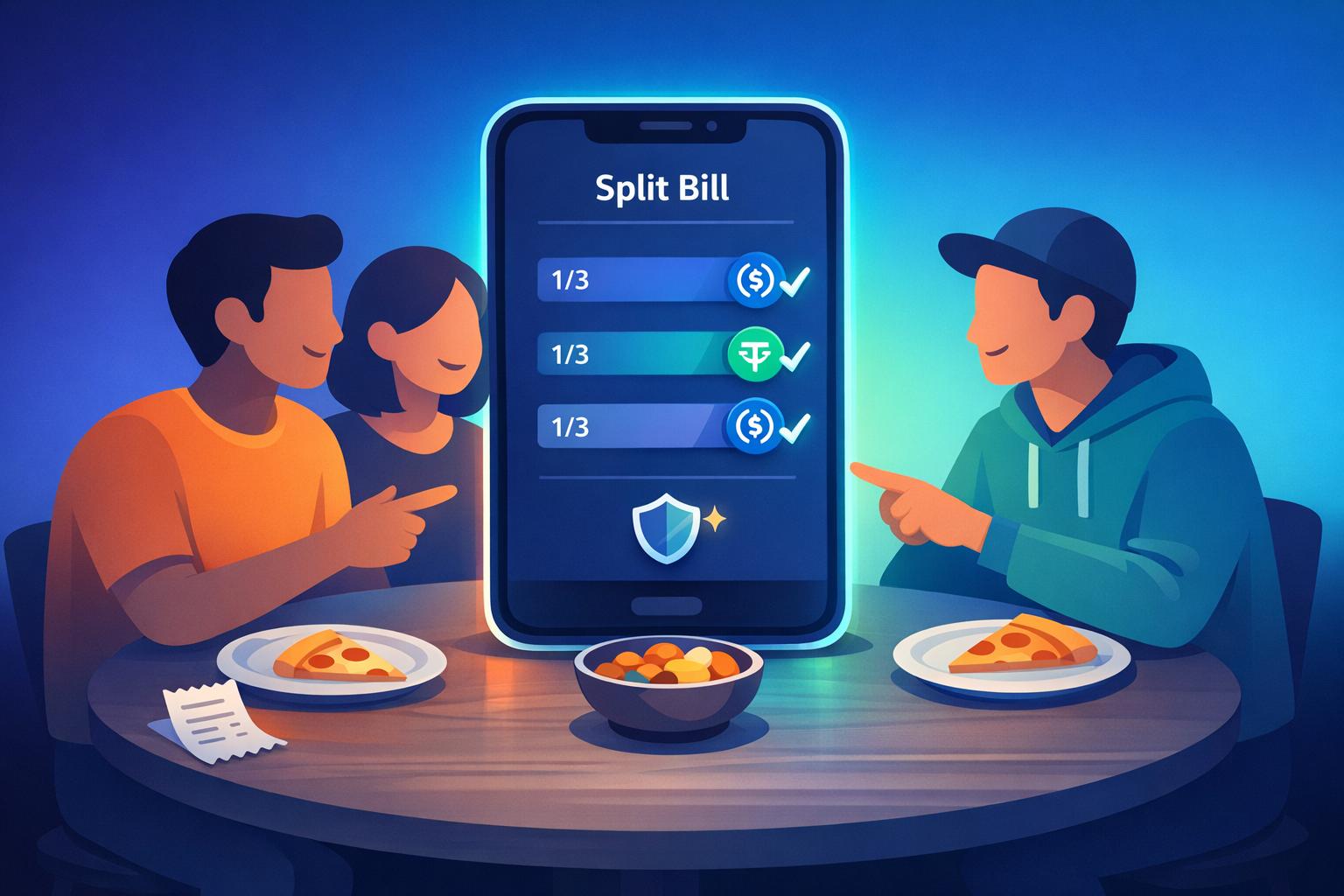
Splitting bills with friends can be quick, easy, and bank-free using stablecoins like USDC or USDT. These digital currencies are tied to the U.S. dollar, ensuring a consistent value of $1 per coin. With a smartphone and a digital wallet, you can send payments instantly, anytime, with minimal fees - perfect for rent, dinners, or group trips.
Key Points:
- Stable Value: USDC and USDT maintain a $1:1 ratio with the U.S. dollar.
- Fast Transactions: Payments settle in seconds, 24/7.
- Low Fees: Costs are typically under $1, far cheaper than traditional bank transfers.
- No Bank Account Needed: All you need is a wallet app like Trust Wallet or MetaMask.
- Borderless Payments: Send money anywhere without currency conversion fees.
Platforms like Kryptonim make buying stablecoins simple - no account required. Just set up a wallet, purchase stablecoins, and start sending payments securely. Always double-check wallet addresses and use secure networks to avoid errors or scams.
Stablecoins offer a modern, hassle-free way to manage shared expenses, making them ideal for anyone looking to simplify payments.
What Are Stablecoins and Why Use Them for Splitting Bills
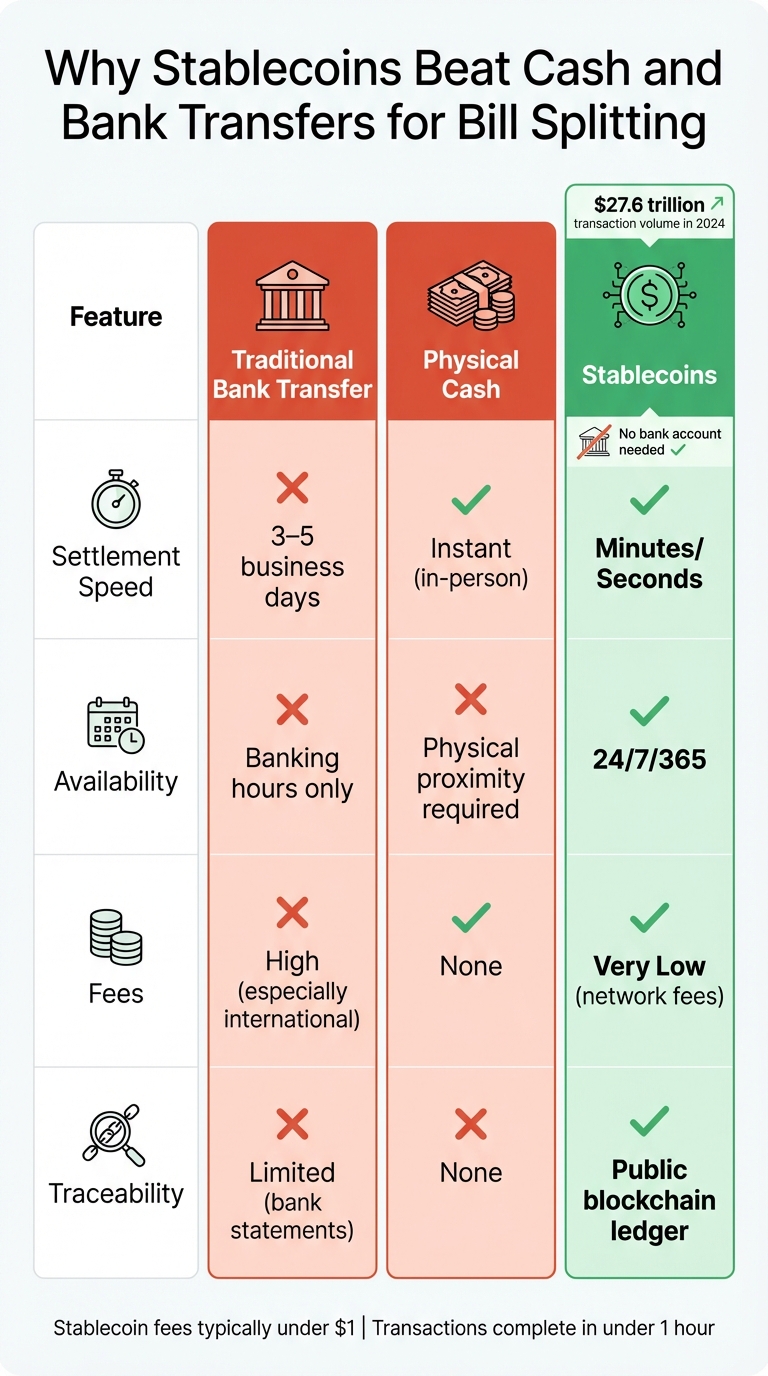
Stablecoins vs Traditional Payment Methods Comparison Chart
Stablecoins are a type of cryptocurrency designed to keep their value steady by being tied to real-world assets, often the U.S. dollar. Popular examples include USDT (Tether) and USDC (USD Coin). For instance, if you hold $100 in USDC, it will always be worth $100. This predictability makes them perfect for everyday transactions like paying back a friend, splitting rent, or handling shared expenses - all with the convenience of digital payments.
How Stablecoins Work
The way stablecoins maintain their steady value is what makes them so reliable. Their stability comes from two key mechanisms: collateral backing and arbitrage.
For fiat-backed stablecoins like USDT and USDC, every coin in circulation is backed by reserves held by the issuer, such as cash or U.S. Treasuries. This means for every $1 in stablecoin, there’s a corresponding $1 in reserves. If the price of a stablecoin drops below $1, traders can buy it at a discount and redeem it for a full dollar, driving the price back up. Similarly, if the price rises above $1, traders can sell it for a profit, pulling the price back down. These natural market forces keep the value stable.
To build trust, reputable issuers conduct regular third-party audits, often called “proof of reserves,” allowing users to confirm that the reserves truly exist.
Benefits of Using Stablecoins for Bill Splitting
Stablecoins make splitting bills simple and efficient by enabling direct transactions between digital wallets on the blockchain, eliminating the need for banks. These payments settle in seconds, and since blockchain networks operate 24/7, you can send money anytime - even in the middle of the night. Plus, transaction fees are incredibly low compared to traditional methods. For example, while cross-border transfers can cost around 6.35%, stablecoin fees on high-speed blockchains like Solana are usually under $0.10, no matter the amount being sent.
In fact, stablecoins have become so widely used that in 2024, their transaction volume hit $27.6 trillion, surpassing the combined transaction volume of major credit card networks. Another perk? Every transaction is recorded on a public blockchain ledger, making it easy to verify payments and track who has paid their share.
Why Stablecoins Beat Cash and Bank Transfers
When it comes to convenience and efficiency, stablecoins outperform both cash and traditional bank transfers. Let’s break it down:
| Feature | Traditional Bank Transfer | Physical Cash | Stablecoins |
|---|---|---|---|
| Settlement Speed | 3–5 business days | Instant (in-person) | Minutes/Seconds |
| Availability | Banking hours only | Physical proximity required | 24/7/365 |
| Fees | High (especially international) | None | Very Low (network fees) |
| Traceability | Limited (bank statements) | None | Public blockchain ledger |
With stablecoins, transactions are typically completed in under an hour, and fees rarely exceed $1.
"Stablecoins act as a much-needed bridge, connecting the stability of traditional money with the powerful technology of the blockchain."
– Stablecoin Insider
Another major advantage? You don’t need a bank account to use stablecoins - just a smartphone and a self-custody wallet. This makes them accessible to anyone, whether they’re unbanked, traveling, or simply looking for a faster, cheaper way to split expenses.
sbb-itb-0796ce6
How to Buy Stablecoins on Kryptonim Without an Account
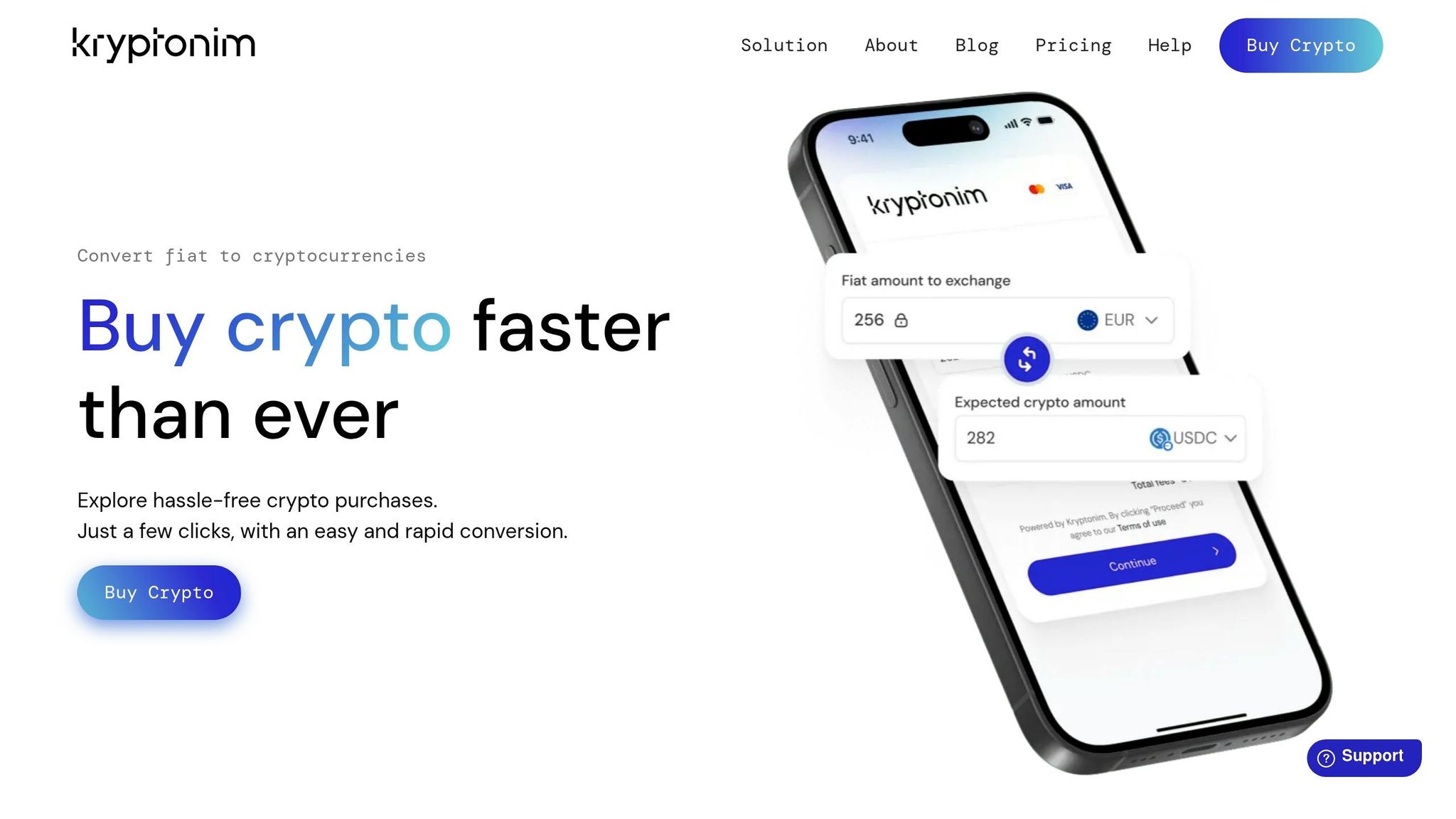
If you're ready to dive into the world of stablecoins, Kryptonim makes it easy - no account required. This EU-regulated platform allows you to purchase stablecoins like USDC and USDT in just minutes. With a user-friendly converter tool, all you need is a wallet address and a payment method to get started.
Pick the Stablecoin That Fits Your Needs
When deciding between USDC and USDT, it’s important to consider what suits your priorities best.
- USDC: Known for its transparency, USDC undergoes regular audits and is highly regulated. It’s a go-to choice for anyone prioritizing security and clarity in their transactions.
- USDT: As of November 2025, USDT holds the largest market cap at around $183 billion, making it the most widely adopted stablecoin. Its compatibility across platforms makes it ideal for tasks like splitting bills or transacting across various services.
No matter which you choose, double-check that your wallet supports the blockchain network of your stablecoin (e.g., Ethereum, TRON, or BSC) to ensure smooth transactions.
Steps to Purchase Stablecoins on Kryptonim
Here’s how to buy stablecoins on Kryptonim:
- Visit the Kryptonim Website: Head to their homepage and locate the converter tool.
- Choose Your Currency: Select your fiat currency (like USD or EUR) and the stablecoin you want to purchase.
- Enter the Amount: Specify how much you’d like to buy and provide your wallet address. This is where your stablecoins will be sent.
- Select a Payment Method: Kryptonim supports credit/debit cards (Visa and Mastercard), Apple Pay, Google Pay, and local payment options. Using mobile payment methods like Apple Pay or Google Pay can speed up the process by skipping manual card entry.
Fees and Transaction Speed
For EU users, a 2% transaction fee applies, while non-EU users are charged 4%. Once the payment is confirmed, your stablecoins are sent directly to your wallet, typically within minutes. The entire process is designed to take less than five minutes from start to finish.
Since Kryptonim delivers stablecoins directly to your self-custody wallet, you maintain full control of your funds right away. Before starting, ensure your wallet is set up and ready to receive stablecoins.
How to Set Up and Secure a Stablecoin Wallet
Before you can start receiving stablecoins, you’ll need a non-custodial wallet to store them safely. The right wallet can make splitting bills as easy as sending a quick text.
Choosing a Beginner-Friendly Wallet
For those new to stablecoins, Trust Wallet and MetaMask are great starting points. Trust Wallet, a mobile app with over 200 million downloads as of 2025, supports stablecoins like USDC and USDT across multiple blockchains, such as Ethereum, Solana, and BNB Chain. This flexibility makes it a user-friendly option for managing your assets on the go.
MetaMask, on the other hand, functions as both a browser extension and a mobile app. If you prefer managing your funds on a desktop, MetaMask provides an intuitive interface that’s perfect for that setting.
Both wallets are non-custodial, meaning you have full control over your funds. Features like "Send" and "Receive" buttons, QR code scanning for simplified address sharing, and clear dashboards for tracking balances make them accessible for beginners and experienced users alike.
Once you’ve chosen your wallet, follow these simple steps to get started.
Step-by-Step Wallet Setup
Setting up your wallet is quick and straightforward. Download Trust Wallet from the App Store or Google Play, or install MetaMask as a browser extension for Chrome, Firefox, Brave, or Edge. When you open the app for the first time, you’ll be prompted to create a secure password and will receive a 12-word recovery phrase - this phrase is the key to your wallet.
"Your 12-word phrase is the only way to recover your wallet in case you forget your login credentials or need to restore your wallet on a new device. Never share it or store it online." – Trust Wallet
Write down this recovery phrase and store it in a safe, offline location. Treat it like cash, as anyone with access to this phrase can control your funds.
Tips for Safeguarding Your Wallet
To enhance security, enable features like Face ID, fingerprint scanning, or two-factor authentication (2FA) in the wallet settings. When sending stablecoins, confirm that both you and the recipient are using the same blockchain network. For instance, sending USDC on Ethereum to a Solana wallet address could result in permanent loss of funds because blockchain transactions are irreversible.
"Assets sent to the wrong address cannot be recovered." – Dynamic
For your first transaction, it’s wise to send a small test amount - around $1 or $2 - to ensure everything works smoothly. Also, avoid using public Wi-Fi networks during transactions. Stick to your home internet or mobile data to lower the risk of interception.
Once your wallet is set up and secured, you’re all set to start splitting bills with stablecoins.
How to Split Bills and Send Stablecoins to Friends
Once your wallet is set up, splitting expenses with stablecoins becomes a breeze. Stablecoins like USDC and USDT are tied 1:1 to the U.S. dollar, meaning each unit equals exactly $1.00. This fixed value makes dividing costs straightforward.
Calculate the Split Amount
Splitting costs is as simple as basic division. For instance, if a dinner for four costs $100, each person owes 25 USDC ($100 ÷ 4 = $25). Keep in mind there may be minor network fees, especially on platforms like Solana or Polygon. Similarly, if you’re splitting a $60 grocery bill between two people, each person would send 30 USDC plus a small fee for the transaction.
"Whether you're paying your share of the rent, reimbursing a friend for concert tickets, or splitting a dinner bill, USDC makes peer-to-peer payments straightforward." - USDC.com
Send Stablecoins Step-by-Step
- Open your wallet app and select your stablecoin (USDC or USDT).
- Tap "Send" and either input your friend’s wallet address manually or scan their QR code to avoid mistakes.
- Enter the exact amount (e.g., 25 USDC) and confirm the network fee.
- Double-check the recipient’s wallet address and confirm the transaction. Most transfers are processed in seconds or minutes, depending on the blockchain.
It’s crucial to ensure both you and your friend are using the same blockchain network. For example, sending USDC on Ethereum to a Polygon wallet could result in the funds being lost. Once the transfer is complete, confirm receipt with your friend and keep a record of the transaction.
Verify Receipt and Track Settlements
After sending the funds, your wallet will provide a transaction hash or ID. Share this with your friend so they can track the payment. Wallets often notify users when funds are received, and your friend can confirm by checking their updated balance.
For additional clarity, you can use a blockchain explorer like Etherscan (for Ethereum) or Solscan (for Solana). By pasting the transaction hash, you can view real-time updates on the transfer’s status. Since all transactions are recorded on a public ledger, there’s a permanent and verifiable record. If you’re splitting bills with a larger group, keeping a note or spreadsheet of who’s paid can save everyone from confusion.
"USDC transactions are typically confirmed within seconds to minutes, depending on which network you're using and how much network traffic is occurring at the time of your transaction." - USDC.com
Security Tips for Safe Transactions
Ensuring the safety of your stablecoin transactions is just as important as securely setting up your wallet. Stablecoin transactions are permanent - once they're sent, there's no undo button. A small mistake, like a typo in the wallet address, could lead to losing your funds entirely. Here’s how to keep your transactions secure.
Double-Check Wallet Addresses
Manually typing wallet addresses is risky. Always rely on the copy-and-paste function or scan a QR code to avoid errors. But even then, be cautious - malware can tamper with addresses in your clipboard. To stay safe, verify the first five and last five characters of the address after pasting. Watch out for similar-looking characters, such as "0" (zero) and "O" (uppercase letter O), or "1" (one) and "l" (lowercase L).
"A single character error sends your funds to a completely different wallet that you cannot access." - Trust Wallet
Avoid copying wallet addresses directly from your transaction history to protect yourself from address poisoning scams. Instead, use your wallet’s address book to store verified contacts. If your wallet supports the Ethereum Name Service (ENS), consider using human-readable names like friend.eth for added convenience.
Test with a Small Amount First
Before sending a large amount, do a trial run with a small transaction - say $2 - to ensure the funds are delivered to the correct address. On low-fee networks like Polygon or BNB Chain, this precaution is affordable, with transaction costs ranging from $0.01 to $0.10 on Polygon and $0.10 to $1.00 on BNB Chain.
Use Trusted Networks and Avoid Phishing
Stick to secure, private Wi-Fi networks when making transactions. Public Wi-Fi, like those in coffee shops or airports, can expose you to potential risks. To avoid phishing scams, always access your wallet platform by typing its official URL directly into your browser instead of clicking on random links.
"Anyone with access to your 12-word recovery phrase will have unfettered access to your wallet and your funds." - USDC.com
For added security, enable two-factor authentication (2FA) or use biometric logins like Face ID or fingerprint scanning when available. Keep your 12-word recovery phrase offline and secure - never store it in cloud services, emails, or as a screenshot. And most importantly, never share it with anyone.
Conclusion
Splitting bills with friends doesn’t have to mean juggling bank transfers, dealing with cash shortages, or keeping track of informal IOUs. Stablecoins provide a faster, cheaper, and more accessible way to share expenses, operating 24/7 without needing a traditional bank account. This guide has walked you through how to use stablecoins to simplify expense sharing.
With Kryptonim, you can quickly purchase stablecoins like USDT or USDC - no account setup required - and send them to friends anywhere. These digital currencies allow for instant, low-cost transactions while maintaining a stable 1:1 peg to the dollar, making them perfect for managing shared costs. The process is straightforward: buy stablecoins through Kryptonim, set up your wallet, and securely send payments by following the security tips covered here.
"Stablecoins are making all of this simpler, faster, and more affordable than traditional methods." - Trust Wallet
FAQs
Which network should I use to send USDC or USDT?
To transfer USDC or USDT, you'll need to use a blockchain network that supports these stablecoins. Two popular choices are:
- Ethereum (ERC-20): Known for its broad compatibility across wallets and exchanges.
- Tron (TRC-20): Offers lower transaction fees and faster processing times.
Wallets like Trust Wallet typically let you pick the network you want to use. Your decision should depend on factors like transaction costs and whether the network is supported by your wallet or exchange.
How do I avoid losing funds if I send to the wrong address?
When sending stablecoins, it's crucial to take a few precautions to avoid losing funds. Always double-check the recipient's wallet address, the type of coin, and the amount before confirming the transaction. Since blockchain transactions cannot be reversed, even a small mistake can lead to permanent loss.
A helpful tip: Use QR codes when sharing wallet addresses to reduce the chance of errors. Before hitting send, carefully review the address displayed in your wallet to ensure it matches the intended recipient's address. These simple steps can help ensure your transactions are secure and error-free.
Do I have to pay taxes when splitting bills with stablecoins?
When splitting bills using stablecoins, you might have tax obligations. The IRS treats stablecoins as property, meaning any transaction involving them could trigger capital gains or income taxes. It’s wise to review tax rules or consult a professional to clarify your responsibilities.