
How an On-Ramp Handles KYC and Liquidity So You Don't Have To
Explains how a crypto on-ramp handles KYC, payment checks, and liquidity routing to simplify first-time purchases.
Buying crypto is less about clicking “buy” and more about getting through ID checks, payment approval, and price locks before the quote runs out.
When I look at how a fiat-to-crypto on-ramp works, the main job is simple: it takes my USD payment and turns it into crypto in my wallet while it handles the hard parts in the background. That usually means:
- KYC checks to confirm who I am and screen against sanctions lists
- Card or bank checks to lower failed payments and fraud flags
- Liquidity routing to find enough crypto at the quoted price
- Quote locks that often last about 30 seconds
- Clear checkout details like fees, exchange rate, and crypto amount before I confirm
For first-time buyers, the common failure points are plain: identity review, card declines, ACH delays, and expired quotes. This article shows how an on-ramp handles each one, and how Kryptonim keeps those steps in one checkout flow instead of sending me across different sites and tools.
One stat stands out: 71% of consumers say they would buy and use crypto if they could find a simple place to do it. That helps explain why a good on-ramp matters so much for a first purchase.

How a Crypto On-Ramp Works: From USD to Wallet in Minutes
How KYC checks work behind the scenes
KYC, or Know Your Customer, confirms a buyer’s identity and checks that person against sanctions lists before a purchase can go through. From the buyer’s side, this usually happens before payment gets approved.
Behind the scenes, automated systems check government-issued IDs, run selfie or liveness tests, and compare names against sanctions databases, including OFAC in the U.S.
What you may need to provide during verification
What you’re asked to submit usually depends on how much crypto you want to buy. Most on-ramps use a tiered verification setup that scales with transaction size:
| Verification Level | Information Required | Typical Use Case |
|---|---|---|
| Basic | Name, phone, email, street address | Very low-limit purchases or initial setup |
| Standard | Basic data + date of birth, SSN | Standard purchase limits for verified U.S. users |
| Advanced | Standard data + government-issued photo ID, selfie/liveness check | Higher-limit purchases |
For the photo ID step, a driver’s license, state ID, or U.S. passport will usually do the job. The selfie or liveness check is there to confirm that the person making the purchase is the same person shown on the ID.
If you plan to buy a larger amount, it often makes sense to finish Advanced verification up front. That can help you avoid getting paused halfway through a purchase. It also helps to match the address on your account with the billing address tied to your payment method, which can cut down on fraud flags.
After that clears, the flow moves to payment approval.
How Kryptonim keeps verification simple for beginners
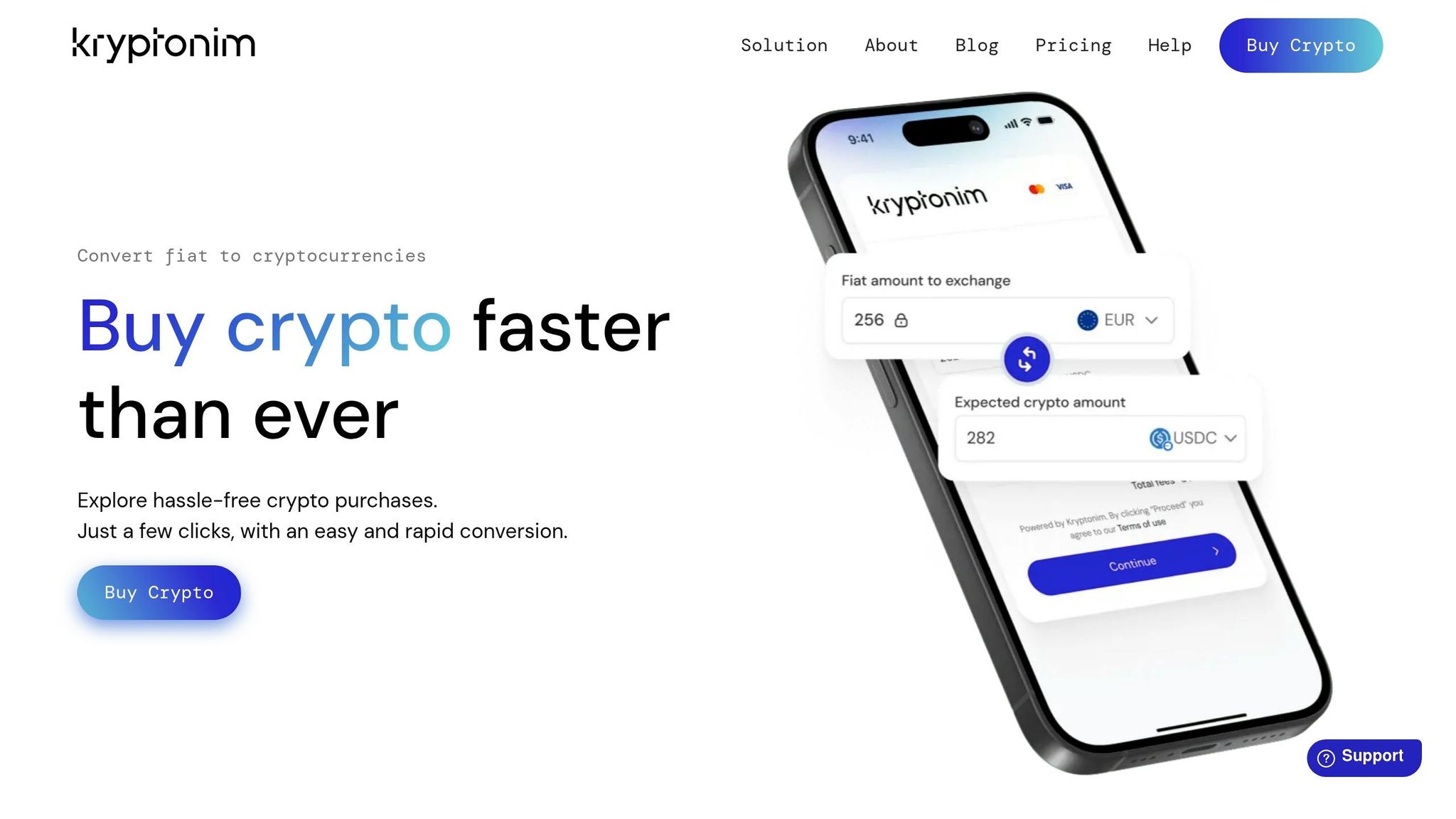
Kryptonim keeps the compliance flow inside the purchase experience with a widget-based setup, so you stay in the app instead of getting pushed to a separate site. That sounds like a small detail, but it matters. Fewer redirects usually means less confusion and fewer drop-offs.
The checks run in the background while you stay in one place. Kryptonim uses automated tools to validate IDs and run biometric checks in real time, which helps make the process feel faster and less disruptive. Clear prompts also help. The flow is built to keep buyers moving with fewer handoffs and fewer abandoned purchases.
Once verification clears, the purchase moves into payment authorization. From there, the next step is card or bank verification, followed by crypto release.
sbb-itb-0796ce6
What happens when you pay by card or bank transfer
Once KYC is approved, the on-ramp checks your payment method before it sends the crypto. A few checks happen in parallel behind the scenes. The goal is simple: make sure the payment clears cleanly so the crypto can be released without a hitch.
Card payments go through fraud checks before crypto is sent
If you pay with a debit or credit card, the on-ramp runs CVV, billing address, ZIP code, and 3D Secure (3DS) checks. If those details don’t line up, the payment may be declined.
That extra screening helps cut fraud and avoid declines that would stop the purchase midway. Once the card network approves the payment, the crypto is released, even though the card settlement shows up later.
Bank transfers require account and transfer validation
Bank transfers follow a different path. For ACH transfers, that usually means linking your bank account through instant verification or micro-deposits to confirm account ownership.
Wire transfers are used more often for larger amounts, generally above $50,000, and they’re processed one by one. Even though bank transfers are less reversible than card charges, on-ramps still run risk checks before releasing crypto. That keeps the transfer tied to the buyer and helps the on-ramp send the crypto without extra delays.
How an on-ramp sources liquidity for fast order fills
Liquidity means there’s enough crypto available at a usable price so your order can fill fast. When liquidity is thin, slippage - the gap between the quoted price and the final execution price - can cut into the amount you receive.
Once your payment clears, liquidity is what decides whether the crypto shows up fast and at the quoted amount. Liquidity providers supply the crypto needed to fill your order at that quoted rate, which helps keep checkout moving even when the market shifts.
That liquidity usually comes from more than one place at the same time. An on-ramp connects to multiple sources, such as internal inventory, partner exchanges, and OTC desks. Its routing system checks those sources at once, looks for the best available price and volume, and then shows you a live quote before you confirm.
Most on-ramps lock that quote for a short window, often around 30 seconds, to reduce the impact of price swings during checkout. If the market moves hard and that window runs out before you confirm, the order gets repriced.
How Kryptonim reduces delays and unexpected price changes
Kryptonim shows the full cost breakdown before you confirm, including the exchange rate, service fee, and expected crypto output. That gives you a clear view of what you’re paying for, instead of leaving you to guess where the extra cost came from.
For first-time buyers, seeing clear USD-to-crypto amounts makes the purchase easier to follow and helps cut down on surprises. It makes the last step feel a lot more straightforward.
How Kryptonim simplifies the USD-to-crypto process
After verification, payment checks, and liquidity are taken care of, the big win for beginners is a simpler checkout. Kryptonim handles KYC, payment checks, and liquidity routing in one checkout flow. You stay in the same flow from start to finish. And before you confirm, you can see the exchange rate and total cost up front.
Once payment clears, crypto can land in your wallet in minutes. Kryptonim is an EU-regulated platform that supports transactions in more than 70 countries. For first-time buyers, that means fewer steps, fewer failed attempts, and a faster first purchase. That’s a big deal when you’re just getting started and want the process to feel doable, not stressful.
Key points for first-time buyers
An on-ramp is the bridge between your USD and the crypto in your wallet. It handles verification, payment screening, and crypto sourcing so your order fills at a usable price. Kryptonim pulls those steps into one flow, so you’re not jumping between a bank, an exchange, and a verification portal just to complete your first purchase.
That kind of simplicity matters. 71% of consumers say they would purchase and use crypto if they could find a trustworthy, simple place to do it.
FAQs
Why did my crypto purchase fail?
Crypto purchases usually fail in the fiat payment layer, not on the blockchain.
That means the problem often shows up before the crypto transfer even starts - during identity verification, fraud checks, or payment processing.
Common reasons include:
- Incomplete or mismatched documents
- Failed selfie checks
- Card declines
- 3D Secure issues
- Insufficient funds
- Suspicious activity flags
- Country mismatches
- Expired quotes
- Wrong network selection
- Unsupported payment methods in your location
In plain English: even if the blockchain is working fine, a purchase can still fall apart if the payment side hits a snag.
How long does KYC usually take?
Modern on-ramps use automated identity checks instead of slower manual reviews. That helps keep the process fast and smooth, even though timing can vary based on the provider and the details you submit.
In many cases, verification is completed within minutes.
What happens if my quote expires?
Your quote is locked for a short time, often less than two minutes, to help protect your purchase while your payment is being processed and prices are moving.
If the quote expires before you finish the transaction, you may need to request a new one based on current market conditions. This happens more often when the asset price swings a lot or the blockchain is congested.