
What Is a Crypto On-Ramp? (And Why It Matters for Your Wallet)
Turn fiat into crypto securely: learn how on-ramps work, payment options, fees, and KYC to protect your wallet.
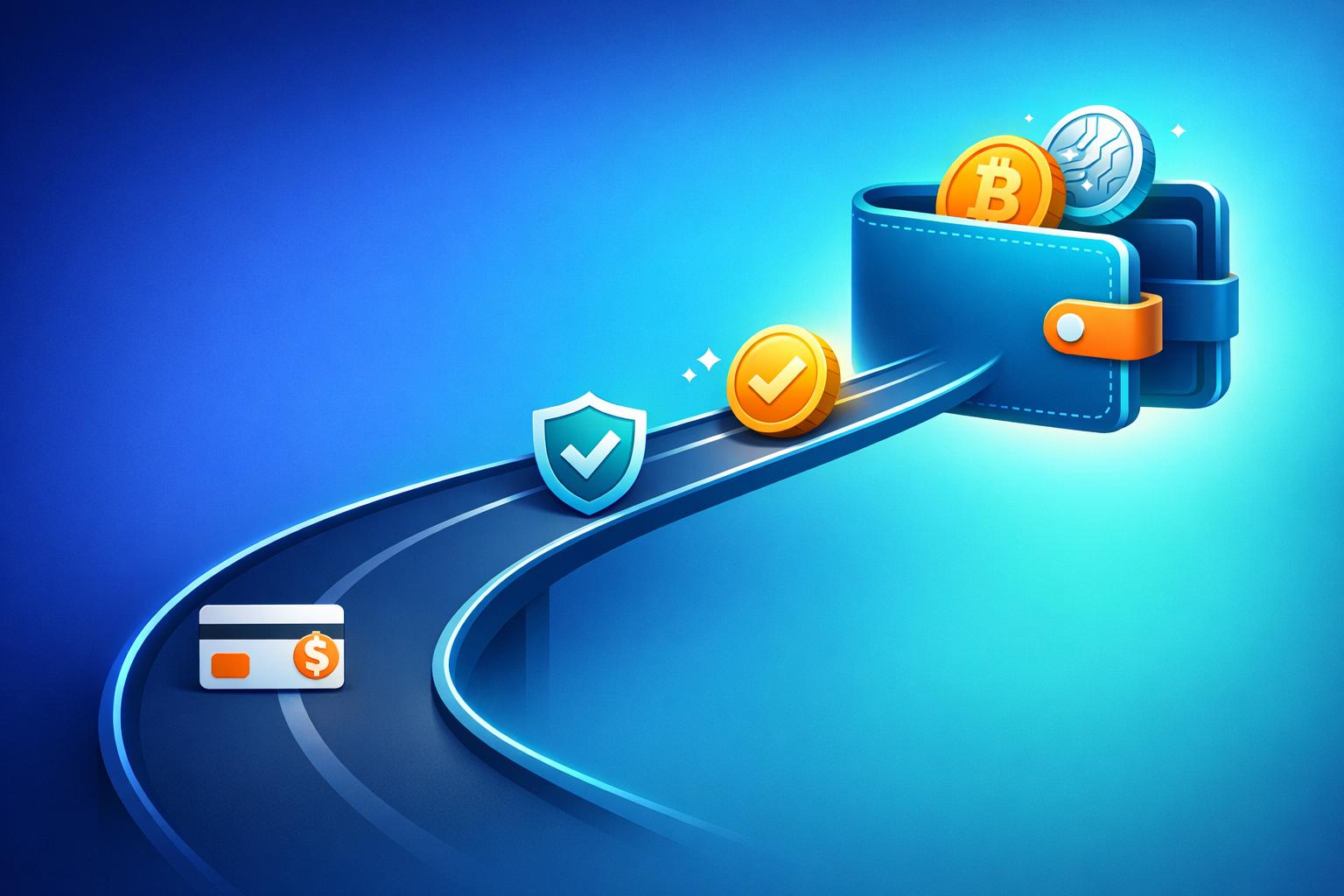
A crypto on-ramp is a service that helps you convert regular money (like dollars) into digital currencies such as Bitcoin or Ethereum. It simplifies the process of entering the cryptocurrency market by allowing you to use familiar payment methods like credit cards, bank transfers, or Apple Pay. These platforms handle the technical side, ensuring your crypto is delivered securely to your wallet.
Why does this matter? Many people avoid crypto because it seems too complex. On-ramps remove that barrier, making it easy to start without needing deep knowledge of blockchain or trading platforms. Plus, they ensure compliance with regulations, protect against fraud, and offer transparent pricing.
Key points:
- What it does: Converts fiat money into cryptocurrency.
- How it works: Pick a payment method, verify your identity, and receive crypto in your wallet.
- Payment options: Credit/debit cards (faster but higher fees) or bank transfers (slower but cheaper).
- Security: Requires ID verification (KYC) to ensure safe transactions.
- Examples: Platforms like Kryptonim offer simple, regulated, and secure on-ramp services with clear pricing.
On-ramps make crypto accessible, secure, and easy to manage for beginners and experienced users alike.
What Is a Crypto On-Ramp?
A crypto on-ramp is a service that lets you exchange traditional money, like U.S. dollars, into digital currencies such as Bitcoin, Ethereum, or stablecoins like USDT. Think of it as a bridge connecting your bank account to the blockchain. Since blockchain networks don’t naturally integrate with traditional banking systems, on-ramps handle the technical side for you. All you need to do is decide how much you want to spend, pick a payment method (like a credit card, debit card, or bank transfer), and the on-ramp transfers the crypto directly to your wallet. It’s designed to make the process simple - especially for newcomers.
For someone new to crypto, these on-ramps are a game-changer. Without them, buying digital assets would involve learning complicated concepts like liquidity pools, network protocols, or navigating advanced trading platforms. On-ramps strip away these complexities, making the process as easy as shopping online.
To keep this process secure, most trusted on-ramps require identity verification through a Know Your Customer (KYC) process. This usually involves uploading a government-issued ID and taking a selfie to comply with anti-money laundering rules. While it adds an extra step, this measure protects both you and the platform from fraud, ensuring a safer experience as you manage your crypto wallet.
sbb-itb-0796ce6
How Crypto On-Ramps Work for Beginners

Crypto On-Ramp Payment Methods: Speed vs Cost Comparison
Using a crypto on-ramp is simple once you grasp the basics. The process typically takes just a few minutes for your first transaction, thanks to a one-time verification step. After that, buying crypto feels as effortless as any standard online purchase. Let’s break down the key steps - choosing payment methods, verifying your identity, and receiving crypto - so you can understand how it all works.
Choosing Your Payment Method
The payment method you select affects both the speed of your transaction and the fees you’ll pay. For instance, using a credit or debit card can deliver your crypto in as little as 5–15 minutes, but the fees range between 3.5% and 5.0%. That’s about $35–$50 in fees for a $1,000 purchase.
If you’re looking to save on fees, bank transfers like ACH are a better option, with fees as low as 0.5% to 1.0%. However, they take longer - usually 3–5 business days. For larger transactions, the savings are significant. On a $10,000 purchase, for example, a bank transfer could save you $300 to $430 compared to using a card.
One important tip: Check whether your bank treats crypto purchases as cash advances. If they do, you could be hit with extra high-interest charges on top of the on-ramp fees. Also, confirm that your bank or card issuer supports crypto transactions before proceeding. Once you’ve chosen your payment method, the next step is a quick identity verification.
Completing Verification and Compliance
Before you can purchase crypto, you’ll need to verify your identity. This is a one-time process where you provide a government-issued ID and a selfie. It’s designed to meet Anti-Money Laundering (AML) standards and protect against fraud. The platform also checks your information against global watchlists to ensure everything stays secure.
"The key to building a safe and secure crypto onramp lies in using the right technology to optimize for conversion while reducing risk and fraud." - Austin Cornell, Plaid
Most platforms now use automated tools that process your verification almost instantly, meaning you won’t have to wait long before moving to the final step.
Receiving Crypto in Your Wallet
After your payment is processed and your identity is verified, the crypto is transferred directly to your wallet, completing the process. From this point on, you control your assets entirely through your wallet’s private keys. Unlike a traditional bank account, where an institution manages your funds, holding crypto in your wallet means you’re solely responsible for securing your digital assets.
One critical thing to remember: Always send crypto to the correct blockchain network. Sending it to the wrong network could result in losing your funds permanently. If you’re using a self-custodial wallet for decentralized applications, make sure to buy some of the network’s native tokens (like ETH for Ethereum) to cover transaction fees.
Using Kryptonim as Your Crypto On-Ramp
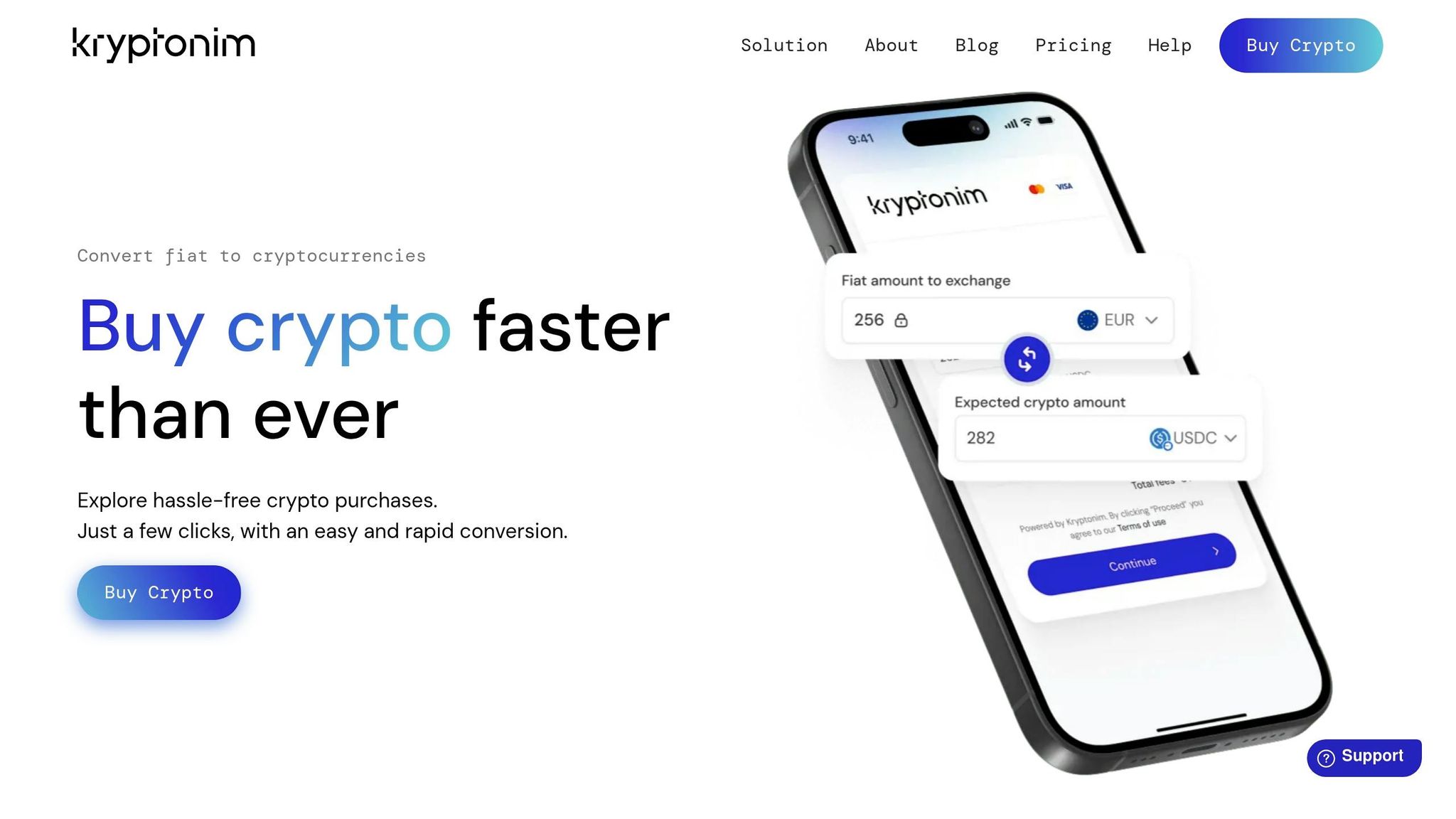
Kryptonim makes converting dollars to cryptocurrency a breeze. As an EU-regulated platform, it complies with strict financial standards while keeping the process as straightforward as possible. Getting started is as easy as providing your email - no need to create an account. This simplicity aligns with the basic on-ramp steps outlined earlier.
What Sets Kryptonim Apart
Kryptonim removes many of the usual obstacles associated with buying cryptocurrency. You can purchase crypto using a credit or debit card (Visa, MasterCard, or Maestro) in just a few steps. The platform supports more than 27 fiat currencies - such as USD, EUR, GBP, and CAD - and ensures that your purchased assets are delivered directly to your personal wallet, like MetaMask or Trust Wallet, typically within 2 to 20 minutes.
"Purchasing cryptocurrencies via Kryptonim is easy and doesn't require prior experience. We made our tool so simple and intuitive that anyone can use it." - Kryptonim
The platform's $10 minimum transaction (or equivalent) makes it an approachable option for beginners. This means fewer barriers, from verification to wallet management. As a non-custodial on-ramp, Kryptonim sends funds directly to your wallet, ensuring you retain full control over your assets as soon as the transaction is complete.
Kryptonim Pricing by Region
Kryptonim uses a transparent, all-inclusive pricing model - what you see is what you pay. Fees vary by region:
| Region | Transaction Fee | What's Included |
|---|---|---|
| EU Users | 2% | Processing fee and EU-regulated security; no hidden charges |
| Other Regions | 4% | Processing fee and local payment support; no hidden charges |
"With Kryptonim's all-in-one pricing, the price you see is exactly the price you pay." - Kryptonim
Note: Network fees are charged separately.
In addition to clear pricing, Kryptonim prioritizes security.
How Kryptonim Secures Your Transactions
Kryptonim adheres to AML and KYC standards, requiring users to verify their identity with a valid ID and complete a facial recognition check. The platform employs industry-standard encryption and only collects the data necessary to complete transactions, reducing potential risks in case of a breach. Plus, since no traditional account is required, fewer personal details are stored - minimizing your exposure.
"Kryptonim is a secure, EU‑regulated on‐ramp tool for purchasing cryptocurrencies." - Kryptonim
Why On-Ramps Matter for Your Crypto Wallet
As mentioned earlier, converting fiat to crypto is the starting point, but on-ramps take it a step further by ensuring your wallet is secure and easy to manage. They handle funding, protect against price swings, and offer transparency. On-ramps simplify the process of turning traditional currency into crypto, removing the need for complicated exchanges or risky peer-to-peer transactions. Essentially, they turn a blockchain address into a functional asset tool.
Adding Funds to Your Wallet
On-ramps act as the link between your bank account and the blockchain. They let you add funds using credit or debit cards, ACH transfers, Apple Pay, or Google Pay. Among these, card purchases are often the quickest, typically processing in just a few minutes.
For those new to crypto or concerned about market fluctuations, many on-ramps offer the option to start with stablecoins. These coins maintain a consistent value of $1.00, giving you the flexibility to explore the crypto market without being immediately impacted by price volatility. Once the funds are in your wallet, you have complete control - whether you decide to hold onto them, trade, or use them with decentralized applications.
This straightforward funding approach also helps you navigate market volatility more effectively.
Protecting Against Price Changes
In addition to making funding easy, a good on-ramp locks in the price at checkout, protecting you from sudden market swings. This feature is especially useful during periods of high volatility when crypto prices can change drastically.
Speed plays a crucial role here. While bank transfers might save you 1-2% in fees, they can take 1-3 business days to process. During that time, the crypto you intended to buy at $2,000 could jump to $2,200 - or drop to $1,800. On the other hand, card payments, though they typically come with higher fees (around 2-5%), deliver crypto almost instantly. This allows you to secure the price you planned for with greater reliability.
Security and Clear Pricing
Regulated on-ramps significantly reduce the risks associated with peer-to-peer transactions or using unverified platforms. Licensed providers follow strict KYC (Know Your Customer) and AML (Anti-Money Laundering) rules. They also use encryption, fraud monitoring, and identity verification to protect both your financial information and your purchased crypto. As Stripe explains:
"A crypto on-ramp is a program that converts fiat currency to cryptocurrency quickly and safely while abiding by financial regulations."
Transparent pricing is another key factor for managing your wallet effectively. The total cost typically includes the service fee, the spread (the difference between the market price and the quoted price), and network fees for transferring the crypto to your wallet. Reliable providers disclose all these costs upfront. Beware of hidden spreads, as they can reduce the amount of crypto you receive, even if the provider advertises zero fees. It's always smarter to compare the actual amount of crypto delivered rather than focusing solely on the percentage fee.
How to Choose the Right On-Ramp
When it comes to selecting the best on-ramp for buying crypto, three factors stand out: security, ease of use, and transparent pricing. These elements ensure that your crypto transactions are safe, straightforward, and reasonably priced. Let’s break down what you should focus on as you evaluate your options.
Checking Security and Regulation
Start by confirming that the on-ramp complies with local regulations. For instance, in the U.S., platforms should be registered with FinCEN, while in the EU, they should meet MiCA standards. Compliance with these frameworks usually involves KYC (Know Your Customer) checks, which use government-issued IDs and selfie verification to prevent fraud and money laundering.
Look for platforms that prioritize payment security. Features like 3D Secure add an extra verification step for card payments, reducing the risk of unauthorized transactions. Additionally, platforms with Two-Factor Authentication (2FA) provide extra protection against unauthorized logins. If the on-ramp uses a custodial model, check whether they store most funds in cold storage and have insurance coverage for assets kept in online "hot wallets."
To avoid phishing scams, always verify the platform’s URL and bookmark the official site. Be cautious of anyone asking for personal details or private keys through social media or unofficial channels. For example, Kryptonim is an EU-regulated platform that adheres to strict financial protection laws and uses encryption and fraud monitoring to safeguard its users.
While security is crucial, the platform’s usability also plays a big role in your experience.
Looking for Ease of Use
A user-friendly on-ramp should be simple and intuitive, especially for beginners. Avoid platforms designed for advanced traders, which often feature complex charts and order books. Instead, look for services with straightforward "Buy" buttons and clear workflows.
The best on-ramps support familiar payment methods like credit/debit cards, Apple Pay, and Google Pay. These options usually process transactions within minutes, unlike bank transfers that may take 1–3 business days. Platforms offering automated KYC processes can also save time, completing identity verification in just a few minutes.
Transparency in pricing is equally important. The platform should clearly display the final amount of crypto you’ll receive after fees and spreads are accounted for. Hidden costs can make transactions more expensive than they seem. As Iconomi puts it:
"A good ramp explains fees, spreads, and FX fees in plain language."
Platforms like Kryptonim simplify the process with a no-account-needed interface and quick verification, making them ideal for newcomers.
Once you’ve found a secure and easy-to-use platform, the next step is comparing fees.
Comparing Fees and Pricing
Crypto purchases come with various costs, including platform fees, processing fees, spread markups, and network fees. Your choice of payment method can significantly impact these costs - up to 70% of the total transaction cost.
Bank transfers, such as ACH in the U.S. or SEPA in Europe, typically incur fees between 0.5% and 1.0%. On the other hand, card payments often come with higher fees, ranging from 3.5% to 5.0% or more. For someone investing $1,000 monthly, using bank transfers instead of debit cards could save around $384 annually.
Be mindful of spread markups, which can range from 0.2% to 2.0%. Some platforms might advertise "zero fees" but hide costs in the exchange rate, with spreads as high as 3–5%. To avoid overpaying, compare the on-ramp’s quoted price with a major exchange’s spot price. Watch out for minimum fees too - a flat $5 fee, for example, can dramatically increase costs for smaller transactions.
Kryptonim provides clear pricing with no hidden charges: 2% per transaction for EU users and 4% per transaction for other regions. This transparency allows you to calculate costs upfront without surprises. To cut costs even further, consider using Layer 2 networks like Arbitrum, Optimism, or Base. These networks can slash Ethereum gas fees from $5–$50 down to as little as $0.01–$3.00.
Key Points to Remember
Crypto on-ramps make digital assets accessible by allowing you to use familiar payment methods like credit cards, bank transfers, and Apple Pay. The best part? You don’t need to be a tech expert to get started.
Security and compliance are essential. Top-tier on-ramps adhere to KYC (Know Your Customer) and AML (Anti-Money Laundering) regulations while implementing strong security protocols. As Mastercard puts it:
"Improved ramp solutions translate to faster, safer and easier participation in the crypto economy."
These safeguards are critical as you begin your journey into the crypto world.
Your choice of on-ramp affects transaction costs. For example, bank transfers typically come with lower fees compared to card payments. Kryptonim, for instance, offers clear pricing: 2% per transaction for EU users and 4% for other regions, with no hidden charges or unexpected markups.
When deciding, it’s also important to weigh speed against cost. Bank transfers may save you money, but card payments are much faster, often delivering crypto within minutes. The right choice depends on how quickly you need your funds and what you’re willing to spend.
Non-custodial on-ramps are another key feature to look for. These platforms send crypto directly to your wallet, giving you immediate control of your assets and private keys. This ensures you’re in charge from the start, offering both convenience and security.
These points highlight why selecting a secure, cost-effective on-ramp is so important for managing your crypto wallet efficiently.
FAQs
Do I need an exchange to buy crypto, or is an on-ramp enough?
An on-ramp is all you need to start buying crypto. It allows you to convert fiat currency into digital assets without the hassle of using a separate exchange. This streamlined process is especially helpful for beginners, making it simple to begin managing your crypto wallet both securely and conveniently.
What fees should I look for besides the on-ramp’s listed fee?
When using an on-ramp service, the listed fee isn’t the only cost to consider. Be mindful of payment processing fees, spread markups, and network gas fees. These additional charges can add up quickly, increasing the total cost of your transaction. Always review all possible fees carefully before finalizing your purchase.
How do I make sure I don’t send crypto to the wrong network?
When transferring crypto, it's crucial to ensure you're sending it to the correct blockchain network. Always confirm that your wallet or exchange supports the recipient's blockchain. For instance, a Bitcoin address should only be used for Bitcoin transactions - not Ethereum or any other blockchain.
Take a moment to double-check both the address and network details before hitting confirm. Many platforms will alert you if there's a mismatch, so pay close attention to these warnings to avoid losing your funds.