
How to Buy Crypto in Portugal in 2026
Guide to buying crypto in Portugal: regulated exchanges, ID/NIF rules, 365‑day tax exemption, 28% short-term tax, and reporting steps.

Buying cryptocurrency in Portugal in 2026 is straightforward, thanks to clear regulations and tax policies. Here's what you need to know:
- Regulations: Portugal follows the EU's MiCA framework, ensuring safer and transparent crypto transactions.
- Taxes: Crypto held for over 365 days is tax-free. Short-term gains are taxed at 28%.
- Platforms: Use regulated exchanges like Kryptonim, which comply with anti-money laundering (AML) and know-your-customer (KYC) rules.
- Requirements: You'll need a valid ID, proof of address, and a Portuguese tax ID (NIF) to start.
- Payment Methods: SEPA bank transfers are low-cost but slower. Debit/credit cards offer instant transactions with higher fees.
- Compliance: Report all crypto activity on the annual Modelo 3 tax return, even tax-exempt gains.
Portugal’s crypto-friendly environment makes it an attractive place to invest. Always prioritize secure storage and proper record-keeping to stay compliant and protect your assets.
Portugal's Crypto Regulations in 2026
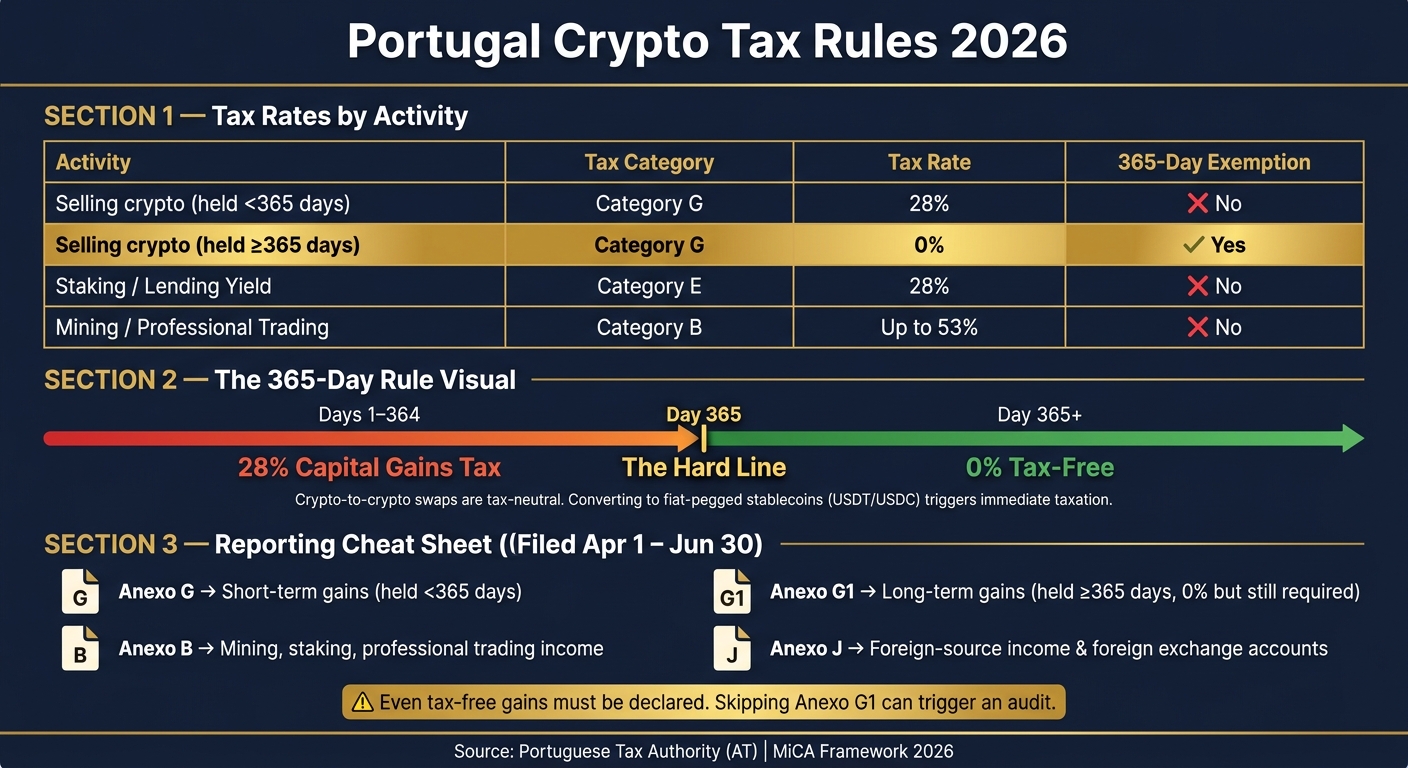
Portugal Crypto Tax Rules 2026: Rates, Categories & Reporting
Portugal has refined its approach to crypto regulations, aligning with the EU's Markets in Crypto-Assets (MiCA) framework, which was fully implemented on July 1, 2026. This framework brings clearer rules, stronger protections for consumers, and reduces uncertainty for both investors and platforms. These updates aim to ensure safer and more transparent crypto transactions in Portugal.
Crypto Tax Rules in Portugal
Portugal’s crypto tax rules are relatively straightforward. If you sell crypto assets held for less than 365 days, the gains are taxed at a flat 28% under Category G (capital gains). However, assets held for 365 days or more are entirely tax-free.
Here’s a key detail:
"The 365-day rule is a hard line: an asset disposed of on day 364 is fully taxable at 28%; the same asset disposed of on day 366 is entirely exempt." - CryptoTaxAtlas
Other important tax rules include:
- Crypto-to-crypto swaps are tax-neutral, meaning no tax is owed until you convert to fiat. However, swapping to fiat-pegged stablecoins (like USDT or USDC) triggers immediate taxation.
- Staking and DeFi rewards are taxed at 28% (Category E), but the tax is deferred until the tokens are sold.
- Mining and professional trading are treated as self-employment income (Category B) and taxed at progressive rates up to 53%, with no 365-day exemption.
| Activity | Tax Category | Rate | 365-Day Exemption |
|---|---|---|---|
| Selling crypto (held <365 days) | Category G | 28% | No |
| Selling crypto (held ≥365 days) | Category G | 0% | Yes |
| Staking/lending yield | Category E | 28% | No |
| Mining/professional trading | Category B | Up to 53% | No |
Proper reporting and strict compliance are critical to avoid penalties.
Reporting and Compliance Requirements
Staying compliant in Portugal’s evolving crypto landscape means understanding your tax obligations and filing all required information. Even tax-exempt gains from crypto held longer than 365 days must be reported. All crypto activity is declared on the annual Modelo 3 tax return, which is filed online through the Portal das Finanças between April 1 and June 30.
Here’s how to report different types of crypto activity:
- Capital gains (including tax-exempt long-term holds) go on Anexo G.
- Income from mining or staking is reported on Anexo B.
- If you use non-Portuguese platforms, you’ll also need Anexo J for foreign income.
Starting in 2026, Law 26/2026 incorporates the EU’s DAC8 directive and the OECD’s CARF framework. This law requires all crypto-asset service providers to report detailed user data - including your NIF (tax ID), transaction amounts, and external wallet transfers - directly to the Portuguese Tax Authority (AT) by May 31 each year. According to Miguel Pinto-Correia of Madeira Corporate Services:
"The 'fiscal anonymity' of crypto disappears in practice. Even transfers to external wallets fall within the scope of what must be reported."
Penalties for platforms failing to meet reporting deadlines can reach €22,500. Users who don’t provide identification after two notices risk having their accounts blocked.
Why Use Regulated Platforms
Compliance isn’t just about taxes - using regulated platforms ensures your transactions meet Portugal’s strict legal standards. EU-licensed exchanges that are registered as Virtual-Asset Service Providers (VASPs) with the Banco de Portugal follow stringent AML (Anti-Money Laundering) and KYC (Know Your Customer) protocols. This reduces audit risks and makes bank transfers smoother.
For example, Kryptonim operates as a regulated platform, providing a compliant paper trail from the start. Before using any exchange, always verify that it holds a valid VASP registration with the Banco de Portugal.
sbb-itb-0796ce6
What You Need Before Buying Crypto in Portugal
Basic Requirements
Before diving into crypto purchases in Portugal, you'll need to have a few key documents ready. All platforms regulated under MiCA require identity verification. This means you’ll need to submit a valid government-issued photo ID, such as a passport, Portuguese Cartão de Cidadão, or an EU/EEA national ID. Additionally, you’ll need recent proof of address (dated within the last three months) and complete a biometric check. These steps are typically processed within three business days, so plan accordingly. To avoid delays, ensure your ID is current, and the photos you upload are clear and well-lit - blurry images are a common cause of setbacks.
If you’re planning to fund your purchases using a Portuguese bank account, you’ll also need a NIF (Número de Identificação Fiscal). This tax ID is mandatory for opening a local bank account and conducting formal financial transactions within Portugal. Lastly, you must be 18 years or older to register on any regulated crypto exchange in Europe.
Once your documents and identity are verified, you can move on to selecting the payment method that works best for you.
Accepted Payment Methods
In Portugal, crypto buyers often rely on SEPA bank transfers. These transfers are a cost-effective option, often free or costing as little as $1.00 for withdrawals. However, they’re not the fastest - SEPA transfers usually take one to two business days to process, though some platforms now offer instant options.
For quicker transactions, debit and credit cards (Visa or Mastercard) are a popular choice. They provide instant access to crypto but come with higher fees, typically ranging from 1.5% to 3.99% per transaction. While convenient for smaller or urgent purchases, these fees can add up significantly for larger investments. To comply with anti-money laundering rules, only use bank accounts or cards registered in your name - third-party deposits are not accepted.
Here’s a quick comparison of the main payment methods:
| Payment Method | Speed | Typical Fees | Best For |
|---|---|---|---|
| SEPA Transfer | 1–2 business days | $0 – ~$1.00 | Larger investments, low cost |
| Credit/Debit Card | Instant | 1.5% – 3.99% | Small or urgent purchases |
| Digital Wallets | Instant | Variable | Mobile users, convenience |
Why Choose Kryptonim
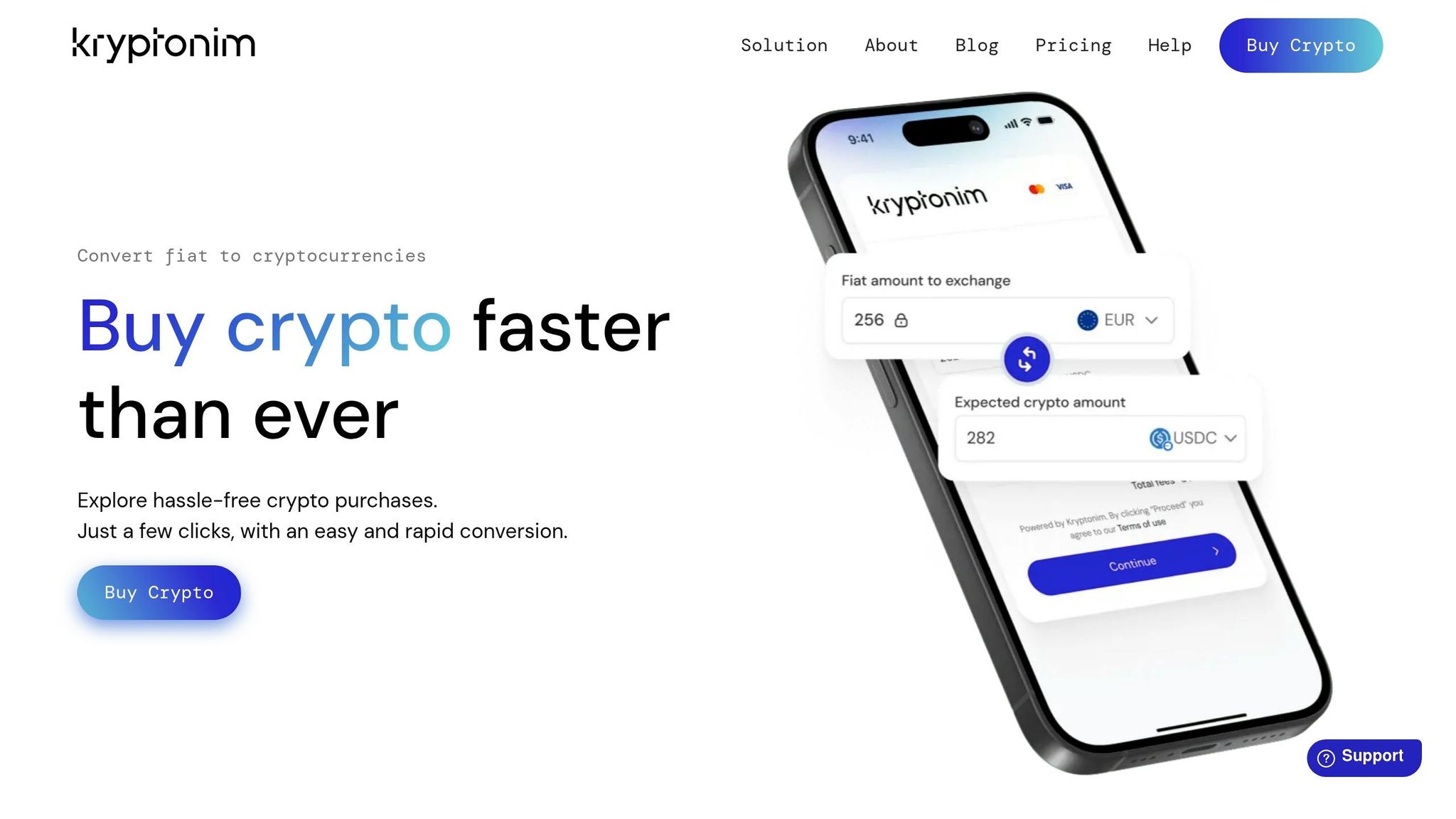
If simplicity is what you’re after, Kryptonim stands out as a great option. Developed by Daftcode and fully EU-regulated, Kryptonim makes the fiat-to-crypto process straightforward - perfect for first-time buyers. The platform eliminates the need to create an account. Instead, you simply verify your identity, complete your purchase, and you’re done.
Kryptonim’s pricing is clear and upfront. EU-based users pay a flat 2% fee per transaction, with no hidden costs. The platform supports local payment methods and operates in full compliance with MiCA regulations. This means every transaction includes a clear paper trail, making it easier to handle your Modelo 3 tax return when the time comes.
How to Buy Crypto in Portugal: Step-by-Step
Buying Crypto with Kryptonim
Kryptonim makes purchasing cryptocurrency straightforward and quick - no need to create a dedicated account. With your documents ready, the process takes just a few minutes.
-
Pick your cryptocurrency and amount
Select the cryptocurrency you'd like to buy and specify the amount in euros. Kryptonim shows exactly how much crypto you'll receive, including a clear 2% flat fee. -
Verify your identity
Provide a valid government-issued ID and complete biometric verification, as required under EU MiCA regulations. -
Select your payment method and complete the purchase
You can pay using a SEPA bank transfer or a Visa/Mastercard. After your payment is processed, the cryptocurrency is sent straight to the wallet address you provide.
Once your transaction is done, focus on securely storing and managing your crypto.
How to Store and Manage Your Crypto Safely
After buying crypto, deciding where to store it is just as crucial as the purchase itself. A poor storage decision can leave your funds vulnerable to hacks or permanent loss. This section dives into storage methods, wallet options, and essential security practices to protect your crypto investments.
Custodial vs. Non-Custodial Storage
The main decision here is about control - specifically, who controls your private keys. With a custodial wallet, such as an exchange account, a third-party platform manages your keys. In contrast, a non-custodial wallet puts you in charge of your private keys, eliminating the need for a middleman.
| Feature | Custodial (Exchange) | Non-Custodial (Self-Custody) |
|---|---|---|
| Who controls keys | The platform | You |
| Tax reporting | Automatic via DAC8/Law 26/2026 | You report disposals manually |
| Best for | Beginners, active traders | Long-term holders, privacy-focused users |
| Tax proof | Platform provides transaction history | You maintain your own records |
In Portugal, there's an important detail to note: holding crypto in a private wallet does not require reporting to the Portuguese Tax Authority (AT), as long as there are no taxable gains. Tax advisor Diogo Pedro of Global Citizen Solutions explains:
"The fact of simply holding crypto does not trigger any taxation per se. So there is no general obligation to report every wallet."
However, once you sell or swap, you’re responsible for proving your holding period. This makes your storage choice not just a security decision but also a factor in simplifying tax reporting while staying compliant with Portugal’s regulations.
How to Choose the Right Wallet
The ideal wallet depends on how you use your crypto. For long-term storage, hardware wallets like Ledger Nano X or Trezor (priced between $65 and $165) are excellent. These devices keep your private keys offline, offering robust security. If you’re more active with transactions or involved in DeFi, software wallets such as MetaMask, Trust Wallet, or Exodus are free and convenient, though their online nature makes them more vulnerable to attacks. For beginners, exchange-based custodial wallets are the easiest to start with, but they offer less control over your assets.
If you’re aiming to hold crypto for over 365 days to benefit from Portugal’s 0% capital gains exemption, a non-custodial wallet is often a better choice. It’s also critical to regularly export and save your transaction history. The Portuguese Tax Authority can audit records going back up to four years - or even ten years in cases of suspected fraud. Once you’ve selected a wallet, it’s time to focus on keeping your assets secure.
Security Best Practices
Protecting your crypto starts with enabling two-factor authentication (2FA) using an authenticator app, which helps prevent SIM-swapping attacks. Your 12–24 word seed phrase should always be stored offline - write it down on paper and keep it somewhere safe. Never share it, as it provides full access to your wallet.
Additional tips:
- Enable withdrawal address whitelisting: This restricts transfers to pre-approved addresses.
- Avoid public Wi-Fi: Public networks are a common target for hackers.
- Stay vigilant against phishing scams and fake support chats. Crypto theft through phishing and smart-contract exploits totaled $80 million globally in 2025.
As João Freire de Andrade from Portugal Fintech puts it:
"Decentralisation means self-responsibility - users must control their private keys, deploy hardware wallets and stay alert to fake support chats."
Lastly, make it a habit to export a CSV of your transaction history annually. If a platform shuts down or faces insolvency, this data could be your only proof for tax purposes. Taking these steps ensures both the safety of your crypto and your peace of mind.
Tracking Your Crypto and Staying Tax-Compliant
Once you've secured and managed your crypto, keeping track of your transactions becomes essential - especially for staying compliant with Portugal's tax regulations. Accurate record-keeping is key to ensuring your filings align with data from regulated exchanges. With the implementation of Law 26/2026, the Portuguese Tax Authority (AT) now receives transaction data directly from EU-licensed exchanges, so it's important that your records match theirs.
How to Track Your Portfolio
To simplify tracking and calculations, consider using crypto tax software like CoinLedger, Koinly, or Blockpit. These tools automate cost basis calculations and help monitor holding periods.
Portugal applies a portfolio-level FIFO (First-In-First-Out) method across all wallets and exchanges. Andrew Kovalenko, Founder of TAXCLARA, explains:
"The 365-day rule is per-asset, FIFO. If you bought BTC over multiple dates and sell some, AT applies first-in-first-out matching to determine which lot was disposed and whether it qualifies."
Be sure to log acquisition dates, as the FIFO method uses the 365-day rule to determine taxable lots. Additionally, convert every transaction into euros at the time it occurred. Use either the exchange's reported price or the official European Central Bank (ECB) rates for this.
Key Tax Events to Watch
In Portugal, not every crypto activity triggers a tax event. Here are the main scenarios that do:
- Selling crypto for euros
- Converting to fiat-pegged stablecoins like USDC or USDT
- Using crypto to pay for goods or services
These fall under Category G (capital gains) tax. Meanwhile, staking and DeFi rewards are classified as Category E (investment income) and are generally taxed when the tokens are sold. Mining or professional trading activity is categorized as Category B (business income), which requires registration as an autónomo (self-employed worker).
For better tracking, organize your records according to these tax form categories:
| Tax Form | What It Covers |
|---|---|
| Anexo G | Short-term disposals held <365 days |
| Anexo G1 | Long-term disposals held ≥365 days (0% exempt, but still required) |
| Anexo B | Mining, staking, or professional trading income |
| Anexo J | Foreign-source income and foreign exchange accounts |
A common oversight is failing to report tax-free gains. For example, if you held Bitcoin for over a year and sold it at a profit, you still need to declare it on Anexo G1. Skipping this step could lead to a verification request from the AT.
Filing Your Taxes in Portugal
Once your portfolio is properly tracked and key tax events are identified, the next step is filing your taxes. Portugal's annual Modelo 3 filing period runs from April 1 to June 30 each year. Before filing, reconcile your records with exchange summaries to avoid discrepancies that could trigger audits.
For simple portfolios, using a reliable tax tool and maintaining organized records is usually sufficient. However, if your situation involves complex factors - like heavy DeFi activity, staking income, or more than 20 transactions - consider hiring a certified accountant (contabilista). Professional fees for crypto-heavy filings typically range from €300 to €800, which is a small price to pay compared to potential fines of €500 to €11,250 for errors or omissions.
Conclusion: A Simple Guide to Buying Crypto in Portugal
Buying crypto in Portugal in 2026 is straightforward. Begin by choosing a platform that complies with MiCA regulations and is registered with Banco de Portugal. You'll need to verify your identity using either a Cartão de Cidadão or a passport. To fund your account, SEPA transfers are a great option, offering near-zero fees.
When planning your purchases, think about how long you intend to hold your assets, as this directly impacts your tax obligations. Portugal's tax policy offers a 0% rate on assets held for over 365 days, while short-term gains are taxed at 28%.
Stay organized by using tax tracking tools to ensure your records match exchange reports. If you're looking for a simple entry point, Kryptonim provides EU-regulated fiat-to-crypto transactions with a transparent 2% fee - no account creation or hidden charges.
The crypto environment in Portugal has evolved considerably. As Diogo Pedro, a Private Tax Advisor, aptly states:
"Portugal is no longer a 'crypto tax haven' - but it may be something more powerful: a compliant EU mobility hub with long-term legal certainty."
That certainty is a valuable advantage. Make the most of it.
FAQs
Does the 365-day tax-free rule reset if I move crypto between wallets?
No, transferring cryptocurrency between your own wallets doesn’t restart the 365-day tax-free rule. The original holding period and acquisition value of the asset usually remain intact, even if you exchange one cryptocurrency for another. Since the exemption depends on your total holding time, it’s essential to maintain detailed records of all transactions. This ensures you can accurately track the original purchase date and holding period for tax purposes.
What records do I need to prove my holding period and cost basis to the AT?
To demonstrate your holding period and cost basis to the Autoridade Tributária (AT), it's crucial to keep detailed, transaction-level records for every asset. These records should include:
- Acquisition date (formatted as YYYY-MM-DD)
- Disposal date
- Quantity
- Original purchase price, converted into Euros
Make sure to save CSV exports from exchanges and wallets as part of your documentation. For any transactions involving foreign currencies, convert them to Euros using the official exchange rate at the time of the transaction.
Additionally, track acquisition dates for each lot carefully. Portugal uses portfolio-level FIFO (First In, First Out) when determining tax exemptions, so accurate records are essential.
Which crypto actions trigger tax in Portugal (stablecoins, swaps, staking, DeFi)?
In Portugal, cryptocurrency taxation varies based on the activity involved. Mining and transaction validation fall under business income (Category B). Meanwhile, activities like staking, lending, and yield generation are taxed as capital income (Category E) at a flat rate of 28%. For capital gains (Category G), taxes apply to events like asset sales or stablecoin swaps. However, if you hold assets for over 365 days, you might be exempt - unless you're classified as a professional trader. Activities in the DeFi space can lead to taxation under both income and capital gains categories.