
How LATAM Crypto Rules Affect Buying and Cashing Out
LATAM crypto rules are reshaping how users buy, transfer and cash out—expect stricter KYC/KYW, travel-rule reporting and tighter taxes.
Latin America’s crypto regulations are evolving quickly, directly influencing how users buy, sell, and manage digital assets. In 2025, the region processed over $730 billion in crypto transactions, a 60% increase from the previous year. Key countries like Brazil, Argentina, and Mexico have introduced distinct rules that impact everything from transaction reporting to tax compliance. For example:
- Brazil: Requires crypto platforms to secure licenses under strict banking regulations. The DeCripto system for tax reporting launches in July 2026, and stablecoins are treated as foreign exchange operations.
- Argentina: Enforces KYC/AML compliance with a registration-based system. Stablecoins are widely used as an inflation hedge.
- Mexico: Operates under its 2018 Fintech Law, limiting platforms to those authorized by its central bank. Crypto gains are taxed as income.
For U.S. users engaging in LATAM crypto markets, compliance with local rules is critical. Brazil’s Travel Rule (2026) and other identity verification mandates require detailed transaction records and cross-border compliance. Platforms like Kryptonim simplify these processes with transparent fees and EU-regulated frameworks, ensuring smoother transactions and easier tax reporting.
Quick Overview:
- Brazil: Licensing required; strict KYC/AML; tax-free crypto sales under R$35,000/month.
- Argentina: Stablecoins dominate; registration required for high-volume transactions.
- Mexico: Limited platforms; crypto gains taxed up to 35%.
Navigating LATAM’s regulatory landscape demands careful planning, accurate record-keeping, and adherence to local laws to avoid penalties.
Overview of LATAM Crypto Regulations
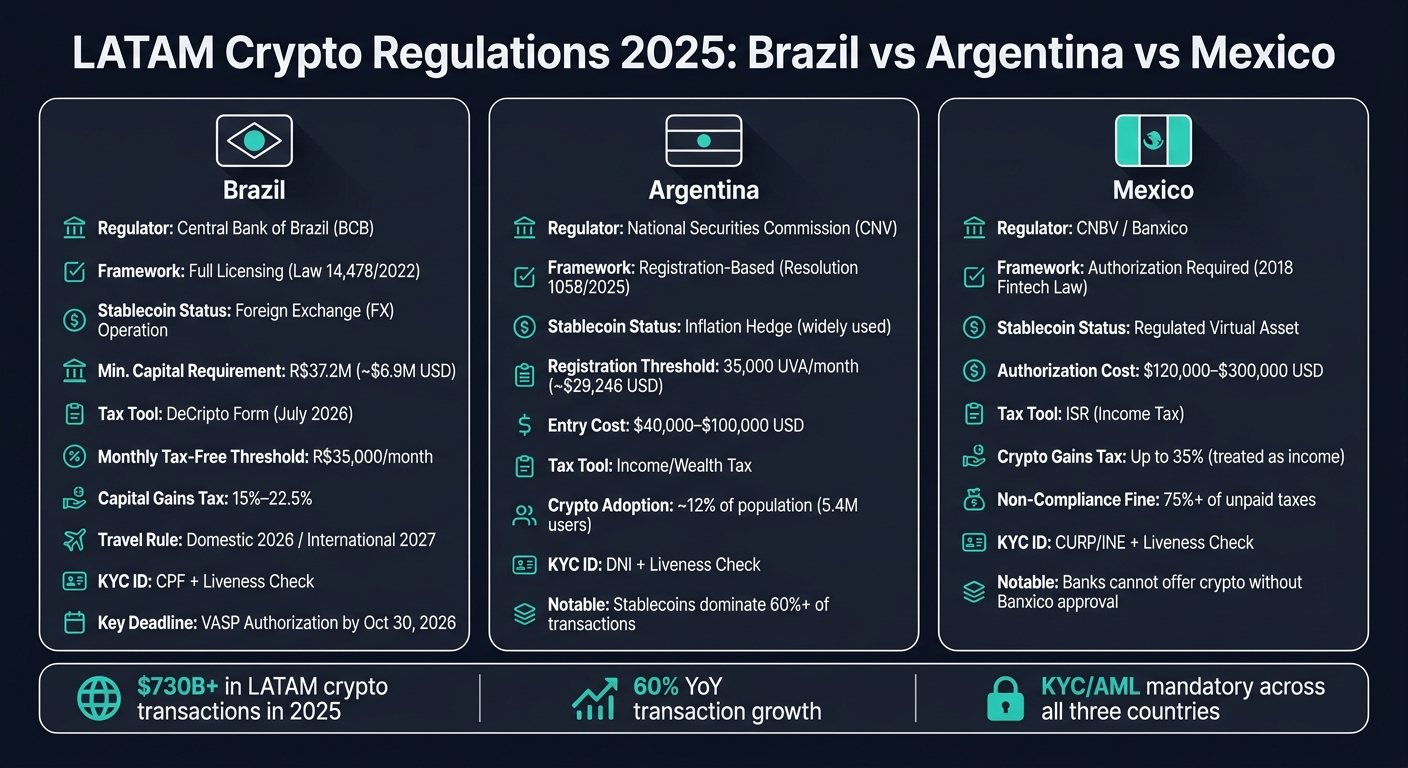
LATAM Crypto Regulations 2025: Brazil vs Argentina vs Mexico
LATAM presents a diverse array of regulatory systems, with each country charting its own course. Among the key players in the region are Brazil, Argentina, and Mexico. Understanding their unique approaches is essential for anyone involved in buying or cashing out cryptocurrency.
How Brazil, Argentina, and Mexico Regulate Crypto
Brazil stands out with its well-developed regulatory framework. Under Law 14,478/2022 and SPSAV (Resolutions 519–521), crypto platforms must secure a license from the Central Bank of Brazil (BCB). One key requirement is asset segregation, which ensures client funds remain legally separate from company assets. Stablecoins like USDT and USDC are treated as Foreign Exchange (FX) operations, meaning they are regulated similarly to international wire transfers. For a full-service broker license, the minimum capital requirement can reach R$37.2 million (about $6.9 million USD).
Mexico takes a stricter stance. The 2018 Fintech Law and Banxico Circular 4/2019 mandate that platforms obtain authorization from the National Banking and Securities Commission (CNBV) to operate legally. Traditional banks cannot offer crypto services to the public without explicit approval from Banxico. The cost of obtaining CNBV authorization ranges from $120,000 to $300,000 USD, limiting the number of licensed operators.
Argentina, on the other hand, offers a more accessible regulatory environment. The CNV's Resolution 1058/2025 establishes a registration-based system that focuses primarily on anti-money laundering (AML) and Know Your Customer (KYC) compliance. Entities with monthly transaction volumes exceeding 35,000 UVA (around $29,246 USD) must register with the National Securities Commission (CNV). Entry costs are relatively low, typically falling between $40,000 and $100,000 USD.
| Country | Regulator | Framework Type | Stablecoin Status | Tax Reporting Tool |
|---|---|---|---|---|
| Brazil | BCB | Full Licensing | Foreign Exchange (FX) | DeCripto Form |
| Mexico | CNBV/Banxico | Authorization | Regulated Virtual Asset | ISR (Income Tax) |
| Argentina | CNV | Registration | Inflation Hedge | Income/Wealth Tax |
These regulatory differences shape the dynamics of each country's crypto market.
How Economic Conditions Drive Crypto Adoption in LATAM
Argentina leads LATAM in crypto adoption, with approximately 12% of the population - over 5.4 million people - actively using digital assets in 2025. This isn't about speculative investments; it's about financial survival.
"Argentines have embraced cryptocurrencies, especially dollar-pegged stablecoins like USDT, as a financial survival tool rather than a speculative investment." - Cripton AI Research Team
With inflation exceeding 100% and strict capital controls limiting access to U.S. dollars, stablecoins have become a lifeline for preserving savings. Venezuela faces an even more dire situation, with the bolívar depreciating by 750% on the informal market in 2025. This has driven many everyday transactions onto USDT-based peer-to-peer networks. In response, regulators across the region are ramping up AML and Know-Your-Wallet (KYW) measures to monitor informal financial flows.
This blend of economic hardship and crypto adoption highlights the importance of understanding cross-border compliance for U.S. users.
What U.S. Users Need to Know About Cross-Border Rules
For U.S. users engaging with LATAM markets, compliance with local regulations is a must. Brazil, for instance, enforces strict rules for transactions involving resident users.
A key development to watch is Brazil's rollout of the Travel Rule. Starting in 2026, domestic transfers will require full originator and beneficiary data, with international transfers following in 2027. This means U.S. users conducting cross-border transactions with Brazilian wallets or exchanges will need to provide detailed identity information for both parties. Additionally, platforms operating in the Brazilian or Mexican markets must ensure they have a local subsidiary. By October 30, 2026, platforms without a local presence in Brazil risk losing access to local payment systems entirely.
Staying informed and proactive about these evolving requirements is essential to successfully navigating LATAM's regulatory landscape.
Buying Crypto in LATAM Under Local Rules
LATAM's regulatory framework now plays a significant role in shaping how crypto is bought in the region. Each country enforces its own set of rules, which are particularly important when transferring funds across borders.
How the Buying Process Works in Brazil, Argentina, and Mexico
In Brazil, purchasing crypto requires the use of licensed SPSAV platforms, a rule that takes full effect in February 2026. PIX is the most common payment method, with fees ranging from 0% to 0.5%. Credit and debit card transactions are also available but come with higher fees, typically between 2% and 7%. The country boasts around 6.5 million active crypto investors.
In Argentina, buyers often turn to registered Virtual Asset Service Providers (VASPs) or peer-to-peer platforms. Stablecoins are especially popular here, as many see them as a way to counter inflation's effects.
In Mexico, regulated fintech rails dominate as the primary payment method. However, only platforms explicitly authorized by Banxico can legally offer crypto services to the public. This restriction significantly limits the options available for everyday users.
These processes illustrate the diverse regulatory landscape in LATAM, which also demands strict identity and payment verifications.
How KYC, AML, and Payment Rules Affect Purchases
Identity verification is mandatory across all platforms. Brazil uses CPF with a matched-owner check, Mexico requires CURP/INE, and Argentina relies on DNI. In many cases, users must also pass a liveness check, such as submitting a selfie or short video, to unlock advanced KYC features and higher deposit limits.
Brazil enforces a particularly strict matched-owner rule. For PIX deposits, the name and CPF on the bank account must match the details in the exchange's KYC profile exactly. Any mismatch results in an automatic reversal. This measure was introduced after PIX-related fraud reached R$6.5 billion in 2025. Furthermore, when transferring funds to self-custody wallets, Brazil's Know-Your-Wallet (KYW) protocol requires users to prove ownership of the external wallet address before processing withdrawals.
"The anonymity of the bridge has ended. If you use PIX to buy crypto... the SPSAV must document that you are the beneficial owner of that self-hosted address." - BingX
These compliance measures have led platforms like Kryptonim to simplify cross-border transactions and buying processes.
Using Kryptonim to Buy Crypto and Transfer Funds to LATAM
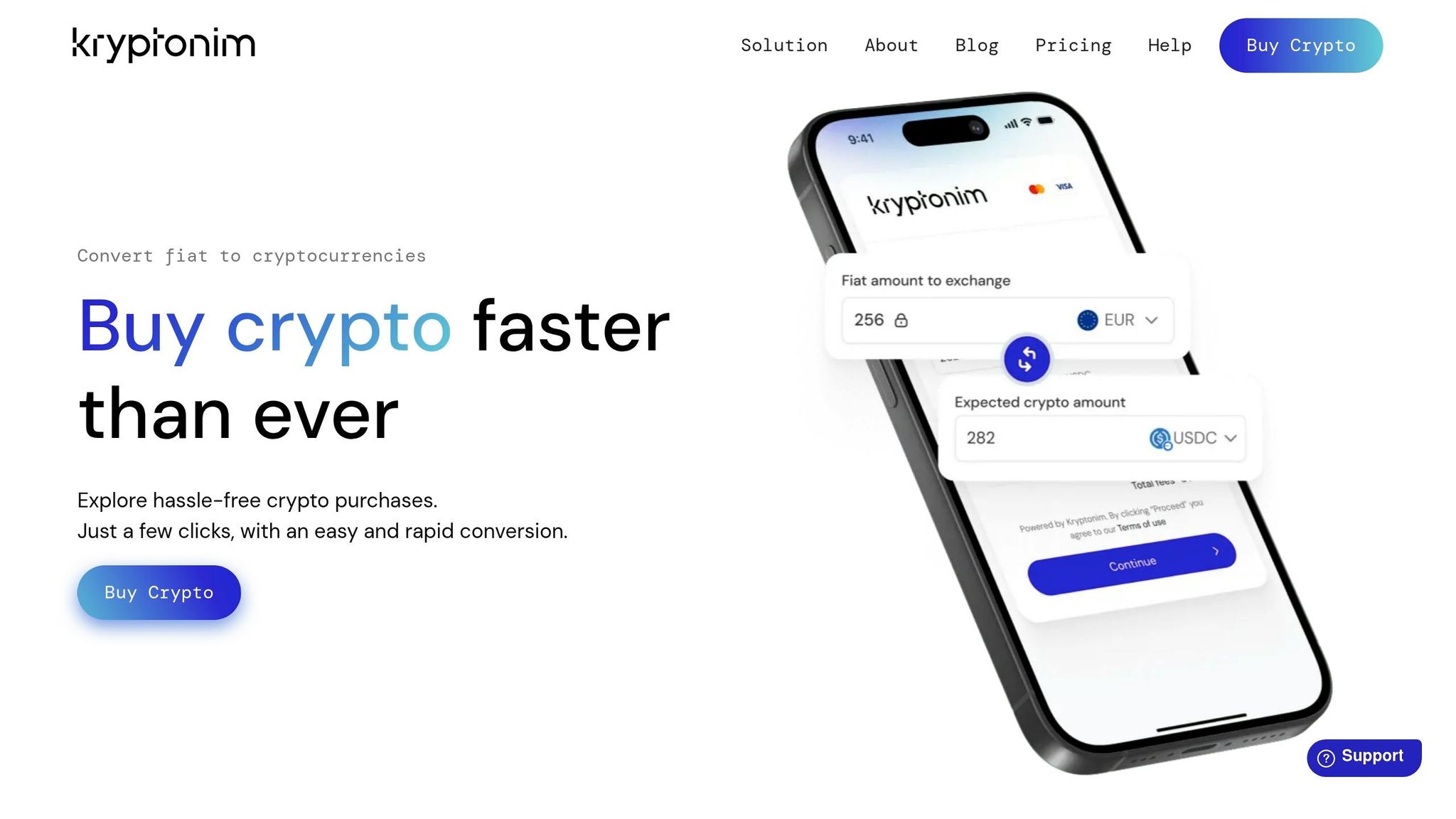
Kryptonim offers a simple solution for purchasing crypto and transferring funds to LATAM. As an EU-regulated platform, it provides transparent fiat-to-crypto conversions with a 4% fee for non-EU users, free from hidden charges. The platform's beginner-friendly setup doesn't even require account creation.
After buying crypto through Kryptonim, you can transfer it to a LATAM-based wallet. This process adheres to the region's detailed rules, such as KYW verification in Brazil or VASP registration in Argentina. Completing identity verification on both ends before initiating a transfer ensures compliance and helps avoid delays, making the transaction smoother and more efficient.
Cashing Out Crypto to Local Currencies in LATAM
Navigating the process of cashing out cryptocurrency in LATAM can be just as intricate as purchasing it. Each country in the region has its own set of strict rules for withdrawals, and failing to comply can lead to hefty penalties.
Cash-Out Steps by Country
The steps to convert crypto into local currency vary widely across countries like Brazil, Argentina, and Mexico. Understanding the specific requirements in each country is essential before initiating any withdrawals.
In Brazil, cashing out requires using an exchange licensed by the Central Bank of Brazil (BCB) under the SPSAV framework. After converting your crypto to BRL, withdrawals are processed through PIX, settling in under 10 seconds with fees usually ranging from 0% to 0.5%. It’s important to ensure that the CPF associated with your exchange account matches the CPF on your bank account. Additionally, Brazil’s Know-Your-Wallet (KYW) protocol, effective since February 2026, mandates proving ownership of a self-custody wallet before withdrawing to it.
"The BCB now treats these [stablecoin] transfers as Foreign Exchange (FX) operations." - BingX Regulatory Guide
In Argentina, stablecoins are a popular choice for withdrawals, with over 60% of transactions handled by CNV-registered Virtual Asset Service Providers (VASPs). Meanwhile, in Mexico, withdrawals involve converting crypto to MXN through entities authorized by Banxico. Transactions exceeding certain thresholds must be reported to the Unidad de Inteligencia Financiera (UIF).
Reporting and Record-Keeping Requirements
Brazil’s DeCripto system, set to launch in July 2026, will automate monthly tax reporting for transactions made through licensed exchanges. However, if you use a foreign platform, you’re responsible for self-reporting when your monthly crypto activity exceeds R$35,000.
Brazil offers a tax exemption for domestic crypto sales under R$35,000 per month. Exceeding this threshold triggers a progressive capital gains tax starting at 15%. For crypto held on foreign exchanges, annual gains above R$6,000 are taxed at a flat 15%, with no monthly exemption. In Mexico, crypto gains are treated as taxable income, with rates reaching up to 35%. Failure to report can result in fines of at least 75% of the unpaid taxes. To avoid issues, keep detailed records of dates, amounts, transaction IDs, and fiat values for all transactions.
How Kryptonim Helps Manage Cross-Border Cash-Outs
Kryptonim simplifies compliance by meticulously recording every transaction, including cost basis and verifiable data. These records can be easily exported for cross-border tax filings. As an EU-regulated platform, Kryptonim provides structured transaction data that aligns with the reporting requirements in Brazil, Argentina, and Mexico. By combining Kryptonim’s records with local reporting tools like Brazil’s DeCripto system, users can maintain compliance at every step of their crypto journey, ensuring a seamless process for managing cross-border cash-outs.
sbb-itb-0796ce6
Compliance, Tax, and Risk Management for Beginners
Key Compliance Areas: KYC, AML, and Tax Rules
Compliance starts with verifying identities. In LATAM, every regulated exchange requires users to provide a government-issued ID along with a liveness check, such as a selfie or short video.
AML (Anti-Money Laundering) rules go a step further, requiring platforms to monitor transactions for any signs of suspicious activity. For instance, in Brazil, the name on your bank account must match your exchange's KYC profile exactly. Even a small mismatch could lead to a PIX transfer being flagged or rejected. Additionally, Brazil's 2026 regulations will require exchanges to segregate customer funds from their operational capital, ensuring added security for users.
Tax rules vary across countries but generally follow a simple principle: profits from certain activities are taxable. For example, in Brazil, capital gains tax starts at 15% and rises to 22.5% for gains exceeding R$30 million. Meanwhile, Mexico considers crypto gains as ordinary income, with tax rates reaching up to 35%. These regulations highlight the importance of maintaining detailed records to simplify tax preparation.
How to Track Transactions for Tax Reporting
Accurate record-keeping is critical to avoid penalties. For every transaction, make sure to log the following details: date, asset type, amount, purchase price, sale price, transaction ID, and the local currency value at the time of the transaction. In Brazil, the Average Cost Basis (Custo Médio Ponderado) method is standard. This allows you to include fees and spreads in your acquisition cost, helping to reduce your taxable gains.
To stay organized, download monthly CSV files of your trade history. Tools like Koinly or CoinTracker can sync directly with exchanges and generate tax reports tailored to specific countries. If you're in Brazil and planning a large withdrawal - say $13,500 (around R$70,000) - splitting it across two calendar months could help. Keeping each withdrawal under the R$35,000 monthly exemption threshold might eliminate capital gains tax on both transactions.
"In 2026, the cost of non-compliance far outweighs the effort of documentation." - BingX Learn
This level of tracking is especially important for managing cross-border transactions effectively.
How Kryptonim Reduces Compliance Friction
Kryptonim simplifies the compliance and tax tracking process. Operating under an EU-regulated framework, the platform records every transaction with detailed cost basis data and provides verifiable records from the start. For users outside the EU, Kryptonim charges a flat 4% fee per transaction, ensuring transparency and keeping cost basis calculations straightforward.
The verification process is beginner-friendly. Kryptonim automatically tracks all transaction data, aligning it with local tax requirements, including Brazil's upcoming DeCripto automated system. This eliminates guesswork, ensures compliance with cross-border regulations, and provides a reliable record that holds up under scrutiny.
Practical Strategies for Navigating LATAM Crypto Rules
How to Plan Purchases Within LATAM Reporting Limits
Understanding reporting thresholds is key to avoiding unexpected tax bills when dealing with crypto in LATAM. Take Brazil, for instance: the R$35,000 per calendar month threshold determines whether your transactions are tax-exempt. This includes the total gross value of all disposals, even crypto-to-crypto trades like swapping BTC for USDT. Staying under this limit means no taxes, but exceeding it triggers a 15% progressive tax on your entire profit for that month.
To minimize taxable gains, include on-ramp fees in your acquisition cost. In Brazil, you can legally factor in processing fees, PIX spreads, and IOF charges as part of your Custo de Aquisição (acquisition cost). This strategy can reduce the amount subject to taxation.
How to Cash Out in LATAM Without Running Into Issues
Timing your cash-outs can make a big difference. For example, if you’ve made R$70,000 in profits in Brazil, withdrawing R$35,000 in March and the other half in April keeps both transactions under the monthly tax-free threshold. Doing this could save you around R$10,500 in taxes compared to withdrawing the full amount in one month.
For larger withdrawals, typically above $5,000–$10,000, prepare source-of-funds documentation ahead of time. Exchanges often require proof of where the funds originated, such as CSV exports or trade histories. Keeping organized records monthly can ease compliance for both domestic and international transactions.
"Your crypto profits aren't real until they're in your bank account. Let's make sure you get them there safely." - Alex Mercer, Crypto Analyst
These steps not only simplify domestic transactions but also help U.S. users manage cross-border activity effectively.
Tips for U.S. Users Managing Cross-Border Crypto Activity
For U.S. users transferring funds in and out of LATAM, maintaining dual-currency records is critical. Document every transaction in both USD and the local currency at the exact time it occurs. This ensures compliance with both U.S. and LATAM regulations. For example, Brazil’s Central Bank (BCB) has mandated that all VASPs secure full authorization by October 30, 2026.
Platforms like Kryptonim, which operates under an EU-regulated framework, charge a flat 4% fee for non-EU users. This setup simplifies cost basis tracking from the start, providing U.S. users with clean, auditable records that meet compliance standards across borders.
Conclusion
Crypto regulations in LATAM have a direct impact on how users buy and cash out digital assets across the region. Key developments include Brazil's October 30, 2026, deadline for VASP authorization, Mexico's stringent Fintech Law, and Argentina's CNV registration requirements. These country-specific rules exist alongside a surge in transaction volumes, reflecting the region's growing crypto activity. Stablecoins like USDT and USDC dominate the market, making stringent compliance and thorough transaction screening essential.
To navigate these regulations effectively, clear compliance strategies are crucial. For U.S. users, practical steps include verifying platform licenses, maintaining consistent identity verification processes across accounts, and keeping detailed transaction records in both USD and local currencies. In Brazil, the upcoming DeCripto framework - set to take effect in July 2026 - will require detailed reporting of activities like staking, airdrops, and large payments.
The varied regulatory landscape in LATAM pushes both local and international users to adapt their approaches when dealing with digital assets. Platforms like Kryptonim, with its EU-regulated framework and a flat 4% fee for non-EU users, offer a reliable way to track costs and maintain auditable records across borders. As regulations in LATAM continue to evolve, partnering with a transparent and compliant platform remains a critical step in safeguarding your transactions.
FAQs
What documents do I need to prove the source of my crypto funds in LATAM?
To demonstrate the origin of your cryptocurrency funds in LATAM, it's crucial to maintain thorough, well-organized records of your asset activity. This means keeping exchange statements, transaction exports (like CSV files), and wallet histories that document how the assets were acquired, held, and eventually converted into fiat currency.
Make sure your records include key details such as transaction dates, amounts, counterparties, and the equivalent value in your local currency at the time. It's also important to connect this activity to your overall financial profile, including your residency status and income sources, to ensure regulatory compliance.
How do Brazil’s KYW and Travel Rule change sending crypto to a self-custody wallet?
Under Brazil's rules, transferring cryptocurrency to a self-custody wallet now requires Know-Your-Wallet (KYW) verification. This process confirms ownership of the private address and helps streamline transactions. Once verified, the wallet is whitelisted with the exchange, cutting down on delays caused by manual reviews. Licensed platforms are obligated to document this ownership to meet regulations that oversee asset transfers between custodial and non-custodial wallets. This ensures greater transparency and compliance with the country's regulatory standards.
How should U.S. users track crypto trades in both USD and local currency for taxes?
If you're a U.S. taxpayer, you'll need to report your gross proceeds and cost basis to the IRS using Form 1099-DA. To make this process smoother, it's essential to maintain detailed records of every transaction.
Here’s what to keep track of:
- Date and time of each transaction
- Transaction ID for reference
- Amounts involved in the trade or conversion
Since all reporting must be in U.S. dollars, you'll also need to document the fair market value of the assets in USD at the exact time of each transaction. Keeping these records accurate and timestamped will make it much easier to calculate your capital gains and losses when tax season rolls around.