
Front-Running in Crypto: Beginner Guide
Learn how public mempools enable front-running and sandwich attacks, plus practical defenses to protect DeFi trades.

If your crypto trade is public before it confirms, someone may jump ahead of it and cost you money.
I’d sum it up like this: front-running happens when bots spot a pending transaction, place their own transaction first, and profit from the change that your trade or contract call is about to cause. For most people, the pain shows up as worse prices, failed swaps that may still burn gas, or missed time-sensitive actions like token buys or liquidations.
Here’s the short version:
- Public mempool = visible transaction
- Visible transaction = chance for bots to react
- Large swap + thin liquidity + high slippage = bigger risk
- Main defenses = lower slippage, smaller orders, private submission, and limit-style execution
A common example is the sandwich attack:
- A bot buys before your swap
- Your swap moves the price more
- The bot sells right after
- You get a worse fill
That’s why transaction order matters so much in DeFi. On public chains, trades do not land all at once. They run one by one, and even a small change in order can change the result.
A few facts worth knowing up front:
- On Ethereum and similar networks, pending transactions are often visible before confirmation
- MEV bots scan mempools nonstop for profit chances
- Even when a trade fails, you may still lose the network fee
- Simple wallet-to-wallet transfers usually face much less risk than DEX swaps
If I were explaining this to a beginner, I’d keep the checklist simple:
- Use tight slippage
- Avoid very large swaps in thin pools
- Check price impact
- Use private transaction tools when available
- Double-check the token, network, and route before you sign
Bottom line: front-running is mostly a DeFi trading problem, not a basic fiat-to-crypto purchase problem. If your transaction can move price or trigger a contract change, it can become a target.
The rest of this guide breaks down how it works, where it shows up, what you can lose, and how to cut your risk.
How a pending transaction moves from your wallet to a block
When you hit "send" in your wallet, your transaction doesn't go into a block right away. It first gets broadcast to the network, then sits in a pending state until a block includes it. That short delay gives other participants time to react before the transaction is confirmed.
The path is simple: broadcast → pending in the mempool → confirmed.
What the mempool is and what others can see there
The mempool is the network's waiting room for unconfirmed transactions. While your transaction is sitting there, anyone watching the network can see it.
That means observers can view the recipient, the asset, and, in the case of swaps, the trade size. Bots watch this public queue for trades that might make money. And that matters because block producers still choose which transactions go in first.
How fees and validators determine transaction order
Higher fees can help a transaction get picked up sooner, especially when the network is crowded. But paying more doesn't hide anything.
Your transaction is still visible to anyone monitoring the mempool. And once people can see it, transaction priority and ordering start to matter a lot.
Slippage and price impact explained simply
Slippage is the gap between the price you expected and the price you actually get when the swap confirms. If the transaction stays pending longer, the market has more time to move.
That's why front-running shows up so often in DeFi.
sbb-itb-0796ce6
Where front-running appears in DeFi
Front-running shows up most often in DEX swaps. Why? Because pending trades can reveal both size and timing before they’re confirmed. That makes DEX trading the clearest place to watch front-running play out.
DEX swaps and sandwich attacks
The most common DEX example is the sandwich attack. An attacker places one trade before yours and another right after it. That sequence pushes your execution price in the wrong direction, with your trade stuck in the middle of the attacker’s buy and sell.
This risk gets worse when your swap is large compared with the pool’s liquidity. And if you set a wide slippage limit, you give bots more space to work against you.
Liquidations, oracle updates, and token launches
Front-running also appears anywhere a protocol reacts to live state changes. In lending protocols, bots race to liquidate risky positions, especially when a visible oracle update is about to change account health. Oracle updates can open another path too: a bot can place its own liquidation transaction so it lands right after the update, before anyone else has time to react.
The same pattern shows up when a contract gives scarce rewards to the first caller. Bots can jump ahead and grab that allocation first. For users, that can mean a missed allocation or a failed transaction.
Governance votes and other contract actions
The same problem can appear when a contract action is visible onchain but not yet confirmed. A pending execution of an already-approved change can show how a protocol is about to behave. Other participants may act on that information first by adjusting positions, moving liquidity, or trading an affected asset before the change takes effect.
These patterns can lead to direct costs for traders and smart contract users.
Risks for users and how to reduce them
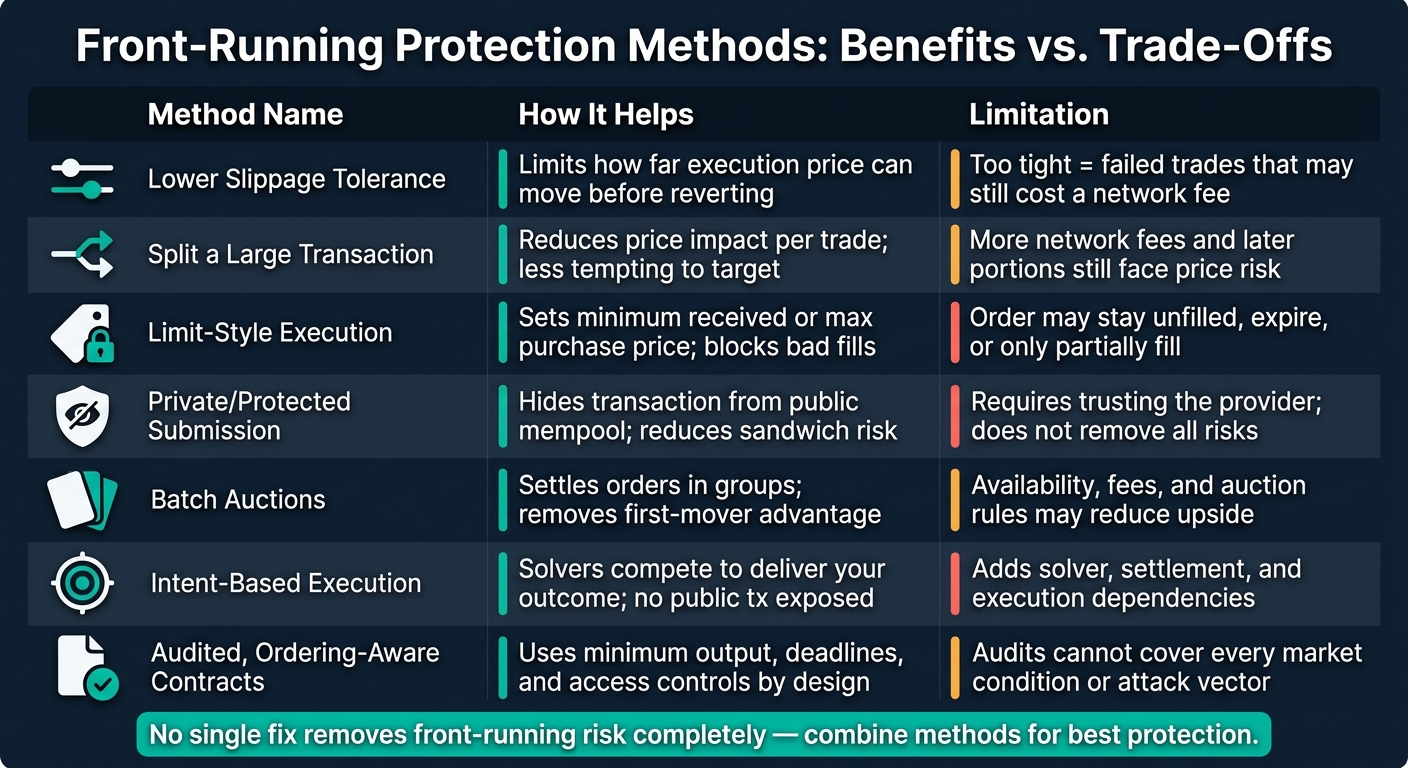
Front-Running Protection Methods: Benefits vs. Trade-Offs
What traders and smart contract users can lose
The most direct loss is a worse execution price. If a bot gets in front of your trade, the pool price can move before your transaction lands. That means you might pay more for the same tokens or get fewer tokens than the original quote suggested.
Another common problem is a failed transaction that still costs money. If an earlier trade moves the market beyond your slippage setting, the smart contract may revert your transaction. On many public networks, validators have still processed the transaction, so you can lose the network fee even though nothing was received. The exact result depends on your network, wallet, RPC provider, and the way you submitted the transaction.
You can also lose a time-sensitive chance. That might mean missing out on a limited-supply token purchase or failing to complete a liquidation before someone else gets there first.
Front-running risk is highest when a transaction is publicly broadcast, time-sensitive, and tied to a price-sensitive action. Think large DEX swaps, token launches with limited supply, liquidations, and contract calls where the result depends on the current state. A simple transfer between your own wallets is usually a much smaller target because it doesn't usually create a clear profit opening.
Protection measures and their trade-offs
No single fix removes front-running risk completely. Still, using a few practical steps together can cut your exposure.
Tighter slippage tolerance is often the easiest place to start. It puts a limit on how far the execution price can move before the transaction reverts. The downside is simple: if you set it too tight, normal volatility or network congestion can make the trade fail anyway, and you may still pay the network fee.
Private or protected transaction submission works differently. Services like Flashbots Protect send your transaction through a private mempool instead of broadcasting it in public. That can reduce the chance that public bots copy, reorder, or sandwich your trade. But there's no free lunch here. You still have to trust the provider and its builders, and private submission doesn't solve thin liquidity, contract risk, or every ordering issue.
| Protection measure | How it helps | Limitation |
|---|---|---|
| Lower slippage tolerance | Limits how far the execution price may move before the transaction reverts. | If set too tightly, normal volatility or congestion can cause failure - and a failed public transaction may still consume a network fee. |
| Split a large transaction | Reduces the price impact of each trade and makes one big swap less tempting to target. | Adds network fees, more execution steps, and leaves later portions exposed to changing prices. |
| Limit-style execution | Sets a minimum amount received or a maximum purchase price, blocking execution beyond that line. | The order may stay unfilled, expire, or fill only in part. |
| Private or protected submission | Hides the transaction from public mempool watchers and can reduce sandwich and front-running exposure. | Requires trust in the provider; does not remove contract risk, liquidity issues, or all ordering risks. |
| Batch auctions | Settles orders in groups, which cuts the edge that comes from being first in a visible transaction sequence. | Availability, fees, liquidity, and auction rules can reduce the upside. |
| Intent-based execution | Lets approved solvers compete to deliver a stated outcome instead of exposing a fully specified public transaction. | Adds solver, settlement, and execution dependencies. |
| Audited, ordering-aware contracts | Uses checks like minimum output, deadlines, and access controls to reduce design-level ordering risk. | Audits cannot cover every market condition, integration, or economic attack. |
A pre-transaction checklist for beginners
Before you hit confirm, take a minute and check the basics:
- Confirm the token, amount, recipient, and network. Check the contract address and make sure your wallet is on the right chain.
- Review the quoted output, price impact, slippage tolerance, route, and liquidity. If price impact looks high or the slippage setting looks unusually wide, treat that as a warning.
- Avoid unusually large swaps during severe congestion or sharp volatility unless you know how the execution method handles those conditions.
- Check the expected network fee and transaction deadline. Pay attention to any wallet warning that says the transaction may fail.
- Submit the transaction only after confirming the settings.
- Wait for final confirmation and verify your actual token balance and transaction receipt. Don't assume the quoted amount arrived just because the wallet showed it before submission.
Key takeaways
Transaction order matters on public blockchains because pending transactions are visible before they're confirmed. If a bot sees your trade in the public mempool, it can send a competing transaction that lands first. That's front-running. A sandwich attack takes it a step further: one transaction goes before yours, and another goes right after to profit from the price move. These tactics fall under MEV (maximal extractable value).
Slippage settings matter too. Wider slippage gives bots more room to work with. Tighter slippage can limit the damage, but it also makes failed trades more likely.
Your risk comes down to three things: visibility, liquidity, and how much the transaction can change market or contract state. Exposure is highest with large DEX swaps in thin pools. It's lowest with simple transfers, where the result doesn't depend much on the transactions around them.
For beginners making simple purchases, fiat-to-crypto transactions on Kryptonim come with far less front-running risk than public DeFi trades. That's why front-running is mostly a DeFi problem, not a basic on-ramp problem.
Front-running risk goes up when a visible, predictable transaction can materially move market or contract state, especially in low-liquidity or crowded DeFi markets.
FAQs
How do I know if my swap is easy to front-run?
Your swap is easier to front-run when it sits in the public mempool. That’s the waiting room where bots scan pending transactions and jump on trades they can profit from.
The risk goes up when you use high slippage, like the common 3% default, or when you trade in low-liquidity pools. In plain English, you’re giving bots more room to squeeze value out of your trade.
You can lower that risk by:
- using tighter slippage, such as 0.5% or 1%
- trading when network congestion is lower
Using Kryptonim avoids the public mempool, which removes this specific risk.
Can front-running happen on all blockchains?
Yes. Front-running can happen on blockchains with a public mempool, where pending transactions are visible before confirmation.
When transaction order depends on public visibility and higher gas fees, bots can spot pending trades and pay more to jump ahead. The exact mechanics, and how often it happens, vary by network.
Do private transactions fully stop sandwich attacks?
No. Private transactions don’t fully stop sandwich attacks, but they can greatly cut the risk.
When trades stay out of the public mempool through private transaction pools or protected RPC endpoints, bots have a much harder time spotting pending transactions and using them against you. That said, switching RPCs in the middle of a transaction can expose the trade and weaken that protection.