
How to Find Volatile Coins for Crypto Scalping
Use a 4-step filter—scan movers, check ATR%/RVOL, verify pair volume and spreads, then confirm on 1‑5m charts.

The best coins to scalp are not just moving a lot - they also need tight spreads, deep books, and enough volume on the exact pair you trade. If I want a short list fast, I check 24-hour movers, confirm ATR % and intraday range, verify at least $10 million to $20 million in pair volume, then cut anything with a spread above 0.30% or a thin order book.
In plain terms, I use a 4-step filter:
- Find coins in play with top gainers, top losers, and trending pairs
- Check movement with ATR % and today’s high-low range
- Check activity with 24-hour pair volume and RVOL
- Cut bad trades by checking spread, depth, and fast-chart strength
A coin can post a big 24-hour move and still be a poor scalp. Why? Because a 0.30%+ spread, weak depth, or low pair volume can eat up the trade before price goes anywhere. On the other hand, pairs with $50 million to $100 million+ in daily volume often trade more cleanly, especially when RVOL is above 1.5 and price is still expanding on the 1-minute and 5-minute charts.
Here’s the short version: I want movement, activity, and clean execution at the same time. If one part is missing, I pass.
| Check | What I look for | Quick read |
|---|---|---|
| Volatility | Top movers, ATR %, range expansion | Enough movement to scalp |
| Volume | $10 million to $20 million minimum on the pair | Better fills, less slippage |
| Relative activity | RVOL 1.5-2.0+ | More trader interest |
| Spread and depth | Below 0.10% is best; avoid 0.30%+ | Lower trading friction |
| Fast-chart check | 1-minute and 5-minute price + volume still active | Setup is still live |
That’s the whole process at a glance. From there, the article walks through how I apply each filter step by step.
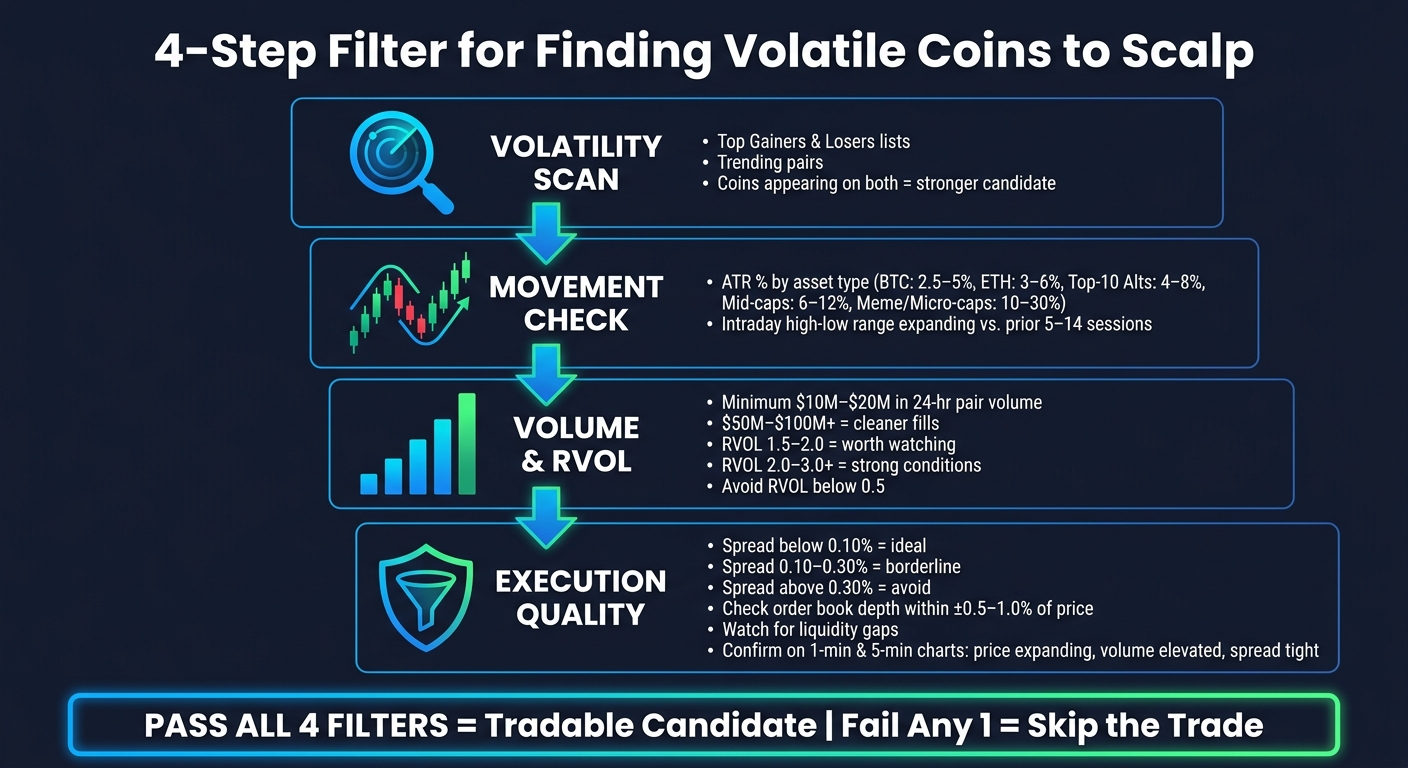
4-Step Filter for Finding Volatile Coins to Scalp
Set your volatility screen
Use a quick screen to cut thousands of coins down to a small group of active names. The first filter spots coins in play. The second makes sure they move enough to scalp.
Check 24-hour movers and trending pairs
Start with the Top Gainers and Top Losers lists on your exchange or market data platform. These lists show which coins have made the biggest percentage moves over the last 24 hours. The move's direction doesn't matter. A hard sell-off can be just as tradable for scalping as a sharp push higher.
Then check trending pairs. These can flag coins drawing unusual trading interest before they make the top movers list. If a coin shows up on both, that's a better candidate.
Once a coin lands on the movers list, check whether its range is big enough to scalp.
Measure range with ATR and intraday range expansion
After you have a short list of active movers, confirm that each coin has enough movement to trade. The two main tools here are Average True Range (ATR) and the coin's intraday high-low range.
ATR shows how much a coin has been moving on average over a set period. To compare coins at different price levels, use ATR as a percentage of price instead of a raw dollar amount:
| Asset Type | Typical Daily ATR % |
|---|---|
| Bitcoin (BTC) | 2.5%–5% |
| Ethereum (ETH) | 3%–6% |
| Top-10 alts (SOL, XRP) | 4%–8% |
| Mid-cap alts | 6%–12% |
| Meme/micro-caps | 10%–30% |
Use them only to compare coins at a glance.
The intraday high-low range gives you a live check. Compare today's range with the last 5 to 14 sessions. If a coin has traded in a tight band for several sessions and then starts to expand, volatility may be building. What you want is steady widening, not one random spike.
If the range holds, move on to volume.
sbb-itb-0796ce6
Check volume and relative activity
After volatility, look at volume. A fast move only helps if enough traders are active to fill your entries and exits without nasty slippage.
Once a coin is moving enough to pass your volatility screen, check if that move has actual trading activity behind it.
Verify 24-hour volume before adding a coin
Start with the 24-hour trading volume for the exact pair you want to trade, not the coin’s global volume. A coin might look busy overall, but if your pair is thin, your fills can get ugly fast.
For scalping, use $10M–$20M in 24-hour volume on the exact pair as a baseline. Pairs doing $50M–$100M+ per day often have tighter spreads and deeper order books, which makes fast in-and-out trades easier to manage.
Once volume drops below $5M, spreads can widen in a hurry. Even small market orders may push price against you before the order fills.
Compare current volume with the recent average
After a coin clears the 24-hour volume threshold, ask one more thing: is today’s activity actually unusual, or is this just business as usual? That’s where relative volume (RVOL) helps.
RVOL compares current volume with average volume over a prior period. The formula is: RVOL = Current Volume ÷ Average Volume (over N periods).
| RVOL Reading | Meaning |
|---|---|
| Below 0.5 | Very quiet; usually avoid scalping |
| 0.5–0.8 | Below average; lower conviction |
| Around 1.0 | Normal participation |
| 1.5–2.0 | Above average; worth watching |
| 2.0–3.0+ | Strong interest; better scalping conditions |
Here’s the practical read: a breakout on a 5-minute chart with below-average RVOL is a warning sign. Price may move, but the move can fade fast if there isn’t enough follow-through.
What you want instead is price expansion with RVOL staying high across several bars in a row, not just one random spike.
During U.S. trading hours, 9:00 a.m.–12:00 p.m. ET often gives the best mix of participation and tradable conditions.
If volume looks high on paper but the pair still trades thin, skip it and move on to spread and order-book checks.
Filter out illiquid coins and build a shortlist
After volatility and volume checks, the next job is execution quality. A coin can look active on paper and still be a pain to trade. This step is where you separate interesting coins from tradable ones.
Reject wide spreads and thin order books
The bid-ask spread is the first hard filter. Use this formula: (ask − bid) ÷ mid-price × 100%.
For scalping, a spread below 0.10% is ideal. A spread in the 0.10%–0.30% range is borderline. It can still work, but only when the expected move is big enough to pay for that friction. Once the spread gets above 0.30%, it can take most of your profit before the trade even has a chance to play out.
But a tight spread by itself doesn't tell the whole story. A market can show a decent spread and still have a weak order book. That's why the next check is order-book depth. Look at how much size is sitting within about ±0.5%–1.0% of the current price. You want solid resting liquidity close to the market. If the book is thin, slippage becomes a problem fast.
Also watch for liquidity gaps. These are price levels with no resting orders at all. When that happens, price can jump instead of moving smoothly, and exits get a lot harder to manage.
Keep only pairs with tradable conditions
Once you've checked spread and depth, combine them with the first two filters:
- strong volatility
- solid 24-hour volume
- tight spread
- meaningful book depth
If even one of those falls apart, scalping gets much messier.
Start with USD pairs and liquid majors like BTC/USD and ETH/USD. They usually have tighter spreads and deeper books than obscure altcoin pairs. USD pairs also make position sizing and P&L easier to track.
Keep only the pairs that pass all four filters. Then move those names to fast-chart confirmation on the 1-minute and 5-minute charts.
Confirm setup readiness on fast charts
After screening for volatility, volume, and liquidity, fast charts are the last check. At this stage, open the 1-minute and 5-minute charts to make sure the move is still alive.
Confirm the move on 1-minute and 5-minute charts
Pull up both the 1-minute and 5-minute charts for each coin on your shortlist. You’re not hunting for a perfect setup here. You’re checking whether the move still qualifies right now.
Focus on three things:
- Price is expanding
- Volume remains elevated
- The spread stays tight
If any of those start to fade, remove the coin from your shortlist.
Fast moves can drain depth and lead to slippage. Order book depth can disappear in a hurry, so check that the book is still holding before you enter a trade.
Conclusion: use a four-step filter every time
Use the same four checks as your final pass before entry:
- Scan for volatility
- Confirm volume
- Reject illiquid coins
- Validate readiness on 1-minute and 5-minute charts
The best scalping candidates show real movement, real volume, and solid execution quality at the same time. Run this filter every time, and you’ll spend less time stuck in exhausted or illiquid trades.
FAQs
What timeframe works best for ATR?
The results don’t point to one perfect timeframe for ATR.
Instead, look at volatility alongside a few other signals:
- 24-hour trading volume
- Order book depth
- Percentage-based price alerts
If you want to catch sharp moves or possible pump-and-dump action, use a 12-hour moving window or watch 30-second intervals. Then back those signals up with solid risk management.
How do I spot fake volume spikes?
Compare trading activity across platforms with CoinMarketCap or CoinGecko. If one exchange reports much higher volume but shows a wider bid-ask spread than the others, that can point to wash trading.
Watch the price action too. If the price suddenly jumps and there’s no clear news or project update behind it, be careful. Volume tends to be more reliable when it lines up with steady price movement, not random extreme spikes.
Should beginners start with major pairs first?
Yes. If you're new to crypto, it's usually smarter to start with major pairs.
Coins like Bitcoin and Ethereum tend to have higher liquidity and a longer history than smaller altcoins. In plain English, that means they're often easier to buy and sell without getting stuck with bad pricing.
They can still swing hard, of course. Crypto is crypto. But major coins are usually less exposed to the wild price spikes and price games that often show up in low-market-cap tokens. For a beginner, that makes it easier to watch trading patterns that are more steady and avoid projects that are thinly traded.