
How to Buy Crypto in Argentina in 2026
Step-by-step guide to buying crypto in Argentina: CNV-registered platforms, required documents, taxes, and secure storage.
Buying cryptocurrency in Argentina in 2026 is straightforward but requires understanding the local economic and regulatory landscape. Here's what you need to know:
- Why Crypto is Popular: With inflation between 140–160% annually, many Argentines use crypto, especially stablecoins like USDT and USDC, to protect their savings and handle everyday transactions. By 2026, 35% of the adult population is expected to use crypto.
- Regulations: Crypto is legal but treated as a "digital asset." Platforms must register with the CNV (Argentina's securities regulator), and users must comply with tax rules, including a 15% capital gains tax.
- Eligibility: To buy crypto, you'll need a DNI, CUIL/CUIT, and a bank account or digital wallet in your name. Verified platforms handle ARS-to-crypto conversions.
- Choosing a Platform: Use regulated platforms like Kryptonim for security and transparency. They comply with CNV rules, support local payments, and provide tax documentation.
- Storage: Protect your funds with a hardware wallet for long-term storage or a hot wallet for daily use. Always enable two-factor authentication and avoid phishing scams.
To start, pick a registered platform, verify your identity, and follow local compliance rules. Whether you're saving, trading, or using crypto for payments, staying informed and secure is key.
Crypto Regulations in Argentina
Argentina has developed a clear set of rules for cryptocurrency. If you're involved in crypto, understanding these regulations is key to protecting your investments and navigating the legal framework without running into trouble.
Legal Status and Framework
In Argentina, owning and trading cryptocurrency is legal, but it’s not considered legal tender. Instead, the government categorizes it as a "digital asset" or "property." Interestingly, private agreements - like paying rent or receiving a salary - can legally be settled in crypto if both parties agree.
The regulatory backbone for crypto is Law 27,739, which came into effect on March 15, 2024. This law tasks the Comisión Nacional de Valores (CNV) with overseeing Virtual Asset Service Providers (PSAVs). Under CNV Resolution 1058/2025, any platform offering crypto exchange, custody, or lending services must register with the CNV's PSAV Registry. Operating without registration is illegal and could lead to hefty fines.
"The CNV is the body in charge of regulating Virtual Asset Service Providers (PSAVs)... its competence falls exclusively on these subjects, not extending to the regulation of the assets themselves unless they qualify as negotiable securities." - Comisión Nacional de Valores
Before using a platform, check for the phrase "Inscripto bajo el N°…. en el Registro de PSAV de la CNV", which confirms it’s legally registered. Beyond that, understanding tax and compliance rules is critical for anyone dealing with crypto in Argentina.
Tax and Compliance Requirements
| Regulatory Body | Role in 2026 |
|---|---|
| CNV | Oversees and licenses exchanges and wallets (PSAVs) |
| ARCA (formerly AFIP) | Collects taxes on income and wealth (Bienes Personales) |
| UIF | Enforces anti-money laundering (AML) and Know Your Customer (KYC) measures |
| BCRA | Sets official exchange rates for asset valuation |
If you sell or trade crypto, you’ll face a flat 15% capital gains tax on net profits. Earnings from staking, mining, or other crypto-related income are taxed at progressive rates ranging from 5% to 35%. Additionally, if your total global assets surpass the inflation-adjusted threshold on December 31, you may owe an annual wealth tax (Bienes Personales).
For tax purposes, all crypto transactions must be converted to Argentine Pesos (ARS) using the exact exchange rate at the time of the trade. Platforms are required to report monthly transaction data to ARCA for users exceeding 50 million ARS in activity. To stay compliant, keep detailed records - such as timestamps, amounts, and counterparties - for at least five years. These steps ensure crypto activities stay aligned with Argentina’s financial regulations.
How Argentina's Financial System Affects Crypto
Argentina’s economic challenges, including inflation and strict exchange controls, have shaped how crypto is used. The Banco Central de la República Argentina (BCRA) continues to ban traditional banks from offering crypto services or processing crypto-related transactions, a policy in place since May 2023. This means registered PSAVs, not banks, have become the go-to platforms for converting pesos to crypto.
Despite these restrictions, PSAVs have integrated seamlessly with local payment systems, making peso-to-crypto conversions straightforward. A game-changer in 2026 was Resolution General 1108/2026, which allows traditional brokers (ALyCs) to handle virtual assets. This move further incorporates crypto into Argentina’s formal financial system.
Carlos Peralta, Head of Public Policy at Bitso Argentina, highlighted the significance of this change:
"This strengthens the local crypto ecosystem, promoting healthy competition between PSAVs... guaranteeing greater security for users and promoting financial inclusion."
sbb-itb-0796ce6
What You Need Before Buying Crypto
Make sure you have the right documents and bank details ready to avoid unnecessary delays.
Eligibility and Required Documents
If you're using regulated platforms, you'll need to complete full identity verification. Here's what you'll typically need:
| Document / Info | Purpose |
|---|---|
| DNI (card format) | To verify your identity |
| CUIT or CUIL | For tax identification and reporting |
| Biometric selfie | To prevent fraud and confirm you're present |
| CBU / CVU (in your name) | To prove ownership of funds for ARS transfers |
| Proof of address | To confirm residency for tax compliance |
For casual purchases, your CUIL might suffice. But if you plan on trading regularly or receiving crypto as payment, a CUIT is better since it serves as a stronger fiscal identifier. Most platforms will also ask for a photo of both sides of your DNI and a live selfie for biometric checks.
Keep in mind, your bank account or virtual wallet must be in your name. Payments from third-party accounts are usually flagged or outright blocked by regulated platforms. Before submitting any documents, check that the platform is listed in the CNV's official PSAV Registry at www.cnv.gob.ar.
Once your documents are in order, it's important to understand how local currency controls might impact your purchase.
Understanding ARS, USD, and Exchange Controls
Although crypto is often priced in USD or stablecoins like USDT, you'll likely pay in Argentine Pesos (ARS). This is due to strict exchange controls, known as the cepo cambiario, which limit access to official USD. As a result, stablecoins have become a practical alternative. Note that bank transfers aren't supported; only registered PSAVs can handle ARS-to-crypto conversions. This makes having a verified CBU or CVU essential.
With inflation in Argentina estimated between 140% and 160% annually, many people turn to USDT as a way to protect their savings from devaluation.
"At 2026, protecting pesos from inflation with crypto is no longer an 'advanced' option - it is the smartest and most accessible way Argentinians have to preserve purchasing power." - Xgram.io Editorial Team
Setting a Budget for Your Crypto Purchase
Once you're ready, it's time to plan your purchase. Start by considering both upfront costs and any ongoing fees. Most regulated platforms allow you to begin with as little as 1,500–2,000 ARS, though some apps let you start with just 100 ARS. Starting small is a good way to familiarize yourself with the platform before committing more money.
Don't forget about transaction fees. Regulated exchanges generally charge around 1%–2%, while peer-to-peer (P2P) markets often include fees in the spread, which can range from 4% to 7%. These costs can add up, especially if you're frequently converting.
Financial experts suggest limiting your crypto investments to 5%–10% of your total net worth because of the market's volatility. For instance, Bitcoin's value can swing by more than 5% in a single day.
"Never use money destined for your basic expenses and perform your own research (DYOR)." - Enrique Cárdenas, Sales Manager and Consultant
If you're new to crypto, starting with stablecoins like USDT is a smart move. It gives you a way to explore the ecosystem without dealing with the dramatic price fluctuations of Bitcoin or Ethereum while you learn the ropes.
How to Choose a Secure Platform for Buying Crypto
Once you've sorted out your documents and budget, the next big decision is picking a safe and reliable crypto platform. In Argentina, where financial controls are strict and inflation is a constant concern, choosing a platform that prioritizes security and transparency is absolutely essential to safeguard your funds.
What to Look for in a Platform
Not all crypto platforms are created equal. To separate the trustworthy ones from the risky options, focus on these key factors:
Regulatory compliance should be your first checkpoint. In Argentina, platforms must register as a PSAV with the CNV. But it's not enough for a platform to simply claim compliance - make sure their registration is active and verifiable. Registered PSAVs are required to meet specific standards, including maintaining a minimum net worth of $150,000 USD and undergoing mandatory annual system audits.
Fee transparency is another critical factor. Be cautious of platforms advertising "0% commission" because they often hide costs in spreads. On Argentine platforms, spreads can range from 0.45% to over 1.6%. To avoid surprises, compare the platform's quoted price with a trusted benchmark like CoinMarketCap.
Security features are non-negotiable. Look for platforms that provide robust protections such as two-factor authentication (2FA), cold storage, and clear custody policies. Regulated platforms are also legally required to segregate client assets from company funds, adding an extra layer of security.
Lastly, ensure the platform supports local ARS transfers. Platforms that accept CBU/CVU transfers and integrate with Argentine digital wallets make it easier to keep your funds within a compliant and traceable system.
Why Kryptonim Is a Good Choice
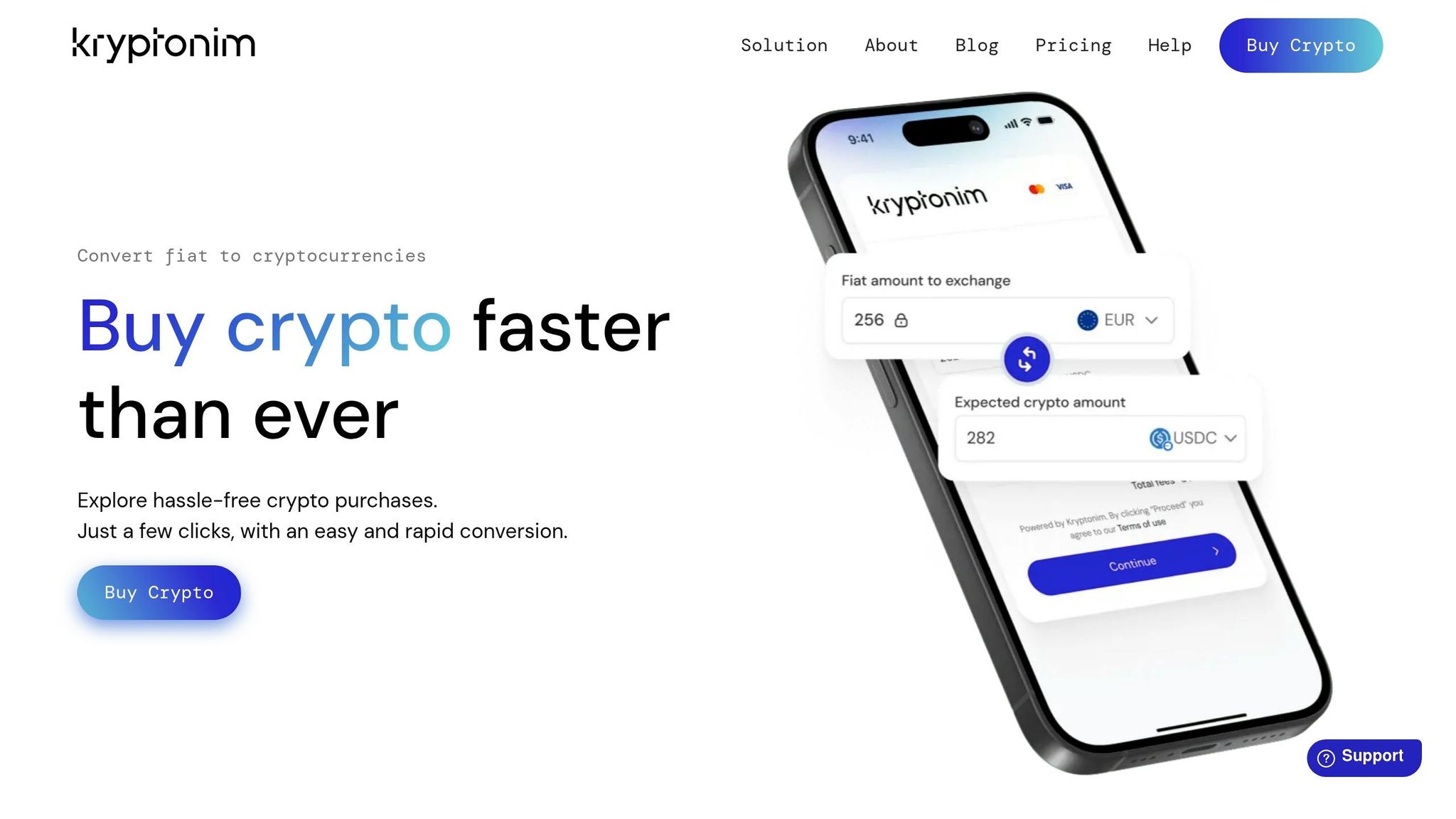
Kryptonim stands out as an EU-regulated platform, which means it operates under one of the strictest financial oversight frameworks globally. For users in Argentina, this translates into meaningful legal protection backed by recognized oversight.
One of Kryptonim's standout features is that you don't need to create an account. You can purchase crypto directly into your wallet without setting up a profile, significantly reducing custodial risk. This is especially beneficial for users who plan to transfer their funds to a hardware wallet like Ledger or Trezor for added security.
Kryptonim charges a flat 4% per transaction for users outside the EU, with no hidden fees or unclear spreads. What you see is what you pay. On top of that, the platform supports local payment methods, making it easy to transact in ARS or USD without resorting to informal channels.
When you compare Kryptonim to unregulated platforms, its advantages become even more apparent.
Kryptonim vs. Unregulated Platforms
Unregulated platforms might seem tempting at first glance, often boasting lower fees or fewer verification requirements. However, these come with significant risks, particularly in Argentina's increasingly regulated crypto environment.
"A registered PSAV is not a black box: it is a regulated entity with obligations defined by law." - Fluyez
The CNV now has the power to request judicial orders to block unregulated platforms operating within Argentina. Moreover, unregulated platforms cannot provide the tax documentation required by ARCA to justify the origin of your funds during an audit. This could lead to serious complications if your bank flags a transaction or ARCA cross-references your holdings.
| Feature | Kryptonim (Regulated) | Unregulated Platforms |
|---|---|---|
| Regulatory Oversight | EU regulation | None or offshore (Seychelles/BVI) |
| Legal Protection | Recognized regulated entity | No local legal recourse; risk of platform blocking |
| Tax Documentation | Supports valid documentation for ARCA audits | Cannot provide compliant tax records |
| Fund Segregation | Client assets segregated | No mandatory segregation |
| KYC/AML | Strict identity verification | Minimal or no verification |
| Fee Transparency | Flat 4% fee, no hidden costs | Opaque spreads and undisclosed charges |
| No Account Required | Yes - buy directly to your wallet | Varies; often requires full account setup |
Step-by-Step Guide to Buying Crypto in Argentina

How to Buy Crypto in Argentina in 2026: Step-by-Step Guide
Now that you've picked a platform, let’s dive into the process of buying cryptocurrency. This guide covers everything from setting up your wallet to completing your first purchase.
Setting Up or Choosing a Crypto Wallet
The first step is setting up a crypto wallet. You have two main types to choose from: custodial wallets and non-custodial wallets.
- Custodial wallets are managed by the platform you’re using. They’re beginner-friendly and convenient for frequent traders, but the downside is that the platform holds your private keys.
- Non-custodial wallets give you full control of your funds. These can be software wallets like MetaMask or Trust Wallet, or hardware wallets like Ledger or Trezor. Remember the golden rule:
"Not your keys, not your coins."
For the highest level of security, consider a hardware wallet. Devices like the Ledger Nano X or Trezor Model T cost between $100 and $300 USD and keep your private keys offline. If you’re making smaller transactions, a free software wallet should suffice. Just make sure to write down your seed phrase (12–24 words) on paper and store it in a safe place - never save it digitally or take a photo of it.
Once your wallet is set up, you’re ready to start your purchase on Kryptonim.
Starting Your Purchase on Kryptonim
With your wallet ready, head over to Kryptonim to buy crypto directly to your wallet address. Select the cryptocurrency you want - options include Bitcoin (BTC), Ethereum (ETH), or stablecoins like USDT. Enter the amount you want to spend in either USD or ARS. Kryptonim will show you the total cost upfront, including a flat 4% transaction fee for users outside the EU.
Double-check your wallet address when entering it - crypto transactions are irreversible.
Completing Identity Verification and Payment
After entering your purchase details, you’ll need to complete the verification and payment process. Kryptonim, as an EU-regulated platform, adheres to strict KYC (Know Your Customer) rules. You’ll need to provide:
- A government-issued ID (such as your DNI).
- A selfie for biometric verification.
- Your CUIL or CUIT number for tax tracking.
The process is quick and straightforward.
For payments, you can use bank transfers via CBU or virtual wallets like Mercado Pago or Ualá through CVU. Once your payment is processed, the cryptocurrency will be sent directly to the wallet address you provided, removing the risks associated with custodial storage.
How to Store and Manage Your Crypto Safely
After purchasing crypto, keeping it secure is a top priority. In Argentina, where inflation and shifting regulations are constant challenges, proper storage is even more critical.
Hot Wallets vs. Cold Wallets
Choosing the right storage method is key to safeguarding your assets. In Argentina's unpredictable financial climate, the method you select can significantly affect your crypto's security.
| Feature | Hot Wallet | Cold Wallet |
|---|---|---|
| Security | Medium – connected to the internet | High – fully offline |
| Convenience | High – instant access | Medium – requires physical device |
| Examples | Trust Wallet, MetaMask | Ledger, Trezor, Tangem |
A smart strategy often involves using both wallet types. For everyday transactions, a hot wallet offers convenience, while a cold wallet is better suited for long-term storage of larger amounts. This approach is particularly useful in Argentina, where stablecoins dominate 68% of crypto transactions, acting as a hedge against inflation.
Security Tips for Crypto Users
To keep your crypto safe, follow these essential security measures:
- Enable Two-Factor Authentication (2FA): Use an app-based authenticator like Google Authenticator instead of SMS, which is vulnerable to SIM-swapping attacks.
- Check URLs Carefully: Always verify website addresses before connecting your wallet or entering login details to avoid phishing scams.
- Use Licensed Exchanges: If you trade on an exchange, ensure it’s registered with Argentina's National Securities Commission (CNV) as a licensed Virtual Asset Service Provider.
These steps help ensure that your crypto remains secure and under your control, even in a challenging economic environment.
Recordkeeping and Tax Compliance
Securing your crypto isn’t just about wallets - it’s also about staying compliant with regulations. In Argentina, maintaining detailed transaction records is a legal obligation. Virtual Asset Service Providers are required to keep records for five years, and individuals should do the same to prepare for potential audits by the UIF or ARCA.
Taxable events include selling crypto for pesos or dollars, swapping one coin for another, or earning income through staking. It’s important to document each transaction with the exact timestamp, amount, and the official ARS exchange rate at the time. Crypto sales are taxed at a flat 15% rate for capital gains, while staking or mining income is subject to progressive rates ranging from 5% to 35%. Failing to comply can result in financial penalties under Argentine tax law.
To simplify this process:
- Export CSV files of your trading history.
- Record wallet balances on December 31st for Personal Property Tax (Bienes Personales) filings.
- Use crypto tax software to handle ARS conversions automatically.
Conclusion: Key Takeaways and Next Steps
Buying cryptocurrency in Argentina in 2026 can be a smooth process when you follow the right steps. Begin by ensuring that any platform you choose is registered as a Virtual Asset Service Provider (PSAV) with the CNV. Make sure your identity and tax documentation are in order, and confirm compliance with ARCA regulations before making your first purchase.
Once your documents are verified and you're confident in the platform's security measures, you're ready to buy. For a secure and straightforward experience, consider using platforms like Kryptonim. For day-to-day transactions, a hot wallet works well, but for larger amounts or long-term storage, transferring funds to a hardware wallet is a safer option.
With approximately 8.6 million Argentines actively participating in the crypto market as of 2026, and with regulations steadily advancing under CNV and ARCA, staying informed is crucial for responsible investing. Financial experts generally advise keeping your crypto investments to 5–10% of your overall portfolio due to the market's volatility.
The next step is simple: start your journey by choosing verified platforms, maintaining complete documentation, and keeping accurate records.
FAQs
How do I check if a crypto platform is CNV-registered (PSAV)?
To verify if a cryptocurrency platform is registered as a PSAV, visit the official PSAV Registry on the Comisión Nacional de Valores (CNV) website. Use the platform's name to conduct your search. Legitimate providers are required to display their registration number (e.g., Inscripto bajo el N°…) on their website, app, or social media profiles. If you can't find the platform listed, it is not authorized to operate.
What taxes apply when I buy, trade, or earn crypto in Argentina?
In Argentina, cryptocurrency transactions can lead to tax obligations depending on the type of activity. Income Tax is applied to earnings from crypto-related activities like sales, mining rewards, staking, or salaries, with rates reaching up to 35% on a progressive scale. For capital gains, profits from selling or trading cryptocurrencies are taxed at a flat rate of 15%. Additionally, the Personal Property Tax includes cryptocurrencies as part of total assets assessed at the end of the year.
To comply with tax requirements, it’s crucial to maintain detailed records of all transactions, including accurate ARS (Argentine Peso) conversion rates, for proper filing with ARCA.
What’s the safest way to store stablecoins for daily use vs. savings?
For everyday transactions, mobile hot wallets such as Trust Wallet or MetaMask are incredibly handy. They make online transactions quick and easy. However, because they are connected to the internet, they are more exposed to potential online threats, which makes them less suitable for storing large sums.
If you're looking to store your assets long-term, hardware wallets like Tangem offer the highest level of security. These wallets keep your private keys offline, significantly reducing the risk of hacks. It's a smart move to transfer balances exceeding $1,000 to a secure, non-custodial hardware wallet for added protection.