
Best P2P Crypto Safety Tips for Bank Transfers
Verify sender name, reject third-party payments, and release crypto only after your bank posts available funds.
If I release crypto before my bank shows the money as posted and available, I can lose it. That’s the whole game.
The article comes down to a few checks I’d never skip:
- I confirm the sender name matches the verified P2P profile
- I reject third-party payments
- I trust my bank app, not screenshots or chat claims
- I wait for funds to post, not just show as pending
- I keep memo text neutral
- I keep all proof inside the platform
- I start with small amounts and use a separate bank account if possible
The risk is not small. The FTC said U.S. consumers lost $1.7 billion through bank transfers and $1.2 billion through crypto in 2023. Median losses were $4,581 and $5,000. That tells me one thing: one rushed release can get expensive fast.
Here’s the short version I’d use before every trade:
| Check | What I look for | What I do |
|---|---|---|
| Name match | Bank sender name matches verified profile | If not, I stop |
| Payment source | No third-party or business-account surprise | If mismatched, I cancel |
| Bank status | Funds show posted/completed and in available balance | Only then do I release |
| Proof | My bank record, not a screenshot | I ignore image-only “proof” |
| Memo | Neutral reference only | I avoid crypto terms |
| Records | Full chat and proof inside the platform | I keep everything there |
My rule is simple: if the bank record is not final, the trade is not paid. That one habit covers most of the risk in P2P bank-transfer deals.
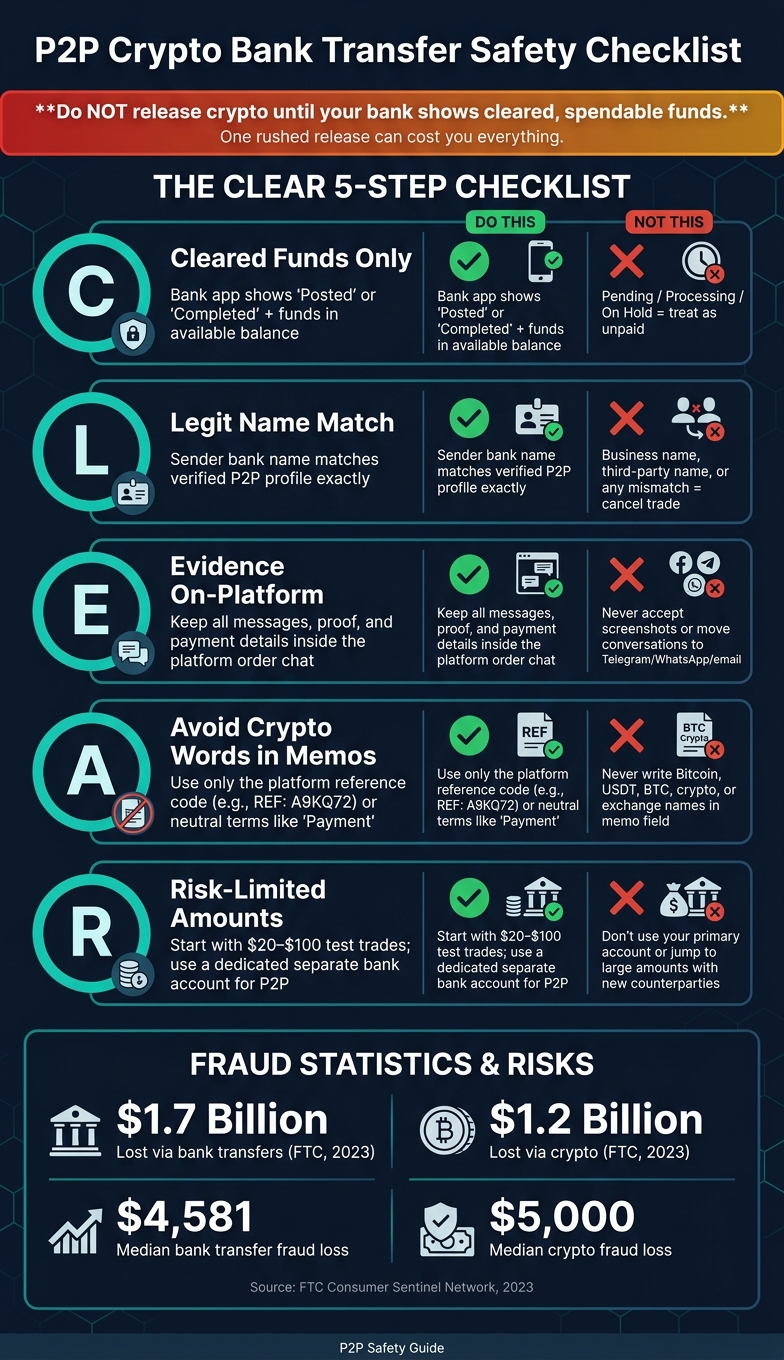
P2P Crypto Bank Transfer Safety Checklist (CLEAR Method)
Why Bank-Transfer P2P Trades Carry Risk
Bank-transfer P2P trades come with risk because the crypto platform doesn't control the money transfer. The bank does. And that changes everything.
Yes, P2P escrow can hold the crypto. But the cash still moves through the banking system, where transfers can be delayed, reversed, or held up by bad details. On top of that, proof of payment is easy to fake. That's why these checks matter so much. They help stop the trade from going off the rails.
Sellers face the biggest immediate danger. Once crypto is released, there's no undo button. A bank transfer, on the other hand, may appear as sent before the bank has fully cleared it. That gap between sent and cleared is where people get burned. So the first thing to check is the bank name.
Buyers can run into the same kind of trouble if they send money from a bank account that doesn't match the verified P2P profile.
Start with the name match.
sbb-itb-0796ce6
1. Match the Bank Account Name to the Verified P2P Profile
The name on the incoming bank transfer should match the buyer's verified P2P profile name exactly. If it doesn't, stop and do not release the crypto.
P2P platforms check identity with government ID, so a different sender name is an immediate red flag. Start here before you look at transfer status or release terms. It’s your first filter, and it can save you a lot of trouble.
Open your bank app, find the sender field, and compare it letter by letter with the verified profile name. Check this in your own banking interface. Don’t rely on a buyer’s message or a screenshot they send over. If the sender name looks unclear, incomplete, or inconsistent, treat the payment as unverified.
Some small differences may need a closer look. A middle initial or a married name might have a simple explanation. But a business name or another person’s name is a clear warning sign. If a dispute starts later, a matching name gives you a stronger record.
2. Reject Third-Party Payments and Mismatched Sender Details
A matching name alone isn't enough. If the payment comes from another account, reject it. If the sender name doesn't match the verified profile exactly, don't move forward. That also applies to payments from a different name or an undisclosed business account.
Here's the tricky part: bank transfers can still land in your account even when the sender name is wrong. So don't assume the payment is safe just because the money showed up. Wait for a matching sender and cleared funds before you release crypto.
This is the triangle scam in plain English: one person agrees to buy the crypto, a second person's account sends the money, and later the payer disputes the transfer. If that happens, you can lose the crypto and still get hit with a reversal.
A few warning signs tend to show up early:
- “My friend will send it.”
- “It’s coming from my business account.”
- Any payment sent from a name that wasn't disclosed upfront
If you spot any of that, cancel the trade and refund the money to the original account if the platform allows it. Third-party payments bring dispute risk, so reject them. And keep the full conversation inside the platform.
Next, check the transfer memo before you act.
3. Confirm Funds Are Cleared in Your Bank Before Releasing Crypto
Check your bank, not the chat.
Open your bank app or sign in on your bank’s website. Then verify that the payment is in your account and the money is available to use. Don’t rely on screenshots, chat messages, or a buyer saying the transfer was sent.
A payment is only safe to act on when your bank shows it as posted or completed. If it says pending, processing, or on hold, the transfer is not done yet. That’s the line you should use before releasing crypto.
| Account Status | What It Means | Release Crypto? |
|---|---|---|
| Pending / Processing | Transfer initiated, not finalized | No |
| On Hold / Under Review | Bank is restricting use of funds | No |
| Posted / Completed + Funds Available | Funds are usable in your account | Yes |
Here’s the part many sellers miss: ACH transfers can still be reversed even after they first show up. So if you release crypto before the funds are fully posted, you’re taking a risk.
And if the buyer starts pushing you? Ignore the pressure. If the payment still shows pending, do not release.
4. Treat Pending, Processing, or On-Hold Transfers as Unpaid
If a sender says the transfer is done, don’t treat it as paid until your bank posts it. If it hasn’t posted, it’s unpaid. Do not release crypto.
“Pending” or “processing” only means the transfer has been started. It does not mean the money is final. A pending transfer can still fail or be reversed, and a bank hold can delay both access to the funds and settlement.
The buyer’s screen and chat messages don’t override what your bank shows. Release crypto only when the funds appear in your bank account as posted and available.
After the transfer posts, check the memo field before you release crypto.
5. Use the Transfer Memo Carefully and Avoid Crypto Keywords
Once the payment shows up, check the memo before you release crypto. This small field matters more than most people think.
Banks may review memo text, so keep it short and neutral. Skip terms like "Bitcoin", "USDT", "crypto", or any exchange name. Those words can slow things down or put the transfer under extra review.
Stick to the exact reference code the platform gives you. That helps match the payment cleanly without drawing extra attention.
| Memo Type | Example | Guidance |
|---|---|---|
| Platform reference code | REF: A9KQ72 |
Use exactly as provided |
| Generic order number | Order 55891 |
Neutral and easy to match |
| Explicit crypto wording | USDT P2P trade |
Avoid |
| Coin or exchange name | Buy BTC from you |
Avoid |
Don't add extra text. Usernames, side comments, or custom notes can make matching harder and increase the chance of bank scrutiny. If the memo is wrong, pause the trade and contact support.
6. Never Accept Screenshots as Proof of Payment
A screenshot is not proof of payment. It can be edited, cropped, or reused from a different transfer. And a pending transfer doesn't turn into a paid one just because someone sent an image.
What counts is simple: your bank must show the payment as posted, completed, or credited. Only your bank's record counts. Screenshots don't, because they're static images that anyone can fake or recycle from an older transaction.
Banks and platform support look at official records, not screenshots.
If a buyer tries to rush you into releasing right after sending a screenshot, treat that pressure as a red flag. Reply in the platform chat and state that you'll release only after the payment posts in your bank. If the buyer keeps pushing, open a dispute with platform support instead of acting on the image. If the payment still shows as pending, treat it as unpaid.
| Screenshot Red Flag | What It May Signal |
|---|---|
| Blurry or cropped account details | Edited or fabricated image |
| Timestamp doesn't match trade timing | Reused screenshot from another trade |
| "Release now, I already sent it" pressure | Urgency tactic to bypass verification |
| Only proof offered | Payment is still unverified |
7. Keep All Communication and Evidence Inside the P2P Platform
Screenshots and bank alerts won't save you in a dispute. The order chat will.
Put every payment detail inside the platform's order chat. That's the record tied to the trade, and it's the place support checks if something goes sideways. If your bank status looks unclear, keep posting updates there until the transfer clears.
Off-platform messages create problems fast. Chats on Telegram, text, or email are easier to fake, easier to edit, and much harder to use as proof. If someone asks you to move the conversation off the platform, treat it as a red flag. That matters even more when the bank still shows the transfer as pending.
When you confirm a bank transfer in the order chat, keep it simple and clear. Include:
- the amount
- the date
- the time
- the reference number
If your bank contacts you, add the main details to the order chat too. Think of it like building a paper trail, except it's digital and tied to the exact order.
| Aspect | On-Platform Order Chat | WhatsApp / Telegram / Email |
|---|---|---|
| Evidence quality | Timestamped logs and files uploaded in the trade tied to the order | Messages can be deleted, edited, or spoofed |
| Dispute support | Support reviews only the trade record | Often carries little weight in a dispute |
8. Start Small and Use a Dedicated Bank Account for P2P Trading
Once you know how to verify payments the right way, the smart move is to start small.
A $20 to $100 test trade gives you a low-stress way to see what happens on your bank’s side. You can watch how pending transfers look, when they switch to posted, how long an ACH transfer takes to show up, and how the platform’s escrow and release process works. It’s a simple way to learn the flow without putting too much money on the line.
After a few trades go through without problems, you can move up little by little. For example, go from $50 to $100, then from $100 to $250. At each step, stop and check how your bank reacts. If you start seeing alerts or unusual account notices, slow down and speak with your bank before you do more.
Using a separate checking account just for P2P trading is also a smart way to keep risk contained. If a payment gets disputed, reversed, or flagged, only the money in that account is at risk. Your paycheck, rent money, and daily spending stay separate in your main account.
Open a second checking account at a bank or credit union, keep a small balance in it - around $200 to $500 - and connect it to your P2P platform through the platform’s KYC and bank verification process. Make sure the account uses the same legal name as your verified P2P profile. Then use that account only for P2P activity. That keeps your records cleaner and much easier to review later.
| Approach | Main Benefit | Main Risk |
|---|---|---|
| Primary account | No extra setup required | A freeze or dispute can block everyday funds |
| Dedicated P2P account | Isolates trading risk from personal finances | Requires opening and managing a second account |
| Small test trades | Limits losses and reveals workflow issues early | Slower path to larger trading volumes |
Once your setup is stable, the next step is learning how to read pending, posted, and reversed transfers.
Cleared, Pending, and Reversed: What Each Status Means Before You Act
Bank labels tell you whether a payment is ready to use, still in limbo, or has been taken back. So before you release crypto, check the status in your banking app.
At this stage, the bank status matters more than anything the buyer says in chat. Release crypto only when the money is posted and available in your bank account. That means your available balance in the app, not a pending line item and not a current balance that still hasn't settled.
| Status | How it appears in your banking app | Release crypto? | Safest next step |
|---|---|---|---|
| Cleared / Posted / Completed | Labeled "Posted" or "Completed"; amount is in your available balance | Yes, after you verify it yourself | Confirm the sender name, then release |
| Pending / Processing / On Hold | Labeled "Pending", "Processing", "On Hold", or "memo post"; may not appear in available balance | No | Wait for it to post |
| Reversed / Returned / Failed | Shows as a reversal, return, failed transfer, or negative offset reversing a prior deposit | No | Treat it as unpaid; gather all evidence and open a dispute with the P2P platform |
If the payment shows as pending, wait. Don't move early. A pending payment is not the same as a posted one.
If it shows as reversed, treat it as unpaid in full. That's a different situation from pending, but the action is the same: hold the crypto.
Here's where people get tripped up. ACH transfers move in batches tied to business days. So a transfer started on a Friday afternoon may not post until Monday. That's normal. For larger trades, it's smart to wait one full business day after a provisional credit before releasing crypto.
Also, keep an eye out for reversals that appear as a separate negative entry on another date. That's easy to miss if you're only glancing at the deposit list. If a pending transfer drags on longer than you expect, call your bank. And if your bank offers alerts, turn them on so you can spot reversals fast.
After the status shows as posted, the next thing to check is the transfer memo.
Safe and Risky Wording for Bank Transfer Memos
If the transfer has already posted, check the memo next. Banks may flag memo text linked to crypto, trading, or speculation.
Use the memo only to match the order reference. The safest option is the exact platform reference code or a neutral term like "Payment", "Invoice," or "Transfer." Stay away from anything tied to crypto or investing talk.
| Memo wording | Risk level | Notes |
|---|---|---|
Platform reference code (e.g., REF: A9KQ72) |
✅ Safe | Use exactly as provided |
| "Payment" / "Invoice" / "Transfer" | ✅ Safe | Neutral, bank-approved terms |
| Any crypto, trading, or investment wording | ❌ Risky | High-risk wording; can trigger bank review or hold |
| Misleading purpose words (e.g., "goods", "loan", "refund") | ❌ Risky | Can create dispute or fraud concerns |
If the platform doesn't require a memo, leave it blank. The buyer and seller should use the same reference format.
If the transfer still shows pending, wait before changing or checking the memo.
What to Do When Funds Still Show as Pending
If the payment still shows as pending after you check the memo, pause and wait. Pending means the money has not been released yet. If the transfer hasn’t moved into your available balance, treat it as unpaid and keep the crypto in escrow.
Say this clearly in the platform chat: you’ll release the crypto only after the funds post. Also save the timestamps and status labels in the chat. That gives you a clean record if the trade turns into a dispute.
If the buyer starts pushing you or insists the transfer was sent, don’t budge. Keep the crypto in escrow until your bank shows posted funds. If the status still doesn’t change, escalate the case through the platform and let support review the pending status and the chat history.
A Simpler Option for Beginners Who Want Less Complexity
P2P bank-transfer trading usually has more moving parts than most beginners expect. If all those checks feel like a lot, a simpler regulated buying flow may be a better fit.
Kryptonim is an EU-regulated, non-custodial platform built to make fiat-to-crypto purchases easier, with clear pricing and no full account signup. Because it’s non-custodial, Kryptonim sends crypto straight to your wallet. That keeps the buying process simple while letting you stay in control of the wallet that receives the funds.
Conclusion
Follow one rule: release crypto only when your bank shows cleared, spendable funds. That’s the check that counts every single time.
Before each release, run through the CLEAR checklist:
- C - Cleared funds only: Open your bank’s official app and confirm the money is fully available. If the transfer shows as pending, processing, or on hold, treat it as unpaid.
- L - Legit name match: The sender’s bank name must match the verified P2P profile exactly.
- E - Evidence on-platform: Keep all messages and proof inside the trade chat.
- A - Avoid crypto words in memos: Use the platform reference only.
- R - Risk-limited amounts: Start small with new counterparties.
If the bank record isn’t final, the trade isn’t ready. Your bank’s cleared balance is the only signal that matters. Chat messages, payment alerts, and promises are just noise.
FAQs
How long should I wait before releasing crypto?
Wait until you’ve independently confirmed the funds have fully cleared in your bank account before releasing any crypto.
Bank transfers, especially ACH, can take 1–5 business days to settle and may still be pending or reversible. So don’t go by an email, a text, or a screenshot from the buyer. Log in to your official bank account yourself and keep the crypto in escrow until the transfer shows as posted and final.
What should I do if the sender name is slightly different?
A slightly different sender name can trigger a review and delay your transaction by 1–3 days. Your bank account name must exactly match the name on your KYC record, so don’t use nicknames, shortened names, or abbreviations.
If there’s a mismatch, update your details so they match your submitted ID exactly. If the problem continues, contact the platform’s support team for help.
What happens if a bank transfer is reversed later?
Bank transfers for crypto trades are usually irreversible. That’s a big difference from card payments, which can sometimes be disputed through chargebacks. Once a bank transfer goes through, you generally can’t pull it back.
The flip side is simple: mistakes can be costly. If you send money to the wrong account, there’s usually no easy undo button. If a trade can’t be completed because of a platform issue, your fiat may be sent back to your original payment method within 2–5 business days.