
Cross-Border AML Checklist for Crypto Buyers
Have ID, 90-day address proof, 3–6 months of bank records, and a sanctions/wallet check to avoid delays on cross-border crypto buys.
If you want to buy crypto across borders without delays, I’d get 4 things ready first: a valid photo ID, proof of address from the last 90 days, records that show where the money came from, and a basic sanctions and wallet check. Once a transfer hits $3,000.00 or more, extra sender and recipient details may need to be collected and shared under Travel Rule requirements.
Here’s the short version:
- Identity: I need a valid passport, driver’s license, or state ID
- Address: I need a utility bill, bank statement, or government letter dated within 90 days
- Source of funds: I should have 3–6 months of bank records, plus pay stubs, tax forms, or other records tied to the money source
- Crypto trail: If I’m using old holdings, I should keep exchange exports, wallet history, and TXIDs
- Cross-border checks: I should confirm the destination country, recipient, wallet address, asset, and network before sending
- Higher-risk transfers: Larger amounts or higher-risk countries can lead to added review and more document requests
One small mismatch can slow the whole process. If my name, address, date of birth, payment account, and transfer details all match, I’m far less likely to get stuck in review.
This article breaks down what I’d prepare before I buy, so I can upload once and move forward with fewer problems.
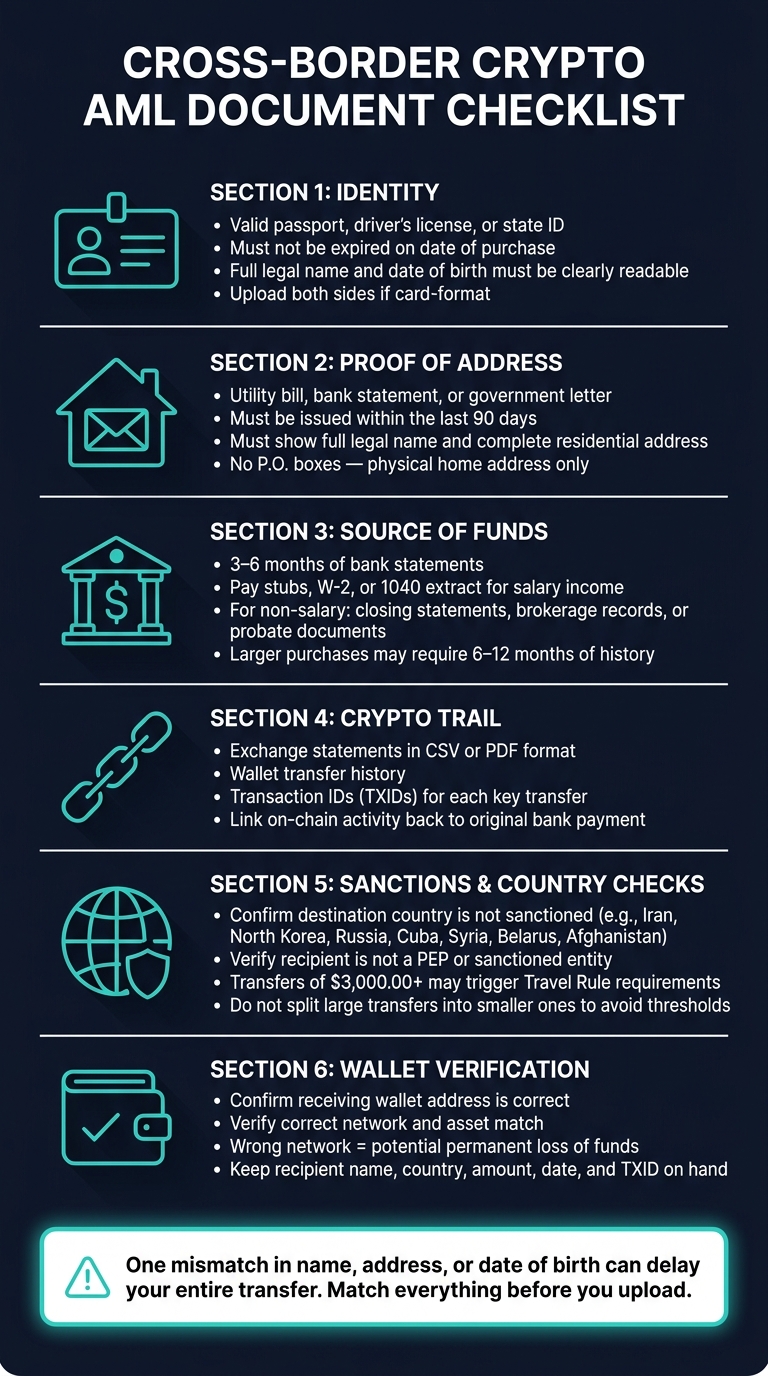
Cross-Border Crypto AML Document Checklist
Prepare Your Identity and Address Documents First
Start with the basics: ID, address, and selfie checks. For most first-time buyers, those are the first three things a platform looks at.
Government ID Checklist for First-Time Buyers
The most common government IDs accepted in the U.S. are a U.S. passport, state-issued driver's license, or state ID card. Whatever you use, make sure it’s still valid on the date of purchase.
Your full legal name and date of birth need to be easy to read and must match the details in your account profile and the name on your payment account. If the platform is doing a cross-border review, those same identity details usually need to line up across your ID, proof of address, and payment account. Some U.S.-based buyers may also be asked for their Social Security Number (SSN) or Individual Taxpayer Identification Number (ITIN) to finish identity verification.
When you take photos of your ID, keep it simple:
- Use bright, even lighting
- Show all four corners
- Upload both sides if the ID is a card
Blurry photos, glare, and cropped edges are some of the most common reasons an ID upload gets turned down.
Proof of Address Documents That Usually Work
For U.S. residents, utility bills and bank statements are commonly accepted as proof of address. Government mail can also work, including an IRS notice or a Social Security Administration letter.
The document should clearly show your full legal name, complete residential address, and issue date. Your address should match exactly, down to the apartment number, city, state, and ZIP code. Use a physical home address, not a P.O. box. If you moved recently, update your bank or utility account first and get a new statement before you begin verification.
Selfie and Liveness Checks Before Approval
Expect a selfie or liveness check as part of the process. Before you start, test your camera, find bright light, and take off hats or large glasses.
You may need to turn your head, blink, smile, or follow other on-screen prompts. These steps help the system tell the difference between a live person and a still image or deepfake. Go slowly. A rushed check is more likely to fail.
Once you have those items ready, move on to your payment-source records.
sbb-itb-0796ce6
Document Your Payment Source and Transaction Trail
Platforms need a clear source-of-funds trail: where the money came from and how it got to the purchase. If money moved across borders, expect more scrutiny. That means you need records for each step in the chain.
Start with salary or bank records. Then add source-specific proof if the money came from property, investments, inheritance, or earlier crypto holdings.
Bank and Income Records to Keep Ready
Pull bank statements for the last 3–6 months for the account you're using. Each statement should show your full legal name, account number, and transaction history. Match those statements with payslips or payroll records that line up with the deposits - same dates, same amounts.
Example: "$2,500.00 biweekly deposit from employer on 06/15/2026 - matches payslip and bank statement."
Make sure you show both sides of the movement: the deposit into the account and the transfer out for the purchase. If the platform wants more proof, a recent Form W-2 or 1040 extract can help confirm your annual income.
If the money didn't come from salary, use records tied to that source instead.
Documents for Non-Salary Funds and Larger Purchases
For property sales, inheritance, investments, or business income, match the paperwork to the source:
- Real estate sale: Signed closing statement plus bank record showing proceeds received
- Investment liquidation: Brokerage statement showing sale date, settlement amount, and transfer to your bank
- Inheritance: Probate documents or executor letter alongside the bank deposit entry
Keep everything in date order and group it by source. Short labels help a lot, especially when someone is reviewing a big file fast.
"Step 1: Sale contract", "Step 2: $45,000.00 deposit 05/20/2026", "Step 3: $15,000.00 transferred to purchase crypto 06/01/2026."
That kind of sequence makes the trail easy to follow. For larger purchases, platforms may also ask for 6–12 months of bank history or a written explanation if a large one-time deposit - like a $150,000.00 inheritance wire - doesn't fit your usual account activity.
If the purchase was funded with earlier crypto, you need to show the first purchase and each transfer after that.
Crypto History If Funds Came From Prior Holdings
Provide exchange statements or transaction exports in CSV or PDF format showing when and how you bought the crypto. Add wallet history for transfers between wallets or platforms, plus the transaction ID (TXID) for each main transfer so a reviewer can check it on a public blockchain explorer.
Only include the coins used for this purchase.
Example timeline: "01/15/2026: Bought 0.5 BTC on U.S. exchange for $20,000.00 → 03/01/2026: Transferred to personal wallet → 07/10/2026: Sent 0.3 BTC to fund cross-border purchase."
Then connect that timeline back to the bank statement that paid for the first crypto buy. That link between on-chain activity and your income records is what completes the trail.
Once the money trail is clear, check wallet details and country rules before sending funds.
Check Country Rules, Wallet Details, and Sanctions
Personal documents are only one part of the review. Before you send money or crypto across borders, make sure the transfer is allowed in both the sending country and the receiving country. Then check the destination, the wallet details, and any sanctions risk before you hit send.
U.S. and Destination-Country AML Checks to Confirm
Start with sanctions. Check whether the destination country, or any country the transfer passes through, is blocked. Transactions are prohibited for several regions, including Afghanistan, Belarus, Cuba, Iran, North Korea, Russia, and Syria. If your transfer touches one of these places, it may be refused.
You should also check whether the transfer is likely to trigger Enhanced Due Diligence (EDD). Higher-risk customers, such as people making large transactions or those coming from high-risk countries, are subject to EDD. That review may include in-person interviews and more frequent monitoring.
If the transfer passes sanctions screening, move on to the wallet details.
Wallet Details to Verify
Make sure the receiving wallet address, network, and asset all match exactly before you send. One small mistake can cause a big problem. Sending funds on the wrong network can lead to permanent loss of funds.
Pre-Transfer Checklist for High-Risk Transfers
If the transfer involves a high-risk country or a larger amount, do one last review:
- Confirm the destination country is supported and not on a sanctions list
- Verify the recipient is not a Politically Exposed Person (PEP) or a sanctioned entity
- Keep the recipient name, country, amount, date, and TXID ready
- Do not split one large transfer into several similar smaller transfers
- Be ready to provide additional documentation if EDD is triggered
Final Pre-Purchase Checklist and Recap
Use this last review to catch any mismatches before you upload. Then pull everything into one clean document set.
Your Final AML-Ready Document Pack
Every cross-border crypto purchase calls for the same core documents. Get these ready before you begin:
| Document Type | What to Prepare | Key Requirement |
|---|---|---|
| Primary photo ID | Passport, driver's license, or national ID | Not expired |
| Proof of address | Utility bill, bank statement, or government letter | Issued within the last 90 days |
| Source of funds | Bank statements, pay stubs, or tax records | Must clearly trace the origin of the funds |
| Crypto source (if applicable) | Exchange statements, transaction hashes, wallet history | Shows how and where the crypto was originally acquired |
Before you upload anything, check that your name, address, and date of birth match exactly across every document. Even a small mismatch can slow a review. In many cases, that's one of the main reasons a file gets stuck.
Once your document pack is ready, check your transfer details too. The payment info should line up with the same information shown in your files.
Key Points to Remember Before Sending Funds
For a cross-border transfer to clear without trouble, your identity, address, funds, sanctions, and wallet data all need to line up. Kryptonim makes fiat-to-crypto purchases simpler, but checks for identity, address, and source of funds still apply.
Set up a labeled, ready-to-upload folder before you start. That small step can save time, cut back-and-forth, and help you move through review with fewer hiccups.
FAQs
What if my documents don’t match exactly?
If your documents don’t match the information you provided, verification may be delayed or rejected. Make sure the name and address on your documents match your profile exactly.
If a utility bill shows both a service address and a mailing address, use the service address if it matches your profile. Also make sure your images are clear, readable, and accurate. If verification is denied, review your details and contact support.
How do I prove source of funds for old crypto?
To prove the source of funds for older crypto holdings, provide records that show how you got the assets. This can include:
- Exchange statements
- Cold wallet screenshots
- Original receipts from fiat-to-crypto purchases
For extra checks, you may also need bank statements or tax documents that trace how the funds moved over time. Clear records make it easier to confirm where your assets came from and support compliance.
When does a cross-border transfer get extra review?
A cross-border transfer may get extra review when AML/KYC risk triggers show up. Common examples include:
- Large transactions or requests to increase limits
- Sending money from or to a high-risk country
- Transfers marked as high risk, including sanctions hits or OFAC-listed addresses
When that happens, the platform may require Enhanced Due Diligence, ask for extra documents, request more details about the source of funds, and apply closer monitoring.