
Top Networks for Stablecoin Remittances
Compare Tron, Ethereum, Solana and Polygon for low-cost, fast stablecoin remittances and real-world cash-out coverage.

If I want the short answer: Tron is often the lowest-cost pick for USDT remittances, Ethereum has the deepest liquidity, Solana is very cheap and fast, and Polygon gives me low-cost Ethereum-style transfers. But the best network is the one the recipient can receive, cash out, and use in their country.
Here’s the core takeaway in plain English:
- Tron: low fees, fast transfers, strong USDT-TRC20 usage in parts of Latin America and East Asia
- Ethereum: broad wallet support and deep liquidity, but gas fees can jump
- Solana: sub-cent fees and fast confirmation, but cash-out routes are less common in some corridors
- Polygon: low fees and familiar Ethereum wallets, but support still depends on the platform
The article looks at each network based on the things that matter most for U.S. senders:
- Transfer cost
- Settlement speed
- Wallet support
- Cash-out coverage
One number stands out: Tron handles about 26% of stablecoin activity in this comparison’s source set, mostly due to USDT on TRC20. That helps explain why it shows up so often in remittance flows.
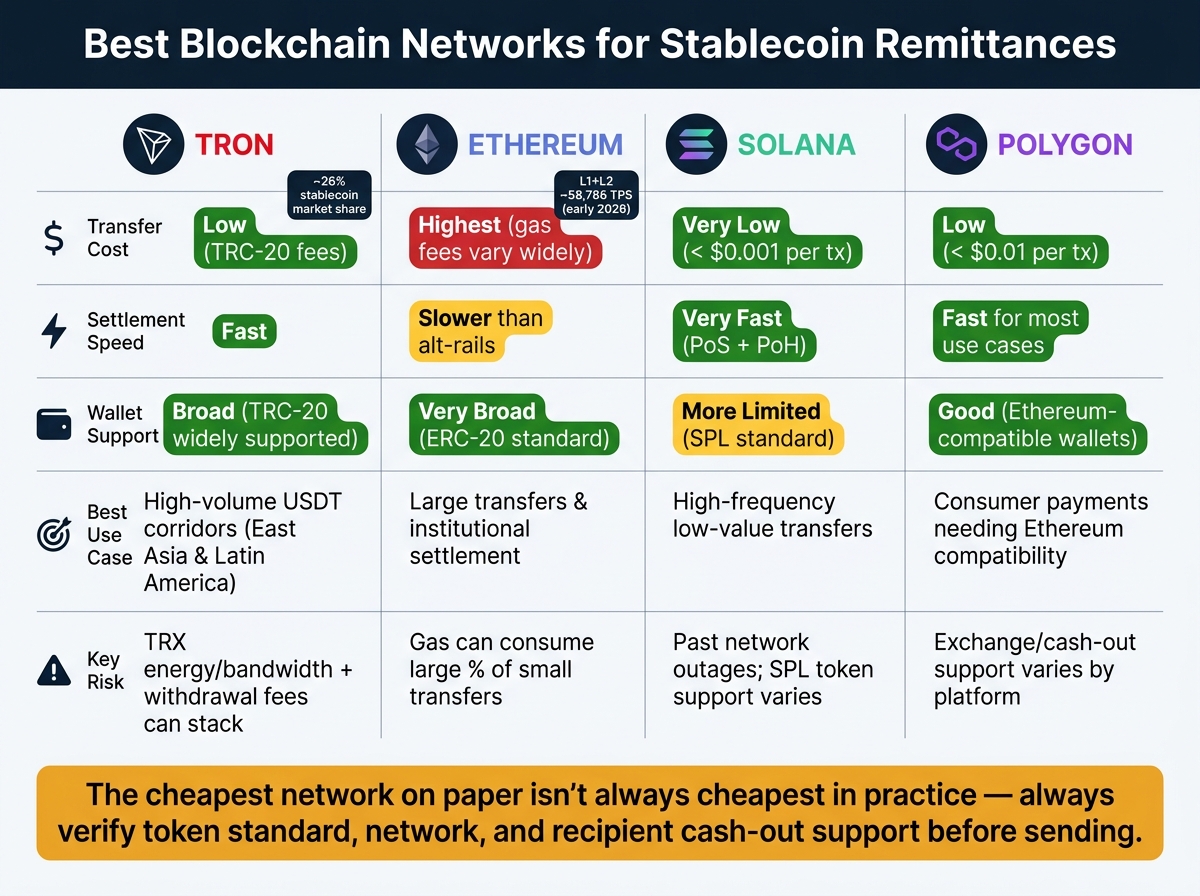
Best Blockchain Networks for Stablecoin Remittances: Cost, Speed & Coverage
Quick Comparison
| Network | Cost | Speed | Wallet Access | Best Fit | Main Risk |
|---|---|---|---|---|---|
| Tron | Low | Fast | Broad | USDT remittances with TRC20 support | Extra costs like withdrawal fees and TRX resource use |
| Ethereum | Often highest | Slower than lower-fee rails | Very broad | Larger transfers and ERC-20 routes | Gas can take a big cut from small payments |
| Solana | Very low | Very fast | More limited than Ethereum/Tron | Low-value, frequent transfers | Recipient may not support the Solana version of the token |
| Polygon | Low | Fast for most use cases | Good on Ethereum-style wallets | Low-cost transfers with Ethereum wallet familiarity | Exchange and cash-out support can vary |
Bottom line: before I send anything, I’d check the exact token, the exact network, the wallet address, minimum deposit rules, and whether the recipient can cash out locally. A cheap transfer on paper can still cost more once I add withdrawal fees, FX spreads, and local payout charges.
That’s the full point of this comparison: cost and speed matter, but payout access decides whether the transfer works in practice.
sbb-itb-0796ce6
1. Tron
Tron handles a big slice of stablecoin payments, with about 26% market share, largely driven by USDT on TRC20. Many platforms pick Tron for a simple reason: it moves money cheaply and fast, and recipients can usually access those funds without much friction.
For remittance platforms, that matters a lot. If you're sending payouts at scale, even small fee differences add up fast. And when recipients need money now, slow settlement can be a dealbreaker.
Transfer Cost
TRC20 fees are usually low because Tron is built for high-volume transfers and doesn't run into the same congestion spikes common on Ethereum mainnet.
That gives platforms more room to keep payout costs down. It also makes small transfers more workable, which is a big deal in remittance flows.
Settlement Speed
Tron settles fast because the network is designed for high throughput.
In practice, that helps remittance payouts clear without long waits. For users, it can feel less like waiting on a bank wire and more like sending a message that lands almost right away.
Wallet Support
TRC20 has broad support across wallets and on-ramps, which makes it easier for remittance platforms to plug into existing user habits.
That matters on both sides of the transaction. Platforms get an easier path to integration, and recipients are more likely to already have a wallet or service that works with TRC20.
Liquidity and Payout Coverage
Tron is especially strong in East Asia and Latin America, where USDT on TRC20 is widely used for day-to-day transfers.
That regional liquidity helps recipients cash out more easily in those markets. In many payout corridors, Tron has become the default low-cost rail for exactly that reason.
2. Ethereum
Ethereum is the best-known smart contract network. But for remittances, it usually loses ground to cheaper rails. The reason is simple: fees can swing a lot, and final settlement is less predictable. You feel that most in transfer cost and settlement time.
Transfer Cost
ERC20 transfer fees on Ethereum L1 can move all over the place. When the network gets congested, costs can jump hard. That makes small remittances tougher to price and harder to scale without eating into the amount the recipient gets.
Settlement Speed
Fees are Ethereum’s biggest weak spot for remittances, but speed still matters. Ethereum L1 finality is slower than what you get on lower-cost remittance rails. That’s a big reason Layer 2 networks now process more of the activity. By early 2026, the combined throughput of Ethereum L1 and its L2s reached roughly 58,786 TPS.
Wallet Support
The ERC20 standard works across major wallets and exchanges. So if a platform already operates inside the Ethereum ecosystem, integration is usually pretty straightforward.
Liquidity and Payout Coverage
Ethereum’s edge isn’t cheap payouts. It’s liquidity depth. That makes it a strong fit for larger transfers, especially when ecosystem compatibility matters. For day-to-day remittances, though, steady fees usually matter more than deep liquidity.
3. Solana
Compared with Ethereum, Solana offers lower fees and faster settlement, but payout coverage is narrower. On cost, it sits close to Tron, which makes it a strong option for remittance flows where every cent matters.
Transfer Cost
Solana transaction fees are usually just fractions of a cent per transfer. So when cost is the main concern, it belongs in the same conversation as Tron for remittances.
Settlement Speed
Speed is where Solana stands out. Its mix of Proof-of-Stake (PoS) and Proof-of-History (PoH) is built to handle high throughput and fast settlement.
Wallet Support
Solana-based stablecoins work across major wallets and exchanges, but support is still narrower than on Ethereum or Tron. In plain English, that means Solana makes more sense in places where cash-out support is already there.
Liquidity and Payout Coverage
Solana's liquidity has grown a lot, which makes it more useful for remittances. But liquidity alone doesn't settle the issue. Corridor support still determines whether a network is practical.
Solana tends to work best where institutional infrastructure is already in place. In more informal, peer-to-peer corridors, Tron still has the stronger foothold. That tradeoff between low cost and payout coverage is the main thing to weigh for the next network.
4. Polygon
Polygon gives you Ethereum compatibility without Ethereum mainnet fees. It’s an Ethereum Layer 2 that keeps the Ethereum experience familiar while cutting remittance costs.
Transfer Cost
Polygon fees sit far below Ethereum mainnet. That makes it a solid fit for remittance flows, especially when low transaction costs are the main concern.
Settlement Speed
Polygon is fast enough for most remittances. Still, Layer 2 finality can feel slower than what users expect when they want near-instant payouts.
Wallet Support
Polygon works with MetaMask and other Ethereum-compatible wallets, so onboarding feels familiar for people already using Ethereum. Kryptonim also supports Polygon purchases, which can make wallet funding easier.
Liquidity and Payout Coverage
Polygon’s main drawback is fragmented Layer 2 liquidity. In plain English, payout coverage depends on whether the recipient’s route is supported. So in actual remittance use, route-specific liquidity is what ends up deciding how useful Polygon is.
Pros and Cons by Network
After the network-by-network breakdown above, this table boils the trade-offs down to the big things that matter most: cost, speed, wallet support, and payout risk. For U.S.-based senders, the best pick usually comes down to one simple thing: does it match the recipient’s wallet and cash-out path?
| Network | Main Advantage | Main Drawback | Best Use | Key Caution |
|---|---|---|---|---|
| Tron | Strong USDT liquidity; low fees; fast confirmation | Real costs can be higher than they first appear - TRX resource requirements and exchange withdrawal fees can stack up | High-volume USDT corridors where both sides clearly support TRC-20 | Confirm the recipient accepts USDT-TRC-20 specifically; leave room for TRX energy and bandwidth costs |
| Ethereum | Deep stablecoin liquidity; broad wallet and custody support | Gas fees swing a lot and can climb to several dollars or more during congestion, which makes small transfers costly | Larger transfers, institutional settlement, and ERC-20-centered integrations | A small remittance can lose a meaningful share to gas alone; always check fees before sending |
| Solana | Sub-cent fees, often below $0.001; very fast confirmation; a good fit for frequent, low-value payments | Non-EVM token standard; past network outages are an operational concern | High-frequency or low-value transfers where both endpoints support Solana's SPL token standard | Verify the recipient supports the exact Solana token and network; a wallet that supports USDT or USDC may not support the Solana version |
| Polygon | Ethereum-compatible wallets and tools at low cost; fees typically below $0.01 | Exchange and wallet support differs by platform | Consumer payments and recurring remittances that need Ethereum compatibility without mainnet fees | Polygon support must be checked separately from Ethereum support; users must choose the correct network |
One thing trips people up all the time: the cheapest network on paper isn't always the cheapest in practice. On-chain fees are only one piece of the bill. Withdrawal fees, FX spreads, and local cash-out charges can end up costing more than the transfer itself.
Before sending, double-check the exact stablecoin, network, token standard, recipient address, minimum deposit, and deposit support. If the network is wrong, funds can become temporarily inaccessible.
Conclusion
There’s no one-size-fits-all network for every remittance.
Tron is often the go-to pick for low-cost USDT transfers. Ethereum brings deep liquidity. Solana is fast and cheap to use. Polygon gives you Ethereum compatibility without the same fee burden.
So the best option comes down to three things: cost, speed, and whether the recipient can actually receive and cash out the funds.
Before you send anything, do a quick check:
- Verify the exact network and token standard - TRC-20, ERC-20, SPL, and Polygon transfers are not interchangeable.
- Confirm the wallet has enough TRX, ETH, SOL, or MATIC/POL for gas.
- Check that the recipient can cash out that token on that network in their region.
Those checks can help you avoid failed, delayed, or expensive transfers.
FAQs
Which network is best for small remittances?
For small remittances, Solana and Polygon are usually the lowest-cost picks. Fees are often under $0.01, and transactions tend to confirm within seconds.
TRON (TRC-20) is also a solid choice if you need better compatibility in emerging markets. The trade-off is cost: fees are often around $1.20 to $4.00 per transaction.
Ethereum is usually a weaker fit for this use case since fees can climb much higher when the network gets congested.
How do I know if the recipient supports the right network?
Confirm that your wallet and the recipient’s wallet are on the exact same blockchain for the stablecoin you’re sending. Before you hit send, ask the recipient which network their wallet supports and make sure your active network matches it.
If there’s any doubt, check the token’s contract address on a block explorer. Then send a small test transaction first before moving a larger amount.
What extra costs should I check before sending?
Look beyond the transfer amount. Check platform fees for converting fiat to stablecoins and back, plus network gas fees, which can change based on blockchain congestion.
Also look at exchange-rate spreads, service markups, and any third-party bridge fees. Together, these can add about 0.05% to 0.3%.