
Stablecoins for Remittances: Beginner's Guide
A practical beginner's guide to using stablecoins for fast, low-cost cross-border remittances, wallets, networks, and risks.

Stablecoins are transforming how people send money across borders. Unlike traditional methods that are slow, expensive, and require bank accounts, stablecoins offer faster, cheaper, and more accessible solutions. Here's why they matter:
- Cost: Traditional remittance fees average 6.49% globally, with some regions paying over 8%. Stablecoin transfers can cost less than $0.01.
- Speed: Bank transfers take 1–5 days, while stablecoin transactions settle in seconds.
- Accessibility: All you need is a smartphone and internet access - no bank account required.
To send stablecoins:
- Convert your local currency to stablecoins like USDT or USDC using a regulated platform.
- Use a digital wallet to send funds across blockchain networks like Polygon, Solana, or TRON.
- Recipients can hold, spend, or convert stablecoins to local currency through various off-ramps.
Stablecoins are especially useful for unbanked populations and those in regions with high remittance fees. However, ensure you double-check wallet addresses and network compatibility to avoid errors, as blockchain transactions are irreversible.
Quick Tip: Start with a small test transaction, and always use trusted wallets and platforms to ensure security.

Stablecoins vs Traditional Remittances: Cost, Speed & Access
How Stablecoin Remittances Work
Key Components of a Stablecoin Remittance
Stablecoin remittances revolve around three essential elements: a digital wallet, a blockchain network, and fiat on/off-ramps.
A digital wallet functions like a personal bank account, holding and sending stablecoins. The blockchain network serves as the "rail" for transferring value, with examples like Polygon, Tron, or Solana. Fiat on/off-ramps are the bridges that allow users to convert traditional currency into stablecoins and back.
Both the sender and recipient must use the same blockchain network. For instance, sending USDT on the Ethereum network (ERC-20) to a wallet that only supports the Tron network (TRC-20) could result in a permanent loss of funds.
Now, let’s break down the process of completing a stablecoin remittance step by step.
Step-by-Step Remittance Process
"The blockchain rail replaces the slow, multi-intermediary chain of correspondent banks, but the user experience still depends on strong on- and off-ramp infrastructure." - Stripe
Stablecoin remittances unfold in five stages:
| Stage | Purpose | Required User Actions |
|---|---|---|
| 1. Funding (On-ramp) | Convert local fiat to stablecoins | Sign up on a platform, complete KYC (Know Your Customer), and deposit fiat using a bank transfer or debit card |
| 2. Selection | Choose asset and network | Pick a stablecoin (e.g., USDT or USDC) and a low-fee network (e.g., Polygon or Tron) |
| 3. Transfer | Move value cross-border | Enter the recipient's wallet address and confirm the transaction |
| 4. Confirmation | Verify delivery | Use a blockchain explorer (e.g., Tronscan) to confirm the transfer |
| 5. Withdrawal (Off-ramp) | Convert to local currency | The recipient exchanges stablecoins for local fiat via a regional exchange, P2P platform, or cash agent |
To avoid mistakes, always copy-paste wallet addresses and double-check the first and last six characters. For transfers over $100, consider sending a small test amount first. Be mindful of all associated fees, including on-ramp, network gas, off-ramp, and exchange rate spreads. Blockchain fees are usually a minor part of the overall cost.
Recipients have several options once they receive stablecoins. They can hold them as a hedge against local currency inflation, spend them directly with merchants that accept stablecoins, or convert them to local fiat. For example, in Mexico, platforms like Bitso provide efficient peso liquidity, enabling USDT transfers to settle within minutes at a fraction of the cost of traditional methods. Similarly, in parts of Africa, services like Yellow Card - operating in over 20 countries - allow recipients to convert stablecoins into mobile money accounts, such as M-Pesa, without requiring a bank account.
sbb-itb-0796ce6
Choosing the Right Stablecoin and Network
Top Stablecoins for Remittances
Not all stablecoins are created equal, and their differences can significantly impact remittance efficiency. The two leading players in the market are USDT (Tether) and USDC (USD Coin), which together make up over 90% of the total stablecoin supply. A distant third option, DAI, caters to a niche audience focused on decentralized finance, as it is backed by crypto assets rather than being pegged 1:1 to the U.S. dollar.
USDT, holding about 69% of the market, is the preferred choice for sending money to regions like Latin America, Southeast Asia, and Africa. Its liquidity ensures recipients can easily convert it to local cash. On the other hand, USDC, with around 21% market share, is favored in areas with tighter regulatory environments, such as the EU, where compliance with frameworks like MiCA is essential.
"The digital dollar is dominant: Tether (USD₮) and USD Coin (USDC) are the backbone of the crypto remittance system." - Plasma
When in doubt, consider USDT on TRON for emerging markets or USDC when navigating regulatory concerns. After deciding on a stablecoin, the next step is selecting a blockchain network that complements its capabilities and meets your recipient's requirements.
Comparing Blockchain Networks
Choosing the right blockchain network is just as crucial as picking the stablecoin. The network determines both transaction costs and processing speed, and using an incompatible network can result in the irreversible loss of funds.
For most everyday remittances, Solana and Polygon are the most cost-effective choices, with transaction fees typically under $0.01. TRON (TRC-20), while slightly more expensive at $1.20 to $4.00 per transaction, is widely supported in emerging markets, making it a dependable option. Ethereum, known for its security, has fees ranging from $0.50 to over $7.00 depending on network congestion, which may not be ideal for smaller transfers.
| Network | Typical Fee | Speed | Best For |
|---|---|---|---|
| Solana (SPL) | <$0.01 | <1 second | Low-cost, fast exchange-to-exchange transfers |
| Polygon (PoS) | ~$0.002 | 2–5 seconds | Low fees with Ethereum ecosystem support |
| TRON (TRC-20) | ~$1.20–$4.00 | 3–5 seconds | Broad compatibility in emerging markets |
| Ethereum (ERC-20) | $0.50–$7.00+ | 15–60 seconds | High-security transfers where cost is less a concern |
Setting Up a Wallet for Stablecoin Remittances
Custodial vs. Self-Custody Wallets
Once you've chosen your stablecoin and network, the next step is picking a wallet. You have two main options: custodial or self-custody.
A custodial wallet is managed by a third-party service that holds your private keys, much like a bank holds your money. These wallets are user-friendly, often allowing login with just a username and password. They may also let you buy stablecoins directly using a bank account or credit card. However, there’s a trade-off: if the platform is hacked or goes bankrupt, your funds could be at risk.
On the other hand, a self-custody wallet - like Trust Wallet or MetaMask - gives you full control of your funds. You’re in charge of your private keys, which means no one else can access your wallet. But with that control comes responsibility: if you lose your recovery phrase (a sequence of 12–24 words), your funds are gone for good.
For beginners, a mix of both options often works best. You can use a custodial wallet to convert your dollars into stablecoins, then transfer them to a self-custody wallet for secure, direct transactions.
| Feature | Custodial Wallet | Self-Custody Wallet |
|---|---|---|
| Key Control | Managed by platform | Managed by you |
| Ease of Use | Simple login/password | Requires key management |
| Fiat Access | Direct bank/card support | Needs third-party services |
| Recovery | Support can reset password | Recovery phrase only |
| Risk | Platform hacks/failure | Losing recovery phrase |
Once you understand these wallet types, you're ready to set up your self-custody wallet.
How to Set Up Your Wallet
Setting up a self-custody wallet is essential if you want secure control over your funds. Here's how to do it:
- Download from official sources. Always get apps like Trust Wallet or MetaMask from their official website or trusted app stores (App Store, Google Play). Counterfeit apps can compromise your funds.
- Write down your recovery phrase. When setting up your wallet, you’ll receive a 12–24 word recovery phrase. Write it down on paper and store it in a safe place. Avoid saving it digitally - no screenshots or cloud storage.
- Enable security features. Use two-factor authentication and set a strong, unique password for both your device and the wallet app.
- Check the network before receiving funds. It's crucial to match the blockchain network your sender is using. For example, sending USDT over TRC-20 to an ERC-20 address could result in permanent loss.
- Do a test transaction. Before transferring a large amount, send a small test amount (e.g., $1) to ensure everything works correctly.
"Stablecoin transactions are typically irreversible once confirmed. Transfers to incorrect wallet addresses, phishing attacks, and payment scams can result in permanent loss of funds." - FS Vector
For added security, consider wallets that use Multi-Party Computation (MPC) for key management. As Fireblocks explains:
"MPC-based key management should be the benchmark. It's what best-in-class looks like for the most secure custody model." - Fireblocks
With your wallet set up and secured, you're ready to start sending and receiving stablecoin remittances confidently.
Sending and Receiving Stablecoin Remittances
How to Send Stablecoins
Sending stablecoins across borders is straightforward. Here’s a step-by-step guide to help you navigate the process:
- Fund your wallet: Start by converting your dollars into stablecoins using a fiat on-ramp service. Fees for debit card purchases typically range from 1.8% to 3.99%, depending on the platform you use.
- Get the recipient’s wallet address: Ask the recipient for their wallet address, which is a long alphanumeric string, or have them share a QR code. To avoid errors, use the QR scan feature whenever possible - typos can be costly.
- Check the network: This is crucial. Both you and the recipient must use the same blockchain network. For example, sending USDT on the TRC-20 network to a wallet that only supports ERC-20 will result in permanent loss of funds.
- Confirm the amount and fees: Before sending, double-check the transaction details, including the amount and network fees. Fees vary by network: Polygon is under $0.01, TRC-20 fees range from $1–$3, and Ethereum’s ERC-20 fees can spike to $5–$50 during peak times.
- Do a test transaction: Send a small amount first to make sure everything is correct before transferring a larger sum.
"Stablecoin transfers on networks like Polygon settle in under five seconds and are available at any time, including weekends and holidays." - Polygon Labs
Once your transaction is confirmed, it’s processed within seconds, no matter the time or day. After that, the recipient can start using or converting the funds.
How to Receive and Use Stablecoins
After receiving stablecoins, recipients can decide whether to hold, spend, or convert them to local currency. The flexibility of stablecoins makes them an appealing option for remittances.
- Holding: In countries facing high inflation, holding stablecoins like USDT or USDC can be a smart move. For instance, in Venezuela, which ranks 9th globally for crypto adoption, many residents use stablecoins as a way to preserve value instead of converting to depreciating local currency.
- Spending: Some recipients use crypto-linked debit cards or shop with merchants that accept digital assets. While this option is growing, it’s still limited in certain areas.
- Cashing out: This is the most common choice. Recipients can convert stablecoins to local fiat through regulated off-ramps, local exchanges, or mobile payment platforms like M-Pesa or GCash. In countries like Brazil, India, and Mexico, services such as PIX, UPI, and SPEI handle the final delivery of funds. Additionally, solutions like MoneyGram’s integration with the Stellar network allow recipients to exchange USDC for physical cash without needing a bank account.
It’s essential to confirm that the recipient has access to an off-ramp that supports the specific stablecoin sent. While blockchain transfers are quick and inexpensive, as Stripe explains:
"The blockchain rail replaces the slow, multi-intermediary chain of correspondent banks, but the user experience still depends on strong on- and off-ramp infrastructure." - Stripe
To ensure security, recipients should enable two-factor authentication (2FA) on their wallet apps and never share their recovery phrases with anyone.
Costs, Risks, and Compliance
Once you’ve got the remittance process down, it’s time to dive into the details of costs, risks, and compliance. These factors are vital to ensuring smooth and secure transactions.
Breaking Down Transaction Costs
Traditional remittances often come with hefty fees - averaging around 6.5% globally, and as high as 8.78% in regions like Sub-Saharan Africa. For example, sending $500 could mean losing $32–$44 in fees.
Stablecoin remittances, however, break costs into three categories: the on-ramp fee (converting dollars to stablecoins), the network fee (blockchain transaction costs), and the off-ramp fee (converting stablecoins back to local currency). On networks like Polygon or Solana, transaction fees are usually less than a cent. But on Ethereum’s ERC-20 network, fees can climb to $5–$50 during peak times. Choosing the right network can keep total costs below 1%.
"The all-inclusive cost averages above 6% for remittances... People who send money home across borders lose over $50 billion a year to remittance fees." - Stripe
Understanding common crypto trading fees is key to managing your overall expenses and minimizing financial loss.
Key Risks and How to Manage Them
Stablecoin transfers come with their own set of risks, the most common being human error. Blockchain transactions are irreversible, so sending money to the wrong address or network means it’s gone for good. Always double-check details, and start with a small test amount.
Other risks include de-pegging, where a stablecoin temporarily loses its 1:1 value with the dollar. While rare, sticking to stablecoins like USDC, which provides regular reserve audits, helps reduce this risk.
On the compliance front, regulated platforms follow rules like the Travel Rule, similar to traditional banking standards. This ensures greater transparency and security.
Here’s a quick summary of the main risks and how to address them:
| Risk Category | Specific Risk | Mitigation Step |
|---|---|---|
| Operational | Issuer failure / De-pegging | Choose stablecoins with clear, 1:1 fiat reserves like USDC |
| Operational | Network congestion | Opt for high-throughput networks like Polygon or Solana |
| User | Irreversible wrong-address transfer | Use QR codes and send a test transaction first |
| User | Wallet or private key loss | Secure funds with hardware wallets or custodial wallets with backup phrases |
| Compliance | Account freezes | Use self-custody wallets for storage; rely on regulated exchanges for on/off-ramps |
| Compliance | Regulatory shifts | Stay informed about local regulations affecting virtual asset service providers (VASPs) |
Taking these steps ensures a safer and more reliable experience when using stablecoins for remittances.
It’s also worth noting that not all platforms approach compliance equally. Platforms adhering to frameworks like the EU’s MiCA or the U.S. GENIUS Act are required to meet strict reserve and reporting standards. Using licensed, regulated platforms not only provides legal protection but also acts as a safeguard against fraud and unexpected account issues. For example, platforms like Kryptonim, which comply with EU regulations, offer an added layer of security for your remittance activities.
Choosing a Fiat-to-Crypto Platform
What Beginners Should Look for in a Platform
If you're new to converting U.S. dollars to stablecoins, it's essential to pick a platform that’s both reliable and straightforward. Start by ensuring the platform complies with regulatory standards. For example, platforms operating under frameworks like the EU's Markets in Crypto-Assets (MiCA) regulation must meet strict requirements, including full asset backing, transparent reserves, and clear consumer protections.
As one expert notes:
"A well-run stablecoin remittance app often follows the same compliance requirements as a traditional money transfer service, just with different rails."
When evaluating a platform, consider the following:
- Ease of use and payment options: The platform should have an intuitive interface and support various payment methods like bank transfers, debit cards, and credit cards. Some even allow purchases without requiring an account, which is handy for urgent transfers.
- Network support: Check if the platform works with low-fee blockchain networks such as TRON, Polygon, or Solana. Choosing the wrong network could lead to unnecessary fees or delays.
- Transparent costs: Look for a clear fee structure. Typical trading fees range from 0.1% to 0.3%, with minimal withdrawal fees, keeping your total costs well below the global remittance average of 6.49%.
- Regional availability: Make sure the platform is licensed and authorized to operate in your state or country.
A smart way to handle this process is by using a regulated exchange to purchase stablecoins and then transferring them to a self-custody wallet. This method combines the security of a regulated on-ramp with the flexibility of managing your funds independently.
Let’s see how Kryptonim stands out as a solution for seamless fiat-to-stablecoin conversions.
How Kryptonim Simplifies Stablecoin Purchases
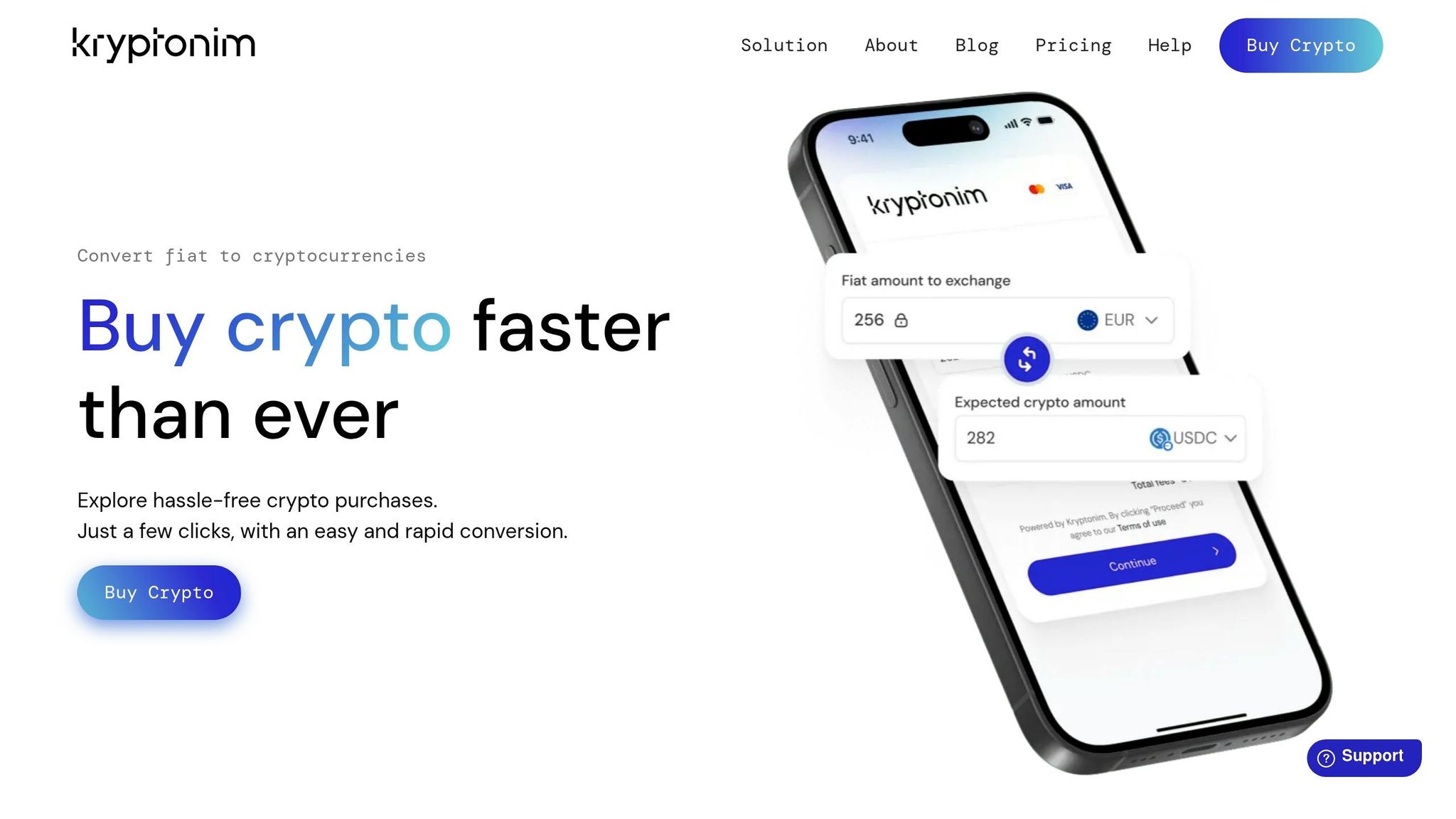
Kryptonim is an EU-regulated platform designed to make fiat-to-crypto transactions easy, especially for those who need quick access to stablecoins like USDT or USDC. It eliminates the hassle of complex account setups or lengthy verification processes.
One standout feature is its no-account-required purchase option. This allows users to select their preferred network, complete the transaction, and buy stablecoins without the need to register - ideal for time-sensitive transfers.
Kryptonim also offers transparent pricing: a flat 2% fee for EU users and 4% for users in other regions, with no hidden charges. Its adherence to EU regulations ensures high standards for reserve transparency and consumer protections, making it a dependable choice for your fiat-to-stablecoin needs.
Conclusion: Stablecoins as the Future of Remittances
Stablecoins are changing the game for international remittances. Compare this: traditional transfers often cost around 6.49% and can take up to five business days to process. Meanwhile, stablecoin transfers on networks like Polygon or Solana settle in mere seconds and cost less than $0.01. That’s a massive leap forward for cross-border payments.
This isn’t just a hypothetical improvement. The numbers tell the story - stablecoin usage continues to grow steadily. Recent data highlights a surge in both stablecoin volumes and supply, proving their ability to scale effectively. USD-pegged stablecoins such as USDC and USDT maintain their value from start to finish, eliminating concerns over market volatility. No surprises, no headaches - just a reliable option for remittances.
"Stablecoins are not a complete replacement for existing remittance infrastructure, but they are increasingly used as a settlement asset and routing layer." - Polygon Technology
To get started, follow these steps: use a regulated on-ramp like Kryptonim to convert your dollars into stablecoins, choose a low-cost network such as Polygon, Solana, or TRON, and send a small test amount first to ensure everything works smoothly. This simple, efficient process - from setting up a wallet to completing affordable transfers - shows how stablecoins are redefining the way we send money across borders.
FAQs
What’s the safest way to avoid sending stablecoins to the wrong network?
Before transferring stablecoins, it's crucial to double-check network compatibility. Make sure the wallet or platform you're using supports the same blockchain network as the recipient’s wallet - whether it's Ethereum, Solana, Tron, or another network. Verify both the recipient's wallet address and the network type carefully. To minimize the risk of irreversible mistakes, consider sending a small test transaction first. This extra step can save you from costly errors.
How can I cash out stablecoins to local currency without a bank account?
To cash out stablecoins without relying on a bank account, platforms like Kryptonim offer solutions that support fiat-to-crypto conversions and alternative payout methods. Here's how it generally works:
- Convert your stablecoins into your local currency using the platform.
- Select a payout option, such as cash pickup or mobile money services.
- Complete the transaction, which may include identity verification steps.
Make sure to review the available options in your area and adhere to any local regulations that apply.
Are USDT and USDC always worth $1, and what if they de-peg?
Stablecoins like USDT and USDC are intended to maintain a value close to $1. However, their price isn't guaranteed to stay perfectly pegged. Factors like market dynamics or shifts in trust toward the issuers can lead to fluctuations. If they lose their peg, their value might stray far from $1, which could undermine their usefulness as stable assets or for purposes like remittances.