
Utility Tokens Explained for New Buyers
Practical guide to utility tokens: check token use, tokenomics, liquidity, and network risks before buying and testing small.
A utility token gives you access, not ownership. If I were new to crypto, I’d focus on four things first: what the token does, whether people use the product, how supply enters the market, and how to avoid losing funds when buying.
Here’s the short version:
- Utility tokens are for use inside a crypto app or network.
- They can be used for fees, discounts, rewards, or voting.
- A token can still be a bad buy if it has weak demand, low liquidity, or big token unlocks.
- In the U.S., rule changes and delistings can hit access and trading fast.
- Simple mistakes - like using the wrong network or contract address - can lead to permanent loss.
- Many buyers skip research: 64% of North American investors spend less than 2 hours, or none at all, before buying crypto.
I’d boil the article down like this: utility matters, but use alone does not protect price. Before buying with USD, I’d check the token’s job in the product, look at supply and vesting, confirm trading volume, verify the chain and contract address, and start with a small test transaction.
A quick comparison helps:
| Asset type | Main purpose | What I get |
|---|---|---|
| Utility token | Use inside a product or protocol | Access, fee use, rewards, or voting |
| Coin | Move value or pay network fees | A payment asset |
| Security token | Investment claim | Ownership or income rights |
So if I were reading this guide for the first time, my takeaway would be simple: buy utility tokens for their use case first, and treat price risk, legal risk, and wallet risk as part of the deal.
How Utility Tokens Work and Where Buyers Use Them
Building on that definition, utility tokens matter only when people use them. A utility token gives holders a job inside a crypto app or network. It might cover fees, unlock features, pay out rewards, or give users a vote on decisions.
Common Uses Inside Apps, Networks, and Communities
The clearest example is fee payment. ETH pays gas on Ethereum, and BNB can cut trading fees on Binance. Some tokens also trim costs inside apps, including swap, hedging, or options fees. Governance is another common use. UNI holders vote on changes to Uniswap, while SAND is used for land purchases, events, and voting in The Sandbox.
| Utility Function | What It Does | Real Example |
|---|---|---|
| Fee payment | Required to process transactions or use the protocol | ETH for gas fees on Ethereum |
| Discounts | Reduces the cost of platform activity | BNB trading-fee discounts on Binance |
| Governance | Lets holders vote on protocol decisions | UNI votes on Uniswap upgrades |
| Rewards | Earned for activity or participation | BAT earned by users for viewing ads in Brave |
For buyers, the big question is simple: does the token solve a real need that comes up again and again?
Why Token Demand Depends on Real Ecosystem Activity
Those use cases matter only if the ecosystem has steady activity. Token demand is strongest when people use the product on a regular basis. Check for active users, transaction volume, and fee revenue. Those signals help show whether a token has a clear purpose or is running on hype alone. That should be the first thing you check before buying.
sbb-itb-0796ce6
How to Evaluate Utility Tokens Before You Buy
Buying on hype alone is one of the easiest ways to make a bad pick. A short research pass before you spend can save you a lot of pain later. The goal is simple: check that the token has a real use, a sane supply setup, and an ecosystem that’s actually alive.
Check Utility, Tokenomics, and Project Activity
Start with the simplest question: what does this token do, and does the product or network need it? Strong utility tokens usually have a clear role. They may be used to pay fees, unlock features, access services, reward users, or take part in governance.
Here’s the key test: if the product works fine without the token, or if some other currency can swap in with no tradeoff, that’s a red flag.
After that, look at the tokenomics. The main numbers to review are max supply, circulating supply, and the emission schedule. A token may look cheap because the price per coin is low, but that can be misleading. If a big chunk of supply is still locked and set to hit the market soon, dilution can become a problem fast.
Distribution matters too. If founders and early investors hold a large share and their lock-up periods are short, that can lead to steady sell pressure, even when the project itself looks solid on the surface.
Project activity matters just as much. Look for recent developer updates, shipped features, and on-chain signs that people are using the network, such as active addresses and transaction volume. If there’s no measurable ecosystem activity, the token is often running on speculation alone.
Review Documentation, Network Fit, and Technical Basics
A project worth your time should publish a whitepaper or litepaper, keep its documentation current, list an official smart contract address, and, when possible, share clear team and legal entity details. Read those materials closely. The token’s purpose should be explained in plain terms, and that explanation should match the live product.
If the docs feel thin, copied, or out of sync with what the product actually does, take that as a warning sign.
Network compatibility is one of those practical details that trips up a lot of new buyers. Many utility tokens exist on more than one chain, so you need to check which network your wallet supports before moving funds. Send a token on the wrong chain, and you could end up with a failed transfer or permanent loss of access. Always verify the exact contract address and network before buying.
| Factor | What to Check | Common Red Flag |
|---|---|---|
| Utility | Is the token needed for fees, access, rewards, or governance in a live product? | Token is optional or replaceable with no real downside |
| Ecosystem | Active users, transaction volume, and developer updates | Stagnant activity or a community focused only on price |
| Tokenomics | Max supply, circulating supply, emission schedule, and insider allocation | Large upcoming unlocks, heavy insider share, or unclear value accrual |
| Regulation | Risk disclosures, jurisdiction, and compliance statements | No clear disclosures or unresolved legal risk |
| Technical | Official contract address, token standard, audits, and wallet compatibility | Unverified contract, no security review, or incompatible chain |
One data point should make this hit home: 64% of North American investors spend less than 2 hours - or do no due diligence at all - before buying crypto. Going through the checks above takes less time than that, and it can lower the odds of buying a project that can’t support its own token.
Key Risks New Utility Token Buyers Should Know
Utility doesn’t cancel out market risk. A token can be useful inside a product and still be a poor buy. It can also drop fast for reasons that have little to do with the app itself. In practice, most of the danger fits into four areas: price, tokenomics, liquidity, and execution.
Price Swings, Weak Tokenomics, and Low Liquidity
Utility tokens trade on open markets. That means price often moves on sentiment, speculation, and the broader crypto cycle, not just on how much the token is used inside a platform. In rough markets, intraday swings of 10%–30% or more can happen even when a token has clear use. Put simply: usage does not guarantee price strength.
Tokenomics matter just as much. Upcoming unlocks can create selling pressure even when a project seems strong on paper. A good product doesn’t protect a token from weak supply design.
Liquidity is the part many first-time buyers overlook. If a token has low trading volume, the bid-ask spread is often wider. So you may pay more when buying and get less when selling. And when the market turns south, thin liquidity can get even thinner, which makes exiting much harder without taking a steep loss.
Market risk isn’t the only problem. Rules and code can damage a token too.
Regulatory and Technical Risks That Affect Buyers
In the U.S., the rules around utility tokens are still changing. If U.S. regulators decide a token should be treated as a security, exchanges may delist it, and liquidity can disappear fast. Even if enforcement speed has changed, the risk is still active. It’s not just something people talk about online.
There’s also the technical side, and crypto gives you very little room for error. Blockchain transfers are permanent. Send a token to the wrong address or over the wrong network, and those funds are usually gone for good. Smart contract bugs and exploits can also hit holders hard by draining liquidity pools or cutting off access to funds when contracts fail.
| Risk | What It Means for You | How to Reduce It |
|---|---|---|
| Speculation/Price | Sentiment can move price faster than product changes | Size positions conservatively |
| Tokenomics | Upcoming unlocks can pressure price | Check vesting schedules before buying |
| Liquidity | Thin markets make exits costly or slow | Verify 24-hour trading volume |
| Regulatory | Reclassification can trigger delistings | Check whether regulated exchanges list the token |
| Technical | Wrong address, wrong network, or exploited contracts mean permanent loss | Double-check addresses; prefer audited contracts; test with small amounts |
Next: the basic steps to buy and use utility tokens safely.
Basic Steps to Buy and Use Utility Tokens Safely
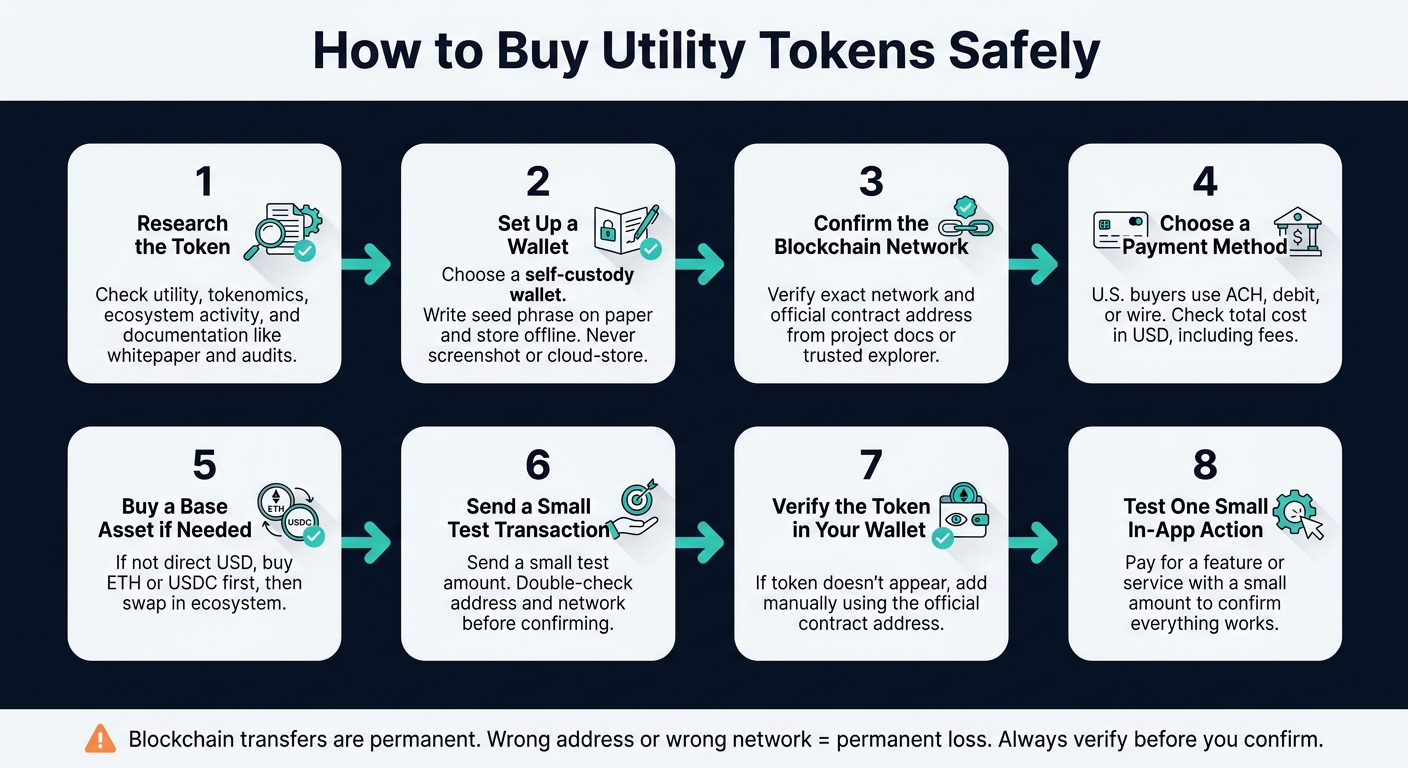
How to Buy Utility Tokens Safely: Step-by-Step Guide
If the token passed your checks, follow this order to buy it with less risk.
Set Up Your Wallet, Payment Method, and Network Details
Before you spend a single dollar, get two things ready: a wallet and a clear understanding of which blockchain the token uses.
For wallet choice, many first-time buyers begin with a self-custody browser or mobile wallet like MetaMask or Trust Wallet. These wallets give you direct control over your funds and usually let you connect straight to most dApps. Write your seed phrase on paper and keep it offline. Don't screenshot it, and don't store it in the cloud.
Next, confirm the token's blockchain network before you move any money. The network needs to match exactly before you send funds. Check the official contract address in the project's documentation or on a trusted block explorer. Never copy it from a social media post.
For payments, U.S. buyers can often use:
- ACH bank transfer
- Debit card
- Wire transfer
Before you buy, check the full cost in USD, including the trading fee, spread, and network fee.
Once your wallet, network, and payment method are ready, you can fund the wallet and make the swap.
Buy Crypto, Transfer Funds if Needed, and Start Using the Token
If you can't buy the token directly with USD, the usual route is to buy a base asset first - often ETH or USDC - and then swap it for the target token inside that token's ecosystem.
Kryptonim can handle the fiat-to-crypto step without account creation. After you receive your base crypto, move it to your self-custody wallet if needed. Check the destination address and withdrawal network one more time before you confirm. That extra pause can save you from an expensive mistake.
From there, use a DEX or in-app swap to exchange into the utility token. Start with a small test amount before sending larger sums. It's the crypto version of dipping your toe in the water first.
After the swap, make sure the token shows up in your wallet. If it doesn't appear on its own, add it manually with the official contract address. Then try one small in-app action - like paying for a feature or accessing a service - to confirm that everything works before you put in more money.
Key Points New Buyers Should Keep in Mind
After the swap, make sure the token appears in your wallet, then test one small use.
Before every purchase, check the fees, network, contract address, and wallet security. Price swings, low liquidity, changing U.S. rules, and plain old technical mistakes are all real risks. It helps to treat your first few purchases like practice rounds: keep amounts modest, move slowly, and build good habits early as your holdings grow.
FAQs
How do I tell if a utility token has real demand?
Look past price swings and hype. Focus on what the token actually does in its ecosystem.
Check which services it unlocks and whether people are using them in practice. A token can sound good on paper, but that matters a lot less if no one uses its features.
It also helps to look at the bigger picture:
- Active development: Is the team still building?
- A clear roadmap: Do they show where the project is headed?
- An engaged community: Are users talking, sharing feedback, and showing up?
- A delivery record: Have they shipped the features they said they would?
That gives you a much better read on the project than price alone.
What tokenomics red flags should I check before buying?
Watch for projects with opaque teams, unclear documentation, or missing terms of service and privacy policies. Those gaps can make it hard to tell who’s behind the project, how it works, and what rights users have.
It also helps to check for third-party smart contract audits. Code bugs and security flaws can create serious risk.
Other red flags include high volatility, low liquidity, weak user adoption, unclear regulatory status, and promises of unrealistic returns.
What mistakes can cause permanent loss when buying utility tokens?
Crypto transactions are final. That’s what makes them powerful, but it also means small mistakes can get expensive fast.
If you send utility tokens to the wrong wallet address, or pick the wrong blockchain network, your funds may be gone for good. So before you hit confirm, double-check both the address and the network. A 10-second review can save you from a permanent loss.
Your private key and recovery phrase matter just as much. If you lose them, you could lose access to your wallet for good. Store them offline, keep them private, and never share them with anyone.
It also pays to stay on guard. Phishing links, malware, and scams are common in crypto, and they often look convincing. Treat your wallet like a safe full of cash: protect access, slow down when something feels off, and don’t trust messages or sites just because they look official.