
How Meme Coins and Utility Tokens Work
Learn how meme coins differ from utility tokens, their value drivers, risks, and practical tips for evaluating and buying them.
Meme coins and utility tokens are two distinct types of cryptocurrencies, each serving different purposes. Here's what you need to know:
- Meme Coins: These are cryptocurrencies inspired by internet jokes or trends. They have no real utility or technical purpose and rely on community hype and social media buzz for value. Examples include Dogecoin (DOGE) and Shiba Inu (SHIB). They are highly volatile and often lose value quickly.
- Utility Tokens: These are digital assets designed to power blockchain ecosystems. They provide access to services, pay transaction fees, or enable governance within a platform. Examples include Ethereum (ETH), Binance Coin (BNB), and Polygon (MATIC). Their value is tied to network activity and practical use.
Key Differences
| Feature | Meme Coins | Utility Tokens |
|---|---|---|
| Purpose | Speculation, humor, community | Access to blockchain services |
| Value Source | Social media trends, hype | Network activity, platform usage |
| Volatility | Extremely high | Moderate, tied to ecosystem growth |
| Use Case | None | Payments, governance, service access |
| Regulation | Minimal oversight | Often subject to stricter regulations |
Quick Insights
- Meme coins are speculative and risky, often treated as "lottery tickets."
- Utility tokens are tied to blockchain functions, offering more stability and long-term potential.
- Understand a token's purpose before investing: Is it driven by hype or actual functionality?
Knowing the difference between these tokens can help you make smarter investment decisions in the unpredictable crypto market.
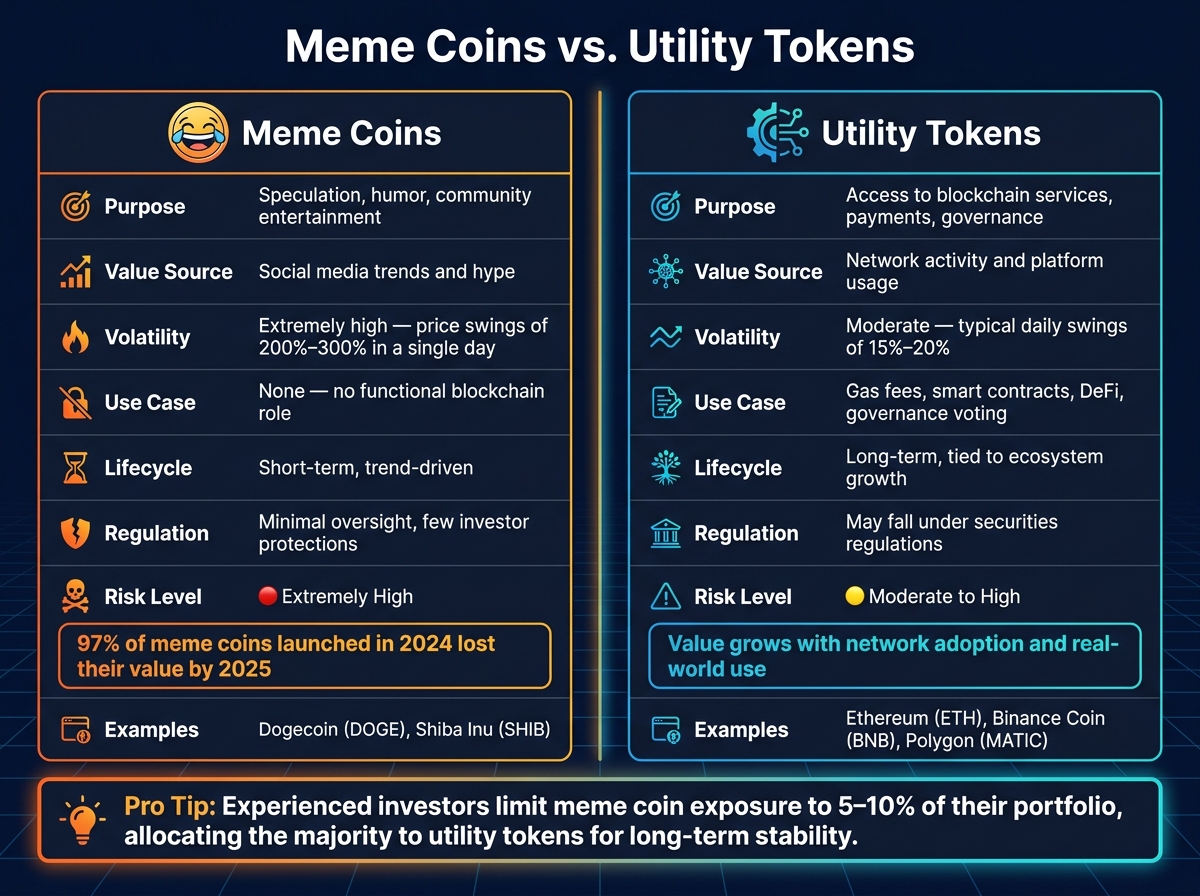
Meme Coins vs. Utility Tokens: Key Differences at a Glance
How Meme Coins Work
Community-Driven Value
Meme coins thrive on the energy of their communities, relying entirely on collective enthusiasm rather than any tangible fundamentals. They don’t generate revenue, offer products, or boast groundbreaking technology. Instead, their value is tied to attention, humor, and shared online culture.
"At their core, memecoins aren't about fundamentals or tech innovation – they're about relatability, humor and shared identity online." - Anzél Killian, Crypto.com
Platforms like Reddit, Discord, and X (formerly Twitter) serve as rallying points for these communities. Members work together to amplify visibility, attract new investors, and sustain momentum. Many of these investors look for easy crypto purchases to enter the market quickly. When a meme coin gains traction, its popularity can snowball quickly. However, as soon as the buzz dies down, so does its price. Celebrity endorsements can play a massive role in these short-term surges - a single post from a high-profile figure can send prices soaring within hours. But this same reliance on community-driven hype makes meme coins prone to dramatic price fluctuations.
Volatility and Speculation
Meme coins are some of the most unpredictable assets in the crypto market. Their prices can spike 200% to 300% in a single day, far outpacing the typical 15% to 20% swings seen with more established utility tokens. This extreme volatility draws speculators eager to ride the wave early, but it also means losses can come just as quickly and severely.
A key driver of this volatility is unit bias, where investors focus on hitting round-number price milestones. Experienced traders often take advantage of this by selling off their holdings before those targets are reached. Additionally, the low liquidity of meme coins means that even a single large sell order can cause prices to plummet instantly.
Little to No Practical Use
Despite their speculative allure, meme coins offer little in terms of practical functionality. They don’t power blockchain networks, reduce transaction costs, or provide access to services. Their appeal lies almost entirely in price swings and the hope of quick profits.
"Meme coins generally do not have anything backing them or generating value other than belief, hype, speculation, and hope." - Investopedia
The ease of creating meme coins has also contributed to their proliferation. Platforms like Pump.fun allow anyone to launch a token in just minutes, requiring no coding skills. This has led to the creation of millions of tokens each year, though the vast majority fail to gain any traction. While some newer projects have experimented with features like staking rewards to extend their lifespan, the core appeal of meme coins remains speculative rather than practical.
sbb-itb-0796ce6
How Utility Tokens Work
Utility tokens stand apart from meme coins by deriving their value from providing access to real network services, like processing transactions or unlocking platform features. Let’s dive into how network activity directly influences the value of these tokens.
Access to Blockchain Services
Think of a utility token as a digital pass granting access to specific features within a blockchain ecosystem. For example, on Ethereum, interacting with smart contracts or decentralized apps (dApps) requires paying gas fees in ETH. Similarly, tokens like Filecoin (FIL), Chainlink (LINK), and Basic Attention Token (BAT) each power unique services on their platforms - ranging from decentralized storage solutions to reliable oracle data feeds. These tokens aren’t just speculative assets; they’re essential tools that enable the platforms to function, giving them a clear purpose and value.
Value Tied to Network Activity
The value of utility tokens is closely tied to how actively the network is used. When more people use a platform, demand for its token increases. On the flip side, less activity means reduced demand.
"Utility tokens gain value from the product or service that they are connected to." - Toby Foster, Author
This dynamic is especially important when considering token supply. A limited supply, combined with growing network activity, often leads to a steady increase in value. Unlike meme coins, which can see wild price swings - sometimes jumping 200%–300% in a single day - utility tokens tend to follow more predictable trends.
Function Over Hype
Because utility tokens are tied to actual usage, they tend to hold up better during market downturns. Their functional purpose provides a baseline value that speculative assets often lack.
"Utility tokens are much more sustainable in nature in comparison to meme coins." - Georgia Weston, Content Writer, 101 Blockchains
This stability is why institutional investors are increasingly drawn to utility tokens. As networks grow and their usage expands, these tokens remain relevant, offering long-term potential without relying on fleeting market trends or hype.
Meme Coins vs. Utility Tokens
Understanding how meme coins and utility tokens operate individually is just the start. When you compare them side by side, their differences extend beyond their purposes, influencing how you approach evaluation, holding strategies, and risk management.
Key Differences Between the Two
The easiest way to differentiate these tokens is to ask: Does this token serve a functional purpose? Utility tokens are built to enable services within a blockchain ecosystem, while meme coins are mostly about entertainment and speculative trading.
Their value sources are another key distinction. Meme coins are subject to wild swings, often dictated by social media buzz, while utility tokens tend to follow the growth and adoption of their respective networks. For instance, meme coins can fluctuate dramatically based on viral trends, while utility tokens typically see daily fluctuations in the range of 15%–20%.
| Feature | Meme Coins | Utility Tokens |
|---|---|---|
| Purpose | Entertainment, community engagement, and speculation | Access to services, payments, and governance |
| Value Source | Social media trends and hype | Network activity and platform usage |
| Risk Profile | Extremely high, with rapid loss potential | Moderate to high, depending on project success |
| Lifecycle | Short-term, driven by trends | Long-term, tied to ecosystem growth |
| Regulatory Status | Often not classified as securities | May fall under securities regulations |
Regulation is another major difference. Meme coins usually bypass securities laws, which means investors have less protection if things go wrong. Utility tokens, on the other hand, may face stricter oversight, depending on how they’re structured. Recognizing these differences is crucial for assessing the risks and potential of each type.
Use Cases and Examples
Real-world examples highlight these distinctions. Take Dogecoin, for instance - it’s a classic meme coin, thriving on community sentiment and viral appeal. Meanwhile, Ethereum is a prime example of a utility token. Every transaction on its network, from running smart contracts to interacting with decentralized apps, requires ETH to cover gas fees.
Interestingly, the lines aren’t always clear-cut. Shiba Inu (SHIB) started as a meme coin but has since evolved. With the launch of Shibarium - a Layer-2 blockchain solution featuring DeFi applications and NFTs - it has added functional value to its ecosystem.
"Utility tokens are more reliable for long-term growth as they are tied to blockchain adoption, institutional interest, and real-world use cases." - Pardeep Sharma, Crypto Analyst
The longevity of meme coins is often questionable. A striking example? By 2025, about 97% of meme coins launched in 2024 had lost their value. This statistic highlights the fleeting nature of tokens fueled by social media hype compared to those built with practical utility in mind.
How to Evaluate Meme Coins and Utility Tokens
Understanding the distinction between meme coins and utility tokens is helpful, but taking the time to evaluate them thoroughly is essential to protect your investments.
Evaluating Meme Coins
When assessing meme coins, start by examining the community size and activity. Platforms like X, Reddit, and Telegram often reveal how engaged and active the community is. Since meme coins typically lack underlying products, their value is heavily tied to community participation. A drop in activity could signal a decline in the coin's value.
Next, look at liquidity and token distribution. If ownership is concentrated among a few wallets (commonly referred to as "whale" wallets), the risk of sudden sell-offs increases - this is often called a "rug pull". Transparency is another key factor. Check whether the project provides a clear roadmap and whether the developers are identifiable. Projects with anonymous founders or minimal documentation tend to carry higher risks.
It’s also important to remember that most meme coins lack protections defined by the SEC, meaning the responsibility for due diligence falls entirely on you.
On the other hand, utility tokens require a different approach to evaluation, focusing more on their functionality and the growth of their networks.
Evaluating Utility Tokens
When analyzing utility tokens, the first question to ask is: Does the token serve a critical function within its platform? Tokens that are necessary for accessing services, paying fees, or participating in governance decisions demonstrate clear demand.
Another critical factor is ecosystem growth. A utility token tied to an expanding network is more likely to maintain demand than one linked to stagnant activity. For instance, Ethereum’s ETH is indispensable for running smart contracts and conducting DeFi transactions, directly connecting its value to the platform's usage.
"Utility tokens are better aligned with long-term investors who wish to get exposure to blockchain projects with real-world applications." - Georgia Weston, Content Writer, 101 Blockchains
Credibility is also strengthened by transparent leadership, a well-defined roadmap, and clear adoption milestones. If the token claims to address a specific issue - like facilitating cross-border payments or providing decentralized data feeds - verify that it’s actively solving these problems rather than just presenting them in a whitepaper.
Experienced investors often treat meme coins as "lottery tickets", limiting their exposure to about 5%–10% of their portfolios. Meanwhile, they allocate the majority of their investments to utility tokens, which tend to offer more stability and long-term potential.
How to Buy Meme Coins and Utility Tokens
Once you've evaluated your meme coins and utility tokens, the next step is making a secure purchase. Taking the right precautions is key to protecting your investment in this unpredictable market.
Using a Secure Platform Like Kryptonim
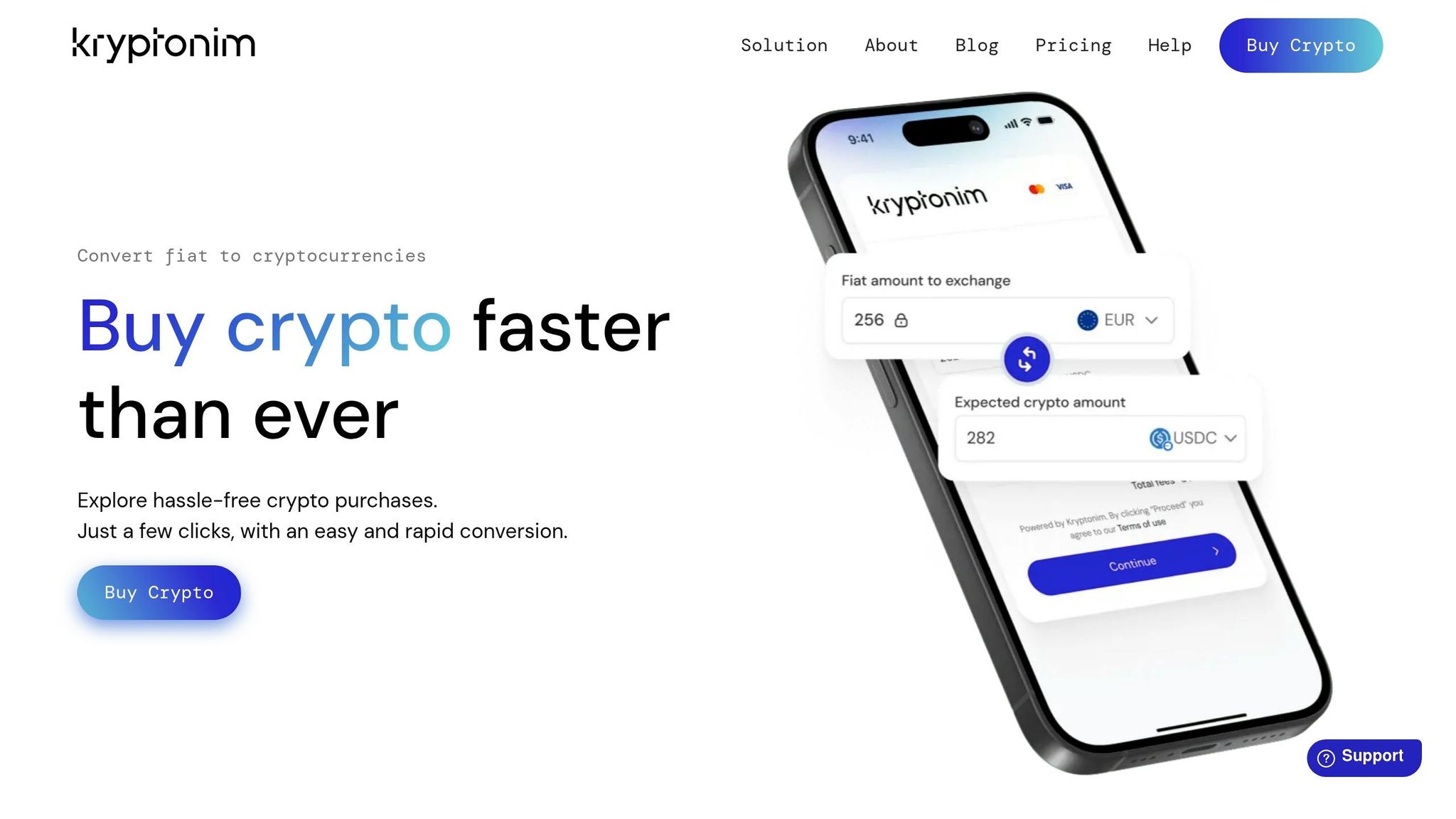
For newcomers, the biggest challenge is converting traditional currency into cryptocurrency. On most exchanges, you first need to buy Bitcoin or Ethereum before trading for the token you’re after. Platforms like Kryptonim simplify this process by allowing direct fiat-to-crypto purchases with USD. No need to create an account or deal with intermediate steps.
Kryptonim operates under EU regulations, ensuring it adheres to established financial standards. This is especially important when buying meme coins, where unverified projects are common. Starting with a platform that offers transparent pricing helps reduce risks right from the beginning. For users outside the EU, Kryptonim charges a flat 4% transaction fee.
Steps for Buying Tokens
The process of purchasing tokens is straightforward, but there are a few key steps to ensure safety:
- Choose your token. For popular tokens like DOGE, SHIB, or ETH, Kryptonim enables direct fiat-to-crypto purchases. For smaller meme coins, you’ll need to use a decentralized exchange (DEX) after acquiring a base token like ETH or SOL.
- Verify the token's contract address. Always cross-check using reliable platforms like CoinGecko or CoinMarketCap. Token names alone can be misleading.
- Complete your purchase. Enter the amount in USD, your wallet address, and confirm the transaction through Kryptonim’s guided interface.
It's a good idea to start small - test the process with $5–$10. If the meme coin you’re eyeing is trending on social media, proceed cautiously. Buying during a price surge often means purchasing from early investors looking to cash out. After your purchase, consider transferring larger holdings to a private hardware wallet for added security.
"Good tokenomics in a meme coin means simple: no hidden taxes, no team allocations, no mint authority. The fewer moving parts, the less there is to exploit." - Dextools
This principle also applies to how you buy. A simple, transparent purchasing process minimizes unnecessary risks and keeps things manageable.
Conclusion
Key Takeaways
Meme coins and utility tokens operate on entirely different principles. Meme coins thrive on social media buzz, community enthusiasm, and viral trends. On the other hand, utility tokens gain their value from actual use cases within blockchain ecosystems. Both come with their own risks: meme coins, often fueled by hype and lacking regulatory oversight, can lose value quickly, while utility tokens tend to offer more stable value based on network activity.
"Understanding the unique characteristics of each type of token is crucial for making informed investment decisions in this dynamic and evolving space." - OKX
These insights highlight the importance of assessing a token's purpose and risk factors before diving in.
Final Thoughts
Before buying any token, ask yourself: What is its purpose? If the answer is "nothing, but people are excited about it", you're likely dealing with a meme coin - treat it as a speculative gamble, not a solid investment. On the flip side, if a token addresses a real-world problem or powers an active blockchain network, it might warrant a more significant commitment.
Allocating only a small portion of your portfolio to meme coins while focusing the majority on utility tokens tied to established ecosystems won't eliminate risk entirely but can help balance speculative ventures with more stable opportunities.
"A strong portfolio should rely on utility tokens for stability and long-term growth, while meme coins can be treated as speculative opportunities." - Pardeep Sharma, Analyst
FAQs
How can I spot a meme coin scam early?
To spot a potential meme coin scam early, keep an eye out for these warning signs:
- Anonymous Developers: If the creators of the coin remain unidentified, it can be a major red flag.
- Lack of Transparency: Limited or no information about the project's goals, team, or roadmap should raise concerns.
- Overhyped Marketing: Excessive promotion without substance often signals an attempt to lure in unsuspecting investors.
- Poor Tokenomics: Weak or unclear economic structures for the coin can indicate instability or a lack of long-term planning.
- Market Manipulation: Watch for evidence of practices like rug pulls, where developers drain liquidity and abandon the project.
Always approach investments with caution and conduct thorough research to protect yourself.
What makes a utility token actually needed on its network?
Utility tokens play a key role in their networks by offering access to services, covering transaction fees, enabling governance, or activating platform features. Unlike meme coins, which thrive on hype, utility tokens gain their worth through real-world functionality. They encourage user engagement, streamline transactions, and help maintain decentralization, security, and scalability - critical elements for the network's development and long-term health.
How do I check a token’s contract address before buying?
To confirm a token’s contract address, start by consulting the official or verified address shared by the project itself or other trusted sources. Look for this information on reputable platforms where the token is listed, such as decentralized exchanges. If available, review any audit or security reports tied to the token for added assurance. Always cross-check the contract address on the project’s official website or through their community channels to steer clear of scams or counterfeit tokens.