
What Are Altcoins: Basics and Examples
A beginner's guide to altcoins: types, coins vs tokens, how they work, examples, and key risks to check.

Altcoins are every crypto asset that isn’t Bitcoin. If I had to sum this up in one line: altcoins include base-chain coins like ETH, SOL, and ADA, plus tokens like USDC and UNI, and they differ by what they do, how they run, and how much risk they carry.
If you’re new to crypto, here’s the short version:
- Bitcoin was built mainly to send and store value.
- Altcoins often try other jobs, like running apps, handling voting, or keeping a price near $1.00.
- Some altcoins are coins with their own blockchain.
- Others are tokens that run on another chain and still need that chain’s fee coin.
- The main groups are layer-1 coins, stablecoins, utility tokens, governance tokens, and meme coins.
- The main risks are price swings, weak projects, token unlocks, low trading volume, and stablecoin peg breaks.
A few examples make this simple:
- Ethereum (ETH): runs smart contracts and apps
- Litecoin (LTC): focuses on low-cost peer-to-peer payments
- Dogecoin (DOGE): a meme coin driven by online attention
- USDC: a token that aims to stay near $1.00
Here’s the core idea: not all altcoins work the same way. Some help power blockchains. Some give access to a product. Some let holders vote. And some move mostly on hype.
| Type | Main use | Example | Main risk |
|---|---|---|---|
| Layer-1 coin | Pays fees and runs a base network | ETH, SOL, ADA | Network and market risk |
| Stablecoin | Tries to hold $1.00 | USDC, USDT, DAI | Losing the peg |
| Utility token | Used inside a platform | BNB | Demand may drop |
| Governance token | Lets holders vote | UNI, AAVE | Control can stay with large holders |
| Meme coin | Community and internet-driven | DOGE, SHIB | Sharp price swings |
Before I buy any altcoin, I’d check four things first: use case, supply, governance, and chain structure. That simple filter can help cut down avoidable mistakes.
How Altcoins Work
Building on why developers create altcoins, the next step is seeing how these networks work in practice.
Altcoins run on blockchains, which are shared ledgers that store transactions in linked blocks. When you send an altcoin, your wallet broadcasts that transaction to the network. From there, nodes check it and record it on the chain.
Blockchains, Consensus, and Network Roles
For a blockchain to function, the network needs a way to agree on which transactions are valid and what the ledger looks like at that moment. That process is called consensus. The two most common models are proof of work (PoW) and proof of stake (PoS).
In a PoW system, miners compete to solve complex mathematical puzzles. The first one to solve the puzzle adds the next block and earns a reward in the network’s native coin. In a PoS system, validators lock up coins as stake and are randomly picked to propose and validate blocks. If they act honestly, they earn rewards. If they cheat, they can lose part of their stake. PoS has become a leading alternative to PoW because it uses less energy and can handle growth more efficiently.
Each network uses its native coin to pay transaction fees and reward miners or validators. On Ethereum, this fee is called gas. It is paid in ETH, even if you are sending a different asset.
These choices help shape the main types of altcoins and the jobs they do.
Coins vs. Tokens: What Is the Difference
This is one of the most useful distinctions to learn early on. A coin is the native asset of its own blockchain. A token is an asset built on top of another blockchain.
| Concept | What it is | Simple example |
|---|---|---|
| Coin | Native asset of its own blockchain | ETH on Ethereum |
| Token | Asset built on another blockchain | USDC on Ethereum |
ETH is Ethereum’s coin. It powers the network, pays fees, and helps reward validators. USDC, by contrast, is a token that runs on Ethereum but is not part of the base protocol. If you want to send USDC, you still need ETH in your wallet to cover the gas fee.
More broadly, tokens rely on the host chain for security, transaction processing, and fees. That’s why it helps to keep a small amount of the native coin on hand before buying and moving tokens around.
Those mechanics explain why some altcoins are coins, while others are tokens built on existing chains.
sbb-itb-0796ce6
Main Types of Altcoins and Their Uses
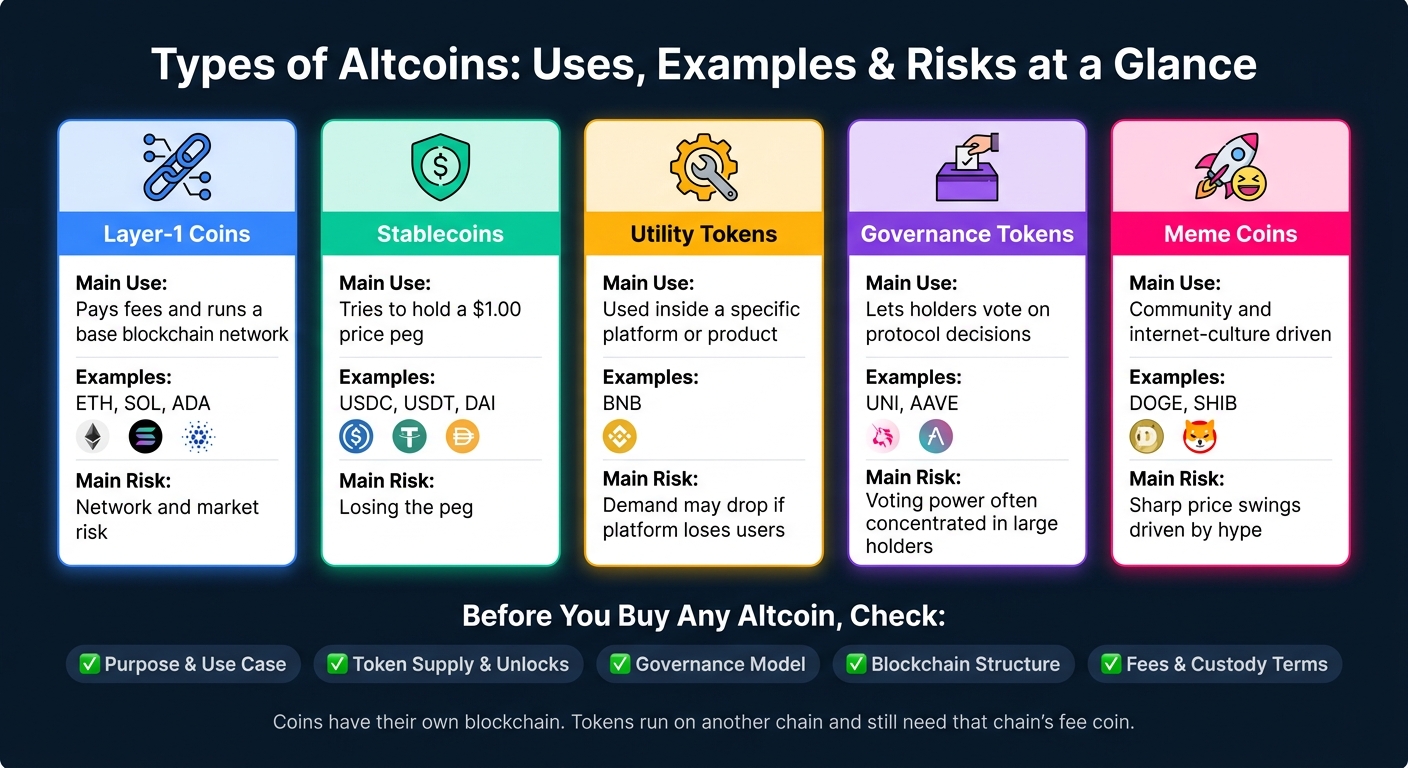
Types of Altcoins: Uses, Examples & Risks at a Glance
Now that the difference between coins and tokens is clear, it helps to look at the altcoin groups you’ll run into most often.
Layer-1 Coins and Base Networks
Layer-1 coins are the native assets of base blockchains. ETH on Ethereum, SOL on Solana, and ADA on Cardano all fall into this group. They’re used to pay transaction fees, reward validators, and run smart contracts and decentralized apps.
Put simply, these coins sit at the core of their networks. Compared with Bitcoin, layer-1 altcoins often aim for faster transfers, lower fees, or more programming flexibility.
Stablecoins, Utility Tokens, and Governance Tokens
Stablecoins are tokens built to stay close to $1. USDT, USDC, and DAI all aim to hold that price level. People use them for trading, moving funds between platforms, and as the stable side of DeFi lending pairs.
That said, not every stablecoin stays steady under stress. Reserve visibility, rules from regulators, and smart contract structure can all affect whether a stablecoin keeps its peg.
Utility tokens give users access to a product or service inside a given platform. A common example is BNB, which can help users pay lower trading fees in the Binance ecosystem. The value of a utility token usually depends on how much demand there is for the platform behind it.
Governance tokens give holders a say in protocol decisions. UNI lets Uniswap holders vote on fee structures and treasury spending. AAVE gives holders voting rights on risk settings for the Aave lending protocol. In practice, though, voting power often ends up in the hands of large holders, which can leave smaller holders with little influence.
Meme Coins and Community-Driven Tokens
Another common group is community-driven tokens. Meme coins are shaped more by internet culture and online communities than by technical use. Dogecoin and Shiba Inu are the best-known examples.
Their prices can move fast, and often for reasons that have little to do with the project itself. A viral post, a celebrity mention, or a spike in social chatter can send them up or down in a hurry. That makes meme coins some of the most speculative assets in crypto.
Popular Altcoin Examples for Beginners
A few well-known coins make the main altcoin groups easier to understand.
Ethereum: Smart Contracts and Decentralized Apps
Ethereum is one of the top smart-contract blockchains. It supports smart contracts, DeFi, stablecoins, and layer-2 networks.
Litecoin: Peer-to-Peer Payments
Litecoin is an early altcoin built for faster, lower-cost peer-to-peer payments.
Dogecoin: A Community-Led Meme Coin
Dogecoin is a community-driven meme coin, and its price often moves with social attention and market sentiment.
Key Risks to Know Before Using Altcoins
Altcoins can be useful, but beginners need to size up the risk before putting money in.
Volatility, Project Risk, and Token Design
Altcoin prices can swing hard, and tokens with low trading volume often move the most. That cuts both ways. A token can jump fast, then drop just as fast. Meme coins are a classic example because hype can push prices up in a rush and then send them crashing back down.
There’s also the project itself to think about. Many new tokens fail or stop trading not long after launch. So even if the price looks cheap, that doesn’t mean the risk is low.
Token supply matters too. If an altcoin has a small circulating supply compared with its total supply, or if big unlocks are scheduled soon, early holders may start selling and push the price lower. In plain English: more tokens hitting the market can mean more pressure on the price. And if the token design is weak, losses can pile up fast. That’s especially important for coins that rely on a peg, since a break in that peg can trigger a sharp drop.
What to Check Before Buying an Altcoin
Different altcoins run into different problems, so it helps to look at the basics before you buy. Focus on purpose, supply, governance, and structure.
| What to Check | Why It Matters |
|---|---|
| Purpose and use case | What problem does it solve, and is there real demand for it? |
| Token supply and unlocks | Large upcoming unlocks or heavy wallet concentration can trigger sudden sell-offs |
| Governance model | Who controls upgrades - a small team or a decentralized community? |
| Blockchain structure | Is it a layer-1 coin, a token on another chain, or a stablecoin? Each carries different risks |
| Clear fees and custody terms | Use a platform that shows fees, custody, and total cost clearly |
It also helps to confirm whether the altcoin is available in the U.S. and what rules apply before you buy. Then keep any single altcoin as only a small part of your portfolio.
FAQs
How do I choose my first altcoin?
Choose your first altcoin with a disciplined, research-based approach. Start with your own risk tolerance and financial goals, and only put in money you can afford to lose.
Then look at the project itself. Check its utility, tokenomics, developer activity, and security audits. Also review market capitalization and trading volume so you can get a feel for its health and liquidity.
A lot of beginners start with Bitcoin or Ethereum first, then put 20% to 40% of their portfolio into altcoins. That approach can help keep things simple while you learn how the market works.
Why do some altcoins need ETH for fees?
Some altcoins need ETH for fees because they run on the Ethereum blockchain. On Ethereum, ETH pays for gas fees. Those fees cover the computing power used to process and verify each transaction.
So even if you're sending or using a token, the Ethereum network still needs ETH to execute the smart contracts behind it.
Are altcoins riskier than Bitcoin?
Yes, altcoins are usually riskier than Bitcoin.
Bitcoin and Ethereum tend to be more stable and easier to buy or sell because they have deeper liquidity. Smaller altcoins, on the other hand, can swing hard in either direction. In a market slump, it’s not unusual for them to fall 80% to 90%.
They also come with extra risk that goes beyond price moves alone, including:
- Lower liquidity
- Market manipulation
- Concentrated ownership
- A higher chance that the project fails
That mix can make altcoins feel less like blue-chip assets and more like high-risk bets.