
Ultimate Guide to Encryption in Crypto Exchanges
Encryption defines exchange security: TLS, AES-256, HSMs, cold storage and key management—user practices still matter.

Encryption is the backbone of security in crypto exchanges, safeguarding user data, transactions, and funds. Without it, exchanges would be vulnerable to billions in losses, as seen in past breaches. Here's what you need to know:
- Encryption layers: Protects communication (TLS), data storage (AES-256), wallet keys (ECC), and transaction integrity (SHA-256).
- Cold storage: 90–95% of funds are kept offline, secured by multi-signature wallets or MPC techniques.
- Key management: Keys are generated, rotated, and destroyed securely using industry standards like HSMs and formal key ceremonies.
- User security tips: Use hardware keys for 2FA, enable withdrawal whitelisting, and avoid storing large funds on exchanges.
- Regulatory compliance: Exchanges must meet standards like SOC 2 and ISO 27001, ensuring encryption and access controls are effective.
Encryption ensures your funds and data stay secure, but your personal practices also play a big role. Always check an exchange’s security features and follow best practices to protect yourself.
Core Cryptography Concepts for Exchange Users
Understanding how cryptographic tools like hash functions, encryption methods, and digital signatures work is essential to grasping how exchanges keep your funds and data secure.
Hash Functions and Transaction Integrity
A hash function takes any input - whether it's a word, a transaction, or an entire file - and transforms it into a fixed-length string of characters known as a digest or fingerprint. For example, using the SHA-256 algorithm, the word "Hello" will always produce the same 64-character hash. The magic of hashing lies in its sensitivity: changing even a single character results in a completely different hash, making tampering obvious to anyone monitoring the network.
"Hashing is a vital component of blockchain technology, ensuring that transactions are secure and tamper-proof." - OKX
Hashing is a one-way process, meaning it cannot be reversed with current technology. In practice, every blockchain transaction is assigned a unique identifier called a TXID, derived from its hash. This TXID can be used with a blockchain explorer to confirm the transaction's status and verify that it hasn't been altered. Additionally, blockchains employ Merkle Trees, which organize transaction hashes into a hierarchy, ultimately summarizing them into a single "Merkle Root." As security researcher Amber Dimas notes: "If anyone tries to alter a transaction later, the Merkle root changes, breaking the chain's continuity."
Next, let’s look at the two main encryption methods exchanges rely on.
Symmetric vs. Asymmetric Encryption
Both symmetric and asymmetric encryption play crucial roles in securing exchange operations, often working together.
- Symmetric encryption uses one secret key for both encrypting and decrypting data. It's fast and ideal for protecting large datasets, such as user records and KYC files stored on an exchange's servers. AES-256 is the standard choice here.
- Asymmetric encryption, on the other hand, relies on a key pair: a public key that can be shared openly and a private key that must remain confidential. Data encrypted with the public key can only be decrypted by the matching private key.
| Feature | Symmetric (AES-256) | Asymmetric (ECC/RSA) |
|---|---|---|
| Keys used | One shared secret key | Public + private key pair |
| Speed | Very fast | Slower, higher overhead |
| Primary use | Encrypting stored data | Transaction signing, key exchange |
| Common algorithms | AES, ChaCha20 | ECC (secp256k1), RSA |
A quick note on key sizes: a 256-bit ECC key provides security equivalent to a 3,072-bit RSA key. This efficiency is why Bitcoin and Ethereum use the secp256k1 elliptic curve - it ensures strong protection while keeping keys compact and manageable.
These encryption techniques lay the groundwork for digital signatures, which are essential for transaction security.
Digital Signatures and Transaction Authentication
Digital signatures build on encryption to ensure that transactions are both authentic and tamper-proof. Instead of exposing private keys, wallets generate digital signatures to sign transactions. Here’s how it works: your wallet hashes the transaction data and signs it using your private key. The network then verifies the signature using your public key.
"A message signature mathematically guarantees that certain message was signed by certain (secret) private key, which corresponds to certain (non-secret) public key." - Nakov, Practical Cryptography for Developers
Digital signatures provide three key assurances:
- Authentication: Only the holder of the private key could have signed the transaction.
- Integrity: The transaction data hasn’t been altered since it was signed.
- Non-repudiation: The signer cannot deny authorizing the transaction.
Most exchanges and blockchains rely on ECDSA (Elliptic Curve Digital Signature Algorithm) for digital signatures. Bitcoin is also gradually adopting Schnorr signatures, which combine multiple transaction inputs into a single signature. This shift reduces the amount of block space used and lowers transaction fees.
sbb-itb-0796ce6
How Crypto Exchanges Use Encryption
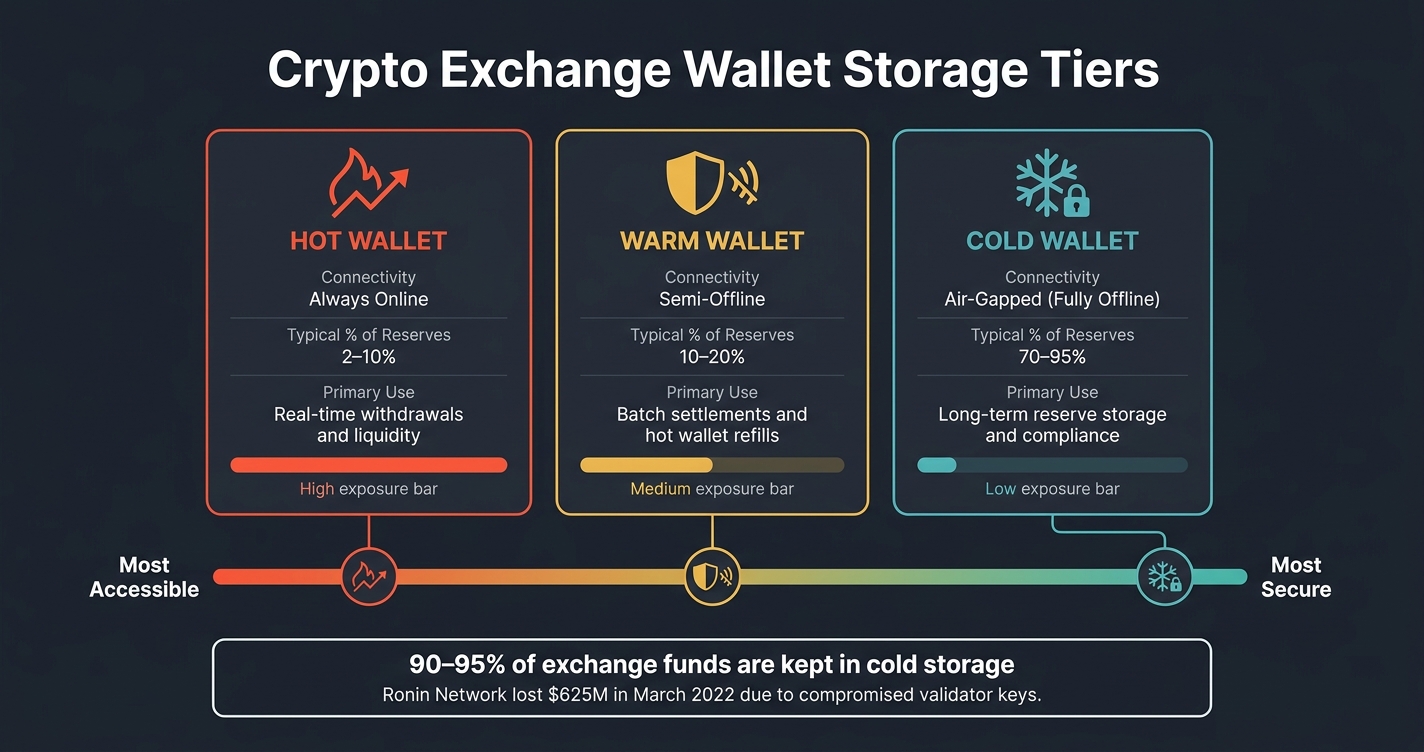
Crypto Exchange Wallet Tiers: Hot vs. Warm vs. Cold Storage
Crypto exchanges rely on encryption at every step, from user login to fund withdrawals, to ensure the highest level of security.
Protecting User Data and Communications
When you log in to a crypto exchange, your browser and the platform establish a secure, encrypted connection using TLS (Transport Layer Security). This protects your login credentials and transaction details during transmission. Once the data reaches the exchange’s servers, it is further encrypted at rest using AES-256, a widely trusted encryption standard. This ensures that even if someone gains access to the servers, they cannot read the sensitive information stored there.
"Encryption is the last line of defense. If an attacker bypasses your firewalls... encryption ensures they get ciphertext, not data." - Codelit Team
This multi-layered encryption approach safeguards data at every stage, from transmission to storage.
Wallet Encryption and Key Protection
Securing wallet keys is one of the most critical tasks for crypto exchanges. To minimize risk, exchanges typically store the majority of funds - around 90–95% - in cold storage, while keeping only 5–10% in hot wallets for immediate withdrawals.
| Wallet Tier | Connectivity | Typical % of Reserves | Primary Use |
|---|---|---|---|
| Hot Wallet | Always online | 2–10% | Real-time withdrawals and liquidity |
| Warm Wallet | Semi-offline | 10–20% | Batch settlements and hot wallet refills |
| Cold Wallet | Air-gapped | 70–95% | Long-term reserve storage and compliance |
Cold storage wallets, which are completely offline, are secured using Hardware Security Modules (HSMs). These devices generate and store private keys in a highly secure, offline environment. Additionally, many exchanges implement Multi-Party Computation (MPC). This method splits the private key into fragments distributed across multiple nodes, ensuring that the full key is never reconstructed in one place. This eliminates a single point of failure, which could otherwise lead to catastrophic losses.
The Ronin Network breach in March 2022 highlights the importance of robust key management. Attackers compromised five out of nine validator keys controlled by a single entity, resulting in a $625 million theft.
"Cold storage means the private keys never touch an internet-connected device. Ever." - Scott Otten, Exchange Infrastructure Engineer
Encryption in Internal Systems and Third-Party Integrations
Crypto exchanges also secure their internal systems and third-party integrations with strong encryption practices. For internal operations, components like the matching engine, settlement systems, and administrative tools communicate using Mutual TLS (mTLS). This ensures that both ends of the communication channel authenticate each other, preventing unauthorized access. Many exchanges use service meshes like Istio or Linkerd to manage these secure connections automatically.
When integrating with third-party services, such as Know Your Customer (KYC) providers, exchanges use end-to-end encryption to protect user documents. These integrations are further secured with OAuth 2.0 API tokens. Additionally, API requests are signed with HMAC (Hash-based Message Authentication Code) signatures, which include request details and timestamps to prevent replay attacks. To reduce exposure, the core trading engine is typically isolated from public-facing systems and communicates only through encrypted internal message queues.
These measures collectively ensure the security of both user data and the operational backbone of crypto exchanges.
Key Management and Security Controls in Exchanges
Managing the Key Lifecycle
Cryptographic keys go through a well-defined lifecycle: generation, storage, use, rotation, and destruction. At every stage, there are specific risks that need to be addressed.
Generation is where it all begins. Keys should be created within FIPS 140-2 or 140-3 certified Hardware Security Modules (HSMs). For cold storage, exchanges often perform formal key ceremonies. These ceremonies involve multiple witnesses and distributed signers to ensure no single individual has complete control of the key.
Once generated, keys enter the active use phase and must be rotated periodically. According to NIST SP 800-57, symmetric data encryption keys should have an originator usage period of no more than two years, while asymmetric private signature keys typically last between one and three years. Hot wallet keys, however, are rotated more frequently to minimize the risk of exposure in case of a silent compromise.
When a key is no longer needed, it must be securely destroyed using a process known as zeroization. This ensures the key cannot be recovered by an unauthorized party. The importance of having a recovery plan was highlighted in the Multichain incident of July 2023, where approximately $1.5 billion in assets were rendered inaccessible after the CEO - who was the sole administrator for bridge functions - went missing in China. Without a secondary signer or recovery plan, the assets were effectively locked.
"In an always-on market, an exchange that cannot sign transactions is operationally indistinguishable from one that has been breached." - KarCrypto
While strong key management is essential, managing access controls is equally critical in safeguarding exchange security.
Access Controls and Session Security
Encryption alone cannot protect an exchange if unauthorized users gain access. This is where access controls play a crucial role.
Role-Based Access Control (RBAC) helps enforce the principle of least privilege. For example, customer support teams can view account histories but cannot process withdrawals, while developers can deploy code without accessing private keys. This separation of duties is not just a best practice - it addresses a major vulnerability, as 75% of successful breaches have been linked to poor access controls. These controls, combined with encryption, create a secure environment even for authorized sessions.
For high-risk operations, exchanges use the Two-Person Rule, requiring at least two authorized individuals to approve significant actions like high-value withdrawals or wallet configuration changes. This approach mitigates risks from insider threats and single-account compromises.
On the authentication front, the industry is shifting away from SMS-based two-factor authentication, which is prone to SIM-swapping attacks. Instead, exchanges are adopting FIDO2/WebAuthn hardware security keys like YubiKey for administrative actions. To further secure sessions, exchanges bind them to device fingerprints and IP ranges, and many enforce 24–48 hour waiting periods before activating newly added withdrawal addresses.
Encryption and Regulatory Compliance
Strong internal controls also support compliance with external regulatory standards. Encryption practices are at the core of meeting these requirements.
In the U.S., encryption and key management practices are shaped by a range of regulations. FinCEN (31 CFR Part 1022) oversees anti-money laundering (AML) efforts, the SEC (17 CFR Part 275) sets standards for qualified custodians, and the OCC's Interpretive Letter 1170 outlines conditions for banks offering crypto custody. Exchanges also align with SOC 2 Type II and ISO 27001 frameworks, which mandate detailed access logs, encryption controls, and regular audits.
For KYC and AML compliance, exchanges must ensure user identity documents sent to third-party KYC providers are protected with end-to-end encryption. Access to this sensitive data is logged and audited, and regulators require quarterly reviews to verify that only authorized personnel can access critical systems.
Looking ahead, regulatory expectations are changing. By 2026, regulators will require exchanges to provide proof that their security controls are effective under stress. This will involve threat-led penetration testing and incident response drills. For U.S.-based exchanges, this shift means security measures must go beyond ticking boxes - they need to demonstrate real-world effectiveness.
"The cost of proper security architecture is always less than the cost of a breach." - Codono
How to Evaluate Encryption Practices in Crypto Exchanges
Encryption Features Users Can Check
For many people, spotting a padlock icon in their browser is enough to feel secure. But that’s just scratching the surface. A closer look can reveal a lot more about an exchange's encryption standards. For example, check if the platform uses HTTPS with TLS 1.2 or 1.3 by clicking on the padlock. Shockingly, a 2026 study of the top 250 exchanges found that some still rely on outdated encryption protocols - an alarming fact for an industry managing billions of dollars. These details complement earlier points about key management and layered encryption.
Beyond the padlock, here are some key indicators to evaluate:
- Cold storage ratio: Leading exchanges typically store between 90% and 98% of user funds in cold storage, keeping them offline and safe from hackers.
- Multi-sig or MPC wallets: These wallets spread key control across multiple parties, reducing the risk of a single point of failure.
- Third-party certifications: Look for certifications like SOC 2 Type II, ISO 27001, or PCI DSS as proof that the platform’s security measures meet independent verification standards.
- Proof of Reserves (PoR): Exchanges that publish cryptographically verifiable reserve proofs, often using Merkle Trees or zk-STARKs, demonstrate a commitment to asset transparency and security.
The same study revealed another red flag: 74% of exchange web applications contained outdated software, libraries, or frameworks. If an exchange can’t keep its software updated, it’s fair to question whether its encryption practices are up to par.
These technical signals are a great starting point, but they should lead to deeper questions about operational security.
Security Questions to Ask an Exchange
While visible indicators are helpful, asking the right questions can provide a clearer picture of how seriously an exchange takes security. Before entrusting your funds, consider asking:
- How is wallet key management handled? Find out if the exchange uses HSMs (hardware security modules) for key generation and whether withdrawals are protected by multi-signature controls (e.g., a 2-of-3 setup).
- What is the breach response time? Top-tier platforms aim to halt all withdrawals within 60 seconds of detecting a breach.
- Are time-locks enforced on new withdrawal addresses? A 24–48 hour time-lock can help prevent unauthorized transfers.
"The exchanges that thrive long-term are the ones where security is baked into the culture, not just the technology stack." - Scott Otten, Exchange Infrastructure Engineer, Codono
Additionally, confirm whether the platform supports FIDO2/WebAuthn hardware keys (like YubiKey) for authentication and offers anti-phishing codes to verify the authenticity of emails.
These questions, paired with technical evaluations, can help you determine whether an exchange prioritizes user security.
How Kryptonim Approaches User Security
Kryptonim is an EU-regulated platform that prioritizes both security and simplicity. Operating under strict EU regulatory oversight, Kryptonim follows established standards for protecting user data, securing transactions, and verifying identities - all aligning with the encryption practices discussed here.
For fiat-to-crypto transactions, Kryptonim employs AES-256 encryption to protect data at rest and TLS-secured communications to safeguard data in transit. This ensures that both personal information and transaction data remain secure throughout the process. Plus, since Kryptonim doesn’t require users to create accounts, the risks tied to stored credentials are minimized. With its regulatory compliance and transparent pricing, Kryptonim offers a secure and straightforward way to handle fiat-to-crypto exchanges.
Conclusion and Practical Tips for Users
Key Takeaways on Exchange Encryption
Encryption is the cornerstone of a secure exchange. From safeguarding personal data during transmission with TLS to protecting private keys through cold storage and advanced key management, every layer plays a vital role in reducing risk. As mentioned earlier, strong encryption practices - like TLS-secured communications and cold wallet storage - are essential for ensuring the safety of exchanges. History has shown us just how critical these measures are. For instance, the Ronin Network suffered a $625 million loss in March 2022 due to compromised key controls.
The strength of an exchange’s encryption directly impacts the security of your funds. Factors like cold storage ratios, multi-signature wallet setups, and TLS-secured communications are measurable and should be verified before trusting any platform with your money. These considerations naturally lead to practical steps that every user can adopt.
"Security is not a feature you add to a cryptocurrency exchange. It is the foundation everything else is built on." - Scott Otten, Exchange Infrastructure Engineer, Codono
A Simple Security Checklist for Users
Your personal security practices are just as important as the platform’s measures. More than 60% of stolen funds in 2024–2025 were linked to phishing attacks targeting individual users rather than large-scale protocol breaches. To protect yourself, here’s a straightforward checklist:
| Action | Why It Matters |
|---|---|
| Use a TOTP app or hardware key (e.g., YubiKey) for 2FA | Reduces the risk of SIM-swap attacks, which compromise SMS-based 2FA |
| Enable withdrawal address whitelisting with a 48-hour delay | Gives you time to detect and block unauthorized transactions |
| Set an anti-phishing code in your account settings | Ensures emails are legitimately from the exchange |
| Access the exchange only via a saved bookmark | Prevents accidental visits to phishing websites |
| Use a dedicated email address for crypto accounts | Limits exposure if other services experience data breaches |
Additionally, treat exchanges as temporary storage solutions rather than permanent vaults. Keep only what you need for active trading on the platform, and transfer the rest to a self-custody hardware wallet. Top-tier devices typically range from $60 to $150.
Platforms like Kryptonim demonstrate how encryption can be seamlessly integrated into user experiences. This EU-regulated platform offers secure, account-free fiat-to-crypto transactions, eliminating the risk of stolen credentials. With AES-256 encryption and TLS-secured connections, it adheres to the high-security standards discussed in this guide.
FAQs
How can I confirm an exchange is using modern TLS (1.2/1.3)?
To determine if an exchange uses modern TLS (1.2 or 1.3), you can examine its server configuration or rely on command-line tools like OpenSSL. Use specific flags to test TLS 1.2 or 1.3 connections and check if the handshake completes successfully. This process helps confirm that the exchange is using secure and current encryption protocols.
What’s the difference between multi-sig and MPC for protecting wallet keys?
The main distinction between multi-sig and MPC (multi-party computation) lies in how they handle and protect wallet keys.
- Multi-sig involves using multiple separate private keys, requiring signatures from several of them to approve a transaction. This approach spreads control across multiple parties, reducing the risk of a single point of failure.
- MPC, on the other hand, takes a different approach. It splits a private key into multiple parts using advanced cryptographic methods. These parts work together to sign transactions securely, without ever reconstructing the full key. This method adds an extra layer of security by ensuring the key remains fragmented and never exists in a complete form.
Both methods aim to improve wallet security, but they achieve it through very different mechanisms.
What are the top 3 security settings I should enable before depositing funds?
Taking a few critical steps before depositing your funds can go a long way in keeping them secure. Here are the top three security settings you should activate:
- Enable Two-Factor Authentication (2FA): This adds an extra layer of protection by requiring a second form of verification, like a code sent to your phone, in addition to your password.
- Use Strong, Unique Passwords: Create passwords that are hard to guess and avoid reusing them across different platforms. This minimizes the risk of unauthorized access.
- Activate Withdrawal Security Controls: Features like withdrawal whitelists or multi-signature requirements can restrict where funds can be sent, adding another safeguard against unauthorized transactions.
By enabling these settings, you can better protect your assets against hacking, phishing attempts, and unauthorized withdrawals.