
7 Tips for Safe Crypto Transactions Online
Learn seven practical steps to secure crypto transfers, from using hardware wallets and 2FA to avoiding public Wi‑Fi, phishing, and choosing regulated platforms.

When dealing with cryptocurrency, security is everything. Unlike traditional banking, crypto transactions are irreversible, and losing access to your private keys means losing your funds forever. With billions stolen in crypto thefts annually, here’s how you can protect yourself:
- Avoid Public Wi-Fi: Use secure networks or a VPN to keep your data safe.
- Enable Two-Factor Authentication (2FA): Use apps or hardware keys instead of SMS for added protection.
- Use Personal Wallets: Store your crypto in hardware wallets, not exchanges, to control your private keys.
- Beware of Phishing Scams: Always verify URLs and avoid clicking suspicious links.
- Create Strong Passwords: Use 15+ character passwords and a password manager for better security.
- Keep Software Updated: Regular updates prevent hackers from exploiting vulnerabilities.
- Choose Regulated Platforms: Opt for platforms adhering to strict EU regulations for safer transactions.

7 Essential Tips for Safe Cryptocurrency Transactions
1. Use Secure Networks and Avoid Public Wi-Fi
When it comes to crypto transactions, public Wi-Fi is a major no-go. Places like coffee shops, airports, and hotels may offer free and convenient internet access, but these networks are often unsecured. That means anyone connected to the same network could potentially intercept your sensitive data - things like login credentials, private keys, or transaction details. These vulnerabilities make public networks a hotbed for cybercriminal activity.
The risks are real and substantial. Hackers often rely on techniques like Man-in-the-Middle (MitM) attacks or set up fake networks with names like "Free_Airport_WiFi" to trick users into connecting. In one notable example from 2019, a user lost over $60,000 in Bitcoin after falling victim to such tactics.
"Public Wi-Fi is definitely a no-no for all cryptocurrency holders that want to keep their funds safe." - Brandon Stanley, Journalist, National Cybersecurity Alliance
To protect your transactions, taking extra precautions is essential. A Virtual Private Network (VPN) is a great starting point - it encrypts your internet traffic and keeps your activities hidden from prying eyes. Additionally, disable automatic network connections and file sharing on your devices to limit accidental exposure. Affordable VPN options like Mullvad VPN, which costs just $5 per month and doesn't require personal information to sign up, are a solid choice.
For even more security, make sure your home network is locked down. Change your router's default settings, enable strong encryption protocols, and, if possible, use a dedicated device exclusively for crypto activities. This reduces the risk of malware or other vulnerabilities compromising your transactions.
sbb-itb-0796ce6
2. Turn On Two-Factor Authentication (2FA)
Two-factor authentication (2FA) adds an extra layer of security to your crypto accounts, making it harder for someone to gain access with just your password. In the world of cryptocurrency, where a single breach can result in massive losses, this second layer of protection is a must.
Consider this: In 2018, Coincheck suffered a breach that led to a staggering $496 million loss. Fast forward to early 2022, and the Ronin Network faced a theft of $540 million. These incidents highlight how relying on just a password is far from enough.
So, how does 2FA work? It requires two forms of identification to log in. These typically fall into three categories: something you know (like your password), something you have (like a mobile device or security key), or something you are (like a fingerprint). For most users, this means entering a password followed by a six-digit code that refreshes every 30 seconds.
That said, not all 2FA methods are equally secure. Codes sent via SMS, for example, are especially vulnerable to SIM-swap attacks. In these attacks, scammers trick your mobile carrier into transferring your phone number to their device, giving them access to your calls, texts, and 2FA codes.
"In a SIM-swap attack, fraudsters will actually contact your wireless carrier pretending to be you, and persuade the customer service agent to redirect your cell service to a different device... Once they succeed, they are able to receive all calls and SMS messages sent to your phone number - including any two-factor authentication codes sent to you via SMS." - Matt Muller, Head of Security Operations, Coinbase
To avoid the risks tied to SMS-based 2FA, consider using authenticator apps like Google Authenticator, Authy, or Microsoft Authenticator. For even greater security, especially if you're managing high-value assets, physical security keys like YubiKey are a solid choice. This added layer of protection is a smart step toward keeping your crypto safe.
3. Move Crypto to a Personal Wallet
Keeping your crypto on an exchange means giving up control of your private keys. And without control of those keys, you're at the mercy of the exchange. If the platform experiences issues - like a breach or shutdown - you could lose access to your funds. The phrase often repeated in the crypto world sums it up perfectly: "Not your keys, not your crypto."
After making secure crypto purchases, transferring your crypto to a personal wallet puts you back in the driver's seat. By managing your private keys yourself, you reduce the risks tied to relying on third-party custodians. This step is a cornerstone of maintaining control, as emphasized in many crypto security tips.
For the highest level of security, consider a hardware wallet. These devices keep your private keys offline, shielding them from online threats. When you make a transaction, the signing process happens directly on the device, ensuring your keys remain inaccessible - even when connected to your computer. Popular hardware wallets like Ledger and Trezor are available for $50 to $200.
For daily use, a hot wallet works well, but store the majority of your holdings in a cold wallet for better long-term protection. Always buy hardware wallets directly from the manufacturer to avoid tampered devices. Write down your 12–24 word recovery phrase on paper and store it in a fireproof, waterproof, and secure location. Never save it digitally to avoid potential hacks.
4. Watch Out for Phishing Scams and Check URLs
When it comes to protecting your crypto assets, staying alert to phishing scams is critical. Scammers often disguise themselves as trusted exchanges, wallet providers, or even support staff, aiming to trick you into revealing your login credentials or private keys. Once they gain access, your funds are gone for good.
A common tactic involves using deceptive URLs that closely resemble legitimate ones by swapping out characters to fool users.
"The green lock does not mean you are on a legitimate website, only that you're securely communicating with some website." – Coinbase
To stay safe, manually type in your exchange's URL or bookmark the official site. Before clicking any link, hover over it to check the actual destination and ensure it matches the official URL.
Be especially cautious of messages that create a sense of urgency, like "Your account will be frozen unless you act now." These are designed to cloud your judgment. If you receive such alerts, avoid clicking any links. Instead, verify your account status directly through the official mobile app or website. The Federal Trade Commission warns: "Only scammers demand payment in cryptocurrency. No legitimate business is going to demand you send cryptocurrency in advance – not to buy something, and not to protect your money".
5. Create Strong, Unique Passwords
To round out your crypto security strategy, having strong and unique passwords is absolutely essential. Your password is your first line of defense, and length beats complexity every time. Sure, adding special characters helps, but the real game-changer is making it long. A 16-character password, for instance, is exponentially harder to crack than one with only eight characters. According to the National Institute of Standards and Technology, a password with at least 15 characters could take a computer over 500 years to guess all possible lowercase combinations.
Reusing passwords across platforms? That’s a big no. Weak or reused passwords open the door to credential stuffing attacks, which account for more than 25% of all data breaches. If one platform gets hacked, attackers will try those same credentials on crypto exchanges and wallets. And with over 3,000 data breaches reported in 2024 alone, the odds that your credentials are floating around somewhere are pretty high.
"Length is far more important than special characters. For example - ILikeToCreateLongerPassphrases is far more secure than L33t$spe@k." – CryptoCurrency Certification Consortium
Using a password manager can make this process much easier. These tools can generate strong, high-entropy passwords and securely store them, so you only need to remember one master password. Many password managers even autofill your credentials on trusted sites, reducing the risk of accidentally entering sensitive details on phishing sites. For added security, enable two-factor authentication (2FA) on your password manager and make sure your master password is exceptionally strong.
Steer clear of obvious choices like "password", "qwerty", or "123456" - these are on every hacker’s radar. Also, never store your passwords or wallet seed phrases in unprotected locations like plain text files, photos, or cloud notes. If your device gets compromised, these could be easily accessed. By following these practices, you’re building a solid foundation for your crypto security.
6. Keep Software and Devices Updated
Using outdated software makes it easier for hackers to exploit vulnerabilities. Security updates are designed to fix these weaknesses, which cybercriminals often target to gain access to devices and crypto wallets. Skipping updates is like leaving your front door wide open. For example, on February 12, 2026, Apple released emergency security fixes for an actively exploited zero-day vulnerability affecting iOS, macOS, and other devices. This update was crucial in preventing unauthorized access to user data.
Just like using secure networks and strong two-factor authentication, keeping your software updated is a critical defense. It’s not just about protecting your accounts - your devices need to be secure too. Regularly update everything: operating systems (Windows, macOS, iOS, Android), web browsers, crypto wallet apps, and even your router firmware. The security of software-based wallets depends heavily on the integrity of your device’s operating system. If your OS has unpatched vulnerabilities, your wallet is at risk, no matter how strong your password is.
"Security depends on keeping the app and operating system being fully updated." – Crypto.com
To make this easier, enable automatic updates whenever possible, ensuring security patches are installed as soon as they’re available. For devices like routers, visit the manufacturer’s website to update the firmware and replace any default passwords with stronger ones. When updating wallet apps, always download updates directly from official sources. Avoid clicking on ads or links from social media, as scammers often use fake wallet clones to steal funds.
Don’t forget antivirus software - it plays a key role in protecting against new malware threats. Keeping antivirus programs updated adds another layer of security.
With over $2.7 billion worth of cryptocurrency stolen in 2025, staying on top of updates isn’t just a good habit - it’s a necessity. If automatic updates aren’t an option, set a monthly reminder to manually check and update all your crypto-related software and devices.
7. Choose EU-Regulated Platforms Like Kryptonim
Picking the right platform is just as important as securing your networks and credentials. Unregulated exchanges often face extreme price swings and offer limited legal protection. On the other hand, EU-regulated platforms follow strict rules, including Anti-Money Laundering (AML), Counter-Terrorist Financing (CTF), and Know Your Customer (KYC) standards, which provide a higher level of security. To put things into perspective, global AML-related financial penalties hit $2.91 billion in Q2 2025 - a staggering 193% jump from the previous quarter. These frameworks are not just bureaucratic - they're essential for safeguarding your funds.
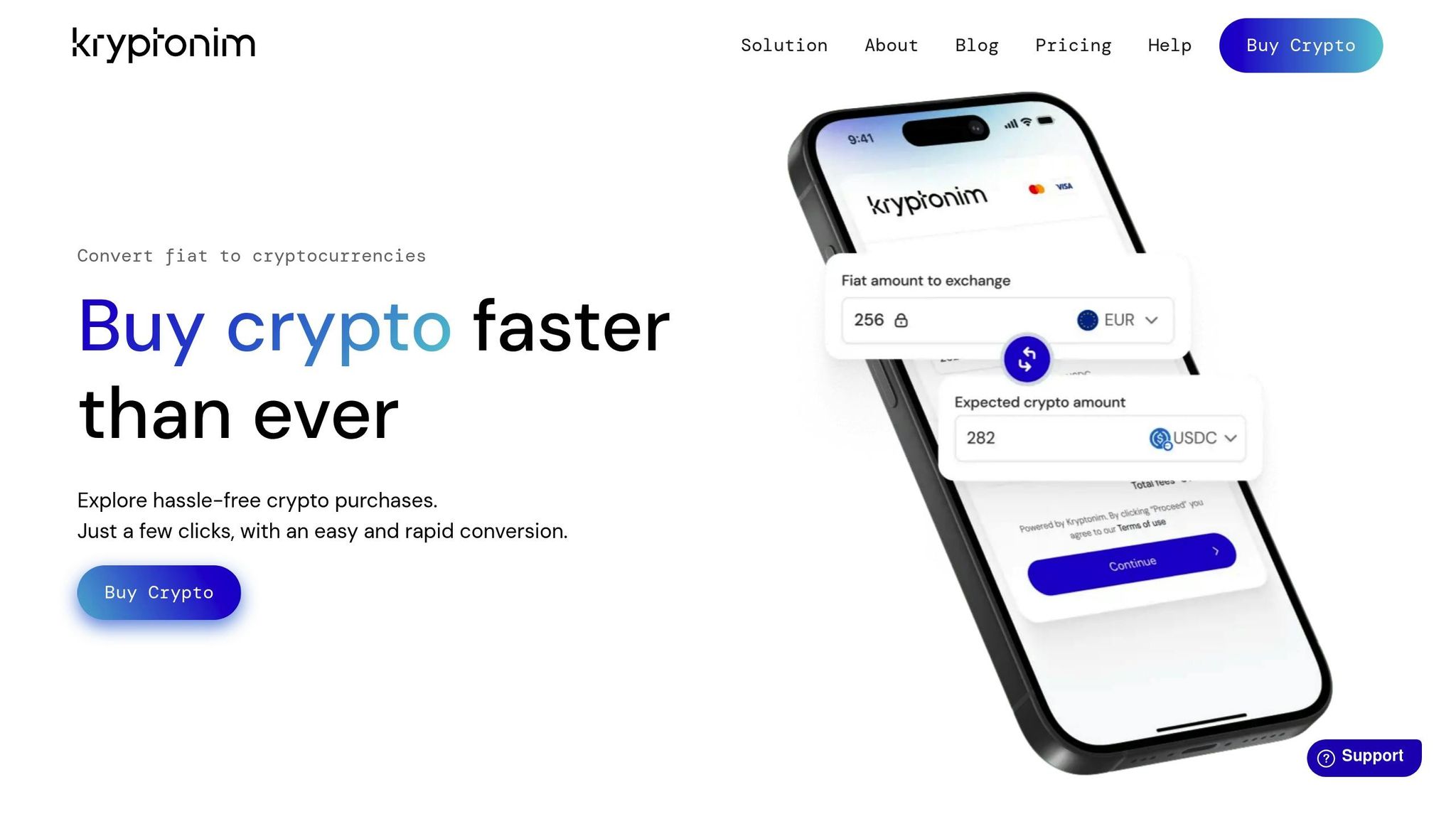
When it comes to platforms, Kryptonim stands out. Operating under EU regulations, it ensures that your personal data is protected under the General Data Protection Regulation (GDPR). Additionally, all transactions are carefully monitored for suspicious activity, adding an extra layer of security. For EU users, Kryptonim charges a straightforward 2% per transaction and skips the hassle of account setup, making fiat-to-crypto transactions both secure and simple.
"By following these regulations and scoring a high level of compliance, cryptocurrency providers and organizations can start to bring some much-needed confidence to markets, which are still considered largely volatile." – Kaspersky
Before committing to any platform, take the time to confirm its regulatory status. Make sure it explicitly complies with EU standards like GDPR and the Anti-Money Laundering Directive (AMLD). Regularly check for ongoing compliance and ensure withdrawal protocols are secure to keep your transactions safe.
Conclusion
Crypto transactions are permanent, and there's no way to reverse them or appeal to a central authority if something goes wrong. Unlike debit or credit card payments, crypto lacks fraud protection - once funds are lost, they’re gone for good. By following these seven practices, you can safeguard your assets in this self-managed and irreversible system.
High-profile breaches remind us that even the biggest platforms aren’t immune to attacks. The best way to protect yourself is by using a layered approach to security.
"Your wallet is your vault. Treat it with the same level of care you'd give to any valuable asset." – Crypto.com
While securing your devices and credentials is essential, the platform you use is just as important. Opting for a regulated platform adds an extra layer of protection. For example, EU-regulated exchanges like Kryptonim adhere to strict AML, CTF, and KYC guidelines, ensuring legal safeguards and GDPR compliance that unregulated platforms don’t offer. Kryptonim provides a secure option with EU regulation and competitive 2% transaction fees.
FAQs
What should I do if I used public Wi-Fi for a crypto transaction?
If you’ve used public Wi-Fi for a crypto transaction, it’s best to disconnect right away and avoid performing any more sensitive actions on that network. Change any passwords you entered during that session as a precaution. To boost security in the future, use a trusted VPN when accessing such networks. Keep an eye on your accounts for any unusual activity, and if necessary, move your assets to a safer option, like a cold wallet, to ensure their protection.
Which 2FA method is safest for crypto accounts?
The most secure two-factor authentication (2FA) methods for crypto accounts are hardware security keys (such as YubiKey or SoloKey) and passkeys that use WebAuthn technology. These methods are resistant to phishing attacks and remove the hassle of manually entering codes, offering top-tier protection.
How do I safely store my wallet recovery phrase?
To keep your wallet recovery phrase safe, write it down on paper right away and avoid saving it digitally - no emails, cloud storage, or any online platforms. For extra security, consider using waterproof and fireproof backups and store multiple physical copies in different secure places, like a locked safe. Most importantly, never share your recovery phrase with anyone and always keep it offline to guard against unauthorized access.