
Stablecoins 101: The Beginner's Guide to Euro and Dollar-Pegged Crypto
Stablecoins make fiat money programmable—learn how dollar and euro-pegged tokens work, their uses, risks, and safe ways to buy and store them.

Stablecoins are digital currencies designed to maintain a stable value by being pegged to fiat currencies like the US Dollar ($1.00) or Euro (€1.00). They combine the benefits of blockchain - such as fast, 24/7 global transfers - with the reliability of traditional money. Popular examples include USDT and USDC for dollar-pegged coins and EURS for euro-pegged options.
Key Takeaways:
- What Are Stablecoins? Cryptocurrencies that avoid volatility by staying tied to fiat currencies.
- How They Work: Most use fiat reserves (like cash or Treasury bills) to back each coin 1:1, ensuring stability.
- Types: Fiat-backed (most common), crypto-backed (e.g., DAI), algorithmic (e.g., UST, now defunct), and commodity-backed (e.g., PAX Gold).
- Top Stablecoins: USDT (Tether) leads the market, USDC is known for transparency, and EURS is a top euro-pegged option.
- Use Cases: Trading, cross-border remittances, and everyday payments, offering faster and cheaper transactions compared to traditional systems.
- Risks & Benefits: While stablecoins provide low fees and fast transfers, risks include de-pegging and regulatory challenges.
Stablecoins are transforming finance by making transactions faster, cheaper, and more accessible. Whether you're trading, sending money abroad, or looking for a digital cash alternative, they offer a practical entry point into crypto. Platforms like Kryptonim simplify buying, storing, and using stablecoins, making it easier to get started.
How Stablecoins Maintain Their Value

Comparison of Stablecoin Mechanisms: Fiat, Crypto, Algorithmic, and Commodity-Backed
Stablecoins use various strategies to keep their value pegged to a specific currency like the US dollar ($1.00) or the euro (€1.00). The most widely used method - accounting for about 95% of all stablecoins - is fiat-collateralization. This approach involves the issuer holding one unit of fiat currency (such as a dollar or euro) in reserve for every stablecoin issued. When someone redeems a stablecoin for fiat, the corresponding digital token is destroyed, ensuring the total supply mirrors the reserves.
Arbitrage plays a key role in maintaining the peg. If the price of a stablecoin drops below $1.00, traders can buy the discounted tokens and redeem them for fiat at full value, pocketing the difference. Conversely, if the stablecoin trades above $1.00 (e.g., $1.02), arbitrageurs can mint new tokens at $1.00 and sell them at the higher price. This increases supply, pushing the price back to its target.
Other models use similar principles but with unique twists. Crypto-collateralized stablecoins like DAI are backed by volatile cryptocurrencies (e.g., Ethereum). To account for price swings, these stablecoins require over-collateralization - depositing $150 in ETH to mint $100 worth of stablecoins, for instance. Meanwhile, algorithmic stablecoins rely on smart contracts to adjust supply automatically based on demand. However, this model has shown vulnerabilities. In May 2022, TerraUSD (UST) collapsed, plummeting from $1.00 to $0.10 and wiping out $45 billion in value in a single week.
"Stablecoins rely on stabilization tools such as reserve assets or algorithms that match supply and demand to try to maintain a stable value."
- Wikipedia
Commodity-backed stablecoins, like PAX Gold, are tied to physical assets such as gold. While they can act as a hedge against inflation, their centralized storage and limited practicality for everyday transactions make them less useful for routine payments.
Comparison of Stablecoin Mechanisms
| Type of Mechanism | Backing Asset | Popular Examples | Strengths | Risks |
|---|---|---|---|---|
| Fiat-Collateralized | Cash, T-bills, Bank deposits | USDT, USDC, EURS | Easy to understand, highly stable, liquid | Centralized custody; trust in issuer |
| Crypto-Collateralized | ETH, BTC, other tokens | DAI, USDS, GHO | Decentralized, transparent on-chain data | Capital inefficiency; risk of liquidation |
| Algorithmic | None (Code-based) | USDD, UST (defunct) | Capital efficient, fully decentralized | High risk of collapse ("death spirals") |
| Commodity-Backed | Physical Gold | PAX Gold, Tether Gold | Tangible backing, inflation protection | Centralized storage; limited daily use |
For newcomers, fiat-backed stablecoins are the easiest to grasp. They’re widely accepted, backed by familiar assets like bank-held dollars or euros, and offer a straightforward way to enter the world of digital currencies.
sbb-itb-0796ce6
Popular Euro and Dollar-Pegged Stablecoins
The stablecoin market is highly concentrated, with just two assets - USDT and USDC - accounting for 90% of the total market capitalization. While dollar-pegged stablecoins dominate 97% of the fiat-backed market, euro stablecoins like EURS are becoming increasingly popular among European businesses aiming to avoid currency conversion risks.
Here’s a closer look at USDT, USDC, and EURS, along with what sets them apart.
USDT (Tether)
USDT leads the stablecoin market with a market cap ranging from ~$177–186 billion as of early 2026. Issued by Tether Limited, it maintains a 1:1 peg to the U.S. dollar and is primarily backed by U.S. Treasury bills, which make up 63.42% of its reserves (equivalent to $122.33 billion). As of December 31, 2025, Tether reported total reserves of $192.88 billion, which also included $17.45 billion in precious metals and $8.43 billion in Bitcoin.
USDT is a favorite among global traders due to its liquidity. It’s widely used as a trading pair on exchanges and serves as collateral for derivatives like perpetual swaps. Many traders prefer it for high-volume, low-cost transfers, especially on Tron (TRC-20), which offers faster settlements and lower fees compared to Ethereum.
However, USDT faces growing challenges in Europe. By July 1, 2026, EU-regulated exchanges will no longer be allowed to offer USDT trading, as it does not comply with the Markets in Crypto-Assets (MiCA) framework. Major platforms like Coinbase Europe, Binance, and Kraken have already restricted or delisted USDT for European users. Tether also faced scrutiny in the past, including a $41 million fine from the CFTC in 2021 for misrepresenting its reserves, which were fully backed only 27.6% of the time between 2016 and 2018.
"USDT is a blockchain-based digital token issued by Tether Limited that is designed to track the value of one U.S. dollar."
- Devansh Juneja, Education Lead, Coin Bureau
Best for: Active traders seeking high liquidity on global exchanges and users needing low-cost, high-volume transfers on networks like Tron.
USDC (USD Coin)
USDC is a regulated alternative to USDT, issued by Circle and pegged 1:1 to the U.S. dollar. Its market cap reached approximately $75–78 billion by early 2026, reflecting a 73% year-over-year increase. Unlike USDT, USDC is fully backed by liquid cash and short-term U.S. Treasuries, held in regulated institutions. Circle provides monthly attestations from Big Four accounting firms and daily reserve updates.
USDC’s strength lies in its regulatory compliance. In July 2024, Circle became the first global stablecoin issuer to meet MiCA requirements, obtaining an e-money institution (EMI) license from France’s ACPR. It is also fully compliant with the U.S. GENIUS Act, making it a top choice for institutional investors and European traders. Additionally, USDC is available on 30 blockchain networks as of February 2026, including Ethereum, Solana, and Polygon.
USDC’s transparency was tested in March 2023 when it briefly de-pegged to $0.87 after Circle disclosed that $3.3 billion of its reserves were held at the collapsed Silicon Valley Bank. The peg was restored within 48 hours after U.S. regulators guaranteed deposits, and Circle’s CEO confirmed full reserve coverage.
"Issuance and redemption is constrained by the working hours of the U.S. banking system."
- Jeremy Allaire, CEO, Circle
USDC’s focus on compliance and transparency makes it a dependable option for users prioritizing these attributes.
Best for: Institutional investors, EU-based users, DeFi participants, and anyone focused on regulatory compliance and transparency.
EURS
EURS (STASIS EURO) is the leading euro-pegged stablecoin, maintaining a 1:1 peg to the euro. Fully regulated within the EU, it is backed by liquid euro reserves held in partner financial institutions. This eliminates EUR/USD currency risk for businesses and individuals transacting in euros.
One standout feature of EURS is "delegated payments", which allows users to cover transaction fees in EURS instead of native blockchain tokens like ETH. This simplifies the process for users who don’t want to manage multiple cryptocurrencies. EURS is available on more than five blockchains, including Ethereum and Polygon, and offers regular transparency reports audited by BDO.
Although EURS holds a smaller share of the stablecoin market compared to dollar-pegged options, it is gaining traction among European businesses and merchants. Its full compliance with MiCA ensures it remains accessible on EU-regulated platforms, even after the July 2026 deadline that restricts USDT.
Best for: European businesses and users conducting euro-denominated transactions, as well as those seeking a regulated euro stablecoin.
Use Cases for Stablecoins
Stablecoins have moved far beyond their early days as speculative assets, now playing a central role in everyday financial transactions. By 2024, their total transaction volume had surpassed $30 trillion - outpacing Visa's global payment volume during the same period. Thanks to their consistent value, stablecoins are being used in areas such as trading, remittances, and daily payments.
Trading and Investments
On most cryptocurrency exchanges, stablecoins act as the primary "quote currency." This allows traders to seamlessly switch between assets like Bitcoin and Ethereum without needing to convert back to traditional currencies, maintaining efficiency through their stable value. During market volatility, many investors turn to stablecoins to protect their funds, avoiding the delays and fees tied to bank transfers.
Stablecoins are also essential in decentralized finance (DeFi). They are used as collateral for loans, facilitate borrowing, and power liquidity pools that often offer yields between 5% and 8%. This liquidity management system ensures funds remain active and accessible without delays.
But stablecoins aren't just for trading - they're transforming how people send money across borders.
Cross-Border Remittances
Traditional remittance methods are often slow and expensive, with average fees of 6.49% and settlement times ranging from 1 to 5 business days when using SWIFT networks. Stablecoins provide a faster, more affordable alternative. The process involves converting fiat currency into crypto, transferring it via blockchain, and then converting it back into the local currency. This approach avoids the need for intermediary banks and their time-consuming compliance checks.
"The difference between you and your grandpa in moving money from Mexico to Vietnam is USDT & USDC."
- Sankrit K., Transak
By using stablecoins, fees drop by over 75%, with costs falling below 1%, and transfers settle in just minutes. These transactions operate 24/7, free from the constraints of traditional banking hours. By 2025, 26% of U.S. remittance users had adopted stablecoins, with usage rates at 28% in Nigeria and 12% in Argentina.
The same speed and affordability that make stablecoins ideal for remittances also make them a practical option for everyday spending.
Everyday Payments
Stablecoins combine the reliability of fiat currency with the speed and accessibility of blockchain technology, making them a convenient form of digital cash. They are increasingly used for retail e-commerce, payroll for remote workers, and microtransactions that traditional payment systems struggle to handle affordably. For merchants, blockchain transactions offer finality, eliminating the risk of chargebacks.
Businesses managing over $1 million in monthly international transactions are 92% more likely to use stablecoins, and first-time buyers are adopting them at twice the usual rate. In countries with high inflation, stablecoins serve as a practical alternative to unstable local currencies. Major payment processors like Stripe, Visa, and Mastercard have already integrated stablecoin settlement into their systems. With blockchain platforms like Solana enabling transaction speeds as fast as 400 milliseconds, stablecoins are now equipped to support real-time commerce on a large scale.
Benefits and Risks of Stablecoins
Stablecoins bring clear advantages to the table, but they also come with notable risks. Knowing both sides helps users make more informed choices.
On the benefits side, stablecoins allow for fast, 24/7 transactions, often at costs below $1. Compare that to the $9.61 average fee for sending $200 through traditional remittance channels. They also open doors to digital finance for the 1.4 billion adults worldwide who remain unbanked. As Patrick Collison, CEO of Stripe, explains:
"Transactions typically clear in minutes, regardless of banking hours or national holidays. This frees up cash that would otherwise sit idle in transit".
But there are risks to consider. A major one is "de-pegging", where a stablecoin fails to maintain its $1.00 value due to poorly managed reserves or market panic. History has shown that even well-known stablecoins are not immune to temporary de-pegging events.
Transparency and regulation add another layer of complexity. Regulatory actions in the past have highlighted transparency issues among stablecoin issuers. New rules, like the GENIUS Act passed in July 2025 and the EU's MiCA framework, now mandate strict 1:1 reserve backing and monthly reporting. However, regulatory uncertainty still poses challenges for both issuers and users.
The table below summarizes the key benefits and risks of stablecoins:
Pros and Cons of Stablecoins
| Aspect | Benefits | Risks |
|---|---|---|
| Stability | Maintains a steady value pegged to USD or Euro, avoiding crypto volatility. | Risk of de-pegging if reserves are poorly managed or confidence erodes. |
| Speed | Transactions clear in minutes, available 24/7/365. | Irreversible transfers, leaving no recourse for errors or fraud. |
| Cost | Fees typically under $1, compared to $9.61 for traditional remittances. | Blockchain "gas fees" can spike during network congestion. |
| Transparency | On-chain verification and monthly reserve audits for major stablecoins. | Some issuers lack full transparency or independent third-party audits. |
| Regulation | Frameworks like MiCA and the GENIUS Act enhance consumer protections. | Uncertainty in regulations may lead to sudden changes or additional compliance burdens. |
To reduce risks, stick with stablecoins backed by high-quality reserves such as cash or short-term U.S. Treasuries, and ensure they undergo regular third-party audits. Diversifying your holdings across multiple reliable stablecoins can also provide added security. Always keep an eye on the regulatory landscape to ensure the stablecoins you use comply with local laws.
How to Buy, Store, and Use Stablecoins on Kryptonim
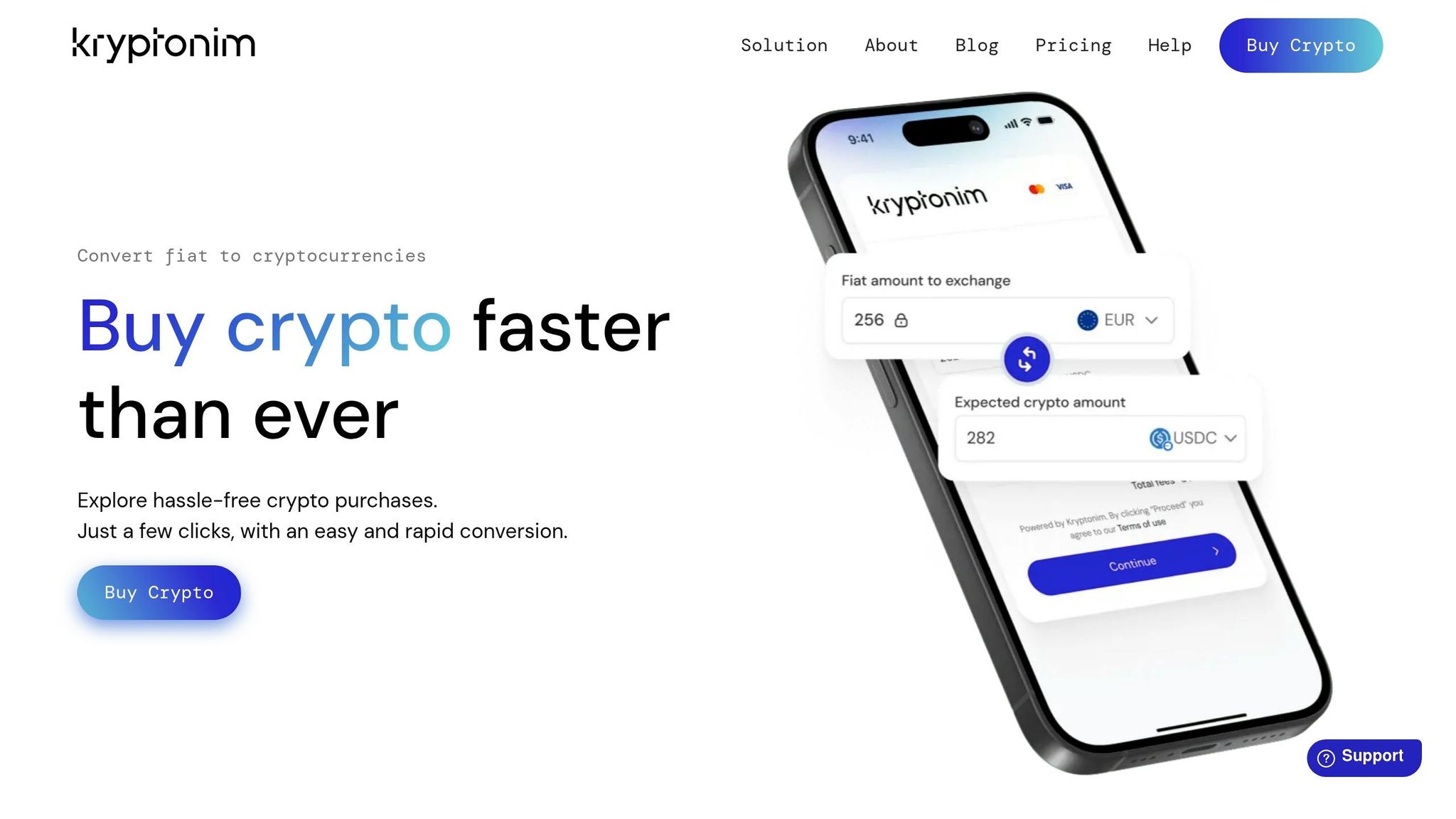
Getting started with stablecoins has never been easier. Kryptonim makes the entire process - from purchase to practical use - simple and fast, all while adhering to an EU-regulated framework that prioritizes transparency.
Buying Stablecoins
Kryptonim eliminates the hassle of lengthy sign-ups with its no-account purchase process. Here’s how it works: head to the Kryptonim website, use the currency converter, select the fiat amount you want to exchange, choose your preferred stablecoin (USDT, USDC, or EURS), pick a payment method (credit/debit card or local option), and provide your destination wallet address. That’s it! Your stablecoins will arrive in your wallet within minutes.
Kryptonim’s pricing is straightforward - EU users pay a 2% transaction fee, while users outside the EU are charged 4%. The platform operates under EU regulations, aligning with MiCA standards. Fun fact: the euro-pegged stablecoin market saw a massive 600% growth between 2022 and 2026.
Once you’ve purchased your stablecoins, proper storage is key to keeping your assets secure.
Storing Stablecoins
Stablecoins purchased through Kryptonim are sent directly to your wallet address, so picking a secure wallet is essential. For frequent trading or daily transactions, non-custodial wallets like Trust Wallet, TronLink, or MetaMask are excellent choices. If you’re planning to hold your funds for the long term, hardware wallets like Ledger or Trezor offer the added security of keeping your private keys offline.
To ensure safety, write down your seed phrase and store it securely offline. Double-check that your wallet supports the correct network (e.g., TRC-20 addresses start with "T") and enable two-factor authentication. It’s also a good idea to test with a small transaction before transferring larger amounts.
Using Stablecoins
Once your funds are secure, you can use Kryptonim to put your stablecoins to work. For trading, transfer your stablecoins to exchanges where they can act as collateral or be swapped for other cryptocurrencies like Bitcoin or Ethereum.
For cross-border remittances, simply send stablecoins to the recipient’s wallet address - often shared via a QR code. The recipient can then convert the stablecoins into local currency using a local off-ramp. This method avoids traditional remittance fees, which average 6.49% globally and can climb as high as 8.78% in sub-Saharan Africa.
You can also use stablecoins for everyday payments, whether it’s paying international vendors or using crypto debit cards. Unlike traditional SWIFT transfers, which can take 2–5 business days and cost between $25 and $50, stablecoin transactions on networks like Polygon settle in under five seconds with fees typically below $0.01 - and they operate 24/7, even on holidays. By 2026, XRP-powered payment corridors were facilitating over $15 billion in monthly cross-border transactions.
Conclusion
Stablecoins have transitioned from niche tools to practical financial assets. By maintaining a 1:1 peg through fiat reserves, they combine the dependability of traditional currencies with the efficiency of blockchain technology. The numbers speak volumes: stablecoins facilitated an estimated $46 trillion in total transaction volume over a year, marking a 106% increase compared to the previous year.
Regulations like the 2025 GENIUS Act in the US and MiCA in the EU have introduced clear guidelines, including requirements for 100% reserve backing and consumer protections. These measures are helping stablecoins gain broader acceptance in mainstream finance. As Stablecoin Insider puts it:
"Stablecoins are no longer just a 'crypto thing' - they are the practical application of how stablecoins work to build a more efficient and open financial system for everyone".
Stablecoins offer a practical solution for various financial needs: reducing remittance fees, trading crypto without converting to fiat, or sending money internationally in minutes instead of days. To ensure safety and transparency, consider regulated options like USDC or EURS, which provide monthly public reserve reports.
Platforms like Kryptonim simplify the entire process. With features like no-account purchases, EU-regulated operations, and competitive pricing, Kryptonim makes buying, storing, and using stablecoins quick and hassle-free. The platform handles every step, from purchase to delivery, in just minutes - letting you focus on using your stablecoins instead of navigating complicated onboarding.
For new users, start small, secure larger amounts in hardware wallets, and always double-check wallet addresses. With Kryptonim's streamlined approach, stablecoins can become a useful addition to your financial toolkit.
FAQs
What happens if a stablecoin loses its $1.00 or €1.00 peg?
When a stablecoin strays from its $1.00 or €1.00 peg, it can shake confidence and create instability. Stablecoins rely on reserve assets or algorithms to keep their value steady, so losing that peg can lead to depegging or even collapse. This can reduce their effectiveness for trading, payments, or other uses.
Which stablecoin is safer for me: USDT, USDC, or EURS?
USDC stands out as a trusted choice because of its clear transparency, regulatory compliance, and fully audited reserves. On the other hand, while USDT enjoys widespread popularity, it has faced criticism regarding its reserve backing and lack of transparency. EURS, which is tied to the euro, is less commonly discussed and doesn't enjoy the same level of prominence. For those prioritizing reliability and stability, USDC tends to be the go-to option.
How do I avoid sending stablecoins on the wrong network?
When transferring stablecoins, it's crucial to verify the network compatibility beforehand. Always double-check the network selection in your wallet or platform - whether it's Ethereum, Binance Smart Chain, Solana, or another option - and make sure it matches the recipient's network. Stablecoins like USDT and USDC function across multiple chains, so confirming both the recipient's address and the correct network is essential to avoid losing funds permanently.