
SOC 2 Reports in Crypto Platforms: Buyer Guide
Treat SOC 2 as proof of controls, not licensing; prioritize Type II, access controls, monitoring, scope, and reports within 12 months.
If I’m checking a crypto platform, I treat a SOC 2 report as proof of controls - not proof of a license, low risk, or safe assets. That’s the big takeaway.
Here’s what I’d look at first:
- Type II beats Type I for most buyers because it tests whether controls worked over time, often 6 to 12 months
- Security is always in scope, but Availability, Processing Integrity, Confidentiality, and Privacy may not be
- I’d check the report date and want it to end within the last 12 months
- I’d read the opinion, test results, and each exception, not just the SOC 2 badge
- I’d compare the report to the platform’s public claims about MFA, logging, incident response, KYC, and uptime
- If there’s a gap after the report period, I’d ask for a bridge letter
In simple terms: a SOC 2 report helps me judge how a platform handles access, logs, alerts, and customer data. It does not confirm legal permission to operate, price quality, or investment safety.
Quick comparison
| Item | What I’d want |
|---|---|
| Best report type | SOC 2 Type II |
| Best report age | End date within the last 12 months |
| Must-check controls | MFA, RBAC, least privilege, offboarding, log reviews, incident response |
| Must-check scope | Whether Availability, Processing Integrity, Privacy, and Confidentiality are included |
| Main red flags | Old report, scope gaps, weak access language, exceptions on login controls or offboarding |
| What SOC 2 does not prove | Licensing, registrations, asset safety, returns, or pricing |
A short example helps: a platform can have a SOC 2 report and still need separate money transmitter or virtual-asset registrations. Those are different checks, and I’d review both.
sbb-itb-0796ce6
Type I vs. Type II: which report type matters more to buyers
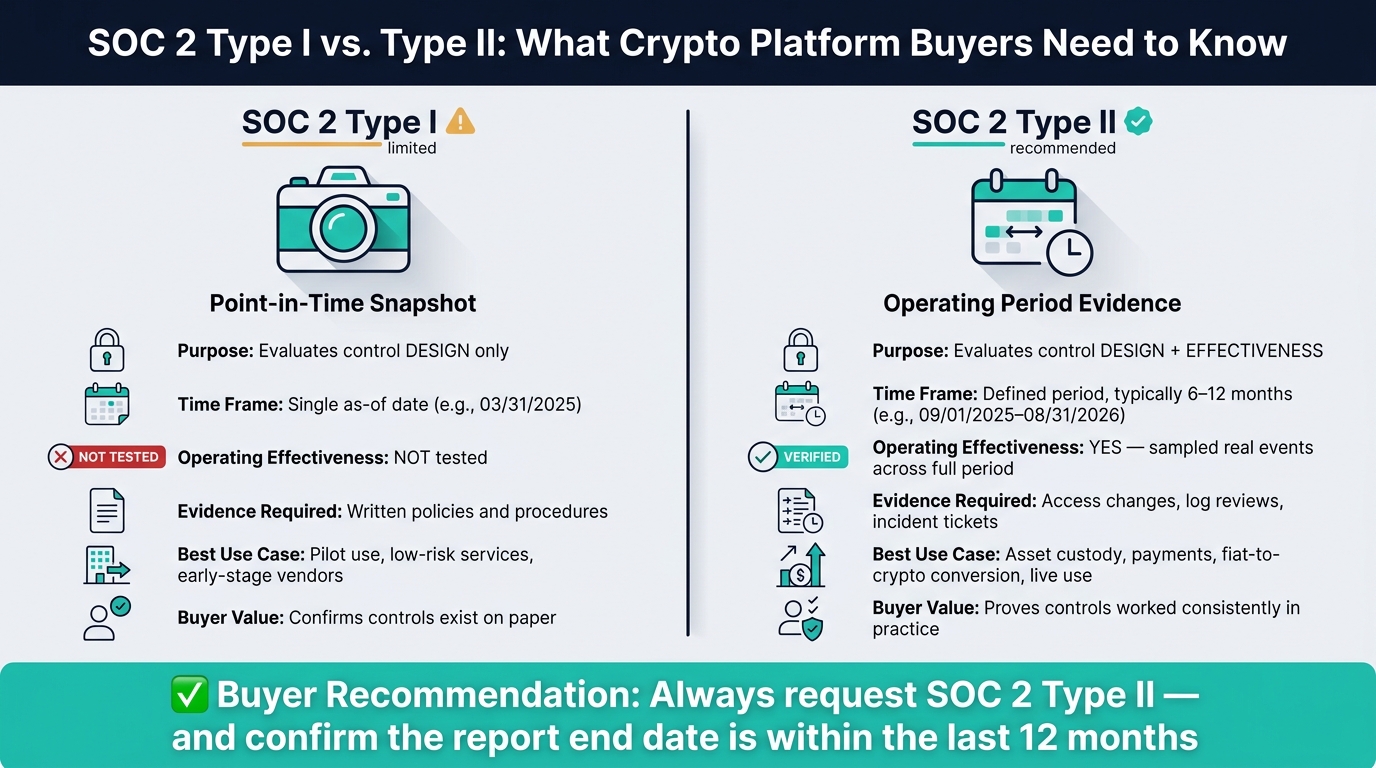
SOC 2 Type I vs Type II: What Crypto Platform Buyers Need to Know
Type II matters more for buyers.
That’s because buyers usually want more than a nice-looking control setup on paper. They want proof that the platform actually followed those controls over time.
Type I: control design checked at a single point in time
A SOC 2 Type I report looks at whether controls were designed the right way on one specific date. Think of it like a snapshot. The auditor reviews the control framework on, say, 03/31/2025, confirms the design makes sense, and issues an opinion.
But here’s the catch: Type I doesn’t show whether the company kept following those controls after that date.
A platform might have a documented access management policy that looks solid in the report. Yet in day-to-day use, that same platform could still apply access rules unevenly. Type I won’t show that gap. That’s a big reason buyers tend to put more weight on Type II.
Type II: whether controls worked over a set time period
A Type II report goes one step further. Auditors test whether controls worked over a set period, usually 6 to 12 months.
So if a report covers 09/01/2025 to 08/31/2026, auditors didn’t just review policies. They sampled actual events across that full period, like:
- access changes
- log reviews
- incident tickets
In plain English, they need operating evidence, not just written procedures.
Use a report that ended within the last 12 months so it lines up with current operations. Then look at which controls the auditor tested.
Comparison table: Type I vs. Type II for platform review
| Feature | SOC 2 Type I | SOC 2 Type II |
|---|---|---|
| Purpose | Evaluates control design at a single point in time | Evaluates design and operating effectiveness over a period |
| Time frame | Single as-of date (e.g., 03/31/2025) | Defined period (e.g., 09/01/2025–08/31/2026) |
| Operating effectiveness | Not tested | Yes - sampled testing of real events across the period |
| Buyer value | Confirms a sound control framework exists on paper | Provides evidence controls worked consistently in practice |
| Best use | Pilot use, low-risk services, or early-stage vendors | Asset custody, payments, fiat-to-crypto conversion, live use |
After you confirm the report type, check which controls were tested and whether they match the platform’s security claims.
What to look for inside a SOC 2 report
Once you confirm the report type, look at the controls that matter most. In practice, that means three things: access controls, monitoring and incident response, and which Trust Services Criteria are actually in scope.
Access management and authentication controls
This is the section buyers should study most closely.
Look for least privilege, role-based access control (RBAC), and multi-factor authentication (MFA) across all privileged access, not just standard user logins. A strong report spells out who approves access changes, how often access gets recertified, and how fast access is removed when someone leaves the company.
A weaker report tends to hide behind broad wording like access is restricted to authorized personnel. That sounds fine on the surface, but it doesn't tell you whether anyone is checking access on a set schedule or removing it with proof. That gap matters. Admin access can touch wallet operations, KYC records, and transaction approvals.
Check CC6.1 and CC6.2 to see whether the auditor actually tested those controls instead of just repeating management's description.
Monitoring, logging, and incident response
Here, you want to see centralized logging, clear alert thresholds, and proof that a security team reviews those alerts. Strong reports explain who monitors events, how often they do it, and what happens when an alert fires.
That should include events like:
- Failed logins
- Privilege escalations
- Unusual API activity
- Wallet actions
- Account takeover attempts
Incident response tells you a lot too. A written response plan is just the starting point. Better reports show that the plan was tested during the audit period, with named escalation roles, remediation tracking, and follow-up.
In crypto, slow detection of an account breach or an unauthorized wallet action can snowball fast into financial loss and reputational damage. That's why this section deserves a close read.
Trust Services Criteria included in the report scope
Security is required in every SOC 2 report. The other four criteria - Availability, Processing Integrity, Confidentiality, and Privacy - might be included, or they might not. The report should state this clearly.
For crypto platforms, that scope choice matters a lot.
If Availability is in scope, the report covers uptime practices, redundancy, and disaster recovery. If Processing Integrity is included, auditors tested whether transactions are processed completely, accurately, and on time. That's directly tied to deposits, withdrawals, and fiat-to-crypto conversions. If Privacy is in scope, the report addresses how personal data from identity verification is handled.
A report that covers Security alone does not tell you anything about those other risk areas. If it isn't listed, don't assume it's covered.
| Trust Services Criterion | What it covers | Why it matters for crypto |
|---|---|---|
| Security (mandatory) | Access controls, monitoring, system operations, change management | Core risk baseline for every platform review |
| Availability | Uptime, redundancy, disaster recovery | Critical for platforms where users need continuous access |
| Processing Integrity | Transaction accuracy, completeness, timeliness | Directly relevant to deposits, withdrawals, and conversions |
| Confidentiality | Protection of sensitive data | Important for sensitive operational and customer data |
| Privacy | Handling of personal data collected during KYC | Important when platforms collect IDs and verification documents |
Next, verify whether these controls line up with the platform's public security claims and the auditor's exceptions.
How to verify a SOC 2 report: a step-by-step process
Once you know which controls matter, verify the report line by line. A polished SOC 2 report can still hide weak controls. Check the evidence, not the badge.
Check the opinion, exceptions, and report period
Start with the auditor's opinion paragraph, usually in Section 1 or 2. An unqualified opinion is the strongest outcome. It means the auditor found the controls to be fairly presented and, for Type II, operating effectively within scope. A qualified opinion means the auditor found issues serious enough to call out, so read the basis for the qualification closely.
Then go to the tests of controls section, usually Section 4, and scan the Results column. Review every exception. Give extra attention to exceptions tied to:
- MFA enforcement
- Access provisioning
- Offboarding
- Log reviews
- Vulnerability remediation
- Incident response
These controls connect most directly to day-to-day risk on a crypto platform. And here's the part many teams miss: an unqualified opinion can still sit alongside individual exceptions. So don't stop at the opinion paragraph.
Next, check the report period dates. A Type II report should be current enough to reflect today's systems and controls. If there's a gap between the report end date and today, ask for a bridge letter that covers that period.
Read the Complementary User Entity Controls (CUECs) too. These are the controls the customer must run for the vendor's controls to stay effective. So if the report says you are responsible for managing your own API keys or limiting administrator access, those assumptions need to match your actual setup. Also check for any out-of-scope service providers or limits on what the audit covered.
Match the report against the platform's public security claims
Next, compare the report with the platform's security page. If that page talks up continuous monitoring, strong access governance, or formal incident response, those controls should appear in the report and be tested. If a claim isn't in scope, treat it as unverified. Put simply, a mismatch means the claim is unverified.
Use this checklist to compare the report with the platform's public claims.
Comparison table: what to verify in the report vs. on the platform
| Report Item | Why It Matters | Confirm in the SOC 2 Report | Confirm on the Platform's Public Site |
|---|---|---|---|
| Report Type | Determines whether operating effectiveness was tested | Look for an explicit SOC 2 Type II report and a recent operating period | Look for an explicit SOC 2 Type II statement and the report period, not just a badge |
| Coverage Dates | A stale report may not reflect current systems or staffing | The report period should be recent; if there is a gap, request a bridge letter | Compare the report timing against the latest security or privacy policy update |
| Criteria in Scope | Defines what was actually audited | Confirm which criteria are included | Match the audited scope to the platform's claims about uptime, transaction accuracy, data protection, or privacy |
| Access Controls | Helps prevent unauthorized access to funds, wallets, and customer data | Look for tested controls on MFA, least privilege, and access removal, and note any exceptions | Verify whether the platform publicly describes the security controls it says it uses |
| Monitoring | Shows whether threats are being detected and escalated | Confirm tests for log reviews, alerting, and incident response, not just a written policy | Match against claims of continuous monitoring or real-time threat detection |
| Opinion Status | The auditor's overall assessment of the control environment | Look for unqualified wording that indicates the controls were fairly presented and, for Type II, operated effectively | Cross-reference the report with the platform's security page, compliance statements, and other public disclosures |
Conclusion: using SOC 2 as one part of platform due diligence
Once you've checked the scope, exceptions, and report dates, use the document for what it actually shows. A SOC 2 report is an independent control attestation, not a license. It tells you how a platform protects data and systems. Licensing or registration, on the other hand, speaks to legal permission to operate. A platform can have both, and each answers a different question.
When you review the report, pay close attention to the controls that matter most: access management, authentication, and monitoring. Those areas are tied directly to how the platform protects customer data and day-to-day operations.
Next, compare the audit scope with the platform's public claims. Cross-check what the auditor tested against the platform's public security, AML/KYC, and compliance statements. If a platform says it has ongoing monitoring or identity verification, but those controls don't show up in the SOC 2 scope, treat those claims as unverified. Use SOC 2 alongside regulatory status and public disclosures to build a complete view.
FAQs
Does SOC 2 prove a crypto platform is legally licensed?
No. A SOC 2 report does not prove a crypto platform is legally licensed.
A SOC 2 report is a voluntary audit of internal controls. It looks at things like data protection, access rules, and monitoring. That points to a focus on security and day-to-day operations.
But legal licensing is a different matter. A platform still needs the right approval from the proper regulator to operate as a financial services provider.
When should I ask for a bridge letter?
Ask for a bridge letter if there’s a gap between the period covered by a platform’s latest SOC 2 report and the date of your review.
A bridge letter is a formal statement from management that says no major changes were made to security controls after the report’s end date. It helps you keep visibility into that gap until the next full report is issued.
What if a platform only has SOC 2 Security in scope?
If a platform only has SOC 2 Security in scope, the audit covers the Common Criteria for security. That usually includes areas like logical and physical access controls, system operations, and risk mitigation.
That points to a solid security baseline. But it does not give assurance for availability, processing integrity, confidentiality, or privacy. So it’s best to look at it in context, alongside other compliance measures, such as those maintained by Kryptonim.