
Cross-Border Crypto Privacy Laws Explained
How GDPR, AML rules, SCCs, BCRs and the EU Travel Rule shape cross-border crypto data transfers, platform duties, and user rights.
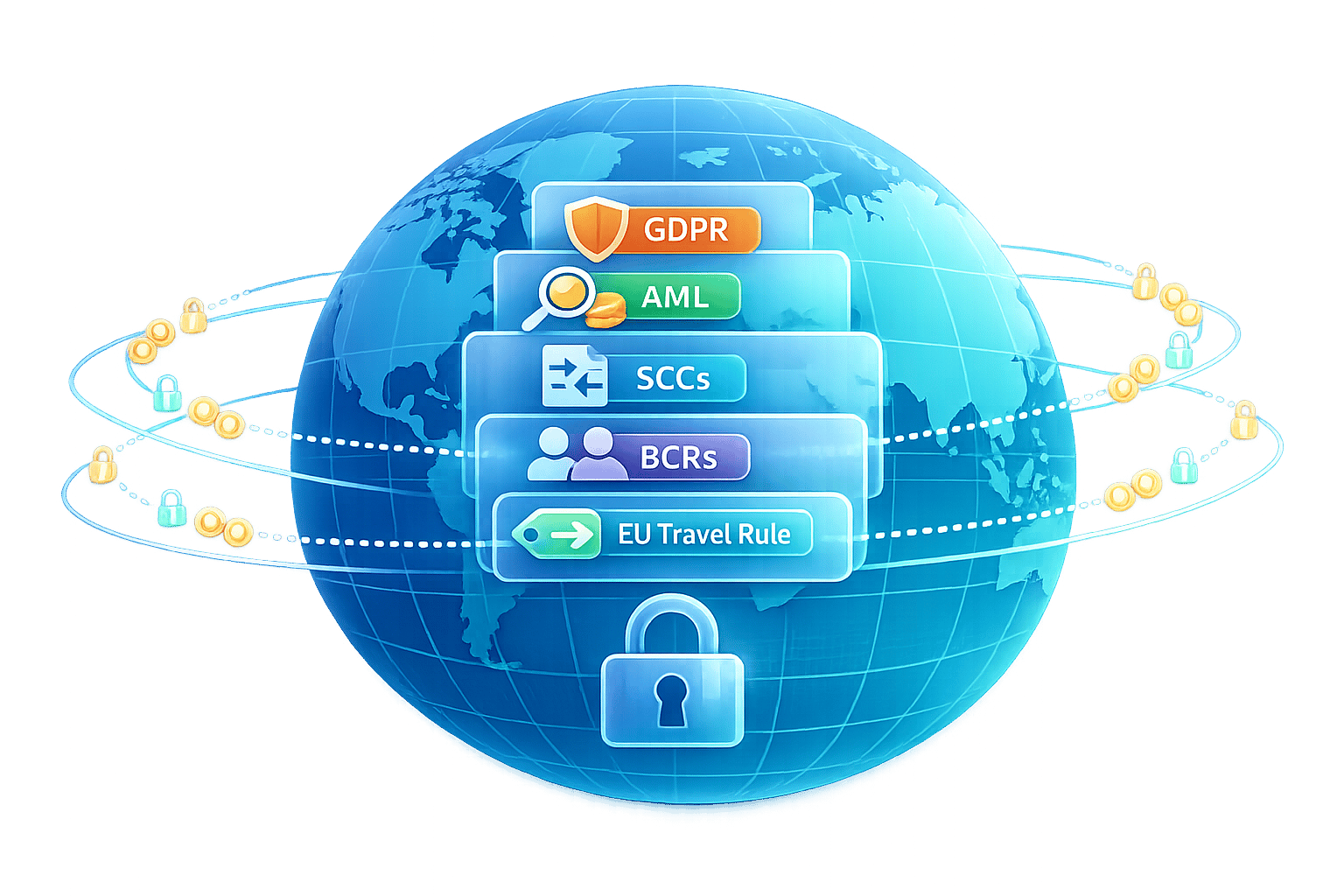
Cross-border crypto privacy laws determine how personal data is transferred and protected when it crosses national borders. These regulations impact both crypto platforms and users by enforcing strict rules to safeguard sensitive information. Platforms must comply with frameworks like GDPR in the EU, AMLR, and state laws in the U.S., while users should understand their rights regarding data collection and usage.
Key takeaways:
- Crypto platforms face complex global regulations: GDPR imposes fines up to €20M or 4% of global turnover for violations.
- Data transfer mechanisms include: Standard Contractual Clauses (SCCs), Binding Corporate Rules (BCRs), and adequacy decisions.
- User privacy rights: Access, correct, delete, or export data and object to automated profiling.
- New rules like the EU's Travel Rule (2024): Require identifying details for all crypto transactions.
Staying informed helps users protect their privacy and choose compliant platforms.
How Cross-Border Privacy Laws Affect Crypto Platforms

Cross-Border Crypto Data Transfer Mechanisms Compared
Crypto platforms cater to users across the globe, which means they must navigate a maze of regional privacy laws. These platforms store data internationally and operate in jurisdictions with unique regulatory requirements, creating a complex compliance landscape.
Key Privacy Frameworks That Apply to Crypto Platforms
Operating on a global scale means crypto platforms face some of the strictest privacy regulations out there.
One of the most impactful is the General Data Protection Regulation (GDPR). This EU regulation doesn’t just apply to European companies - it covers any platform offering services to EU residents, no matter where the company is based. This applies even to platforms providing easy crypto purchases for individuals across different borders. Non-compliance can lead to fines as high as €20 million or 4% of global turnover, whichever is greater.
The EU's Anti-Money Laundering Regulation (AMLR) also plays a significant role. It designates Crypto-Asset Service Providers (CASPs) as "obliged entities", meaning these platforms must conduct full Know Your Customer (KYC) checks. They are also required to retain transaction and identification records for at least five years after a business relationship ends.
In the United States, the regulatory landscape is more fragmented. There’s no overarching federal privacy law like GDPR. Instead, platforms must comply with state-level laws such as California's CPRA, alongside federal anti-money laundering (AML) requirements enforced by FinCEN. This patchwork of rules adds another layer of complexity for platforms serving American users.
"Every crypto payment your business receives now carries an identity paper trail, similar to what SWIFT transfers have carried for decades." - CoinGate
These regulations not only set the standards for compliance but also dictate how data can be transferred across borders.
Cross-Border Data Transfers in Crypto
When it comes to international data transfers, crypto platforms need clear legal mechanisms to stay compliant. Commonly used methods include adequacy decisions, Standard Contractual Clauses (SCCs), and Binding Corporate Rules (BCRs). Each approach has its pros and cons in terms of legal strength and operational effort:
| Mechanism | Legal Strength | Operational Complexity | Best For |
|---|---|---|---|
| Adequacy Decision (DPF) | Medium (subject to legal challenges) | Low | US-certified SaaS providers |
| Standard Contractual Clauses (SCCs) | High (with a TIA) | Medium | General transfers to third countries |
| Binding Corporate Rules (BCRs) | Very High | Very High | Large multinational groups |
| Derogations (Art. 49) | Low | High | Rare, one-off transfers |
Relying on a single mechanism can be risky. For instance, the EU-US Data Privacy Framework (DPF), which governs transatlantic data flows, is under legal scrutiny and could be invalidated at any time. As Morvantine highlighted:
"The prudent legal strategy is to treat the DPF as a convenience mechanism for the period during which it remains valid, while maintaining robust SCC and TIA infrastructure as the permanent baseline."
To mitigate risks, platforms are advised to treat the DPF as a temporary solution while establishing SCCs as their primary method for international data transfers. For countries without an adequacy decision, platforms must conduct Transfer Impact Assessments (TIAs). These detailed assessments ensure the destination country’s surveillance laws don’t undermine GDPR protections. Combining BCRs and SCCs can offer a more comprehensive solution for handling both intra-group and third-party transfers.
sbb-itb-0796ce6
Privacy Responsibilities for Crypto Platforms
Crypto platforms face strict requirements when it comes to handling user data, and these responsibilities must be seamlessly integrated into their operations.
Core Privacy Obligations
To comply with privacy laws, platforms should limit data collection to what’s absolutely necessary for their operations - like verifying identities or processing transactions. Any data collected must be used strictly for its original purpose. For instance, information gathered for Know Your Customer (KYC) checks cannot be repurposed for marketing unless there’s a separate legal basis.
Transparency is another key requirement. Platforms need to inform users whenever their data is transferred, explaining the safeguards in place and providing links to relevant legal documents. For example, under Article 13(1)(f) of the GDPR, platforms must specify the mechanism used for data transfers, such as Standard Contractual Clauses or adequacy decisions.
Additionally, users must have the ability to access, correct, delete, or export their personal data. They should also be allowed to object to automated profiling. Ensuring these rights are part of everyday processes is critical for staying compliant.
How Compliance Fits Into Platform Operations
Privacy responsibilities aren’t separate from a platform’s daily activities - they’re deeply tied to core functions. For example, KYC and Anti-Money Laundering (AML) checks require platforms to collect sensitive information, such as government-issued IDs and proof of address, under legal mandates.
The Travel Rule adds another layer of responsibility. Starting December 30, 2024, under EU Regulation 2023/1113, all Crypto-Asset Service Providers (CASPs) must gather and share identifying details for both senders and receivers in every crypto transaction, regardless of its value. As Manimama Law Firm highlights:
"Every crypto transaction - regardless of size - must now include identifying information about both the sender and the receiver."
These requirements demonstrate how privacy obligations are intertwined with the operational framework of crypto platforms.
What Crypto Users Should Know About Data Privacy
Before you share personal data on any crypto platform, it's crucial to understand your rights. Platforms operating under major regulations are required to clearly explain how they collect, use, and protect your information. This section builds on earlier discussions about platform responsibilities and focuses on what users should check to safeguard their own privacy.
Key Factors to Check Before Using a Crypto Platform
A trustworthy platform will offer a transparent privacy policy, including details like the legal entity's contact information and how they handle data protection. If these details are missing, consider it a warning sign.
Take a close look at the type of data the platform collects. Most platforms will mention categories such as:
- Identification Details: Name, email address.
- KYC/AML Information: Government-issued ID, date of birth.
- Financial Data: Wallet addresses, payment card details.
The platform should also explain the legal reasons for processing this data. These could include contractual requirements, legal obligations, or legitimate interests like fraud prevention.
Here’s a quick summary of the critical factors to review before committing to a crypto platform:
| Factor | What to Look For |
|---|---|
| Platform Regulation | Compliance with laws like GDPR, CCPA, or MiCA |
| Data Categories | Clear list of collected data, such as identification, KYC, and wallet addresses |
| Retention Periods | Specific timelines for data storage, often tied to tax, accounting, or AML requirements |
| Cross-Border Transfers | Safeguards like Standard Contractual Clauses (SCCs) for data sent outside regulated regions |
| User Rights | Options to access, correct, delete, or export your data |
| Third-Party Processors | Transparency about vendors (e.g., cloud storage or KYC services) that handle your data |
| Automated Profiling | Clear disclosure of any automated decision-making processes |
These elements are not just about trust - they're also essential for meeting regulatory requirements. For instance, if a platform moves your data outside the European Economic Area (EEA) or the United Kingdom (UK), it must specify the safeguards in place, such as SCCs or adequacy decisions. Without proper protections, platforms risk hefty regulatory fines.
Additionally, platforms often gather technical data like IP addresses and browser types. This should be disclosed in their privacy policy. If the platform uses automated decision-making, such as profiling, this information must also be clearly outlined. If no such processes are used, the platform should explicitly state that as well.
How Crypto Platforms Protect User Privacy
It's not enough to know what data is collected - what truly matters is how that data is protected day in and day out. Leading crypto platforms don't just meet privacy requirements on paper; they integrate technical and legal safeguards into their core operations to ensure user data remains secure.
Common Privacy Safeguards Used by Crypto Platforms
One of the primary tools for protecting user data is encryption, which secures information both during transmission and while it’s stored. This includes personal data gathered through cookies, system logs, and account details.
"Personal data from cookies is encrypted to prevent unauthorized access." - Kryptonim Privacy Policy
Platforms also rely on HTTPS protocols to secure communication between browsers and servers, effectively blocking interception attacks. On top of this, access controls restrict sensitive information to authorized personnel only, reducing the risk of internal misuse.
Another key practice is data minimization, which ensures that only the information necessary - such as that required for AML (Anti-Money Laundering) and KYC (Know Your Customer) compliance - is collected. This approach not only limits the scope of data held but also reduces the potential fallout in the event of a breach. For analytics, platforms often use anonymization, transforming user data into aggregated statistics to improve services while safeguarding individual identities.
When working with third-party vendors, such as cloud storage providers or KYC services, platforms conduct thorough vendor vetting. They establish data processing agreements that dictate how vendors handle user information, ensuring compliance with strict privacy standards. Many platforms choose infrastructure providers like AWS for their proven security measures.
| Safeguard | Purpose | Benefit |
|---|---|---|
| Encryption | Secures data during storage and transmission | Prevents unauthorized access to sensitive information |
| HTTPS Protocol | Protects browser-server communications | Blocks interception attacks during data transfer |
| Access Controls | Limits data access to authorized individuals | Reduces the risk of internal misuse or leaks |
| Vendor Vetting | Ensures third-party security compliance | Maintains privacy standards across the service chain |
| Data Minimization | Collects only essential information | Lowers privacy risks in case of a breach |
| Standard Contractual Clauses (SCCs) | Regulates cross-border data transfers | Provides consistent protection across jurisdictions |
| Transaction Monitoring | Flags suspicious or fraudulent activity | Boosts platform security and regulatory compliance |
These safeguards work hand-in-hand with broader compliance measures. Kryptonim, for instance, demonstrates a detailed and thorough approach to ensuring user privacy at every level.
Kryptonim's Approach to Privacy and Compliance
Kryptonim, a Warsaw-based Polish LLC, places a strong emphasis on privacy and compliance, adhering to the rigorous standards set by the EU's GDPR and MiCA regulations. These frameworks ensure users benefit from some of the most stringent data protection measures available.
A cornerstone of Kryptonim's strategy is its data minimization policy. The platform collects only what’s necessary - such as information for user identification, payment processing, and fraud prevention. Unlike many other platforms, Kryptonim avoids automated profiling, relying instead on human oversight to ensure accuracy in financial assessments.
For data transfers beyond the European Economic Area (EEA), Kryptonim uses established safeguards like Standard Contractual Clauses (SCCs), Binding Corporate Rules (BCRs), and adequacy decisions. These measures ensure compliance both locally and internationally. To handle specialized compliance needs, Kryptonim partners with industry experts:
| Partner | Role |
|---|---|
| Sumsub (Sum and Substance Ltd.) | Handles automated AML/KYC identity verification |
| Elliptic (Elliptic Enterprises Limited) | Manages blockchain analytics and transaction monitoring |
| Straal (Straal Ltd.) | Provides secure payment processing |
These collaborations help Kryptonim navigate complex regulatory requirements, including the EU’s Travel Rule (Regulation (EU) 2023/1113). This regulation, effective December 30, 2024, mandates the inclusion of identifying information for all crypto transactions, regardless of the amount - removing the previous €1,000 threshold.
Kryptonim ensures users maintain full control over their personal data. They can exercise rights like data portability, erasure, and objection to marketing-related processing by contacting [email protected]. The platform’s data processing policy was most recently updated on December 3, 2025.
Conclusion
Cross-border crypto privacy laws have reshaped how platforms operate and how users interact with them. Regulations like MiCA and the EU's Travel Rule now require identifying information for every transaction, with more than 60 jurisdictions committed to automatic data sharing. These shifts highlight the importance of using licensed platforms that ensure secure data transfers, protect user rights, and maintain strong AML/KYC processes.
Being aware of these laws is key to safeguarding your personal data and preventing unnecessary complications when transacting internationally. Before choosing a platform, verify its registration status, understand its data transfer protocols, and ensure it adheres to stringent AML/KYC policies.
As Manimama Law Firm aptly stated:
"The tension between transparency and data protection lies at the heart of this regulatory shift, redefining the operating environment for both crypto-asset service providers (CASPs) and their users."
Regulations are only set to become stricter. The MiCA transitional period for existing providers ends on July 1, 2026, and the first automatic exchange of crypto tax data among EU authorities is scheduled for 2027. Platforms that fail to prepare may face significant disruptions, while users who stay informed can better protect their data. Carefully evaluating platforms remains the best strategy for navigating these changes.
For example, Kryptonim complies with EU regulations, follows GDPR standards, and maintains transparency in how your data is managed at every stage.
FAQs
Does GDPR apply to me if I’m in the United States but use an EU crypto platform?
If you're in the U.S. and using an EU-based crypto platform, the GDPR still applies if the platform processes personal data of EU residents, provides services to them, or tracks their behavior within the EU. Your physical location doesn’t excuse you from complying with GDPR if these criteria are met.
Will the EU Travel Rule mean I can’t send crypto without sharing my identity?
The EU Travel Rule mandates that identifying details for both the sender and receiver must be included in cryptocurrency transactions. Essentially, this means that when using regulated platforms under this rule, sending crypto anonymously is no longer an option.
How can I tell if a platform’s cross-border data transfers are actually protected?
To ensure cross-border data transfers are secure, confirm that the platform adheres to regulations like GDPR and employs measures such as adequacy decisions, Standard Contractual Clauses (SCCs), or Binding Corporate Rules (BCRs). Additionally, verify if they've conducted a Transfer Impact Assessment (TIA) to assess the legal framework of the destination country. Look for safeguards like encryption or pseudonymization, which are critical for mitigating risks in line with the Schrems II ruling.