
How to Use Smart Contracts for Recurring Payments
Step-by-step guide to automating subscription billing with stablecoins and smart contracts — wallet setup, network choice, contract deployment, and security tips.

Smart contracts simplify recurring payments by automating transactions without relying on banks or payment processors. Once set up, they handle tasks like billing, payment processing, and access control - all through blockchain technology. This makes payments fast, transparent, and eliminates hidden fees often associated with traditional systems. Here's a quick overview of how to get started:
- What You Need: A crypto wallet, stablecoins (like USDC or USDT), and a small amount of blockchain-native tokens (e.g., ETH for Ethereum) for transaction fees.
- Why Use Stablecoins: They maintain a stable value, ensuring predictable payments, and reduce costs compared to credit card fees.
- Steps to Set Up:
Smart contract payments are secure, fast, and eliminate chargebacks. However, they require careful setup, including coding or using pre-built solutions, and ensuring your wallet is always funded. By leveraging stablecoins and cost-effective blockchain networks, you can reduce fees and streamline subscription payments.

5-Step Process to Set Up Smart Contract Recurring Payments
What You Need Before Setting Up Smart Contract Payments
To automate subscription payments using smart contracts, you'll need three key components: a crypto wallet, stablecoins for funding, and a secure method for purchasing cryptocurrency. These elements ensure seamless recurring payments on the blockchain.
Crypto Wallets and Their Role
A crypto wallet is essential for interacting with smart contracts. It stores your digital assets and allows you to sign transactions that authorize payments. Think of it as your digital bank account - only you hold the keys to access it.
Smart Contract Wallets (SCWs), such as Safe (formerly Gnosis Safe), Argent, or Ambire, offer advanced features that traditional wallets lack. These include session keys (temporary permissions for specific transactions), gas abstraction (letting you pay transaction fees in stablecoins like USDC or even have merchants cover them), and social recovery options, where trusted guardians can help you regain access if needed.
Here’s how the dRPC Team describes SCWs:
"A smart contract wallet is a new breed of blockchain wallet that uses on-chain logic instead of relying solely on a single private key".
One thing to note: unlike credit cards, which offer credit lines, your wallet must have enough funds at the exact moment the smart contract executes. Insufficient funds will result in payment failure.
Once your wallet is secure, the next step is ensuring stable and cost-effective transactions by using stablecoins.
Why Stablecoins Matter
Stablecoins are cryptocurrencies pegged to fiat currencies like the US dollar, making them ideal for recurring payments. Popular options include USDC (USD Coin) and USDT (Tether). These coins maintain consistent value, ensuring predictable transactions.
Stablecoins also come with several advantages:
- Lower transaction fees - often just a few cents compared to the 3%–7% charged by traditional payment processors.
- Instant settlements, available 24/7, unlike the 2–3 business day delays common in banking systems.
- No chargebacks, as blockchain transactions are final, reducing fraud and revenue loss.
- Accessibility for users in underbanked areas or regions with limited banking options - all that’s needed is a crypto wallet.
As of 2025, the combined market cap of stablecoins exceeds $280 billion, reflecting their widespread use.
Stripe highlights their utility:
"Stablecoins and smart contracts allow money to act more like software. A dollar-backed token can move across the world in minutes, and a few lines of logic decide when it settles".
Where to Buy Cryptocurrency
To fund your wallet, you'll need to purchase stablecoins. Platforms like Kryptonim (https://kryptonim.com), regulated in the EU, provide a secure and user-friendly way to buy crypto. You can easily convert fiat currency into stablecoins like USDC or USDT and transfer them to your wallet.
Additionally, ensure your wallet holds a small amount of the blockchain’s native token - such as ETH for Ethereum or POL for Polygon - to cover gas fees. With your wallet funded and ready, you can confidently set up automated recurring payments. Just keep an eye on your wallet balance to avoid interruptions.
sbb-itb-0796ce6
How to Set Up Recurring Payments with Smart Contracts
Automating subscription payments with smart contracts involves five key steps: buying cryptocurrency, selecting a blockchain network, deploying or connecting to a smart contract, authorizing the payment schedule, and managing your subscriptions. Each step builds on the last to create a seamless process.
Buying Cryptocurrency on Kryptonim
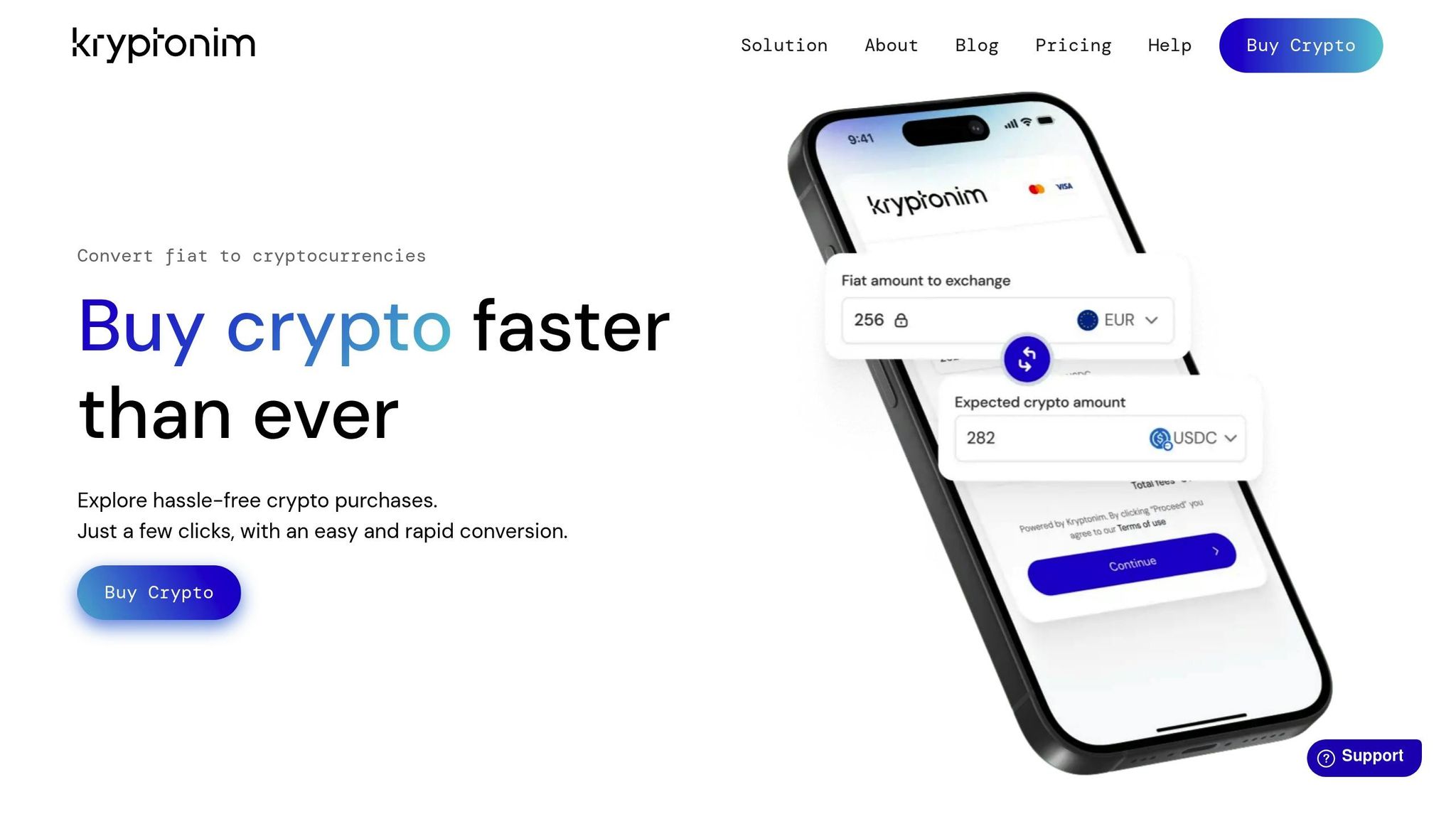
Start by purchasing stablecoins through Kryptonim (https://kryptonim.com), a secure platform regulated in the EU. This site makes it easy to acquire cryptocurrencies like USDC or USDT, which are commonly used for recurring payments. Simply visit the site, choose your stablecoin, and enter the fiat amount you'd like to convert (e.g., in USD). Kryptonim provides transparent pricing and competitive rates, with fees of 2% for EU users and 4% for others - lower than the 2.9% + $0.30 charged by traditional payment processors.
After completing your purchase, the stablecoins are sent directly to your wallet. Be sure to also buy a small amount of the blockchain's native token (like ETH for Ethereum) to cover transaction fees. Even on cost-efficient networks like Base, where fees are often under $0.01, this token is necessary to execute smart contract functions.
Choosing a Blockchain Network and Stablecoin
Select a blockchain network that supports smart contracts and offers affordable transaction fees. Layer 2 networks like Base and Arbitrum are excellent choices since their fees are much lower than Ethereum Mainnet. For example, Base transactions typically cost less than a penny, making it ideal for recurring charges.
For stablecoins, opt for an ERC-20 token like USDC or USDT. These tokens support the functions needed for automated payments, and their stable $1.00 value ensures predictable revenue without the volatility of other cryptocurrencies. Currently, about 32% of small businesses accept cryptocurrency payments, with USDC and USDT being the most popular options.
If you prefer using a network's native currency for subscriptions, you'll need its "wrapped" version, such as WETH (Wrapped Ethereum) or WMATIC (Wrapped Matic). As Unlock Protocol explains:
"Native tokens such as ETH are not ERC-20 tokens. That said, If you want to create recurring memberships in any chain's native currency, you can use the 'wrapper' version of that token, like WETH, or WXDAI or WMATIC."
Ensure your chosen network is compatible with automation tools like Chainlink Automation, which can trigger smart contract functions on schedule. Once your network and stablecoins are ready, you're set to create your subscription smart contract.
Creating a Smart Contract for Subscriptions
You can create your subscription smart contract by coding in Solidity with OpenZeppelin libraries or by using pre-built platforms. For those with development skills, writing a custom contract allows you to define subscription parameters and business rules. Key parameters include the start date, frequency, amount, and duration of payments. For instance, a $10 monthly subscription in USDC might run for 12 months, charging on the 1st of each month.
CRON expressions can be used to set precise schedules. For example, 0 17 * * 0 triggers payments every Sunday at 5:00 PM UTC. If coding isn’t your strength, tools like ChatGPT can convert plain English instructions into smart contract code. Alternatively, platforms with pre-built contracts offer user-friendly customization without requiring technical expertise.
Once your contract is ready, verify it on a blockchain explorer like Etherscan. Verification is essential for automation tools to access the contract's ABI, which is needed to trigger scheduled payments. Include functions to handle failed payments with retry logic, attempting transactions again at intervals (e.g., 1, 3, and 7 days) before canceling the subscription. After verifying your contract, you can move on to granting it permission to manage your funds.
Authorizing and Starting the Recurring Payment
Using your funded wallet and configured network, authorize the recurring payments. Start by sending an approve transaction for the total subscription amount. For example, if your subscription costs $10 per month for a year, approve $120 (12 months × $10). This ensures the contract can only access the necessary funds.
Next, sign an EIP-712 signature (a payment permit) to confirm your consent to recurring charges without sharing your private keys. As Jonathan Becker, a researcher, explains:
"This method of allowing smart-contracts to recursively call transferFrom(...) based on a timelocked proxy function enables subscriptions on the blockchain, one of the most important aspects when it comes to running a service or business."
This system is non-custodial, meaning you maintain full control over your funds and can revoke permissions anytime through your wallet.
Once authorized, the smart contract or a decentralized automation service (like Chainlink Automation, which requires LINK tokens for funding) will trigger payments at the specified intervals. The first payment usually processes immediately, with subsequent ones occurring automatically.
Tracking and Managing Your Subscription Payments
You can monitor your subscription payments through your wallet or a blockchain explorer. Most wallets display active subscriptions, showing details like the next payment date, amount, and remaining balance.
Set up notifications or reminders before each scheduled payment to ensure your balance is sufficient. If a payment fails, well-designed contracts will retry automatically at intervals before canceling the subscription.
Subscriptions can also be paused temporarily, allowing you to maintain customer relationships without fully canceling. To cancel permanently, revoke the token allowance through your wallet's permissions settings. This stops all future payments immediately, though processed payments are non-refundable - blockchain transactions cannot be reversed, eliminating chargebacks and disputes.
For tax purposes, keep detailed records of all subscription payments, noting their USD value at the time of each transaction. While many platforms offer automated tax reports that meet IRS requirements, maintaining your own documentation provides added security.
Pros and Cons of Smart Contract Recurring Payments
Grasping the advantages and challenges of smart contract-based recurring payments is key to managing subscription services effectively.
On the plus side, smart contract subscriptions offer global reach, instant settlements, and finalized transactions, which eliminate the risk of chargebacks and reduce disputes. Payments happen immediately, bypassing the delays often seen with traditional payment systems. Once a transaction is completed on the blockchain, it’s final - no reversals, no chargebacks.
However, there are some hurdles to consider. Payments via smart contracts depend on external automation or manual triggers to process transactions. If a user's wallet doesn’t have enough funds or gas tokens at the time of renewal, the payment fails instantly - there’s no backup like a credit line or grace period, as seen with traditional payment methods. Additionally, transaction costs can be higher, especially when handling complex subscription setups.
Stablecoins can address price volatility issues, but subscriptions tied to assets like ETH or BTC could see fluctuating values between billing cycles, potentially leading to unfavorable terms for either party. Beyond that, processes like wallet connections, EIP-712 signatures, and token allowance approvals add friction compared to the simplicity of one-click card payments.
Security is another concern. Allowing a smart contract to access your tokens could expose you to risks if the contract has vulnerabilities. That said, while traditional payment processors charge 3% to 5% per transaction, smart contracts can significantly cut these costs. With the subscription economy projected to exceed $1.5 trillion by 2030 and subscription-based businesses growing revenue five times faster than traditional models, the potential savings and scalability of smart contract payments are worth considering.
Smart Contract Auto-Debits vs Manual Payment Reminders
Here’s a breakdown of how smart contract auto-debits compare to manual payment reminders in terms of functionality and user experience:
| Feature | Smart Contract Auto-Debits | Manual Payment Reminders |
|---|---|---|
| Automation | Fully automated after setup; no user action needed. | Requires user action for every billing cycle. |
| Control | Users can grant and revoke token allowances anytime. | Full control, but with added complexity. |
| Failure Risks | Payments fail if wallet lacks funds or gas. | Payments fail if the user misses notifications. |
| Cost | Lower overhead; avoids 3%–5% gateway fees, though gas costs apply. | High card fees and potential chargeback costs. |
| Compliance | Terms are enforced programmatically with transparent on-chain records. | Relies on manual reconciliation and invoicing. |
| User Experience | "Set-and-forget" convenience, like popular subscription services. | More friction, often leading to higher churn. |
According to Loop Crypto, automating payments saves even small clients over 10 hours a month by reducing manual follow-ups for late and upcoming payments. Additionally, using off-chain automation tools for complex tasks can cut gas fees for maintenance by around 84%.
Security Tips for Recurring Payments
Once you've set up recurring payments, keeping your transactions secure should be a top priority. A key step is to use audited smart contracts. The risks are real - over $1 billion has been lost due to flaws in smart contract security. Notable incidents include the infamous 2016 DAO hack, where 3.6 million ETH was stolen, and the Parity multi-signature wallet hack, which resulted in $30 million in losses. Because smart contracts are immutable, any flaws in the code are permanent. This makes auditing your subscription smart contracts before deployment absolutely essential.
When auditing, work with reputable firms and use smart contracts built with well-tested libraries like OpenZeppelin for standard features. Incorporating multi-signature wallets (e.g., requiring 3-of-5 signatures) can also reduce risks by eliminating single points of failure. As ethereum.org emphasizes:
"Smart contract security is serious business... assets stolen from smart contracts are extremely difficult to track and mostly irrecoverable due to immutability".
These audits are just the first step in creating a robust security framework.
Operational Security Measures
After deployment, operational security becomes equally important. Start by keeping an eye on gas fees. Network congestion can cause payment failures, so set a maximum gas price to avoid processing payments during spikes. Also, ensure your wallet is always funded with enough ETH (or the required token) to cover both the subscription amount and gas fees. For added safety, enable email alerts to notify you if your automated payment contract is running low on funds.
Additional Safeguards
To further protect your funds, only grant token approvals to audited contracts. Vulnerabilities in a contract could allow attackers to drain your wallet. Opt for the "pull" payment model, where recipients actively claim their funds instead of receiving automatic transfers. Before committing funds, test the contract on a testnet like Arbitrum Sepolia to identify potential issues.
Lastly, choose contracts that include emergency stop functions (sometimes called circuit breakers). These features allow you to pause payments if vulnerabilities are discovered after deployment. Contracts should also emit events for key actions - like SubscriptionPaid or SubscriptionCancelled - so you can monitor transactions in real time.
Conclusion
Setting up recurring payments with smart contracts is a straightforward process. It starts with choosing a stablecoin-friendly platform that operates within regulatory guidelines. From there, you connect and authorize your wallet, define payment parameters, and keep an eye on transactions. Using stablecoins like USDC or USDT helps avoid the unpredictability of cryptocurrency price swings, making them ideal for subscription-based services. Plus, opting for networks like Polygon, Base, or Arbitrum can keep gas fees minimal - often as low as $0.01 per transaction - making monthly payments highly affordable.
Smart contracts can significantly reduce costs, cutting transaction fees by 60% to 80% compared to traditional payment processors, which typically charge around 2.9% plus additional fees . Payments are also much faster, settling in about 15 seconds compared to the 2–3 business days needed for standard bank transfers. Additionally, blockchain's irreversible transactions eliminate chargebacks, saving businesses from the average $84 dispute fees associated with such incidents.
Platforms like Kryptonim simplify the process further with transparent pricing - 2% for users in the EU and 4% for others - and no need for account setup.
Before launching, it’s crucial to test your setup thoroughly. Use a testnet to simulate transactions, rely on audited smart contracts for security, and set spending limits that typically cover 12 months of payments. Grace periods of 48–72 hours for failed payments are also a good practice, giving users time to top up their funds .
Smart contract-based recurring payments offer a modern alternative to traditional banking, delivering lower costs, faster settlements, and global accessibility . By choosing the right platform and implementing strong security measures, you can automate subscription payments in a way that’s both efficient and secure - unlocking the full potential of blockchain for your business.
FAQs
How do I stop a subscription once it’s active?
To cancel an active subscription through a smart contract, start by connecting your wallet to the platform or interface where the subscription was initially set up. Look for a cancel or revoke option within the contract's management tools and execute the action. In some cases, you can also manage subscriptions directly from your wallet. Completing this process will stop any future payments and remove the permissions associated with the subscription.
What happens if my wallet is short on funds or gas?
If your wallet doesn’t have enough funds or gas, the smart contract transaction won’t go through. Blockchain transactions rely on having a sufficient balance to cover the execution costs. This means recurring payments or subscriptions will remain unprocessed until your wallet has the required amount to complete the transaction.
How can I limit what a subscription contract can spend?
To manage spending in a subscription smart contract, you can implement safeguards like setting a maximum payment amount or using token allowances. A spending cap can be built directly into the contract's logic, ensuring that payments never go over a predefined limit. Alternatively, you can use an approval mechanism where users specify an allowance for the contract. This approach restricts the total funds the contract can access for recurring transactions, offering an extra layer of control.