
Sanctions Screening in Crypto: Ultimate Guide
Guide to screening customers, wallet addresses, and transactions against sanctions, handling alerts, and documenting decisions.
If I run a crypto platform with U.S. exposure, sanctions screening is not optional. I need to screen people, businesses, and wallet addresses before funds move, rescreen when lists change, watch transactions after the fact, and keep records for each alert and decision.
Here’s the short version:
- Sanctions screening checks who I can’t do business with
- In the U.S., OFAC is the main agency I need to watch
- I’m not only screening names. In crypto, I may also need to screen wallet addresses
- Screening happens at onboarding, at deposit and withdrawal, and after list updates
- Fuzzy matching helps catch aliases, misspellings, and name variations
- False positives are common, so human review matters
- Transaction monitoring helps spot signs of sanctions evasion after funds move
- If I find a match, I may need to hold, block, reject, freeze, or escalate
- I also need clear records, defined team roles, and filings like SARs when required
A few facts stand out:
- The OFAC SDN List can change daily or weekly
- High-priority alert reviews often aim for under 24–48 hours
- Wallet risk is not just direct. A wallet can show 1-hop or 2-hop links to sanctioned activity and still trigger review
I see this as a simple workflow:
- Check identity data
- Check sanctions lists
- Check wallet addresses
- Monitor transactions
- Review alerts
- Document every decision
This article explains that flow in plain English so I can see how sanctions screening works across a crypto compliance program.
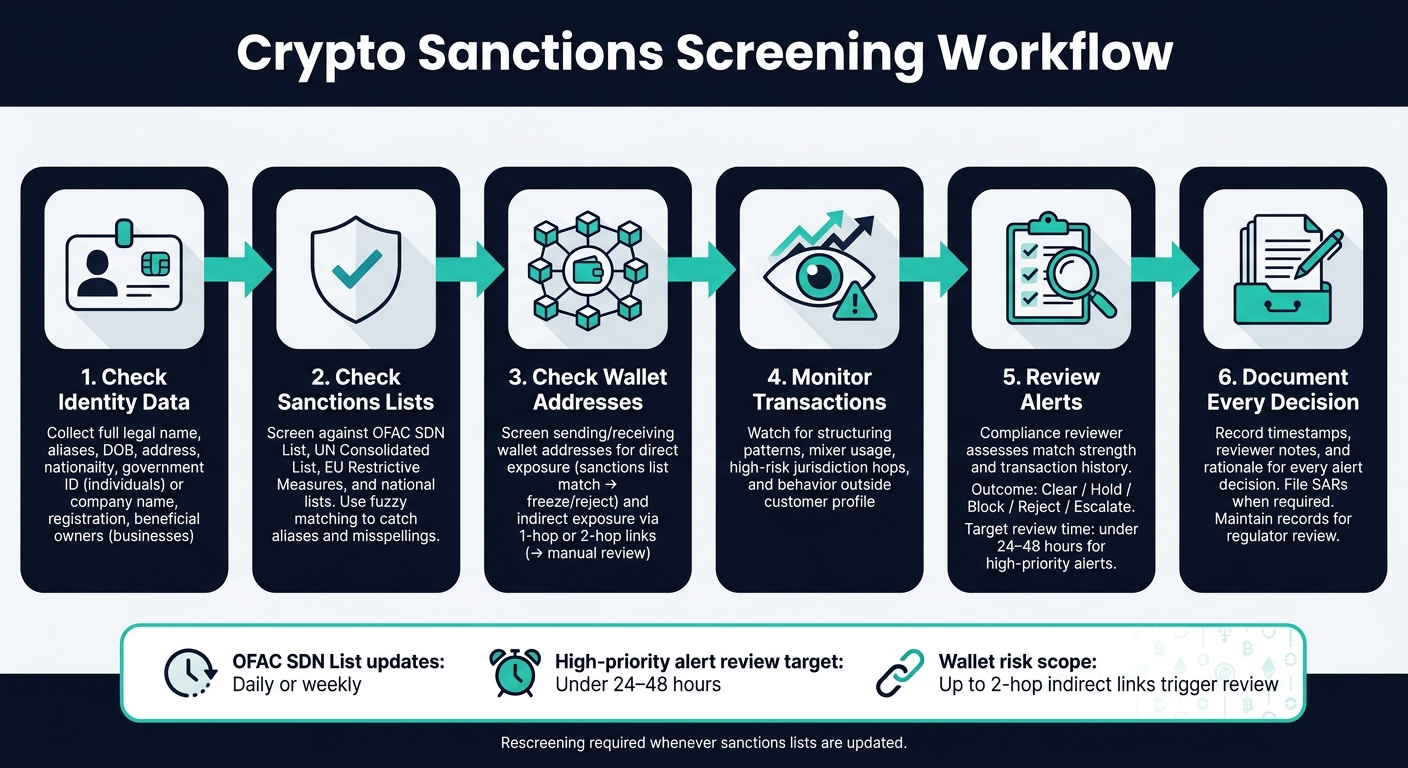
Crypto Sanctions Screening Workflow: Step-by-Step Compliance Guide
Sanctions Lists and Data Sources Crypto Platforms Use
Key Sanctions Lists and Watchlists to Screen Against
U.S.-focused crypto platforms screen against several sanctions lists because each one covers different people, places, and risk areas. They also change on different schedules, which matters a lot when you're dealing with crypto.
| List Source | Scope | Update Frequency | Why It Matters |
|---|---|---|---|
| OFAC SDN List | U.S. persons, entities, and anyone dealing with U.S. interests globally | Very high - often daily or weekly | Highest: Frequently lists specific crypto wallet addresses and exchanges |
| UN Security Council (UNSC) Consolidated List | Global; mandatory for all UN member states | Moderate - periodic committee meetings | Moderate: Focuses on terrorism and state-level proliferation |
| European Union Restrictive Measures | All EU member states and persons/entities doing business in the EU | High - frequent updates to restrictive measures | High: Strongly integrated with MiCA; targets crypto-asset service providers |
| National Lists (e.g., UK HM Treasury, South Korea FIU) | Specific to each jurisdiction's national security interests | Varies by country | Increasing: Local regulators may flag regional threats not yet recognized globally |
For platforms with U.S. exposure, the OFAC SDN List carries the most weight. It can include individuals, companies, exchanges, and even wallet addresses. That last part is a big deal in crypto. You're not just checking names on paperwork. In some cases, you're checking blockchain addresses too.
Because these lists can change often, manual review alone won't cut it. Most platforms use automated screening to keep up.
Still, the lists are only part of the picture. They work best when the platform matches them against verified identity data.
Customer and Business Data Points Used in Screening
For individual customers, platforms usually screen:
- Full legal name
- Aliases
- Date of birth
- Address
- Nationality
- Government ID
For business customers, the checks usually cover company name, registration details, country of incorporation, beneficial owners, and directors.
Sanctions screening also tends to sit next to two related controls. In broader compliance programs, many platforms pair it with PEP checks and adverse media checks. They sound similar on the surface, but they do different jobs.
That information then feeds into the onboarding and wallet checks described next.
sbb-itb-0796ce6
How Crypto Sanctions Screening Works in Practice
Screening Customers at Onboarding and After List Updates
At onboarding, a platform checks a customer's identity data against active sanctions lists before the account goes live. Until that screening clears, trading and transfers stay blocked.
In day-to-day use, platforms usually screen:
- customers at onboarding
- wallet addresses at deposit and withdrawal
- existing users again whenever sanctions lists change
One of the biggest friction points is name matching. Sanctioned people may use aliases, transliterations, or plain old misspellings. So most platforms rely on fuzzy name matching to spot names that are close, even when they aren't exact matches.
That doesn't mean the person is sanctioned. It means the system found a possible match that needs a human review. These are called false positives, and a compliance officer has to sort them out.
Sanctions screening also isn't a one-and-done task. Lists change often. So when a major list like the OFAC SDN List gets updated, platforms rescreen their current customer database against the new data. That helps them catch users who were cleared at onboarding but later become sanctioned.
After onboarding, the next check happens at the wallet level on every deposit and withdrawal.
Screening Wallet Addresses Before Deposits and Withdrawals
Identity checks by themselves don't cut it in crypto. A wallet address can still be tied to a sanctioned entity even if the person behind the account passes name screening. That's why platforms also screen the blockchain addresses involved in each deposit and withdrawal.
For an inbound deposit, the platform checks whether the sending wallet has any direct or indirect link to a sanctioned address. Direct exposure means the wallet itself appears on a sanctions list. Those cases usually lead to a freeze or rejection. Indirect exposure works differently. Those cases usually go to manual review.
Indirect exposure means the wallet received funds from a sanctioned address one or two transactions away in the transaction chain. This is where blockchain analytics tools do the heavy lifting. They trace a wallet's transaction history and map links to known sanctioned or high-risk services, mixers, darknet markets, or sanctioned exchanges.
If the system finds indirect exposure, the platform will usually send the transaction to manual review instead of rejecting it on the spot. That makes sense. Not every nearby connection means the wallet owner did anything wrong.
If a wallet clears screening, monitoring doesn't stop. The platform keeps watching account activity for new risks.
Where a Regulated Platform Fits Into the Workflow
A regulated platform builds identity checks, sanctions screening, and wallet screening into the fiat-to-crypto flow before funds move.
Then comes alert handling: how transaction monitoring flags activity, how reviewers clear false positives, and when a case needs to be escalated.
Transaction Monitoring, Alert Review, and Reporting
What Transaction Monitoring Looks for On-Chain
After wallet screening, platforms don't just stop and move on. They keep watching activity for patterns that may point to sanctions evasion. That’s the main difference with transaction monitoring: it doesn’t only check a wallet at one moment in time. It follows what happens after funds move.
On-chain, platforms often flag:
- Many similar transfers in a short time, which may suggest structuring or an attempt to hide activity
- Behavior that doesn’t fit the customer’s usual profile
- Use of mixers
- Repeated hops through high-risk jurisdictions
If sanctions action hits an exchange, platforms may need to act right away. That can mean blocking transactions at once, freezing assets, and applying closer monitoring.
How Alerts Are Reviewed and Resolved
When one of those patterns triggers an alert, the case moves into a documented review process. A compliance reviewer looks at the strength of the match, the customer’s transaction history, and any direct or indirect links to sanctioned entities. From there, the platform can clear the transaction, hold it, block it, reject it, or send it up to a senior compliance officer or legal team.
Documentation matters at every step. Teams need timestamps, reviewer notes, and a plain record of why the decision was made, not just what the decision was. If the review points to suspicious activity, the platform should file SARs when required.
Teams usually watch a small set of core metrics to keep alert review on track.
| Compliance KPI | What It Measures | Why It Matters |
|---|---|---|
| Alert Volume | Total number of transactions flagged for manual review | Helps with staffing and rule tuning |
| False-Positive Rate | Percentage of alerts found to be legitimate after investigation | High rates point to a need for better data tuning |
| Average Review Time | Time from alert generation to final resolution | Target: under 24–48 hours for high-priority alerts |
These metrics help show whether the program is finding risk without burying reviewers in noise. A high false-positive rate isn’t just a workflow issue. It can wear people down, and that makes it easier for a real match to slip by. Tightening screening rules and keeping customer risk profiles up to date can help bring that rate down over time.
Those controls feed into the ongoing compliance duties covered next.
Ongoing Compliance Duties and Key Takeaways
Core Parts of a Sanctions Program
After alert review, the work shifts to governance: the policies, people, systems, and records that keep the program moving day after day. Sanctions compliance doesn't sit in one corner of the business. It touches every part of the platform. Management needs to assign clear sanctions duties and make sure staff know when and how to escalate issues fast.
A solid program includes a written policy that reflects current rules, a risk-based approach to customer due diligence, screening and monitoring controls, documented escalation procedures, regular independent testing, and secure recordkeeping. OFAC expects risk-based screening across the full customer lifecycle, not just at onboarding.
In practice, these duties are often split across teams:
| Role | Primary Sanctions-Related Duties |
|---|---|
| Compliance | Policy creation and updates, risk assessment, regulatory reporting (SARs), and oversight of independent testing |
| Operations | Ongoing transaction monitoring, reviewing and resolving screening alerts, and enhanced due diligence on high-risk users |
| Engineering | Automated screening tools, API integrations for KYC, and technical block and freeze capabilities |
| Customer Support | Collecting documents and routing flagged cases |
That split matters. Sanctions screening only works when policy, engineering, and operations all do their part to keep controls working as intended.
The last control is documentation. Records from identity verification, transaction monitoring, and alert resolution - including the reason each alert was cleared, held, blocked, or escalated - must be complete, secure, and ready for regulator review.
Key Takeaway
Sanctions screening is continuous. Screen customers, wallets, and transactions against current lists, and document every alert decision.
FAQs
What counts as U.S. exposure in crypto?
In crypto, U.S. exposure means a link between a transaction, platform, or user and the United States that can bring it under U.S. financial laws. That link might be serving U.S. residents, processing transactions tied to U.S. persons, or handling activity that crosses U.S. borders.
If a platform has U.S. exposure, it may need to register as an MSB with FinCEN. It may also need to follow BSA and OFAC rules, including customer due diligence and certain reporting requirements.
How do platforms handle wallet addresses linked to sanctioned activity?
Platforms use real-time monitoring and AI-driven screening to check wallet addresses and transactions against global watchlists. In plain English, they’re checking whether a wallet or transfer shows any sign of ties to sanctioned activity.
If a possible match shows up, the platform moves to enhanced due diligence to figure out the level of risk. That usually means taking a closer look at the wallet, the transaction path, the parties involved, and any link to restricted regions.
When the risk is too high, or a restricted region is part of the transfer, the platform may reject or suspend it. They also keep immutable records for at least five years and report suspicious activity when the law says they must.
What should a platform do after a sanctions match?
After a sanctions match, a platform needs to move fast to stay compliant. If the risk is too high, it should block the transaction right away.
It also needs to report suspicious activity tied to sanctioned people or entities to the right authorities as soon as possible, cooperate with investigations, and keep secure, accurate records for audits and legal needs.