
5 AML Issues in Crypto License Applications
Five AML gaps that stall crypto license approvals: weak KYC, untuned monitoring, sanctions blind spots, poor records and weak SAR workflows.

Most crypto license delays come down to the same five AML gaps: weak customer checks, poor transaction monitoring, sanctions screening holes, bad recordkeeping, and thin suspicious activity reporting.
If I were applying for a crypto license today, I’d focus on one thing first: showing that AML controls work in daily use. Regulators do not just read policy files. They look for proof in customer files, alert logs, sanctions reviews, retention records, and SAR workflows. In the U.S., mistakes can also bring fines such as $25,000 per violation, with some willful failures going above $250,000.
Here’s the short version of what blocks approvals:
- Customer checks: missing ID, address, UBO, or source-of-funds files
- Transaction monitoring: vendor settings left untuned, weak alert logic, poor testing
- Sanctions screening: no wallet screening, no re-screening, weak hit-resolution logs
- Recordkeeping: incomplete files, missing audit trails, poor retrieval
- SAR process: no clear path from alert to review to filing
Bottom line: if your AML setup is generic or thin, your application is far more likely to stall.
Quick Comparison
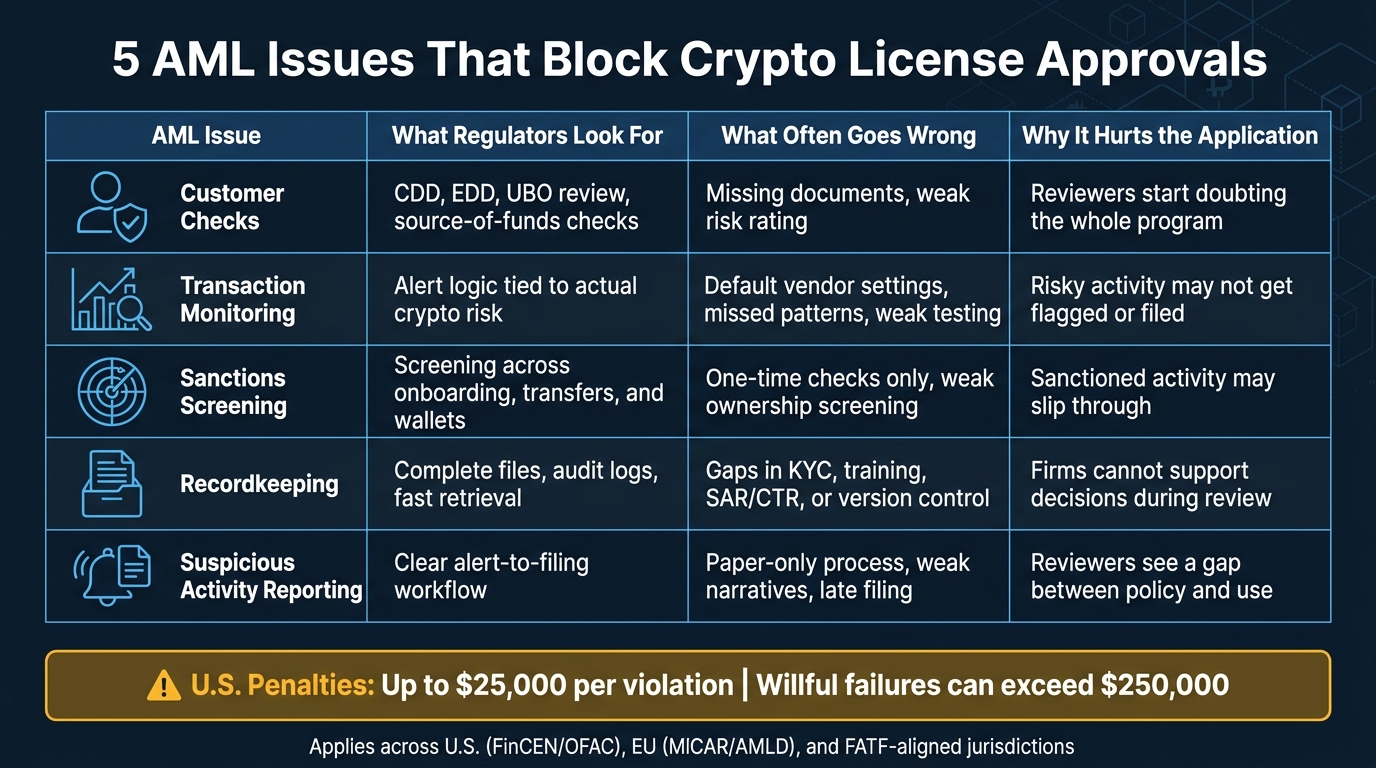
5 AML Issues That Block Crypto License Approvals
| AML issue | What regulators look for | What often goes wrong | Why it hurts the application |
|---|---|---|---|
| Customer checks | CDD, EDD, UBO review, source-of-funds checks | Missing documents, weak risk rating | Reviewers start doubting the whole program |
| Transaction monitoring | Alert logic tied to actual crypto risk | Default settings, missed patterns, weak testing | Risky activity may not get flagged or filed |
| Sanctions screening | Screening across onboarding, transfers, and wallets | One-time checks only, weak ownership screening | Sanctioned activity may slip through |
| Recordkeeping | Complete files, audit logs, fast retrieval | Gaps in KYC, training, SAR/CTR, or version control | Firms cannot support decisions during review |
| Suspicious activity reporting | Clear alert-to-filing workflow | Paper-only process, weak narratives, late filing | Reviewers see a gap between policy and use |
I’d treat these five areas as the core AML checklist before filing any license application, whether the target market is the U.S., the EU, or another FATF-aligned jurisdiction.
sbb-itb-0796ce6
Why Regulators Look So Closely at AML Programs
A crypto license application is a test of whether your AML controls work in practice, not just on paper. Regulators are deciding whether your firm can operate safely and lawfully.
The close review makes sense because the stakes are high. Under the Bank Secrecy Act, penalties can reach $25,000 per violation, and willful recordkeeping or reporting failures can exceed $250,000. That turns weak AML controls into a licensing risk, not just a paperwork problem.
In FATF-aligned markets, reviewers want to see a risk-based framework that matches your products, customers, transaction volumes, and jurisdictions.
Two common exam failures keep showing up:
- Missing risk assessments
- Weak independent testing
That close review often shows up first in customer checks, where weak controls are usually the easiest to spot.
1. Customer Check Deficiencies
Regulators expect more than a one-time ID check. They want CDD, EDD for higher-risk customers, and ongoing monitoring built into daily AML work - not treated like a box-ticking exercise.
The paperwork bar is high. Regulators usually want:
- verified identity
- proof of address
- source-of-funds evidence
That same level of scrutiny applies to UBOs and directors. If those files are missing documents, objections and delays often follow.
A named Compliance Officer is also a must. Even where there isn't a residency rule, regulators still expect one person to own day-to-day AML oversight and be clearly accountable for it.
High-risk customers need extra checks. That includes customers with large-value activity and customers from high-risk jurisdictions. In those cases, regulators expect added verification and closer monitoring.
When onboarding files are incomplete, regulators often start to doubt the rest of the AML program. And that concern doesn't stay limited to onboarding. The same gaps tend to resurface later in transaction monitoring.
2. Transaction Monitoring Weaknesses
Once onboarding checks are set up, regulators look at the next thing: whether the monitoring system can spot risky activity as it happens. Weak transaction monitoring is one of the main reasons crypto license applications get stuck. It’s not enough to say a system is in place. Regulators want proof that it fits the firm’s risk profile and the way money actually moves through the business, including cross-border transfers and convertible virtual currency (CVC) activity. The same discipline reviewed during onboarding has to show up in live transaction review too.
One of the most common problems is relying on out-of-the-box vendor settings with little or no tuning. That tends to trigger concern because it can signal the system wasn’t shaped around the business’s actual risks. Firms should show how alert thresholds were chosen and why those settings match past activity and crypto-specific patterns, such as fast transfers across several new wallets.
In the U.S., programs must support SAR filing for transactions at or above $2,000. They must also support CTR filing for cash transactions over $10,000 in a single business day.
Another frequent gap is independent testing. Regulators expect written proof that alert logic and thresholds were tested, not just a policy sitting in a folder. In New York, applicants also need to show annual independent testing of monitoring logic and alert tuning under NYDFS Part 504. When monitoring is weak, the result is often missed alerts and late filings.
Transfer thresholds and required data fields are where market expectations split the most. Review standards change by market:
- In the EU, the Transfer of Funds Regulation (TFR) applies a €0 threshold, which means sender and recipient data must be collected for every transfer.
- In the U.S., the Travel Rule threshold is $3,000, though many firms use a $1,000 internal threshold to line up with FATF standards.
3. Sanctions Screening Gaps
After transaction monitoring, regulators turn to sanctions controls. At this stage, they want to know one thing: does screening cover every wallet and every counterparty, at every step?
This is where many crypto license applications run into trouble. It’s not enough to show that a screening tool exists. Regulators want proof that it works across onboarding, transfers, withdrawals, and re-screening.
A common red flag is screening that stops after onboarding. A one-time check at sign-up doesn’t cut it. Reviewers expect screening to continue through onboarding, transfers, and withdrawals. They also expect automated wallet screening, so transactions tied to sanctioned entities don’t slip through. One common failure is skipping that automated wallet screening, which can let sanctioned entities move funds.
Another frequent gap is OFAC’s 50% Rule. Under OFAC standards, sanctions can apply to any entity that is 50% or more owned by a sanctioned individual, even if that entity does not appear by name on a sanctions list. That means screening should extend beyond named parties. It should also cover counterparties and beneficial owners, with alias and transliteration matching to catch name variations.
The tool is only part of the picture. Documentation matters just as much. Reviewers usually expect:
- A sanctions risk assessment
- Adjudication logs that show how potential hits were resolved
- Audit trails for list updates and re-screening dates
- Clear ownership, escalation paths, and board reporting for sanctions cases
If those records are missing or incomplete, that’s another red flag. Missing sanctions risk assessments and thin screening logs can make the whole program look shaky.
Expectations also change by market. In the U.S., sanctions rules rely on strict liability under OFAC. In the EU, firms screen against the EU Consolidated List and national lists. In FATF-aligned markets, regulators expect immediate targeted sanctions screening. Those logs don’t sit off to the side, either. They become part of the recordkeeping review.
4. Recordkeeping Shortfalls
If customer checks and screening are the front line, recordkeeping is what regulators look at when they audit. And this is where many license applications start to wobble. Reviewers expect files that are complete, consistent, secure, and easy to pull up fast.
A common red flag is a weak source-of-funds file. If the payment trail doesn’t show where the money came from, or it doesn’t line up with the customer’s profile, reviewers tend to dig deeper.
They usually want to see:
- Identity and address verification
- Source-of-funds evidence
- Transaction histories
- EDD files
- SAR/CTR records
- AML training logs
The exact rulebook changes by market, but the core expectation stays the same: keep records secure and make sure you can retrieve them without delay. In the U.S., MSBs must keep records for at least five years under the BSA. In the EU, firms line up with AML rules and DORA. In FATF markets, retention follows a risk-based approach, with longer periods for high-risk customers, PEPs, and high-risk jurisdictions.
Missing audit logs, weak version control, or a lack of retrieval testing can also hurt the file. And when records are sloppy, even a sound SAR decision becomes much harder to defend.
5. Suspicious Activity Reporting Deficiencies
After recordkeeping, regulators look at the next link in the chain: how suspicious activity moves from alert to review to filing. If that SAR process is weak, a license application can slow down or fall apart. What they want is pretty plain: a clear view of how suspicious activity travels from the first alert to the final filing.
The gap that shows up most often is a missing workflow. Reviewers expect a documented path that shows how flagged activity moves from the monitoring system to staff review, and then to a formal SAR filing. Your records should spell out who reviews alerts, who owns the review and filing decision, and how fast that decision moves.
In the U.S., MSBs file SARs through FinCEN's BSA E-Filing System.
A red flag that many teams miss is leaning on paper-only controls instead of a workflow staff use in day-to-day work. On paper, a process may look fine. In practice, it can fall apart fast. Regulators want processes that can identify and escalate suspicious activity, not just box-ticking. Paper-only controls are a common rejection point.
There’s another catch here: filing rules vary by market. So the same SAR process might pass in one jurisdiction and fail in another.
How AML Review Expectations Differ Across Markets
These five AML failures matter in every market. But regulators don’t review them the same way.
In the U.S., the first test is simple: do the controls work across the full workflow? Reviewers usually want proof that controls are live and working, not just polished policy documents. OFAC screening gets extra scrutiny. Firms are expected to screen customers, counterparties, wallet addresses, and relevant transactions against sanctions lists. They also need a clear escalation process for possible matches.
The EU takes a broader view. Reviewers look at AML controls, but they also want documented technical safeguards. That means internal controls, risk assessments, and DORA-related security records are all part of the review. Compared with the FATF-style baseline, the EU ties crypto AML compliance more directly to cyber resilience under DORA. So security records may sit right alongside AML files during review.
FATF-aligned markets start from the same baseline, but local rules still shape the final review. In practice, regulators often test many of the same controls. The difference is in how each market handles filing rules, data-sharing thresholds, and local enforcement. So even when the framework looks familiar, the review process can feel very different.
The table below shows how those expectations differ by market.
| AML Area | U.S. (FinCEN / OFAC) | EU (MiCAR / AMLD) | FATF-Aligned Jurisdictions |
|---|---|---|---|
| Customer checks | Risk-based customer identification; crypto-specific source-of-funds/source-of-wealth checks | Documented AML controls and risk assessments | Risk-based KYC; depth varies by local rules |
| Transaction monitoring | Rules for mixers, rapid layering, and cross-chain movement; audit trails required | Internal controls and transfer-service documentation; DORA-aligned systems | Travel Rule alignment; transaction traceability |
| Sanctions screening | OFAC screening of customers, wallet addresses, counterparties, and transactions | Risk-based controls documented under MiCAR | Risk-based controls; local adoption varies |
| Recordkeeping | Logs of alerts, investigations, and SAR decisions | Documentation of internal controls and technical security measures | Traceability emphasized |
| Suspicious activity reporting | Detect, investigate, document, and file SARs for crypto red flags | Varies by member state | Varies by jurisdiction; FATF standards as baseline |
AML Issues by Jurisdiction: Comparison Table
This table shows the five AML trouble spots most likely to slow down a license application.
| AML Area | What Regulators Expect | Common Deficiencies | U.S. Review Focus | EU Review Focus | Why the Gap Blocks Approval |
|---|---|---|---|---|---|
| Customer Checks | Risk-based CDD, EDD, and ongoing due diligence for customers and beneficial owners | Missing source-of-funds declarations; weak UBO verification; missing risk assessments for cross-border or crypto transactions | FinCEN review focuses on CDD, EDD, ongoing due diligence, and a written AML program | MiCA review focuses on local governance requirements , similar to those met by an EU-regulated on-ramp provider | Weak onboarding controls can trigger U.S. exam findings and delay or deny approval in the EU when documentation is incomplete |
| Transaction Monitoring | Real-time monitoring for suspicious patterns and documented escalation workflows | Missed alerts; weak thresholds; poor escalation workflows | BSA E-Filing access for SARs and CTRs, with risk-based monitoring for cross-border and crypto transactions | Documented monitoring for fiat and crypto flows | Weak monitoring can lead to civil penalties and license suspension risk |
| Sanctions Screening | Screening against OFAC SDN lists and the 50% rule | Failure to update screening lists in real time; missed cross-border hits during transfers and withdrawals | Screening at onboarding and during transactions; strict OFAC enforcement | FATF-aligned cross-border controls and cross-border sanctions compliance | Gaps can trigger immediate enforcement action under OFAC's strict-liability regime |
| Recordkeeping | Minimum five-year retention for customer, transaction, and agent data | Missing customer and transaction records; incomplete KYC files; audit trails testers cannot retrieve | Audit-ready documentation for U.S. exam findings and a written AML program under 31 CFR § 1022.210 | Retention and retrieval requirements alongside MiCA documentation | Recordkeeping gaps create exam findings in the U.S. and can delay EU approvals when documentation is incomplete |
| Suspicious Activity Reporting | Timely filing for suspicious activity and clear investigation narratives | Missed deadlines; poor narrative quality; no documented escalation workflow | SAR filing through the BSA E-Filing system | Reporting to local financial intelligence units; gaps can create passporting risks across EU member states | Weak SAR controls can cause U.S. exam findings and create cross-border approval risks |
Conclusion
Most crypto license applications fail for a simple reason: their AML controls are too generic, incomplete, or not shaped around the risk patterns that come with crypto.
Customer checks, transaction monitoring, sanctions screening, recordkeeping, and suspicious activity reporting can't just look good in a policy file. They need to work in day-to-day practice.
Before you apply, pressure-test the program against the rules in the main market you plan to serve. Update risk assessments so they cover crypto-specific exposures, and choose the regulatory framework that will act as your main compliance baseline. Building around one anchor framework helps you avoid scattered controls.
FAQs
How can I test if my AML controls actually work?
Test your AML controls through ongoing, risk-based reviews instead of one-off checks. Bring in independent audits to verify that policies like KYC procedures and sanctions screening are being applied the same way across the board - and that they work as intended.
It also helps to use automated monitoring to track trading patterns, transaction speed, and behavior signals in real time. Back that up with routine IT penetration testing and detailed, immutable logs stored for at least five years.
Which AML gap most often delays crypto licenses?
The AML gap that most often slows crypto license applications is fragmented, inconsistent KYC rules across jurisdictions.
Each country has its own standards for identity checks, privacy, and data handling. That makes it hard to build a single compliance system that works everywhere. The result? Longer review times, higher compliance costs, and more friction when verifying beneficial owners.
How do U.S. and EU AML reviews differ?
The biggest gaps come down to thresholds and how the rules are set up.
In the U.S., the Travel Rule usually kicks in for cross-border transfers of $3,000 or more. The EU takes a much stricter route. It uses a zero-threshold rule, which means full sender and recipient details are required for every transaction.
There’s another key difference with self-hosted wallets. In the EU, firms must verify wallet ownership for transfers over €1,000. The U.S. handles things differently. It leans on federal oversight through FinCEN and IRS Form 1099-DA, while the EU follows MiCA’s two-tier system.