
How KYC Stops Money Laundering
How KYC verifies users, supports risk-based due diligence, and uses sanctions screening and monitoring to curb crypto money laundering.

KYC, or "Know Your Customer", is a process that verifies your identity when using crypto platforms. It helps prevent money laundering by confirming who users are, assessing risks, and monitoring transactions. Without KYC, crypto platforms can be exploited for illegal activities like drug trafficking, ransomware payments, or sanctions evasion. For example, Binance faced a $4.3 billion fine in 2023 for weak KYC practices.
Here’s why KYC matters:
- Identity Verification: Prevents fraud and ties transactions to real users.
- Risk Assessment: Flags high-risk users for extra scrutiny.
- Sanctions Screening: Blocks access for bad actors or sanctioned individuals.
- User Protection: Reduces identity theft and fraud risks.
- Platform Compliance: Avoids heavy fines and ensures legal operation.
KYC is not just a legal requirement - it’s a safeguard for users and platforms alike, cutting illegal crypto activity to just 0.4% of transactions in 2024. By linking identities to transactions, it creates a safer and more trustworthy crypto ecosystem.
How Money Laundering Happens in Crypto Trading

3 Stages of Crypto Money Laundering & How KYC Stops Each
The 3 Stages of Money Laundering in Crypto
Money laundering in crypto trading mirrors the process seen in traditional finance, following three distinct stages. These stages explain why Know Your Customer (KYC) controls are strategically implemented.
| Stage | What Happens | Crypto Methods |
|---|---|---|
| Placement | Illicit cash enters the financial system | P2P exchanges, OTC brokers with weak KYC |
| Layering | Funds are moved repeatedly to obscure their origin | Mixers, chain-hopping across blockchains, DeFi swaps, peel chains |
| Integration | "Clean" funds re-enter the legitimate economy | Fiat off-ramps, crypto debit cards, NFT purchases |
The layering stage is where crypto diverges significantly from traditional financial systems. Techniques like chain-hopping - where funds are transferred rapidly across multiple blockchains such as Ethereum, Bitcoin, and Solana - create a labyrinth that's nearly impossible to untangle manually. Another method, peel chains, splits large sums into smaller amounts spread across countless wallets, further complicating investigations.
A striking example occurred in March 2022 when the Lazarus Group, a North Korean state-sponsored hacking organization, stole $625 million from the Ronin Bridge (Axie Infinity). They employed mixers, chain-hopping, and hundreds of wallets to obscure the trail. Investigators, using advanced blockchain analytics, managed to recover some of the stolen funds, but the complexity of these tactics underscores the challenges.
These stages highlight the specific vulnerabilities criminals exploit in the crypto ecosystem.
Platform Weaknesses That Launderers Exploit
The stages of laundering reveal weak points in platforms, which criminals target to exploit gaps in compliance.
One major vulnerability is rapid onboarding with minimal identity verification. Platforms that prioritize speed during sign-up often provide an easy entry point for the placement stage of laundering. Another common weak spot is nested services and OTC brokers. These services operate within larger exchanges but maintain their own, often less stringent, compliance practices, allowing for large anonymous trades with little oversight.
The impact of these weaknesses can be enormous. Take the case of BTC-e, an exchange operated by Alexander Vinnik. Between 2011 and 2017, BTC-e processed over $4 billion in laundered Bitcoin while maintaining almost no anti-money laundering (AML) controls. The platform became a hub for funds from the Mt. Gox hack, ransomware payments, and darknet markets. Vinnik was eventually arrested in 2017 and convicted of money laundering across multiple jurisdictions.
"Money laundering is the key to all cryptocurrency crime, since it gives criminals a way to move funds received from other crimes." - David Grau, Head of Business and Customer Engagement, Cognyte
Consequences of Laundering for Users and Platforms
The exploitation of these vulnerabilities doesn’t just benefit criminals - it creates serious problems for both platforms and their users.
For platforms, the consequences include steep fines and damage to their reputation. In 2022, illicit addresses moved approximately $23.8 billion through exchanges, a 68% increase from the previous year. This surge has placed immense pressure on compliance teams to address these risks.
For users, the risks are personal and far-reaching. Funds that pass through mixers or unregulated exchanges can become "tainted", making them difficult to use or transfer. Additionally, unsuspecting individuals can be drawn in as money mules - often through fake job offers or social engineering - and may face legal consequences, even if they were unaware of their involvement. Strong KYC measures remain one of the most effective defenses against these risks.
sbb-itb-0796ce6
KYC Components That Stop Money Laundering
Customer Identification and Verification
The first step in KYC is straightforward: verify who the user is. Platforms gather key details like legal names, dates of birth, addresses, and government-issued IDs, then confirm this information is legitimate and belongs to the person providing it.
To combat fraud, modern systems often use biometric checks, like requiring a blink or head movement, to ensure the user is physically present and not using stolen IDs or tampered images. These stronger verification methods have had a direct impact, helping reduce illicit cryptocurrency transactions to just 0.4% of the total volume in 2024.
Verification also leaves a traceable record, which is invaluable in disrupting money laundering. For instance, in February 2022, the U.S. Department of Justice recovered $3.6 billion in stolen Bitcoin from the Bitfinex hack. Investigators traced the funds using KYC records from exchanges where suspects tried converting crypto into cash. This foundational step sets the stage for deeper risk assessments.
Risk-Based Customer Due Diligence
Not all users pose the same level of risk. Customer Due Diligence (CDD) helps platforms evaluate each user's risk profile and adjust monitoring accordingly, limiting opportunities for laundering schemes.
"KYC is the umbrella; CDD is the risk assessment layer within it." - Chainalysis
Platforms assign users to risk categories - low, medium, or high - based on factors like transaction size, fund sources, location, and activity patterns. For example, a retail user making small, occasional purchases is far less risky than someone transferring large sums from a high-risk region. This classification determines the level of scrutiny applied:
| Due Diligence Level | Who It Applies To | What's Required |
|---|---|---|
| Simplified (SDD) | Low-risk retail users | Basic identity verification |
| Standard (CDD) | Typical customers | Verification of identity, source of funds, and nature of activity |
| Enhanced (EDD) | PEPs, high-risk jurisdictions | Detailed review of source of wealth and ownership |
Risk levels aren’t fixed. With Perpetual KYC (pKYC), platforms shift from one-time checks to ongoing, real-time monitoring. If a user’s transaction patterns change drastically or geopolitical events make their country high-risk, their profile updates automatically. This proactive approach helps close loopholes that launderers might exploit.
Sanctions and Watchlist Screening
Even fully verified users can turn out to be bad actors. That’s where sanctions and watchlist screening come in, helping platforms identify individuals who may misuse the system for laundering.
Platforms continuously screen customers against lists from OFAC, the UN, and the EU, as well as databases of Politically Exposed Persons and adverse media. This screening happens during account creation and continues in real time, as someone could be sanctioned after becoming a customer.
Skipping this step can lead to major issues. Binance’s $4.3 billion settlement with the DOJ, FinCEN, and OFAC - the largest in crypto history - was partly due to allowing users in sanctioned countries like Iran and Cuba to access the platform, enabling unchecked large-scale laundering.
"Modern compliance means dynamic KYC: continuous monitoring that integrates off-chain identity with on-chain behavior." - TRM Team, TRM Labs
Real-time screening is especially effective against state-sponsored laundering. For instance, in 2023, the Lazarus Group laundered $200 million in stolen cryptocurrency through platforms with weak sanctions protocols, using methods like peel chains and cross-chain swaps to hide their tracks. Platforms with live screening can freeze funds tied to newly sanctioned entities within hours of an update, cutting off opportunities to move illicit funds further.
How KYC Helps Crypto Users and Platforms
KYC (Know Your Customer) processes are more than just a legal requirement - they offer practical advantages for both users and crypto platforms.
Protecting Users from Fraud and Identity Theft
KYC doesn’t just combat money laundering; it plays a crucial role in protecting users from fraud and identity theft. By verifying each account, platforms make it significantly harder for scammers to exploit stolen identities.
For instance, between 2023 and 2025, Chainalysis recovered over $100 million in cryptocurrency tied to romance-based investment scams using KYC records. Additionally, perpetual KYC (pKYC) systems monitor activity in real time, allowing platforms to catch suspicious behavior faster.
These measures don’t just shield users - they also enhance the operational integrity of crypto platforms, creating a safer ecosystem for everyone.
Ensuring Platform Compliance and Stability
For crypto platforms, robust KYC systems are essential to staying compliant and operational. In 2024 alone, crypto companies paid over $5.1 billion in fines due to inadequate KYC and AML (Anti-Money Laundering) programs. By 2025, the average fine for compliance violations reached $3.8 million.
Weak KYC can also jeopardize banking relationships. Traditional financial institutions often require strong compliance programs before providing payment services. Without these partnerships, platforms risk losing features like bank transfers and card payments - services users rely on daily.
"AML-compliant crypto exchanges build trust and transparency with their customers, lower the risk of financial crime, and help to stabilize the crypto market." - Notabene
Investing in reliable KYC systems helps platforms retain their licenses, avoid interruptions, and foster trust. This stability benefits users while encouraging growth in the crypto space.
Building Confidence for New Crypto Users
A strong KYC process sends a clear message: this platform is secure and professional. For new users, this reassurance is critical, signaling that their assets are being managed responsibly.
In fact, 76% of crypto users believe KYC improves platform security and trust, while 67% of institutional investors require robust KYC protocols before partnering with a platform. Meeting these expectations not only attracts new users but also builds confidence in the platform’s long-term reliability.
What to Know About KYC When Trading Crypto
Getting familiar with the steps of the KYC process can make crypto trading feel less daunting. Plus, knowing how to navigate it efficiently can save you time and hassle.
What to Expect During KYC
Most KYC processes follow a standard routine. First, you'll need to provide basic personal details like your legal name, date of birth, address, and a government-issued ID. Then, you'll upload a valid ID along with a recent proof of address. Many platforms now use biometric checks to speed up verification. Thanks to automated eKYC systems powered by AI and OCR technology, this entire process can often be completed in just minutes instead of days.
For users flagged as high-risk, such as Politically Exposed Persons (PEPs) or individuals from high-risk regions, Enhanced Due Diligence (EDD) is required. This can involve additional steps like explaining the source of your funds or even attending a face-to-face interview.
Tips for a Smooth KYC Process
Delays in KYC verification are usually caused by errors or unclear information. Follow these tips to avoid common pitfalls:
- Match your documents exactly: Ensure the name and address you provide match what appears on your ID and proof of address. Even small discrepancies can lead to a manual review.
- Submit clear, valid documents: Use high-quality images that clearly show all details. Double-check that your ID is not expired, as expired documents will be rejected automatically.
- Keep activity consistent: Align your transaction behavior with the profile you’ve submitted to avoid triggering unnecessary alerts.
"Friction in the onboarding process - excessive documentation, long verification times, manual review - is a primary driver of customer drop-off." - Chainalysis
Data shows that over 50% of users abandon onboarding if KYC takes longer than 10 minutes. By preparing your documents and paying attention to details, you can breeze through verification and get started quickly.
How Kryptonim Handles KYC Without Slowing You Down
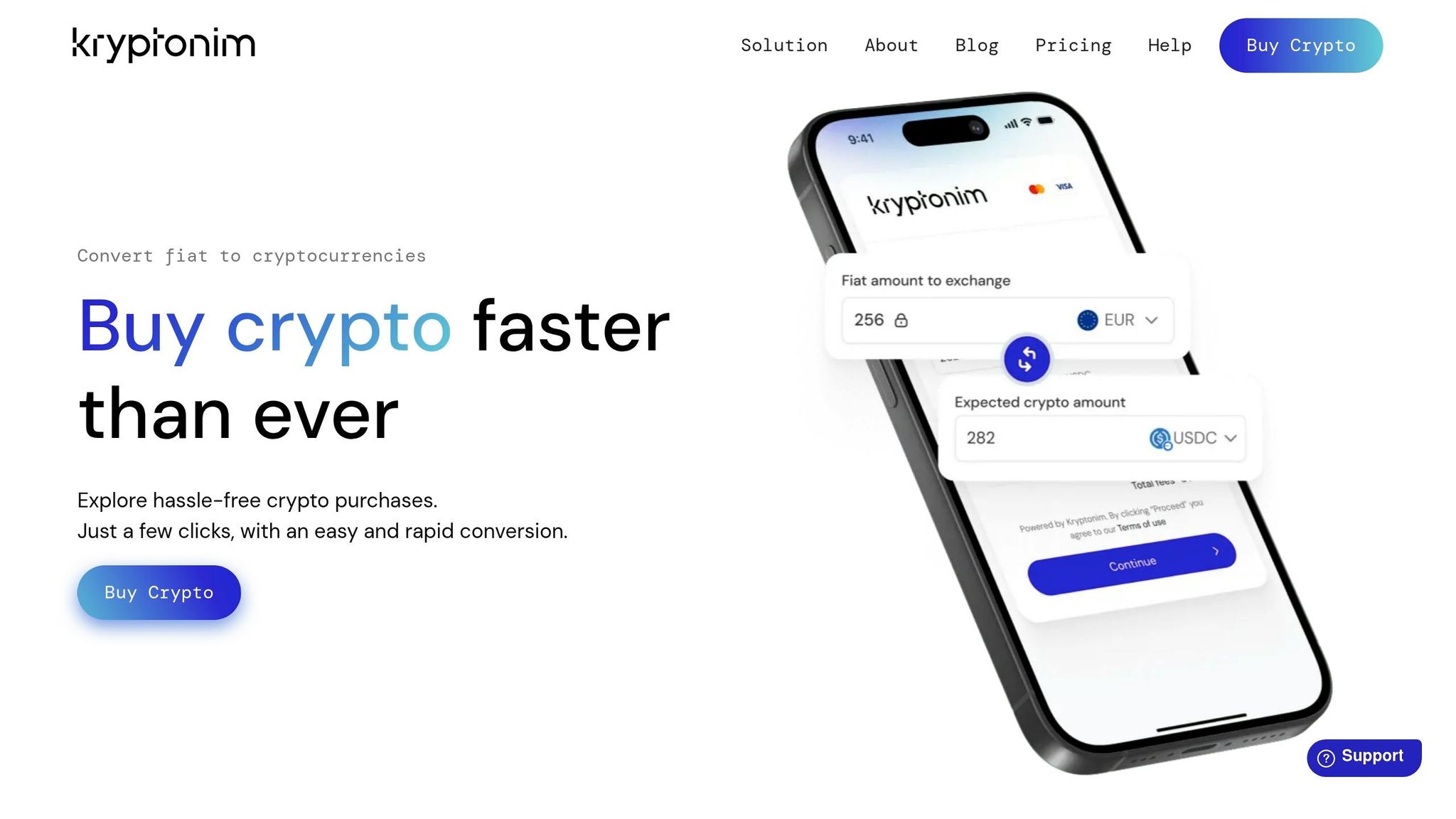
Kryptonim, an EU-regulated platform, has built its KYC process to be both secure and user-friendly. It uses a risk-based approach, tailoring the level of scrutiny to the user. Standard users enjoy a fast and simple verification experience, while Enhanced Due Diligence is reserved for high-risk cases or large transactions.
The platform leverages third-party AI-powered tools to automate tasks like document recognition and face matching. This ensures compliance without unnecessary delays.
Kryptonim’s approach allows users to focus on their transactions without getting bogged down in paperwork. By integrating compliance seamlessly into the background, the platform not only speeds up onboarding but also strengthens security and builds trust - critical for combating illicit activities.
Conclusion
KYC has become the crypto industry's go-to defense against money laundering. By linking identities to blockchain transactions, it closes loopholes that criminals often exploit. Without KYC, platforms are left vulnerable, becoming easy conduits for illicit funds. The numbers speak volumes - just in 2024, around $51 billion in on-chain activity was connected to illegal actors.
Regulators are cracking down hard, with multi-billion-dollar fines highlighting the growing pressure on platforms to comply. These actions aren’t just about enforcing rules; they also aim to enhance user safety. For individual users, KYC offers protection against fraud, identity theft, and exposure to criminal activity.
"The potential risks of skipping KYC - billion-dollar fines, criminal liability, platform shutdown - far outweigh the cost of customer onboarding friction." - Chainalysis
Strong KYC measures do more than prevent illegal activity - they foster trust and confidence in the market. As the crypto space evolves, platforms that prioritize effective KYC processes gain credibility with users, regulators, and institutional partners. Take Kryptonim, for example. This EU-regulated platform, known for its secure and user-friendly verification process, showcases how proper KYC can safeguard users while strengthening market trust.
FAQs
What happens if I fail KYC on a crypto platform?
Failing KYC (Know Your Customer) on a crypto platform can have serious consequences. It might prevent you from completing transactions, restrict access to certain services, or even result in your account being suspended. When verification is incomplete or contains errors, it not only puts your account at risk but also raises the chances of fraud and could lead to regulatory penalties for the platform.
How does KYC work with on-chain monitoring and blockchain analytics?
KYC, or Know Your Customer, works hand-in-hand with on-chain monitoring and blockchain analytics to keep a close eye on blockchain transactions in real time. These tools are designed to spot suspicious activities, like money laundering, by analyzing patterns, identifying anomalies, and mapping wallet connections.
On-chain monitoring evaluates transactions against specific risk criteria, while blockchain analytics tracks the movement of funds across wallets. Together, they help crypto platforms meet regulatory requirements and combat illegal activities more efficiently.
What’s the difference between CDD, EDD, and perpetual KYC (pKYC)?
When it comes to AML (Anti-Money Laundering) and KYC (Know Your Customer) processes, CDD, EDD, and pKYC serve distinct purposes, each varying in scope and the duration of verification.
- CDD (Customer Due Diligence): This is the standard process for verifying identities, assessing risks, and monitoring transactions. It typically occurs during onboarding but continues throughout the customer relationship to ensure compliance.
- EDD (Enhanced Due Diligence): For customers deemed high-risk, EDD involves more rigorous checks. This includes in-depth background investigations and a detailed analysis of the source of funds to mitigate potential risks.
- pKYC (Perpetual KYC): Unlike the other two, pKYC focuses on continuous monitoring of customer identities and activities. The goal is to maintain ongoing compliance and quickly detect any emerging risks over the course of the relationship.
Each approach plays a critical role in creating a comprehensive framework for risk management and regulatory adherence.