
Private Crypto Payments in the EU: What's Legal, What's Private, What's Next
How EU laws (MiCA, AML, Travel Rule, CARF) reshape crypto payments, privacy coins, P2P transfers and compliant platforms.

Crypto payments in the EU are becoming more regulated, with stricter rules on privacy and compliance. Here’s what you need to know:
- Regulations like MiCA and AML rules now require platforms to collect and share identifying information for all transactions, even small ones.
- Privacy coins like Monero and Zcash face restrictions, with many platforms delisting them due to transparency requirements.
- Peer-to-peer (P2P) transfers using self-hosted wallets remain legal and private, but converting crypto to fiat later will require documentation.
- New rules, such as the Travel Rule and CARF, enforce strict data sharing and tax reporting standards, making anonymous transactions nearly impossible.
- Regulated platforms like Kryptonim provide a legal way to buy crypto, but users must verify their identity.
Key takeaway: While privacy tools like self-hosted wallets still offer some control, the EU’s focus on transparency is reshaping how crypto payments work. Staying compliant while protecting your financial privacy requires careful planning.
EU Legal Framework: MiCA and AML Regulations

EU Crypto Transaction Verification Requirements by Amount
The European Union has established a unified approach to cryptocurrency regulation through two key initiatives: the Markets in Crypto-Assets (MiCA) framework and updated Anti-Money Laundering (AML) rules. Together, these create a consistent legal framework across all 27 EU member states, replacing the previous fragmented system.
What MiCA Says About Crypto Transactions
MiCA organizes crypto-assets into three categories: E-Money Tokens (EMTs), Asset-Referenced Tokens (ARTs), and other crypto-assets like Bitcoin or utility tokens. EMTs are treated as electronic money, meaning they must be issued by authorized credit or e-money institutions, and holders have the right to redeem them at face value.
Crypto service providers, referred to as CASPs, must obtain authorization under MiCA. Once licensed in one EU country, a CASP can operate across the entire bloc. In a landmark move, Circle became the first global stablecoin issuer to comply with MiCA in July 2024. By securing an Electronic Money Institution license from France's ACPR, it gained the ability to offer its USDC and EURC tokens legally as e-money tokens throughout the EU.
MiCA also takes a firm stance on privacy coins. Trading platforms are prohibited from listing crypto-assets with built-in anonymization features unless CASPs can identify the holders and track transaction histories. This has prompted major exchanges to delist privacy-focused coins like Monero and Zcash. Violating MiCA rules can lead to hefty penalties, including fines of up to $5 million or 12.5% of a company's total annual revenue. These measures aim to align crypto transactions with the transparency standards of traditional finance.
"MiCA is the EU's first comprehensive crypto regulation covering asset-referenced tokens, e-money tokens, and other crypto-assets." – ComplyFactor
AML Rules and Anonymous Wallet Restrictions
Building on MiCA, the EU's AML regulations impose stricter rules on CASPs. The Anti-Money Laundering Regulation bans CASPs from offering or hosting anonymous crypto-asset accounts or services that enable transaction obfuscation. This extends to custody services for privacy coins, meaning regulated platforms will no longer support such assets by 2027. These rules significantly limit the availability of privacy-focused cryptocurrencies for users in the EU.
The Transfer of Funds Regulation, commonly known as the Travel Rule, requires CASPs to collect and share detailed information about the sender and recipient for every crypto transaction, regardless of the amount. In 2025, two CASPs faced fines of $12.6 million and $8.4 million for failing to comply with this rule on over 15,000 transactions.
"The Travel Rule mandates that CASPs collect and share detailed information about the originators and beneficiaries of crypto transactions... regardless of size." – Manimama Law Firm
Starting in July 2027, the newly established Anti-Money Laundering Authority (AMLA) will oversee major crypto firms. This applies to companies processing more than $52.5 million annually or serving over 20,000 users in any EU country. By September 2025, 217 CASPs had obtained MiCA licenses - up from just 42 in December 2024 - and these licensed platforms now handle 78% of crypto trading in the EU.
Transaction Limits and Exemptions
In addition to general regulatory requirements, specific transaction thresholds trigger extra verification steps. For example:
- Transfers involving self-hosted (non-custodial) wallets exceeding $1,050 require CASPs to confirm the wallet's ownership.
- Transactions between $1,050 and $10,500 necessitate government-issued identification.
- Transactions over $10,500 demand proof of the source of funds.
Furthermore, MiCA imposes restrictions on the use of Asset-Referenced Tokens. If an ART's daily transactions exceed 1 million or its total value within the EU surpasses $210 million, its issuance must be paused. Stablecoins with more than 10 million holders or a market cap above $5.25 billion are classified as "significant" and are directly supervised by the European Banking Authority (EBA).
| Threshold | Verification Requirement |
|---|---|
| All amounts | CASPs must collect originator and beneficiary data (Travel Rule) |
| Over $1,050 | Verification of self-hosted wallet ownership |
| Over $1,050 | Mandatory Customer Due Diligence for occasional transactions |
| Over $10,500 | Proof of source of funds required |
sbb-itb-0796ce6
Legal Payment Methods in the EU
Understanding how to legally use cryptocurrency in the EU is essential, especially with the strict licensing rules that came into effect on December 30, 2024. These rules require all professional crypto-asset service providers to meet specific licensing standards, reshaping how EU residents interact with cryptocurrency while maintaining compliance with the region's regulatory framework.
Using Regulated Platforms Like Kryptonim
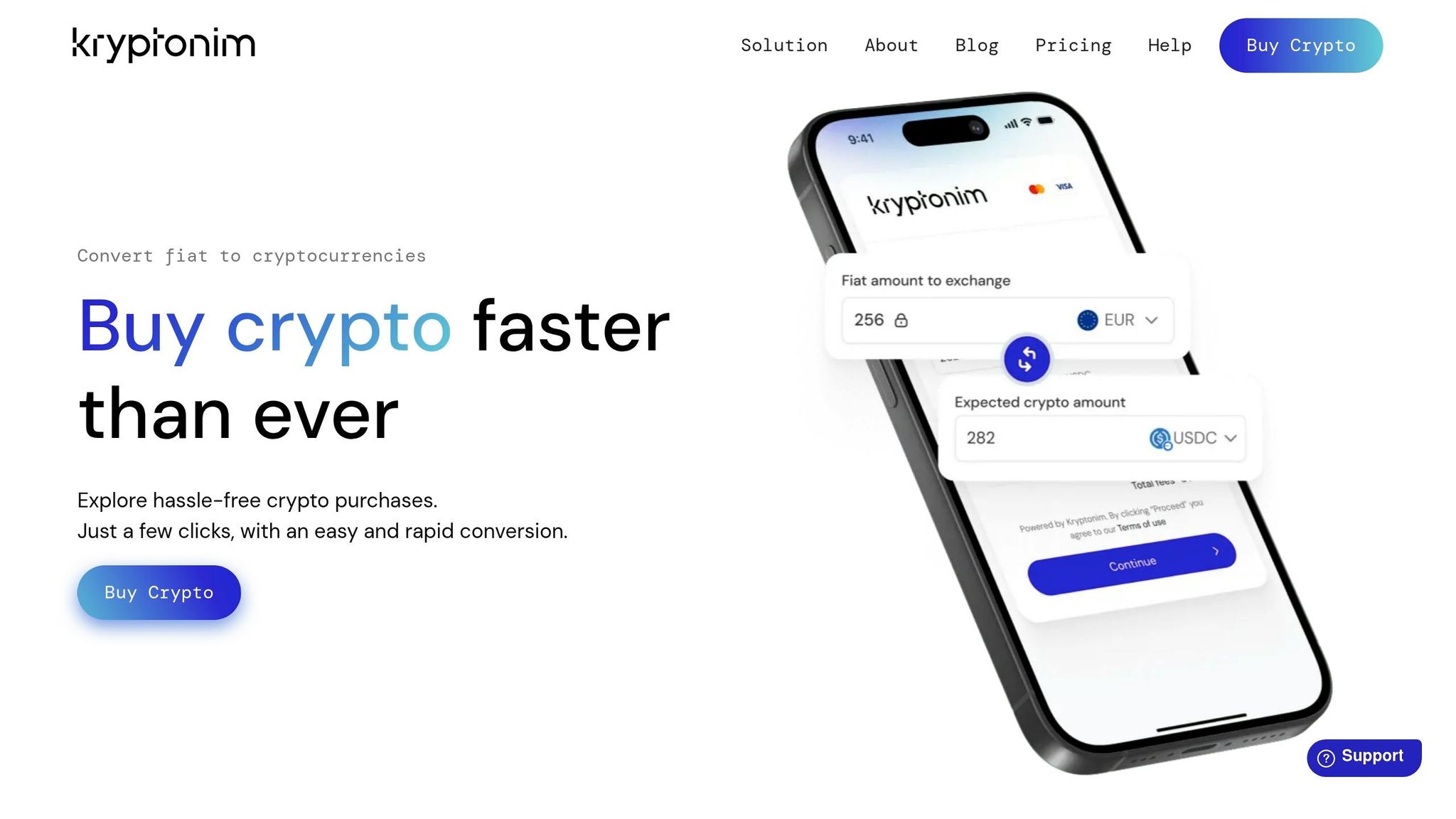
Platforms like Kryptonim provide a straightforward and regulated way to convert fiat currency into cryptocurrency. These platforms must secure MiCA authorization and verify the identity of every customer, regardless of transaction amount. Once authorized in one EU country, a CASP (Crypto-Asset Service Provider) can extend its services across the entire EU bloc.
Kryptonim, as an EU-regulated platform, ensures transparency with a 2% transaction fee for EU users and supports familiar local payment options. This aligns with the Travel Rule, which minimizes legal risks for users. While this process does compromise privacy due to mandatory verification, it protects users from the penalties associated with using unlicensed platforms.
Regulation enforcement is serious - by November 2025, over €540 million in fines had been issued for non-compliance, and more than 50 crypto firms lost their licenses by February 2025. To stay on the safe side, users should always verify a platform's licensing status through national regulatory websites or the European Securities and Markets Authority (ESMA) registry.
For those seeking a different approach, peer-to-peer methods offer another route.
Person-to-Person Transfers and Direct Payments
Direct peer-to-peer (P2P) transfers using self-hosted wallets remain a legal option and are exempt from Know Your Customer (KYC) requirements under MiCA and the Travel Rule, provided no commercial intermediary is involved. While these transfers offer a high degree of privacy initially, converting crypto to fiat later on will require documentation to prove the origin of funds. To prepare for this, users should maintain receipts or digital records of their transactions.
Although P2P transfers themselves don't require KYC, integrating with regulated platforms does. For example, when withdrawing funds from a CASP to a self-hosted wallet, ownership verification is mandatory for transactions exceeding €1,000. This is often done through message signing or similar methods. Anonymous crypto-to-cash exchanges, however, became illegal on December 30, 2024, with operators facing fines of up to €15 million.
"Anonymity in EU offline exchanges officially died on the last day of 2024."
– Peter V., Editor, Crypto Navigator
Legal vs. Non-Compliant Payment Methods
Different payment methods come with varying levels of compliance, privacy, and regulatory obligations. Here's a breakdown:
| Payment Method | Legal Status | Privacy Level | Regulatory Requirement |
|---|---|---|---|
| Regulated CASPs | Fully Legal | Low (KYC required) | MiCA authorization, Travel Rule compliance |
| Direct P2P (Individual) | Legal | High (No KYC) | None for transfers; documentation needed for off-ramping |
| Self-Hosted Wallets | Legal | Medium | Ownership verification for transfers over €1,000 |
| Anonymous Offline Exchanges | Illegal | High (but risky) | Prohibited since December 30, 2024 |
| Unlicensed Platforms | Non-Compliant | Variable | Subject to fines, bans, and ESMA blacklisting |
Commercial exchanges advertising "no verification" are now illegal in the EU. Using such services risks frozen accounts and lost funds. In fact, seven managers of illegal exchanges were sentenced to prison terms ranging from 18 months to 4 years in 2024.
Privacy Features in EU-Compliant Cryptocurrencies
The EU's regulatory framework sets strict boundaries for privacy in cryptocurrencies. While some privacy features remain technically allowed, their practical application on regulated platforms is increasingly restricted.
Privacy Coins and Regulatory Challenges
Privacy coins, such as Monero (XMR), Zcash (ZEC), Dash (DASH), and Grin (GRIN), use advanced cryptography to obscure transaction details. For example, Monero employs ring signatures and stealth addresses to hide sender and recipient information. Zcash, on the other hand, offers both encrypted "shielded" transactions and public "transparent" ones using zero-knowledge proofs (zk-SNARKs).
However, the EU's regulatory measures, like MiCA Article 76, prohibit listing crypto-assets with "inbuilt anonymization functions" unless service providers can fully trace transactions and identify token holders. By July 2027, the Anti-Money Laundering Regulation (AMLR) will also ban CASPs from holding assets with anonymization features.
"Anonymity-enhancing coins" are defined as "crypto-assets that have built-in features designed to make crypto-asset transfer information anonymous, either systematically or optionally." - Regulation EU 2024/1624 (AMLR)
This could mean even Zcash's optional privacy features might classify it as an anonymity-enhancing coin, potentially barring it from regulated EU platforms. A notable example of the risks regulators aim to mitigate occurred in May 2025, when a phishing scam led to over $330 million in BTC being stolen and quickly converted to Monero. This caused Monero's price to surge by more than 50%.
Some projects are attempting to balance privacy with compliance. For instance, Secret Network's SNIP-20 token standard allows users to selectively disclose transaction details to regulators while keeping them private from the public. However, whether such models will gain regulatory approval remains to be seen.
Legal Risks of Mixing Services and Privacy Tools
Crypto mixers, which pool and redistribute funds to obscure transaction trails, are flagged as high-risk tools for money laundering by EU authorities. These tools make tracing fund origins significantly harder.
"Crypto platforms like mixers, privacy coins and layer 2 networks can complicate tracing the origins of funds." - EU Innovation Hub for Internal Security
Mixers operate either as centralized services or decentralized protocols. Under current regulations, CASPs are prohibited from supporting mixing services. Zero-knowledge proofs are only allowed if they enable token holder identification. Similarly, some Layer 2 solutions, like Bitcoin's Lightning Network, complicate traceability by using multi-signature channels that bypass the public blockchain. Using these tools can lead to account freezes, confiscation of funds, and even criminal charges. These measures reflect the EU's focus on maintaining transparency and traceability.
Self-Hosted Wallets: Storage vs. Payments
Self-hosted wallets, where users manage their private keys, are still permitted in the EU for storage purposes. Both hardware and software wallets with privacy-focused features remain legal, as long as no third party has access to the private keys.
However, using self-hosted wallets for payments introduces regulatory hurdles. Under the Transfer of Funds Regulation (TFR), CASPs must verify ownership of self-hosted addresses for transactions exceeding €1,000. This is typically done through message signing or similar methods. While self-hosted wallets provide privacy for asset storage, converting crypto to fiat or transferring it via regulated platforms requires documentation to verify the origin of funds.
Kryptonim: EU-Regulated Crypto Platform
For residents of the EU, Kryptonim provides a fully compliant way to purchase cryptocurrency. As an EU-regulated platform, it aligns with the Digital Operational Resilience Act (DORA), set to take effect in January 2025. Below are the standout features that make Kryptonim a secure and straightforward option for crypto transactions.
Transparent Pricing and Regulatory Standards
Kryptonim charges a flat 2% fee per transaction for EU users, with all costs clearly disclosed upfront. This level of transparency aligns with MiCA's disclosure rules. As a MiCA-authorized platform, Kryptonim enjoys passporting rights, enabling it to operate across all 27 EU member states under a single license. Additionally, customer funds are kept separate from company assets, a safeguard introduced with MiCA's main provisions on December 30, 2024. These measures underscore Kryptonim's dedication to regulatory compliance and user protection.
Privacy-Focused No-Account Purchases
Kryptonim simplifies the crypto-buying process by allowing purchases without requiring an account. Users can visit the on-site converter, select their desired amount, and complete the transaction in just a few steps.
"Purchase crypto in a few easy steps." – Kryptonim
This no-account feature minimizes the storage of personal data on third-party servers, while still meeting EU verification standards. Purchased cryptocurrency is sent directly to the user's personal wallet, eliminating risks tied to storing funds on centralized platforms. This approach reflects Kryptonim's strong emphasis on privacy within the framework of EU regulations.
Support for Local Payment Methods
To make fiat-to-crypto transactions more accessible, Kryptonim accepts both credit/debit cards and widely used local payment methods across the EU. This flexibility is particularly helpful for users whose banks may restrict standard card payments to crypto platforms. The platform’s user-friendly interface ensures a secure and smooth experience for both beginners and seasoned crypto enthusiasts. These features position Kryptonim as a dependable option for those seeking privacy and compliance in the EU market.
What's Next for Private Crypto Payments in the EU
Between 2026 and 2027, changes in EU regulations are expected to reshape or limit private crypto payments.
Potential Privacy Coin Bans by 2027
Privacy-focused cryptocurrencies like Monero and Zcash are under increasing scrutiny. The Transfer of Funds Regulation (TFR) mandates that Crypto-Asset Service Providers (CASPs) include identifying details in every transaction - a requirement that clashes with the fundamental design of privacy coins.
The Anti-Money Laundering Authority (AMLA) is set to launch in 2026, with its oversight extending to large cross-border crypto firms - those serving over 20,000 users in any EU country or processing more than $55 million annually - starting in July 2027. AMLA's focus on ensuring complete transaction traceability will likely push platforms with EU-licensed MiCA authorization to delist assets that fail to meet transparency requirements.
For example, in 2025 alone, 73 exchanges removed Monero to simplify compliance with these stringent reporting rules.
As transparency becomes a regulatory priority, additional measures like CARF are poised to further change reporting standards.
CARF Tax Reporting Requirements
The Crypto-Asset Reporting Framework (CARF), introduced through the DAC8 directive, took effect on January 1, 2026. CARF requires Reporting Crypto-Asset Service Providers to collect and automatically share detailed information about EU tax residents with their respective tax authorities. This includes Know Your Customer (KYC) data such as name, address, date of birth, and Tax Identification Number (TIN).
Accounts are frozen if TINs are not provided within a 60-day compliance window.
"The era of 'not your keys, not your coins' just became 'your keys won't save you if they know you bought the coins.'"
- Mauro Saavedra
CARF reporting covers a broad range of activities, including crypto-to-fiat conversions, crypto-to-crypto trades, and wallet transfers. Even self-custody isn’t exempt if it involves interaction with a regulated platform - actions like withdrawing funds to a Ledger wallet create reportable events. The first reporting deadline, set for September 30, 2027, will cover all activities from 2026. Platforms face penalties between $21,700 and $543,000 per violation, and with 48 to 63 jurisdictions adopting CARF, the concept of a "crypto tax haven" is becoming less feasible.
These tax reporting requirements are closely tied to broader enforcement mechanisms like the Travel Rule, which further tightens regulatory oversight.
Travel Rule Implementation and Enforcement
The Travel Rule became mandatory for all CASPs operating in the EU on December 30, 2024. Unlike earlier versions, the EU’s rule applies to all transactions, regardless of the amount - even those under $1.
"The Travel Rule under MiCA symbolizes a paradigm shift in the regulation of crypto transactions."
- Manimama Law Firm
Under this rule, CASPs must gather and share detailed information about both the sender and the recipient for every crypto transfer. If a platform cannot verify or obtain complete information, it must suspend, reject, or return the transaction.
AMLA's direct oversight, starting in July 2027, will further tighten enforcement. Additionally, non-EU entities must comply with these standards to engage with EU-based platforms, fostering global consistency in regulatory practices. Together, these measures mark the end of semi-anonymous blockchain transactions in the EU's regulated environment.
Final Thoughts
The EU's regulatory framework, including MiCA and the Travel Rule, strikes a balance between privacy and legal compliance. It ensures that while legitimate transactions remain traceable, there's no need to expose your entire financial history. You can meet obligations like reporting capital gains without revealing unnecessary details about your transactions.
To maintain this balance, consider using regulated platforms for your initial crypto purchases. Afterward, transfer your holdings to non-custodial wallets, where you control the private keys. For better privacy, always move funds through self-hosted wallets instead of directly from KYC exchanges. These steps help you stay compliant while protecting your financial privacy.
For EU users, platforms like Kryptonim offer a privacy-conscious entry point with features like transparent 2% fees, support for local payment methods, and no-account purchases.
To further safeguard your privacy, adopt practices such as using a fresh address for each transaction, keeping offline tax records, and masking your IP address with tools like VPNs or Tor.
As privacy and reporting regulations continue to evolve, every decision you make now will influence your future financial autonomy. With CARF requirements becoming stricter, the platforms and practices you choose today play a critical role in shaping your long-term financial control.
FAQs
Are private crypto payments still possible in the EU?
The use of private crypto payments is still allowed within the EU for now. However, starting in 2027, new regulations will ban privacy coins and anonymous wallets. This change will greatly reduce the ways individuals can keep their transactions private.
What records should I keep to prove where my crypto came from?
To confirm where your cryptocurrency originated, keep detailed records. This includes blockchain transaction histories, wallet addresses, and supporting documents like bank statements or transfer records. These records can help show the source of your funds and ensure you're meeting regulatory requirements.
Will privacy coins be effectively banned on EU-regulated platforms by 2027?
By 2027, privacy-focused cryptocurrencies are expected to face strict limitations within the European Union. New regulations aim to restrict the handling, storage, and facilitation of transactions involving these types of cryptocurrencies. The primary focus of these rules is to address the anonymity features of privacy coins and anonymous wallets, which have raised concerns among regulators.