
Non-Custodial vs Custodial Wallet: Which One Actually Keeps Your Crypto Safe
Compare custodial vs non-custodial crypto wallets: control vs convenience, security risks, recovery methods, and when to use each.

Who should control your crypto keys - you or a third party? That’s the core question when deciding between custodial and non-custodial wallets. Custodial wallets, managed by exchanges or providers, are user-friendly and offer features like password recovery. However, they require trust in the provider and come with risks like hacks or account freezes. Non-custodial wallets, on the other hand, give you full control of your crypto by securing private keys yourself. This eliminates third-party risks but demands responsibility - lose your keys, and your funds are gone.
Key Takeaways:
- Custodial Wallets: Easier for beginners, ideal for trading, but less control.
- Non-Custodial Wallets: Greater security and privacy, better for long-term holders, but higher responsibility.
Quick Comparison:
| Feature | Custodial Wallets | Non-Custodial Wallets |
|---|---|---|
| Private Key Control | Held by provider | Fully controlled by the user |
| Ease of Use | High - password recovery, customer support | Low - requires managing seed phrases |
| Security Risks | Hacks, provider failure | User mistakes (e.g., lost keys) |
| Privacy | Requires KYC | No KYC, more private |
| Best For | Beginners, active traders | Long-term holders, DeFi users |
Your choice depends on your priorities: convenience or control. For beginners, custodial wallets are a safer starting point. For experienced users, non-custodial wallets offer unmatched security and privacy.
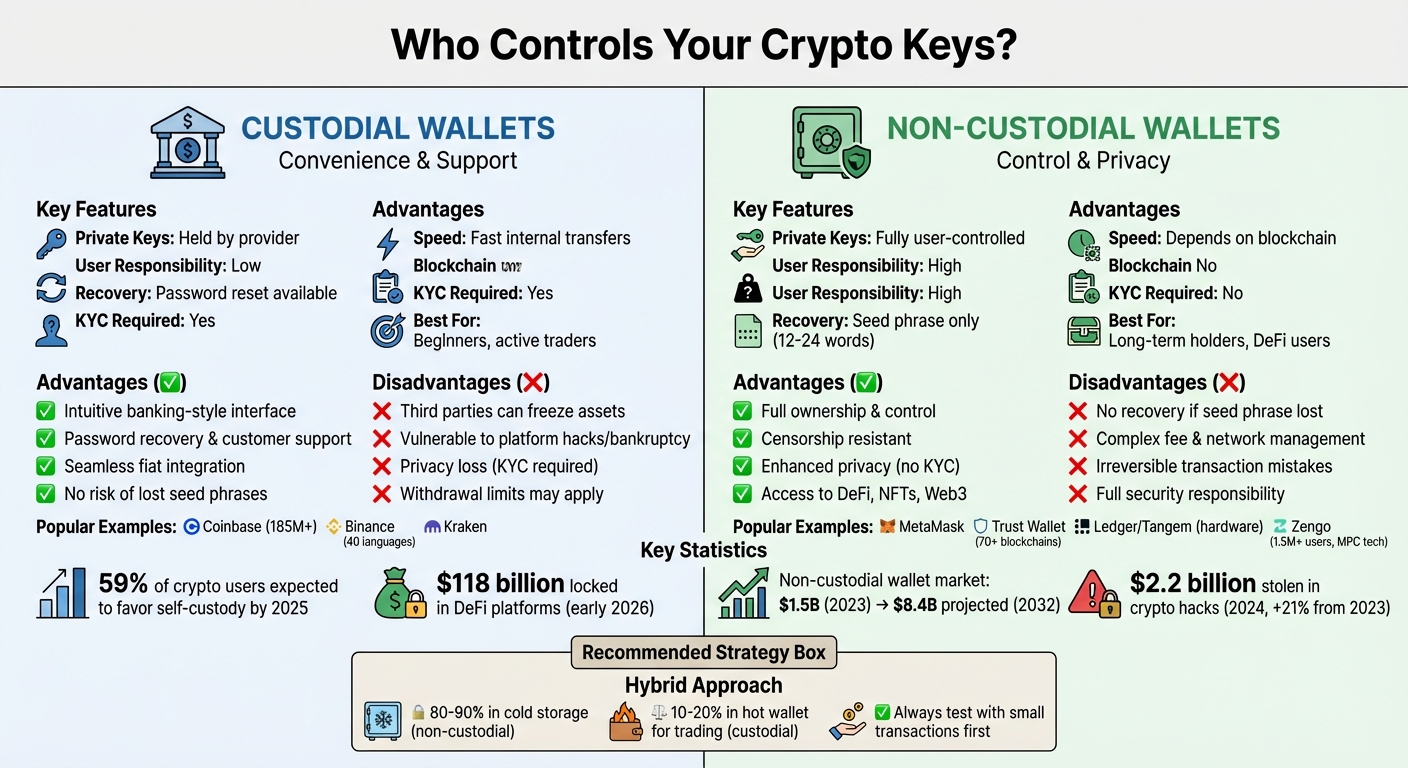
Custodial vs Non-Custodial Crypto Wallets Comparison
What Is a Custodial Wallet
A custodial wallet is a service where a third party - usually a centralized exchange or a specialized provider - manages your private keys for you . Think of it as similar to a bank: you log in to access your funds, but the provider takes care of securing your private keys.
When you use a custodial wallet, you're not directly interacting with the blockchain. Instead, the provider keeps track of your balance on their internal ledger, only executing on-chain transactions for deposits or withdrawals . They handle everything from signing transactions to implementing security protocols and protecting the keys that control your funds .
One big advantage is the ease of account recovery. Forget your password? No problem - reset it through email verification or customer support, as long as you can confirm your identity . As explained by Gemini's Cryptopedia Staff:
"With a custodial wallet, another party controls your private keys. In other words, you're trusting a third party to secure your funds and return them if you want to trade or send them somewhere else."
The downside? Trust. You need to rely on the provider's security measures, operational stability, and compliance with regulations. Custodial wallets also require KYC/AML verification .
Key Features of Custodial Wallets
Custodial wallets are defined by centralized key management: the provider stores all your private keys on secure servers, often keeping most of them in cold storage to minimize hacking risks . These wallets are designed to be user-friendly, hiding complex cryptographic details like long keys or seed phrases. The interface is straightforward and works much like online banking - just enter the amount you want to send and click "send." The platform takes care of gas fees, network selection, and transaction signing automatically.
Because your account is hosted on the provider's servers, it syncs seamlessly across devices like phones, tablets, and computers. This ensures your balance and transaction history are always up to date.
To improve transparency, many custodial wallet providers now use Chainlink Proof of Reserve (PoR). This feature verifies in real-time that their assets - whether on-chain or off-chain - match their liabilities to users.
When to Use a Custodial Wallet
Custodial wallets are ideal when convenience and support are more important than total control. They’re particularly useful for beginners, who don’t have to manage seed phrases or worry about losing access due to mistakes. As BitGo puts it:
"Custodial wallets make sense when your target users expect account recovery, customer support, and a familiar onboarding experience."
They’re also a good choice for active traders. By keeping funds in an exchange-based custodial wallet, traders can execute trades faster and benefit from higher liquidity within the platform’s ecosystem . Constantly moving assets between a non-custodial wallet and an exchange for every trade can be slow and costly due to network fees.
Additionally, custodial wallets are great for users who need easy fiat integration. Platforms like Coinbase and Binance - serving over 185 million users and supporting 40 languages - make it simple to buy crypto using bank accounts or credit cards. Kraken, on the other hand, emphasizes security and compliance while offering custodial storage by default.
For security, it’s best to limit the amount of crypto you keep in a custodial wallet to what’s needed for immediate trading. Many experienced users adopt a hybrid approach: they keep 10-20% of their portfolio in a custodial hot wallet for liquidity, while storing the rest in a non-custodial cold wallet. To further protect your account, always use app-based Two-Factor Authentication (like Google Authenticator) instead of SMS-based 2FA .
Next, we’ll dive into non-custodial wallets and how they give you complete control over your private keys.
sbb-itb-0796ce6
What Is a Non-Custodial Wallet
Non-custodial wallets give you complete control over your cryptocurrency by allowing you to manage your private keys directly. Unlike custodial wallets, where a third party handles key management, non-custodial wallets ensure that only you can access or move your funds. Your private keys are stored locally - on your phone, computer, or even a hardware wallet - and are used to sign transactions before they’re sent to the blockchain. This means your keys never leave your possession.
You've probably heard the phrase: "Not your keys, not your coins". This highlights the importance of holding your private keys to truly own your cryptocurrency. As ChainUp puts it:
"In the blockchain paradigm, total control shifts to the individual."
However, with full control comes full responsibility. Losing your 12- or 24-word seed phrase could result in permanent loss of funds. A well-known example is James Howells, who accidentally threw away a hard drive containing the keys to 8,000 bitcoin - worth about $810 million at the time. With over 560 million cryptocurrency users globally as of early 2026, such stories emphasize the risks involved. Let’s dive into what makes non-custodial wallets stand out.
Key Features of Non-Custodial Wallets
Non-custodial wallets are designed to give you full ownership of your assets. Your private keys remain on your device, and the wallet acts as a tool to interact directly with the blockchain. Since no third party controls your keys, there’s no risk of someone freezing your account or blocking transactions.
Another advantage is privacy. Most non-custodial wallets don’t require KYC (Know Your Customer) verification, making them a preferred choice for accessing Web3 and decentralized finance (DeFi) platforms. These wallets open the door to activities like trading on decentralized exchanges, minting NFTs, or engaging with DeFi protocols. By early 2026, DeFi platforms had locked in over $118 billion in total value.
However, this level of control comes with a learning curve. You’ll need to understand blockchain concepts like gas fees, network selection, and the irreversible nature of transactions. As Sam, an analyst from CoinNews, explains:
"Non-custodial wallets are as safe as the person using them".
Some popular options for non-custodial wallets include MetaMask, Trust Wallet (supporting over 70 blockchains), and hardware wallets like Tangem and Ledger. There’s also Zengo, which uses Multi-Party Computation (MPC) technology instead of traditional seed phrases and has over 1.5 million users.
While these wallets are generally secure, vulnerabilities often arise from user mistakes. For instance, the Slope Wallet hack in August 2022 compromised over 8,000 accounts because the software stored private keys in plaintext on an external server. Understanding these features and risks can help you decide if a non-custodial wallet aligns with your crypto goals.
When to Use a Non-Custodial Wallet
Non-custodial wallets are best suited for long-term holders who prioritize security over frequent trading. If you plan to "HODL" your cryptocurrency for years, self-custody eliminates risks like exchange hacks or bankruptcies.
They’re also essential for anyone actively engaging with DeFi or Web3 platforms. Decentralized applications (dApps) like NFT marketplaces and decentralized exchanges require non-custodial wallets because they don’t use centralized accounts. Additionally, privacy-conscious users often prefer these wallets since most don’t require personal identification.
For added security, experienced users often adopt a tiered strategy: keeping 80–90% of assets in a cold (offline) hardware wallet and leaving 10–20% in a hot (online) wallet for daily use. Before transferring large sums, it’s a good idea to test with a small transaction to confirm the address and network settings.
Always store your recovery phrase offline on physical, fireproof, and waterproof materials - never in digital files or cloud storage. And remember, your private key or seed phrase should never be shared; legitimate support teams will never ask for them. Regularly check your wallet’s permissions and revoke unnecessary smart contract allowances to protect your funds. For larger holdings, consider hardware wallets that sign transactions in a secure, offline environment, safeguarding your private keys even if your computer is compromised.
Custodial vs Non-Custodial: Key Differences
When it comes to managing private keys, the defining difference between custodial and non-custodial wallets lies in who holds the keys. With custodial wallets, a third party - like an exchange - takes responsibility for holding and managing your keys. Essentially, you're trusting them to handle transactions and secure your funds. On the other hand, non-custodial wallets put you in the driver's seat, giving you direct control and interaction with the blockchain.
Custodial wallets take the security burden off your shoulders, which can be convenient, but it comes at the cost of control. If the provider gets hacked, declares bankruptcy, or freezes accounts due to regulations, your funds could be at risk. Non-custodial wallets avoid these third-party risks entirely by making you solely responsible for securing your funds - your seed phrase is everything when it comes to recovery.
Recovery options are a major point of contrast. Custodial wallets often provide user-friendly methods, like password resets or customer support, similar to how banks handle account recovery. Non-custodial wallets, however, depend entirely on a 12- or 24-word seed phrase. If you lose it, there’s no backup plan. As Annie Izockey from Changelly explains:
"In the custodial vs. non-custodial debate, one choice gives convenience, and the other gives you complete control".
Another distinction lies in how transactions are processed. Custodial wallets can execute transactions faster within their ecosystem since they don’t always require blockchain confirmation for internal transfers. Non-custodial wallets, however, rely on blockchain processing, which means transaction times and fees can vary based on network congestion. Additionally, custodial wallets often require identity verification (KYC), while non-custodial wallets let you start using them right away without sharing personal details. These differences highlight the unique risks and advantages of each type.
Comparison Table: Custodial vs Non-Custodial Wallets
| Feature | Custodial Wallets | Non-Custodial Wallets |
|---|---|---|
| Private Key Control | Held by a third-party provider | Fully controlled by the user |
| User Responsibility | Low; provider handles security and backups | High; user must safeguard keys and seed phrases |
| Recovery Options | Offers password resets and customer support | Relies entirely on the seed phrase |
| Transaction Speed | Faster for internal transactions | Depends on blockchain congestion |
| Regulatory Compliance | Requires KYC and AML verification | Typically anonymous; no KYC needed |
| Security Risks | Exposed to hacks or provider insolvency | Relies on user diligence; risk of lost recovery phrases |
| Accessibility | Internet access required for authentication | Can operate offline with hardware wallets |
Next, we’ll dive into the pros and cons of each wallet type to help you decide which one aligns with your needs.
Pros and Cons of Custodial Wallets
When it comes to securing your cryptocurrency, custodial wallets offer both advantages and challenges. These wallets provide a user-friendly, bank-like experience with features like simple logins, password recovery, and customer support. This setup is particularly helpful for those who might otherwise lose access to their funds due to misplaced seed phrases - a common risk with non-custodial wallets.
On the flip side, custodial wallets come with counterparty risks. If the provider is hacked, becomes insolvent, or freezes accounts due to regulatory issues, your assets could be at risk. A striking example occurred in September 2020 when hackers breached KuCoin's hot wallets, stealing approximately $275 million. Although KuCoin managed to recover much of the stolen crypto through industry collaboration, the incident underscored how centralized platforms can become attractive targets for attackers. Similarly, the 2022 collapses of Celsius, Voyager, and FTX left users unable to access billions of dollars because they didn’t hold their private keys.
Another concern is the requirement for identity verification (KYC), which exposes personal information. This process can also lead to withdrawal limits or account freezes during investigations. Automated compliance systems, for instance, flag about 0.5% of transactions as suspicious, potentially causing temporary account lockouts. As the Forvis Mazars Digital Assets Team explains:
"If the provider experiences technical issues, becomes insolvent, or restricts withdrawals, users may lose access to their assets".
These trade-offs boil down to a choice between convenience and control. Custodial wallets remain popular for their ease of use, offering features like fiat on-ramps, built-in staking options, and quick internal transfers. These benefits are especially appealing to beginners and active traders who need a straightforward way to manage their funds.
Table: Custodial Wallet Pros and Cons
| Pros | Cons |
|---|---|
| Ease of Use: Intuitive, banking-style interface | Lack of Control: Third parties can freeze or restrict assets |
| Safety Net: Access to password recovery and customer support | Counterparty Risk: Vulnerable to platform bankruptcy or hacks |
| Fiat Integration: Seamless connection to traditional banking | Privacy Loss: Requires personal data for KYC/AML compliance |
| Reduced Error: No risk of losing funds due to misplaced seed phrases | Withdrawal Limits: Platforms may impose limits or delays |
Pros and Cons of Non-Custodial Wallets
Non-custodial wallets put you in charge of your private keys and, by extension, your assets. This setup means you’re not relying on exchanges or third parties to safeguard your funds, reducing the risk of losing money to exchange hacks or bankruptcies. Even if a platform fails, your assets remain secure in a non-custodial wallet.
As BitPay explains:
"Non-custodial wallets give users the freedom to be their own bankers, but that freedom comes with more responsibility." – BitPay
However, with great control comes great responsibility. There’s no safety net - no password resets or customer support to fall back on. If you lose your private keys, your funds are gone forever. One well-known case involves an individual who lost access to 7,500 BTC (worth over $185 million) simply because he misplaced his private keys. BitGo emphasizes the risks:
"Losing the seed phrases means losing access permanently and managing seed phrases, backups, and device security can feel overwhelming, especially for people who aren't used to handling sensitive data themselves." – BitGo
Another challenge is the technical complexity of using these wallets. You’ll need to understand transaction fees, network options, and how to avoid errors like sending funds to the wrong blockchain address - mistakes that can’t be undone. For newcomers, this learning curve can be daunting. The stakes are high: in 2024 alone, cryptocurrency hacks resulted in $2.2 billion stolen, a 21% jump from the previous year.
On the flip side, non-custodial wallets shine when it comes to privacy and access to decentralized tools. They don’t typically require identity verification, allowing for pseudonymous transactions. Plus, they open the door to decentralized finance (DeFi), NFT marketplaces, and Web3 applications - areas where custodial wallets often fall short. The market for non-custodial wallets reflects their growing appeal, valued at $1.5 billion in 2023 and expected to hit $8.4 billion by 2032, with an annual growth rate of 24.3%.
Table: Non-Custodial Wallet Pros and Cons
| Pros | Cons |
|---|---|
| Full ownership and control over assets | No recovery support - lost seed phrase equals permanent loss |
| Censorship resistance - funds can’t be frozen | Managing fees, network choices, and protocols is complex |
| Enhanced privacy - no identity verification required | Irreversible mistakes (e.g., sending funds to the wrong address) |
| Access to DeFi, NFTs, and Web3 applications | Users bear full responsibility for security, increasing vulnerability to phishing and malware |
Next, we’ll explore how to choose the safest wallet that aligns with your specific needs.
How to Choose the Safest Wallet for Your Needs
Choosing the right cryptocurrency wallet isn’t about finding a one-size-fits-all solution - it’s about tailoring your choice to your experience, the amount of crypto you own, and how you plan to use it. For instance, a trader who moves funds daily has very different needs compared to someone holding crypto for the long term.
Start by considering three key questions: How comfortable am I with technology? How much crypto am I storing? Do I need access to DeFi or NFTs? If you’re new to crypto and only holding small amounts, a custodial wallet on a regulated platform may be the easiest option. But as your holdings grow, it’s a good idea to transfer most of your assets into a non-custodial cold wallet for added security.
A common strategy among investors is to secure 80–90% of their long-term holdings in a non-custodial cold wallet while keeping 10–20% liquid for trading. Before transferring large amounts of crypto, always run a small test transaction to confirm the address and network are correct. Now, let’s dive into the key security trade-offs between custodial and non-custodial wallets.
Security Trade-Offs: Custodial vs Non-Custodial
The main difference between custodial and non-custodial wallets boils down to control versus convenience. Custodial wallets are managed by a third party, which means they handle encryption, recovery options, and security features like multi-signature setups. While this can make things easier, it also creates a single point of failure. Risks like exchange hacks, bankruptcies, or account freezes are real concerns when using a custodial wallet.
On the other hand, non-custodial wallets put you in complete control of your funds. Since there’s no third party involved, your assets can’t be frozen, seized, or lost due to an exchange collapse. However, this also means you’re fully responsible for securing your wallet - there’s no safety net if you lose your seed phrase or make a mistake. For experienced users, this trade-off is often worth it, but for beginners, it can feel daunting.
Take an honest look at your technical skills and risk tolerance. If managing seed phrases, gas fees, and network settings feels overwhelming, starting with a custodial wallet while you learn the ropes is a smart approach. Understanding these trade-offs will help you make informed decisions about your crypto storage.
How Kryptonim Simplifies Wallet Transitions
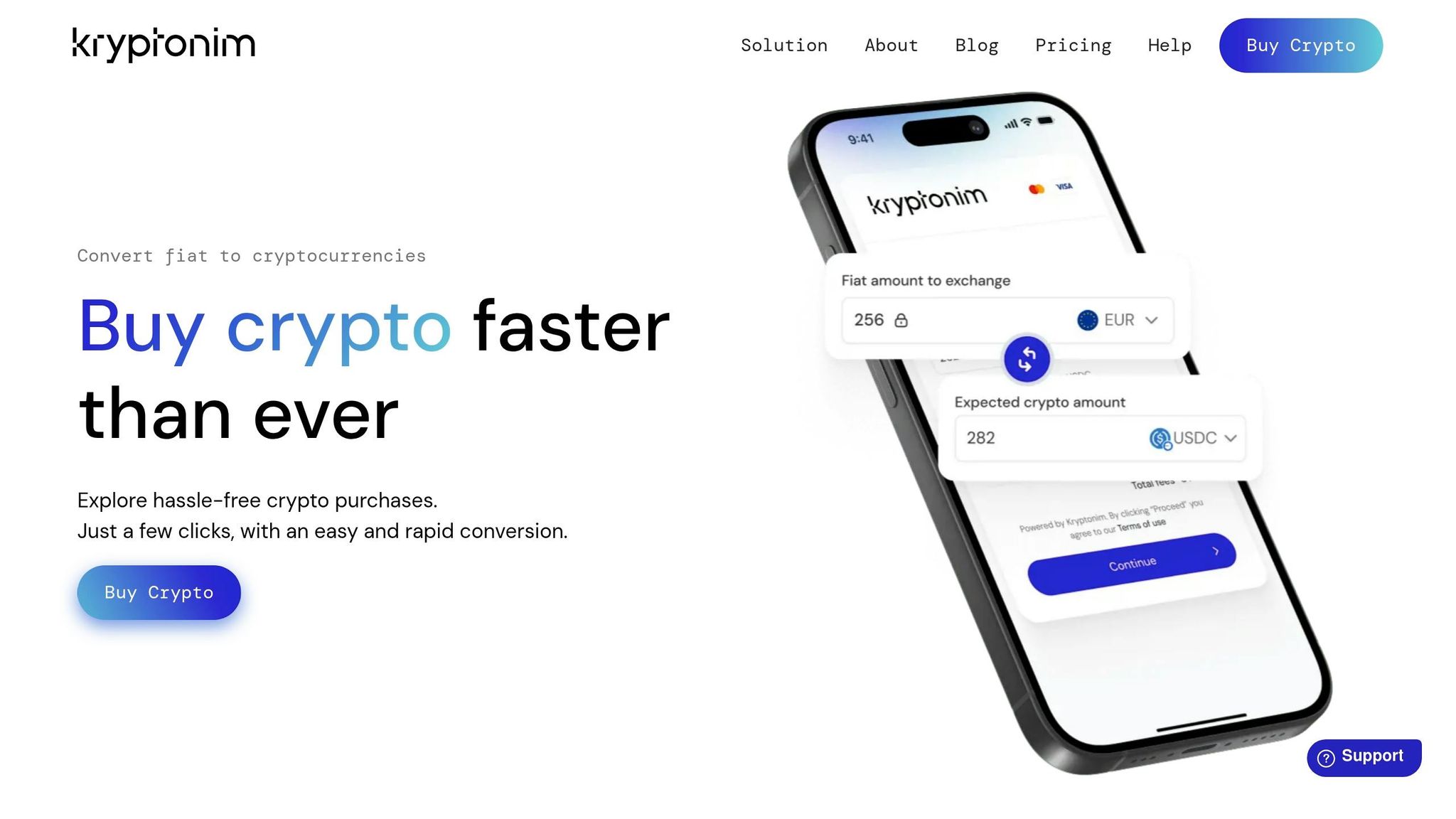
Navigating these choices can feel complicated, but Kryptonim makes the process easier. Whether you’re leaning toward a custodial or non-custodial wallet, the first step is purchasing cryptocurrency - and that’s where Kryptonim shines. It’s a secure, EU-regulated platform that streamlines crypto purchases for both beginners and seasoned users.
With Kryptonim, you can buy crypto quickly without creating an account. The platform supports local payment methods and offers transparent pricing: 2% per transaction for EU users and 4% for users in other regions. There are no hidden fees, and the straightforward verification process lets you move from fiat currency to crypto in just minutes.
Once you’ve purchased your crypto, Kryptonim allows you to transfer it to the wallet type that best fits your needs. Whether you choose a custodial wallet for active trading or a non-custodial hardware wallet for long-term storage, Kryptonim’s beginner-friendly interface takes the intimidation out of the process. It serves as a secure bridge between traditional finance and your chosen crypto storage strategy.
Conclusion: Which Wallet Type Keeps Your Crypto Safest
The core of crypto security boils down to one key question: Who controls your private keys? Your choice of wallet depends entirely on your priorities. If convenience tops your list - complete with features like password recovery and customer support - a custodial wallet might be your best bet. However, if you prefer full control over your assets and want to minimize third-party risks, a non-custodial wallet is the way to go. For long-term storage, hardware wallets often provide the highest level of protection.
By 2025, an estimated 59% of crypto users are expected to favor self-custody solutions, largely driven by concerns over the risks associated with custodial platforms. That said, custodial wallets remain a go-to option for newcomers and active traders who prioritize ease of use and quick access. As Arthur Crowson aptly notes:
"Choosing between a custodial or non-custodial wallet depends on what you are trying to get out of your Bitcoin and how comfortable you are with computer security".
Many seasoned investors adopt a hybrid approach: storing the bulk of their assets in cold storage for security while keeping a smaller portion in a custodial wallet for liquidity and everyday trading. This strategy offers a balance between safety and convenience.
If you're just starting out, begin with what feels manageable. Learn the basics, and as your confidence grows, consider transitioning to more secure storage options. When you're ready to acquire crypto, platforms like Kryptonim make the process simple. They offer transparent pricing (2% for EU users, 4% for others), no need for an account, and an EU-regulated framework. Once you’ve made your purchase, you can move your assets to the wallet type that best suits your needs and comfort level.
FAQs
What happens if I lose my seed phrase?
Losing your seed phrase can mean permanently losing access to your cryptocurrency. For non-custodial wallets, the seed phrase is the only method to recover your wallet. Without it, there’s no way to access your funds or restore the wallet. That’s why securely storing your seed phrase and ensuring it remains safe is absolutely critical.
How much crypto should I keep on an exchange vs in self-custody?
When deciding how much cryptocurrency to keep on an exchange versus in self-custody, it all boils down to your personal comfort with risk, your need for security, and how often you trade. Many experts recommend holding only a small amount on exchanges - just enough for active trading. The rest? It’s safer in self-custody wallets where you control the private keys. This strategy helps reduce the risks tied to exchanges, like hacks or financial troubles, while still offering a balance between convenience and security.
Are hardware wallets worth it for long-term storage?
Yes, hardware wallets are a great option for long-term crypto storage. By keeping your private keys offline, they significantly lower the chances of hacking or online theft. Many hardware wallets also come equipped with advanced security features like secure chips and biometric authentication, making them far safer than wallets connected to the internet. If you're planning to hold onto your assets for the long haul, investing in a hardware wallet is a reliable way to protect them.