
How to Move Stablecoins Between Networks Safely
Securely move stablecoins across chains: verify networks, pick audited bridges or CCTP, test with a small transfer, and limit approvals.
Moving stablecoins like USDT, USDC, and DAI between blockchains can save on fees or unlock specific features on different networks. However, the process involves risks, such as bridge hacks, token mismatches, and gas shortages. To transfer stablecoins securely:
- Understand the Basics: Learn about cross-chain transfers, bridges, wrapped tokens, and differences between native and bridged stablecoins.
- Prepare Properly: Verify the token's network, ensure your wallet supports both chains, and have enough gas tokens for fees.
- Choose the Right Method: Options include issuer-managed burn-and-mint (e.g., Circle's CCTP), canonical bridges, or liquidity pool swaps. Each has trade-offs in speed, cost, and security.
- Double-Check Everything: Use official URLs, verify contract addresses, and always send a small test transaction before transferring large amounts.
- Minimize Risks: Avoid unlimited token approvals, revoke permissions after use, and use audited bridges with strong security records.
For a simpler option, platforms like Kryptonim allow you to buy stablecoins directly on your desired network, bypassing the need for bridging entirely. This reduces complexity and potential errors.
Key Takeaway: Plan carefully, choose secure methods, and always test transfers to avoid costly mistakes.
How to Prepare for a Stablecoin Transfer
Taking the time to prepare for a stablecoin transfer can help you avoid mistakes that might cost you money. Issues like sending to the wrong network, running out of gas, or falling for phishing scams are preventable with a few careful steps.
How to Identify Which Network Your Stablecoins Are On
Start by checking the active network in your wallet to confirm where your stablecoins are located. This is crucial to avoid errors when transferring between networks. Keep in mind that wallets only show token balances for the selected network, so you’ll need to switch networks to verify your holdings.
Pay close attention to token labels and suffixes. For instance, tokens like USDC.e or USDT.e indicate bridged versions rather than native ones. Another clue is the gas token your wallet requests: ETH points to an EVM-compatible network like Ethereum, Arbitrum, or Base, while SOL points to Solana. If you’re unsure, double-check the token’s contract address using a block explorer like Etherscan for Ethereum networks or Solscan for Solana.
Choosing a Compatible Crypto Wallet
Your wallet must support both the source and destination networks. For EVM-compatible chains such as Ethereum, Arbitrum, Base, Polygon, or Avalanche, MetaMask is a reliable choice. For Solana, Phantom is the preferred wallet and also supports some EVM networks, making it helpful for cross-chain transfers. U.S. users might also consider Coinbase Wallet, which supports both ecosystems and offers gasless USDC transfers on Base when moving funds from Coinbase. For added security, especially with larger amounts, pair your wallet with a hardware wallet like Ledger to keep your private keys offline.
EVM wallet addresses look the same across different Layer 2 networks, but they are incompatible with non-EVM wallets. For example, sending funds from a Solana address to an Ethereum-format address without using a bridge will result in a permanent loss of funds.
Once you’ve confirmed your wallet compatibility, ensure you have enough gas tokens to cover transaction fees and avoid any delays.
Planning for Fees and Gas Tokens
A common mistake is successfully bridging stablecoins only to find yourself unable to use them on the destination chain because you lack the native gas token.
"One of the most common operational mistakes is arriving on a destination chain with zero gas. You may bridge USDC successfully but still be unable to swap, bridge again, or interact with applications because you have no native token for gas." - TokenToolHub
Prepare by having enough native gas tokens for both the source and destination networks. Here’s a quick reference for typical fees:
| Network | Native Gas Token | Avg. Gas Fee |
|---|---|---|
| Ethereum | ETH | $2 – $20 |
| Arbitrum | ETH | $0.01 – $0.10 |
| Base | ETH | $0.01 – $0.05 |
| Polygon | MATIC | $0.01 – $0.05 |
| Solana | SOL | $0.001 – $0.01 |
Additionally, third-party bridges often charge a fee of 0.05% to 0.3% of the transfer amount. To avoid running into issues, keep a small reserve of native tokens on every chain you use frequently.
Security Checks Before You Transfer
Before connecting your wallet to a bridge, take these precautions to secure your funds:
- Manually enter the URL or use a trusted bookmark. Avoid clicking links from social media, Discord, or search ads, as phishing sites often mimic legitimate bridges.
- Verify the bridge’s contract address through its official documentation or a trusted block explorer. If anything about the domain, token approval request, or interface seems off, stop immediately.
- Limit token approvals to the specific amount you’re transferring. Avoid granting unlimited approvals, as this gives the smart contract ongoing access to your funds.
Following these steps can help ensure your stablecoin transfer goes smoothly and securely.
How to Choose a Safe Transfer Method

Cross-Chain Bridge Methods Compared: Speed, Fees & Security
When it comes to transferring stablecoins, the method you choose can significantly impact both security and speed. Your decision should align with the specific stablecoin, supported networks, and your balance between risk tolerance and efficiency. With your wallet ready and funds prepared, it's time to select a transfer method that suits your needs.
Comparing Transfer Methods
The three most common transfer methods are issuer-managed burn-and-mint, canonical (lock-and-mint) bridges, and liquidity pool swaps. Each has its own mechanics and risks, so understanding these differences is key to making a safe choice.
Before proceeding, recall the earlier security checks for connecting to any bridge.
"Wrapped tokens rely on the bridge's custody; a breach results in lost funds." - Ben Chatwin, Dwellir
Burn-and-Mint (Issuer-Managed): This method, used by Circle's CCTP, burns USDC on the source chain and mints a native version on the destination chain. By eliminating vault-related risks, it offers a safer alternative. For example, in March 2026, Circle processed $2.4 billion through CCTP in just one month. The introduction of CCTP V2 in March 2025 added a "Fast Transfer" feature, reducing transfer times to 8–20 seconds on supported chains.
Canonical Bridges: Options like the Arbitrum Bridge or Base Bridge lock tokens in a vault on the source chain and mint a wrapped version on the destination chain. These bridges leverage the security of Layer 1 networks but can have slower withdrawal times - up to 7 days for returns to Ethereum due to the optimistic challenge window.
Liquidity Pool Bridges: Protocols like Across Protocol or Stargate Finance enable quick transfers, typically within 1–5 minutes, by swapping tokens through liquidity pools. However, these come with risks such as slippage and potential liquidity shortages.
| Method | Mechanism | Speed | Fees | Best For |
|---|---|---|---|---|
| Issuer-Managed (CCTP) | Burn-and-Mint | 8 sec – 15 min | ~0.0001% + gas | Large USDC transfers; native asset needs |
| Canonical Bridge | Lock-and-Mint | 10 min (in) / 7 days (out) | Gas only | Maximum security for L1 ↔ L2 transfers |
| Liquidity Pool | Swap-based | 1–5 min | 0.04%–0.12% + gas | Fast L2-to-L2 transfers |
Since 2022, bridge exploits have resulted in over $2.8 billion in losses, accounting for roughly 40% of all Web3 security incidents. To minimize risks, always choose a bridge that has been audited by firms like Halborn, OtterSec, or Zellic, and check for an active bug bounty program.
Once you've selected a method based on speed and fees, confirm that the destination network supports a native version of your token. This step ensures you avoid complications with wrapped assets.
Checking Network and Token Compatibility
Before finalizing your transfer, verify that the stablecoin you're sending has a native version on the destination network. This is crucial for avoiding wrapped variants, which may not meet your needs. For instance, if you're transferring USDC, ensure you're receiving native USDC rather than a bridged version like USDC.e.
To ensure accuracy, check the native token's contract address on a block explorer. For example, native USDC on Solana has the contract address EPjFWdd5AufqSSqeM2qN1xzybapC8G4wEGGkZwyTDt1v. Verifying this information helps you avoid receiving an unintended wrapped asset.
"Selection should start with what you must receive (native vs. bridged) and what trust model you can tolerate." - Alex, Stablecoin Insider
Step-by-Step Guide to Using a Cross-Chain Bridge
Once you've chosen your transfer method and confirmed token compatibility, it's time to execute the bridge transaction. Each step in this process is critical - skipping any could result in lost funds.
Connecting Your Wallet and Approving Token Access
Start by accessing the bridge through an official bookmarked URL to avoid phishing scams. Click "Connect Wallet" and choose your provider, such as MetaMask, Rabby, or Coinbase Wallet.
Make sure your wallet is set to the source network so your token balances display correctly. After connecting, you'll need to approve token access. This involves an ERC-20 approval transaction, which allows the bridge's smart contract to move your tokens. When prompted, approve only the specific amount you plan to transfer instead of selecting "unlimited" to limit your exposure in case of a contract issue.
"Bridges have historically been one of the most exploited categories in crypto. Over $2.5 billion has been stolen from bridge hacks since 2021." - Coinstancy Academy
Double-check the bridge's contract address against official documentation. Then, select the appropriate networks and tokens to continue.
Selecting Networks and Tokens
Most bridge interfaces include dropdown menus for choosing your source and destination chains. Pay close attention to the network variants - BNB Smart Chain (chainId 56) is not the same as BNB Beacon Chain (chainId 714).
Ensure your wallet is set up with native tokens on both the source and destination networks. When selecting stablecoins, know the difference between native versions and wrapped or bridged variants. For example, receiving a wrapped token like USDC.e instead of native USDC can limit your options on the destination chain. If you're transferring USDC via a CCTP-supported route (such as Ethereum, Base, Arbitrum, Avalanche, or Solana), the burn-and-mint mechanism ensures you receive a native asset.
If the destination network isn’t already added to your wallet, configure it now so your balance is visible as soon as the transfer is complete. Carefully review all transfer details before confirming.
Reviewing and Confirming the Transfer
Enter the amount you want to transfer and review the associated fees. For liquidity-pool-based bridges, slippage usually ranges from 0.01% to 0.1%, depending on pool depth. Gas fees vary widely: Ethereum mainnet deposits typically cost $1 to $10, while Layer 2 networks like Arbitrum or Base often cost less than $0.10.
Most bridge interfaces provide an estimated arrival time. Liquidity bridges like Across Protocol generally settle in 1–5 minutes, while canonical bridges to Ethereum Layer 2s may take 10–15 minutes for deposits. Once you've reviewed everything, confirm the transaction and save the transaction hash to track its progress.
You can monitor the transfer using the source chain's block explorer (e.g., Etherscan) or the bridge's status tracker.
Verifying Funds on the Destination Network
After the source chain confirms your transaction, switch your wallet to the destination network. If your token balance doesn’t appear, use the "Import Token" feature in your wallet and input the verified contract address. These addresses can be found on trusted block explorers like Solscan for Solana or BscScan for BNB Chain. Also, make sure you have a small amount of the destination network’s native gas token to interact with your funds.
Some bridges, especially those transferring back to the Ethereum mainnet, require an additional "Claim" or "Finalize" transaction on the destination network to release your funds. Always check the bridge’s status page before assuming your transfer is stuck.
Why You Should Always Send a Test Transaction First
After confirming your funds, it’s time for a critical step: sending a small test transaction. Even if you’re confident in your setup, always test with a small amount - $10 to $50 - before transferring a larger sum. This ensures the route is live, the destination address is correct, and the token arrives as expected.
"Regardless of how much you plan to transfer, always test with a small amount ($10–$50) first. Only move larger amounts after confirming the full flow works." - CryptoGuide
A test transaction is a minor expense but can save you from major errors. Once the small transfer arrives correctly - with the right token, on the correct network, and in the intended wallet - you can safely proceed with the full amount.
sbb-itb-0796ce6
Advanced Safety Tips and Common Mistakes to Avoid
This section dives deeper into advanced strategies for safeguarding your assets and highlights common errors to steer clear of during cross-chain transactions.
Understanding Smart Contract Risks
Smart contracts are at the heart of every cross-chain bridge, managing the process of locking, burning, or minting tokens. Unfortunately, this makes them prime targets for attacks. Since 2021, bridge exploits have resulted in staggering losses of over $2.8 billion. In fact, about 70% of all cryptocurrency hacks by value have targeted these bridges. Among the various designs, the lock-and-mint model is particularly vulnerable - if the source vault is breached, the wrapped tokens it supports can quickly lose all value.
"Lock-and-mint bridges pose the greatest risk to stablecoins because they decouple the token from its legal and financial backing, replacing it with a contract-based claim." - KuCoin
To minimize risks, opt for protocols with a proven track record of at least one year without major security incidents. Look for bridges that have undergone multiple audits by well-regarded firms. For USDC, Circle's native CCTP rails are considered safer because they burn and mint native tokens directly, avoiding the wrapped token model. Additionally, steer clear of bridges using a single validator setup (known as "1/1 DVN"), as a compromised node in such a system can authorize unbacked minting.
These smart contract risks should be addressed alongside other essential safety measures, like thorough address verification and careful token approval management.
How to Avoid Address and Chain Mismatches
One of the most common and irreversible mistakes in cross-chain transactions is sending funds to the wrong network or an incompatible address. For example, an EVM-compatible address won't work on Solana, and the BNB Smart Chain (chainId 56) is entirely different from the BNB Beacon Chain (chainId 714).
Always double-check the destination address and network. Avoid relying solely on visual confirmation, as clipboard data can sometimes be tampered with by malicious software. If your wallet doesn't already support the destination network, manually add it using verified chain data before proceeding with the transfer.
Managing Token Approvals
When you grant a bridge permission to move your tokens, that authorization often remains active even after the transaction is complete. To reduce exposure, approve only the amount you intend to transfer. Afterward, revoke any unnecessary permissions using tools like Revoke.cash. This extra step can significantly reduce the risk of unauthorized transactions.
Dealing with Low Liquidity and Slippage
Bridges that rely on liquidity pools need sufficient funds on both sides of the transaction to operate smoothly. If a pool is imbalanced, you could face high slippage or a partial fill, resulting in fewer tokens than expected. For transfers exceeding $50,000, consider breaking the amount into smaller chunks to minimize market impact. Additionally, set your slippage tolerance to less than 0.5% within the bridge interface to avoid unexpected losses.
Proper planning here not only protects your assets during the transaction but also ensures smoother execution.
Keeping Records for Tax and Compliance Purposes
In the U.S., the IRS treats cryptocurrency transactions as taxable events. For example, swapping a native stablecoin for a wrapped version during a bridge transfer could be considered a taxable disposal. To stay compliant, document every bridge transaction. Record the transaction hash, the timestamp, and the USD value of the assets at the time of transfer. Whether you use a simple spreadsheet or a dedicated crypto tax tool, maintaining these records will make tax reporting easier and provide a safety net if any disputes arise later.
Using Kryptonim to Support Your Stablecoin Workflow
Buying Stablecoins Through Kryptonim
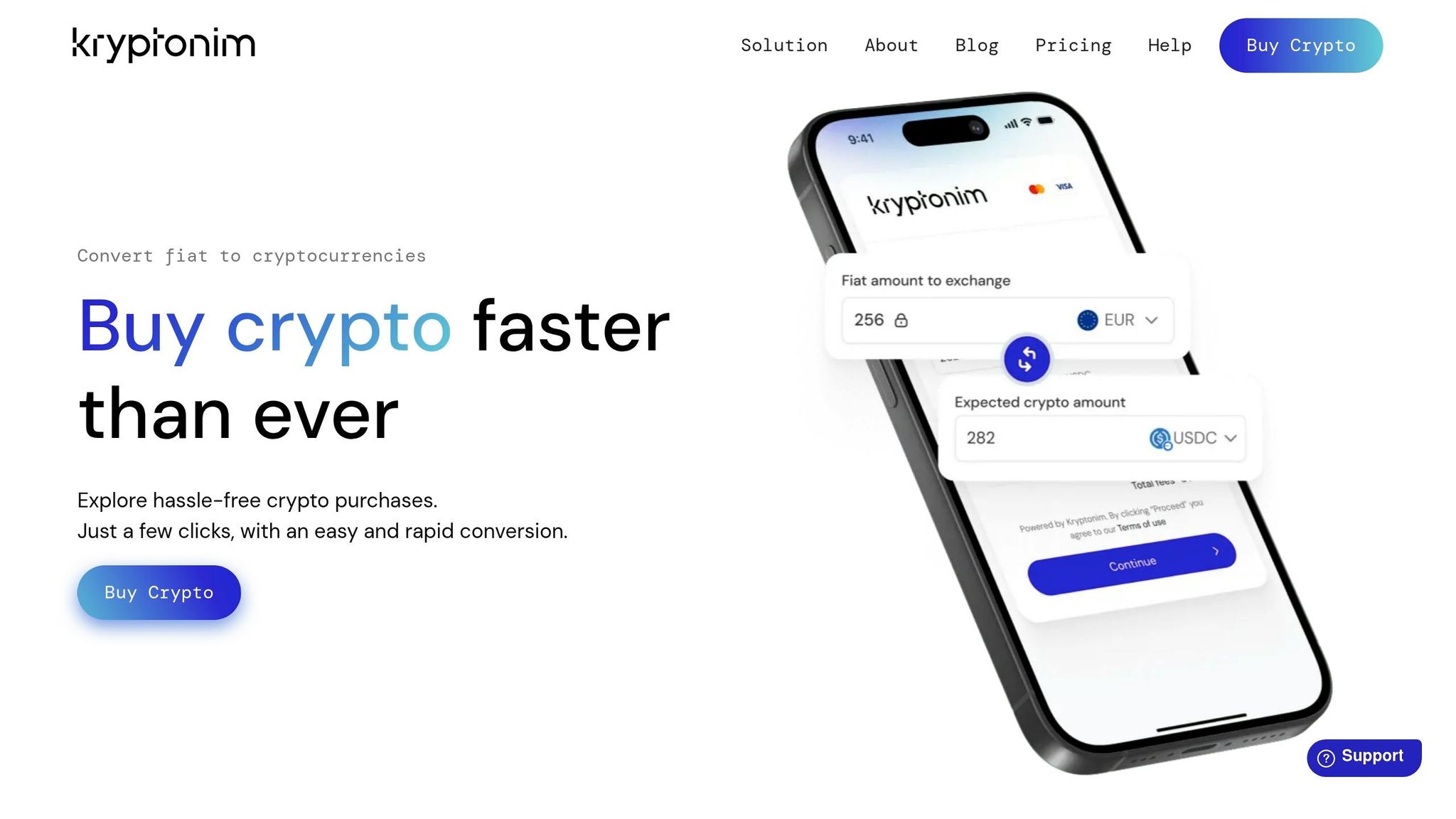
Kryptonim provides a straightforward way to purchase stablecoins directly into your wallet, using familiar payment options like credit and debit cards (Visa, Mastercard), Google Pay, Apple Pay, or even bank transfers. This makes acquiring stablecoins quick and accessible.
No need to create an account! If you're in the U.S., you'll just need to provide an email address, billing information, and a government-issued ID for identity verification. Once verified, your stablecoins are sent directly to your wallet - whether it's MetaMask, Trust Wallet, or another supported option. Transactions are typically completed within 2–20 minutes, though bank transfers may take up to three business days.
"Kryptonim.com enables seamless conversion from fiat to crypto, making crypto more accessible and practical for all users." - Kryptonim
The pricing is transparent: a 4% processing fee for users outside the EU, plus a variable network fee based on blockchain activity. There are no hidden charges, so you know exactly what you're paying.
Combining Kryptonim with Cross-Chain Transfers
Kryptonim also simplifies the process of integrating stablecoin purchases with cross-chain transfers. Instead of buying stablecoins on Ethereum and dealing with the costs and risks of bridging, you can purchase stablecoins directly on the network where you need them. This approach reduces both fees and complexity. Kryptonim supports multiple networks, often eliminating the need for a bridge altogether.
| Stablecoin | Supported Networks |
|---|---|
| USDC | Arbitrum, Avalanche, Ethereum, Optimism, Polygon |
| USDT | Ethereum, Polygon |
| DAI | Arbitrum, Avalanche, Base |
| FRAX | Arbitrum, Avalanche, Ethereum, Optimism, Polygon |
With a low minimum purchase equivalent to roughly $10, Kryptonim even allows you to test the process with small transactions before committing larger amounts.
Conclusion
Moving stablecoins across networks takes some planning, but it’s manageable if you follow the right steps. Start by understanding your token’s network, ensure you have enough gas tokens, and double-check every address to avoid mistakes.
The process itself is straightforward: confirm the source network, pick a secure transfer method, and always test with a small amount before transferring larger sums. Fees are reasonable, with bridge fees ranging from 0.05% to 0.25% and Layer 2 gas costs between $0.01 and $0.10, making transactions both efficient and cost-effective.
Security is just as important as the technical details. Use only official bookmarked URLs for bridges, limit token approvals to exact amounts, and revoke permissions right after completing a transfer using tools like revoke.cash. As Alex from Stablecoin Insider wisely put it:
"If you treat bridging like a repeatable operating procedure: verify, test, then size, you will avoid the most common and costly mistakes." - Alex, Stablecoin Insider
For those looking to skip the hassle of bridging, Kryptonim offers a simpler solution. It allows users to purchase stablecoins directly on their desired network, eliminating extra steps. With support for networks like Arbitrum, Avalanche, Base, and Polygon, it’s a practical option for both beginners and experienced users.
FAQs
Which bridge method is safest for my stablecoin?
When it comes to choosing the safest method for transferring assets, it really depends on your specific needs:
- Official canonical bridges: These are the go-to option for Ethereum Layer 2 transfers. They rely on mainnet security, making them a trustworthy choice.
- Circle's CCTP for USDC: This method stands out for USDC transfers. Instead of traditional bridging, it eliminates risk by burning tokens on the source chain and minting new ones on the destination chain.
- Intent-based bridges: These bridges tackle protocol vulnerabilities by involving market makers, offering an extra layer of security.
No matter the method, always take precautions: double-check the bridge's URL, conduct a small test transaction first, and verify the token contract address on the destination chain. These steps can help you avoid costly mistakes.
How do I make sure I get native (not wrapped) stablecoins?
To make sure you get native stablecoins rather than wrapped versions, stick to protocols that use a burn-and-mint mechanism. A good example is Circle’s Cross-Chain Transfer Protocol (CCTP) for USDC. Look for bridge routes marked as Native or CCTP.
Before finalizing a transaction, take a few precautions: double-check the destination token contract address, perform a small test transfer, and ensure the destination applications are compatible with the token’s contract. These steps can help you avoid any unexpected issues.
What if I have no gas token on the destination chain?
If you don’t have the native token needed to cover gas fees on the destination chain, your funds will transfer successfully but will stay locked in your wallet. Without enough of the destination chain’s native token, you won’t be able to move or use those funds. To avoid this issue, make sure to have a small amount of the destination network’s native currency in your wallet before initiating the transfer.