
How to Buy Litecoin (LTC) with Fiat
Step-by-step guide to buying Litecoin with USD: verification, payment options, fees, and secure wallet setup.

You can buy Litecoin with U.S. dollars in just a few steps: verify your account, choose a payment method, enter your LTC wallet address, review the quote, and pay. The main trade-off is simple: bank transfers usually cost less but take longer, while debit and credit cards are faster but often cost more.
If I were starting today, I’d focus on these points first:
- Litecoin settles faster than Bitcoin with a 2.5-minute block time vs. 10 minutes
- ACH bank transfers often take 1–5 business days
- Debit cards are often the easiest way to make a first buy
- Credit cards can add extra bank fees, including cash-advance charges
- Kryptonim fees shown here are 2% for EU users and 4% for U.S. and other non-EU users
- Buying LTC with USD is not taxable by itself in the U.S., but selling, swapping, or spending it can trigger taxes
- Your wallet address matters: send only to a Litecoin address and check the first and last four characters before paying
- Your recovery phrase is the key to your funds - keep it offline and never share it
Here’s the short version: have your ID, payment method, and wallet ready before checkout. Then compare the total price, fee, spread, and delivery time so you know how much LTC you’ll get and when it should arrive.
| Payment Method | Cost | Delivery Time | Best For |
|---|---|---|---|
| ACH Bank Transfer | Lower | 1–5 business days | Bigger buys, lower fees |
| Debit Card | Medium to high | Usually instant | First purchases, fast checkout |
| Credit Card | Highest | Usually instant | Urgent buys, if supported |
Bottom line: if you want the lowest cost, I’d look at ACH. If you want the easiest first purchase, I’d look at a debit card. Either way, I’d review the final quote, save the transaction details, and move LTC to a wallet I control if I plan to hold it.
What to Prepare Before You Buy LTC
Before you check out, get three things ready: your ID, your payment method, and your wallet address.
Documents, Payment Methods, and Wallet Address
Use a government-issued photo ID, like a driver's license or U.S. passport. Some platforms may also ask for proof of address, such as a recent utility bill or bank statement.
You should also have your bank account, debit card, or credit card ready. And if you plan to keep your LTC in your own wallet, make sure your LTC receive address is on hand before you start.
How Verification and U.S. Rules Work
U.S.-regulated services have to follow anti-money-laundering rules. That’s why they ask for your legal name, address, and ID.
A lot of delays come down to simple issues, like blurry ID photos or details that don’t match. It helps to take the photo in a well-lit area and check that every line of text on the ID is easy to read.
Once your account is verified, lock it down before you buy. Turn on 2FA with an authenticator app after verification, and avoid SMS-only 2FA.
For taxes, keep a record of the date, amount, price, and fees. Buying LTC with USD is not taxable, but selling, swapping, or spending it is.
Fees, Spreads, and Payment Speed at a Glance
Your payment method affects both speed and cost. Fees can change based on the payment method, order size, and pricing model. In most cases, card payments cost more than bank transfers.
| Payment Method | Typical Speed | Typical Fee Level | Best Use Case |
|---|---|---|---|
| Bank Transfer (ACH) | 1–3 business days | Low | Larger, cost-effective purchases |
| Debit Card | Instant | Medium to high | Fast, convenient smaller purchases |
| Credit Card | Instant | Highest | Immediate checkout, where supported |
Always check the final checkout screen before you confirm. Fees are based on your location, payment method, order size, and current market conditions. So the number you pay can shift a bit from what you saw a minute ago.
With your documents, wallet address, and payment method ready, you’ll be in a good spot to compare your purchase options at checkout.
sbb-itb-0796ce6
Step by Step: Buy Litecoin with Fiat on Kryptonim
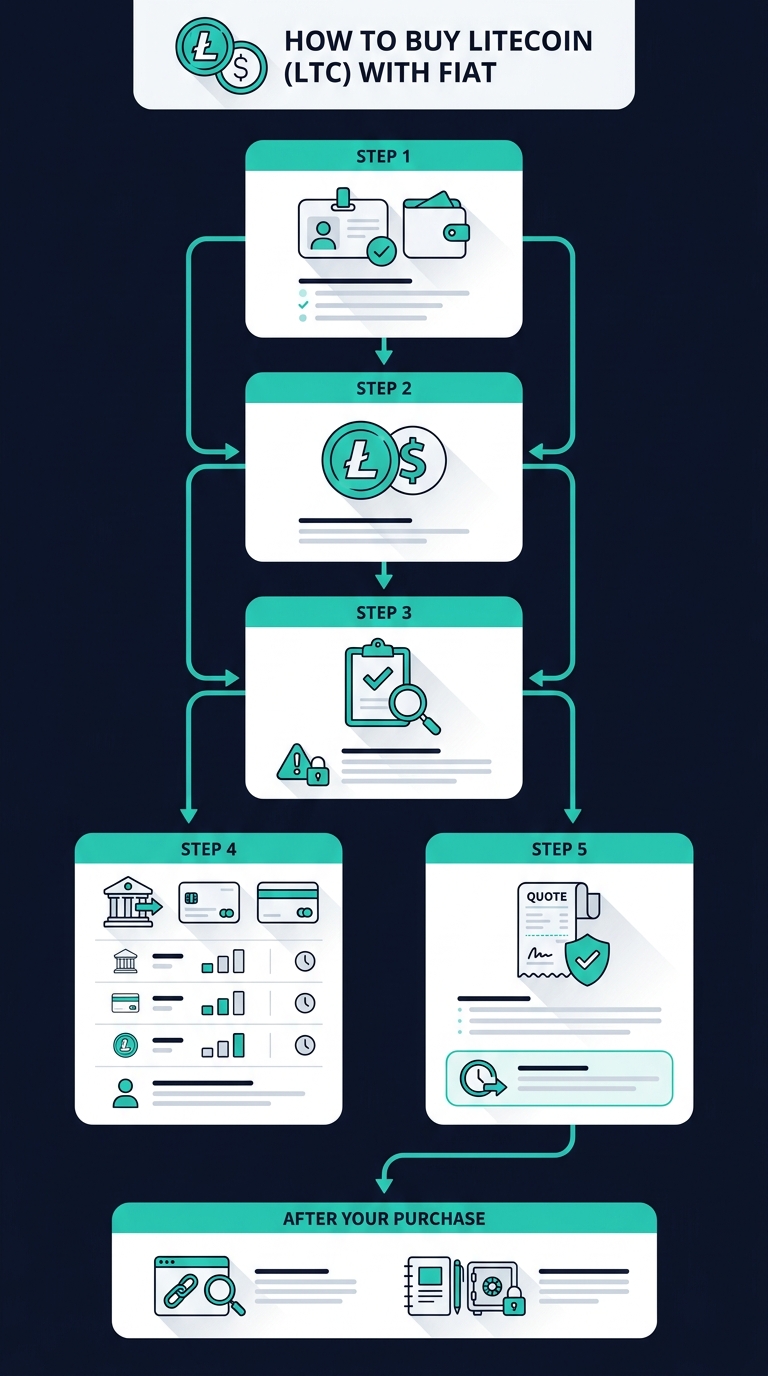
How to Buy Litecoin (LTC) with Fiat: Step-by-Step Guide
With your wallet address ready, buying LTC on Kryptonim is pretty simple. Once your wallet is set up, checkout only takes a few steps.
Enter Your Amount and Choose Litecoin
Open Kryptonim and select Litecoin (LTC). Set USD as your payment currency. Then enter either the U.S. dollar amount you want to spend or the amount of LTC you want to receive. As you change the amount, the quote updates.
Add Your Wallet Address and Complete Payment
After you set the amount, paste in your wallet address and pick how you want to pay. Enter your Litecoin wallet address in the field shown. Then double-check the first and last four characters. Clipboard malware can replace pasted addresses without warning. You should also make sure the address is for the Litecoin network.
Next, choose your payment method:
- Bank transfer
- Debit card
- Credit card
Then complete any identity check shown during checkout.
How Kryptonim Shows Pricing Before Checkout
Kryptonim shows the total before you confirm the purchase. The platform charges a 2% fee for EU users and 4% for U.S. and other non-EU users. If network fees apply, they appear as a separate charge.
Review the quote, then confirm. Kryptonim sends the LTC to the wallet address you entered.
Next, compare bank transfer, debit card, and credit card checkout speed and cost.
Bank Transfer, Debit Card, or Credit Card: Which to Use
At checkout, your payment method affects two things right away: the final price and how fast your Litecoin shows up. So it helps to match the method to your budget and your timeline.
Bank Transfer for Larger or Lower-Cost Purchases
ACH works well for lower-cost, planned buys. The downside is speed. ACH transfers usually take 1 to 5 business days to settle.
That wait is often less of a problem when you're planning a larger purchase in advance. But if timing matters more than cost, card payments are the faster option.
Debit and Credit Cards for Faster Checkout
For a small first purchase, debit cards are usually the fastest practical option. They make it easy to go through the process once and get comfortable with how it works.
Credit cards cost the most and can trigger cash-advance fees. Many U.S. banks treat crypto purchases as cash advances, which can mean higher interest rates and extra issuer fees on top of the platform's processing fee. Put simply, you can end up paying more than expected. It's usually best not to borrow money to buy a volatile asset like Litecoin.
How Fees and Quotes Affect the LTC You Receive
Checkout quotes expire fast. The quoted price also includes a spread. Those two details matter because both the fee and the spread cut into the final amount of LTC that reaches your wallet.
With that in mind, the choice is pretty simple: use a debit card if speed matters for your first purchase, or use ACH if your main goal is a lower-cost buy.
Store Your Litecoin Safely and Keep Your Records
Check Delivery and Confirm the Transaction
Once you’ve paid, make sure the LTC reached the address you entered. Check your wallet balance and transaction history right after the purchase.
If the LTC doesn’t show up at once, don’t panic. Wait a few minutes, refresh your wallet, and check the TXID on a Litecoin explorer.
Choose a Wallet and Back Up Your Recovery Phrase
If you want to keep LTC for a while, move it out of custodial storage and into a wallet you control. This part matters just as much as the purchase itself. If an exchange holds the keys, it holds the LTC. A self-custody wallet puts that control in your hands.
| Storage Type | Security Level | Beginner Ease of Use | Best Fit For |
|---|---|---|---|
| Hardware Wallet | Highest (Offline) | Moderate | Long-term holding and large amounts |
| Mobile/Desktop Wallet | Moderate (Online) | High | Frequent use or small-to-medium amounts |
| Exchange (Custodial) | Lowest (Third-party) | Highest | Immediate trading or very new beginners |
Write your 12- or 24-word recovery phrase on paper and keep it offline in a safe place. Don’t store it on your phone, computer, email, or cloud account. And never share it with anyone. If you lose that phrase, you’ll usually lose access to your LTC for good.
Conclusion: The Simplest Path from Cash to LTC
After you confirm delivery, record the purchase details and store your recovery phrase safely. Keep track of the purchase date, the amount of LTC, the USD cost, and any fees. Good records make tax time a lot less painful.
FAQs
How much Litecoin will I actually receive after fees?
The amount of Litecoin you get depends on three things: the current market price, the platform’s trading or transaction fees, and the payment method you use.
Most exchanges show the total cost and the final amount of Litecoin before you confirm the order. Because fees change from one platform to another - and often by funding method too - it’s smart to check the final order summary before you complete your purchase.
What happens if I send LTC to the wrong wallet address?
If you send Litecoin to the wrong wallet address, your assets may be permanently lost.
Crypto transactions are usually irreversible. So before you confirm a transfer, double-check the destination address and make sure you're using the correct blockchain network.
Should I keep my Litecoin on the platform or move it to my own wallet?
It comes down to what matters more to you.
Keeping Litecoin on a platform is simpler. You can get to trading tools fast, and the platform may come with built-in security features.
A personal non-custodial wallet puts you in full control of your private keys. Many people see that as the safer route. But there’s a trade-off: once you move your coins, you are fully responsible for protecting your keys and your assets.