
7 Global Events That Move Crypto Sentiment
How Fed decisions, inflation, bank stress, geopolitics, elections, regulation, and ETF flows shift crypto sentiment via liquidity and flows.

Crypto can swing before anything changes on-chain. In most cases, the first trigger is macro news that shifts rates, liquidity, or risk appetite.
If I want the short version, it’s this:
- Fed decisions can push Bitcoin and altcoins fast when rate expectations change.
- Inflation reports matter because they can shift the Fed’s next move.
- Bank stress can lead to forced selling or a move into Bitcoin as a relative shelter inside crypto.
- Wars and geopolitical shocks often hit crypto first through fear and thinner liquidity.
- Elections move markets when traders expect rule changes.
- Regulation can tighten or loosen access, which changes liquidity.
- Spot Bitcoin ETF flows now give one of the clearest day-to-day reads on big-money positioning.
A few numbers show why this matters: in early 2026, Bitcoin ETF outflows reached $4.3 billion over five straight weeks, while by Q1 2026 U.S. spot Bitcoin ETFs held more than $130 billion in assets. That tells me one thing: headlines matter, but flows and positioning matter more.
Quick Comparison
| Event | Main market trigger | Usual first signal | Usual crypto effect |
|---|---|---|---|
| Fed decisions | Rates and liquidity | Yields, BTC futures, ETF flows | BTC moves first; altcoins often swing more |
| Inflation data | Fed repricing | CPI/PPI surprise, funding, basis | Hot data often hurts risk assets |
| Bank stress | Cash needs, counterparty fear | ETF flows, stablecoin activity | Selling at first; BTC may hold up better |
| Wars | Fear and liquidity shock | Weekend price gaps, options hedging | Fast drop, then selective dip-buying if calm returns |
| Elections | Policy expectations | ETF flows, sector rotation | Short-term pop or drop based on expected rules |
| Regulation | Market access and compliance | Exchange/stablecoin reaction | Liquidity can tighten; altcoins often get hit harder |
| ETF flow news | Direct institutional demand | Daily net inflows/outflows | Strong effect on BTC, then spillover to ETH and altcoins |
If I’m reading the market in real time, I’d keep it simple: check the surprise, then check yields, the U.S. dollar, Bitcoin, and ETF flows. That usually tells me whether the move has support or if it’s just leverage getting cleared out.
sbb-itb-0796ce6
Why Global Events Matter Beyond the Headlines
Crypto doesn't move on headlines alone. It moves on what those headlines mean for rates, liquidity, and risk appetite. A Fed decision or a geopolitical shock matters because traders instantly start pricing in the next move. And that change in expectations tends to show up first in derivatives and ETF flows.
Here's the basic idea: when rates stay higher for longer, financial conditions get tighter. Cash and other yield-paying instruments start to look better than Bitcoin, which pays no yield. As that happens, traders and large funds often cut risk and rebalance around the new liquidity setup.
That change can hit trading behavior fast. The crypto derivatives market is big enough to reprice at the edges almost immediately. Perpetual futures often move the moment macro expectations shift, and spot prices tend to follow.
ETF flows add another layer of signal. Daily net flows now give a near real-time look at how large investors are positioning as macro conditions change.
The table below shows how key macro indicators often feed into crypto sentiment:
| Macro Indicator | What It Signals | Typical Crypto Impact |
|---|---|---|
| Rising Treasury Yields | Tighter financial conditions | Bearish; reduces demand for non-yielding assets |
| U.S. Dollar Strength | Tighter global liquidity | Typically inverse to crypto prices |
| ETF Net Outflows | Institutional de-risking | Short-term selling pressure |
| Negative Funding Rates | Overcrowded short positions | Potential short-squeeze setup |
That chain reaction often starts with the Fed, since rate decisions and forward guidance can reset risk appetite in a hurry.
1. Federal Reserve Rate Decisions
Federal Reserve meetings can move crypto markets fast. When the Fed lifts rates or hints at tighter policy than traders expected, money gets more expensive and cash or other yield-paying assets start to look better. That pressure tends to hit Bitcoin ETFs and futures first.
Bitcoin is usually the first to react because ETF flows and futures prices adjust as Fed expectations shift. In early 2026, Bitcoin ETF outflows hit $4.3 billion across five straight weeks during a stretch of heavier macro uncertainty.
Altcoins usually follow later, and the moves are often sharper. Their markets aren’t as deep as Bitcoin’s, so when macro pressure shows up, capital often rotates into Bitcoin and away from smaller altcoins.
What moves prices most isn’t always the rate decision itself. It’s the surprise. A widely expected hold may do very little. But an unexpected hawkish signal, or even a rate cut paired with cautious language, can spark much larger swings. In March 2026, crypto ETFs went from $1.5 billion in monthly inflows to a $163 million daily outflow after changes in Fed rate expectations. That shift often starts in derivatives markets before spot prices catch up.
2. Inflation Reports
If rate decisions set the stage, inflation data gives you the next clue. CPI and PPI matter because they shape Fed expectations. And when either report lands hotter or softer than expected, those expectations can swing fast. Crypto sentiment often swings right along with them.
The biggest driver is the surprise. When inflation comes in hotter than expected, traders usually price in a Fed that stays tighter for longer. That can tighten financial conditions and put pressure on risk assets. Softer data tends to flip the mood: rate-cut bets grow, and risk appetite often improves.
You usually see that change show up in positioning first. During macro-driven risk-off stretches, capital often rotates toward Bitcoin and away from smaller tokens.
The first real stress signal often shows up in derivatives. Funding rates and basis can shift within minutes of a CPI or PPI release. And if negative funding shows up after a sharp flush, it can point to crowded shorts and rebound risk.
Core CPI matters most because the Fed watches it more closely than headline inflation.
3. Bank Stress and Financial-System Concerns
Bank failures often hit crypto fast. When a bank collapses, or a central bank injects emergency liquidity, institutions tend to sell risk assets to get cash on hand. In moments like that, liquidity comes first. And crypto is often one of the first areas where they cut exposure.
The big issue is what happens next. Does the selling stay mostly inside crypto? Or does it spill out into a broader market selloff?
During bank stress, money often shifts toward Bitcoin and other large-cap assets. Altcoins usually get sold first because they’re often the first positions trimmed when risk appetite drops. You can often see that move play out in ETF data almost in real time.
That’s why it helps to watch ETF net flows during banking stress. They can show whether institutions are pulling money out of Bitcoin or moving into it as a relative safe spot inside crypto. Put simply, ETF flows are one of the fastest signals of institutional stress.
4. Wars and Geopolitical Escalation
Geopolitical shocks can hit crypto sentiment fast because traders have to price in uncertainty on the spot. In the short run, Bitcoin usually doesn't act like a safe haven right away. Big players often move to cash first while they rethink liquidity and volatility. So when geopolitical tension flares up, crypto becomes an instant stress test for risk appetite, market liquidity, and trader positioning.
The first move usually shows up in derivatives. Crypto trades 24/7, which means a weekend shock can spill into Monday with gaps and sharper price swings. You can often see that fear in 1-week put skew, which may jump as traders rush to hedge downside risk.
Once that first wave of selling hits, the damage often moves down the risk curve. Altcoins tend to drop the fastest as money rotates first into Bitcoin and Ethereum.
What matters most isn't just the first sell-off. The bigger clue is whether risk appetite comes back fast. That tells you more about the market's underlying strength than the initial price drop.
5. National Elections and Political Transitions
Unlike wars or banking stress, elections tend to move crypto through expected policy shifts. A pro-crypto result can trigger a fast rally. But that first pop often doesn't last unless policy starts to turn into actual rules.
That played out after Donald Trump's re-election. The early gains were wiped out within about two weeks as professional investors cut risk while liquidity tightened and macro uncertainty climbed. So the first move is often about anticipation. The harder test comes later, when policy starts taking shape.
Campaign promises also take time. A new administration can change banking access, custody rules, and stablecoin policy. If that rollout is uneven, it can open the door to arbitrage and add compliance risk.
If you're trying to read post-election price action, watch ETF flows more than campaign speeches. That's usually where the market shows what it believes, while the policy details show up later in regulation and enforcement.
6. Cryptocurrency Regulation and Enforcement
Regulation doesn’t hit every part of crypto the same way. Rules aimed at exchanges, stablecoins, tokens, or custody rails can push the market in very different directions. And in most cases, the first thing that changes is liquidity, not just price.
Exchange enforcement tends to land first because exchanges are the main bridge between fiat and crypto. If regulators crack down on that rail, access gets tighter. If they legitimize it, the market usually treats that as a win for liquidity and access. The same basic idea applies to stablecoins too, since liquidity and access are closely tied.
Stablecoin rules often put pressure on liquidity and cross-border settlement. Smaller platforms and altcoins usually feel that pressure the most.
A simple way to read the news: check whether the headline is cutting speculation or opening the door to institutional money. If it targets speculation, altcoins often take the bigger hit. If it pulls major TradFi firms deeper into crypto, it tends to strengthen confidence in regulated, high-liquidity products like Bitcoin and Ethereum ETFs.
Here’s the usual pattern:
| Regulatory Event | Market Reaction | Assets Most Affected |
|---|---|---|
| Exchange enforcement or shutdown | Sell-off, liquidity drop | Bitcoin, altcoins, stablecoins |
| Fed master account granted to crypto firm | Relief rally, structural bullishness | Crypto-related stocks, Bitcoin |
| Stablecoin agency rules | Short-term caution, jurisdiction shifts | USDC, USDT, cross-border platforms |
| Major TradFi firm enters custody or ETFs | Institutional confidence | Bitcoin, Ethereum |
| FSB flags global regulatory gaps | Uncertainty and regulatory arbitrage | Altcoins, cross-border platforms |
When regulation changes access, the next thing to watch is capital flow.
7. Spot Bitcoin ETF and Institutional-Flow News
Once rule changes open the door, ETF flows tell you what institutions are doing with that access. This is where the story gets less theoretical and more concrete. Spot Bitcoin ETF flows can show whether big players are putting on risk or stepping back, while individuals buy Bitcoin and other assets through simpler retail channels, often based on mandate rules, risk caps, and macro positioning.
By Q1 2026, U.S. spot Bitcoin ETFs held more than $130 billion in assets. BlackRock's IBIT alone managed about $75 billion.
Bitcoin tends to react first. If inflows keep coming, ETH and the larger altcoins often move next. That pattern showed up again in July 2026, when U.S. spot Bitcoin ETFs snapped a three-session outflow streak with $297.56 million in net inflows, led by IBIT and FBTC.
That’s why flow data matters so much. A big inflow can hint that institutions are building exposure. A string of outflows can point to risk being cut. And if money piles into just one fund, the bounce may not be as strong as it looks at first glance.
| ETF Signal | What It Usually Means | Who Feels It First |
|---|---|---|
| Strong net inflows | Institutional accumulation; price floor forming | Bitcoin, then ETH |
| Persistent outflows | Risk reduction or macro rebalancing | Bitcoin, then altcoins broadly |
| Major institutional filing | Structural legitimacy signal; long-term bullish | Bitcoin primarily |
| Flows concentrated in one fund | Recovery may be fragile; broad demand unclear | Entire ETF market |
| Sharp flow reversal | Potential deleveraging trigger | Bitcoin, leveraged positions |
Quick-Reference Tables for Reading Market Moves
These tables give you a quick way to read market headlines without overthinking the first move. Match the news to the closest setup, then check one thing first: is this a forced sell-off, or just traders changing positions?
| Inflation Report Outcome | Fed Rate Expectation | Bitcoin Sentiment | Altcoin Reaction |
|---|---|---|---|
| Hotter than expected | Hawkish - higher for longer | Risk-off; sharp price gaps and ETF outflows | High; sell-offs as capital rotates into Bitcoin and other liquid assets |
| Cooler than expected | Dovish - potential cuts or pause | Risk-on; institutional dip-buying through ETF channels | Moderate; speculative rallies possible |
| As expected | Neutral - status quo | Range-bound; focus shifts to idiosyncratic news | Low to moderate; consolidation |
Inflation data tends to hit crypto fast because traders immediately reprice what the Fed may do next. A hot print usually sparks selling and pushes money toward the most liquid parts of the market. A cool print does the opposite, opening the door for dip-buying and more risk-taking.
Geopolitical shocks usually land in waves. The first wave is often blunt and messy. After that, the market starts sorting out whether institutions are stepping in to buy weakness.
| Geopolitical Event Phase | Market Action | Narrative Shift |
|---|---|---|
| Immediate flare-up | Risk-off selling; hedge fund de-risking; thin-liquidity drops | Crypto treated as a volatile risk-on asset to trim |
| Follow-on buying | ETF inflows catch dips; capital rotates from altcoins to BTC/ETH | Crypto viewed as a liquidity framework and institutional alternative |
| Long-term post-event | Capital rotates back into liquid assets; sentiment stabilizes | Crypto seen as resilient, parallel financial infrastructure |
That pattern matters. In the first phase, traders often sell what they can, not just what they want to sell. Later, if ETF buyers show up, the story can flip from panic to selective accumulation.
ETF flows are one of the clearest tells in the market. They show whether money is leaving crypto outright or just moving around inside it.
| ETF Scenario | Short-Term Market Mood | Altcoin Reaction |
|---|---|---|
| Strong inflows | Bullish; signals institutional absorption and dip-buying | Often lag BTC; capital concentrates in high-liquidity assets |
| Persistent outflows | Risk-off; signals portfolio rebalancing or macro-driven exit | High pressure; rapid liquidity withdrawal from the edges |
| New filings or approvals | Structural optimism; "game-changer" adoption sentiment | Positive spillover; viewed as a rising-tide event |
| Delays or friction | Caution; triggers compliance fears and jurisdiction uncertainty | Underperformance; capital flees to stablecoins or BTC |
| Sharp flow reversals | High volatility; triggers rapid deleveraging and stop-hunting | Extreme volatility; sharp intraday moves possible |
A simple way to read this: inflows support price, outflows pressure price, and reversals make things choppy fast. BTC and ETH usually get the first wave of attention, while altcoins react harder once liquidity starts moving around.
How to Read the Market Reaction in Real Time
When a big event hits - a Fed decision, a CPI print, or a regulatory headline - markets can swing in seconds. The trick is to avoid getting pulled into the first burst of chaos. Use a simple checklist to sort signal from noise. Start with the surprise, then see whether rates, the dollar, BTC, and ETF flows back it up.
1. Compare the result with consensus
The first question isn’t “good or bad.” It’s “priced in or surprise?” Markets react hardest to the gap between the result and consensus. That matters because crypto reprices future liquidity expectations, not just the headline itself.
2. Check Treasury yields and the U.S. dollar
These tell you whether rates and the dollar support the move. Rising yields and a stronger dollar at the same time usually put pressure on crypto fast. If yields and the dollar move the other way, the crypto reaction has a lower chance of holding.
3. Watch Bitcoin's initial move - but do not chase the first candle
Bitcoin usually moves first, but don’t treat that first burst as proof. Think of it as positioning, not confirmation. A sharp spike or drop often comes from leverage-driven repositioning. Wait and see whether spot volume backs up the direction.
4. Compare altcoin performance against Bitcoin
This is where market tone starts to show. If altcoins drop more than Bitcoin, liquidity is moving toward BTC and other large caps. If altcoins hold up or beat BTC, risk appetite is getting better. Relative strength helps you judge whether the move is structural or just emotional.
5. Confirm with ETF flows and spot volume
Check ETF flows and spot volume over the next 24–48 hours. Persistent inflows after an initial drop can signal institutional absorption. Weak spot volume after a derivatives-led move often points to a fakeout. If price moves without spot or ETF follow-through, treat it as a first reaction, not a trend.
What to Watch After the First Price Move
The first move is only the opening act. What happens in the next 24 to 72 hours tells you a lot more. That window shows whether the market has legs or whether the move was just a knee-jerk reaction.
Use the next signals to sort a real trend from a short-lived reflex.
For each event, watch the next confirming signal:
| Event Type | What to Watch Next |
|---|---|
| Fed Decisions | Whether ETF flows keep backing the move over the next 48–72 hours, or flip back fast |
| Bank Stress | Stablecoin supply and cash balances |
| Wars & Geopolitical Escalation | Peace progress vs. failed talks, weekend gaps, and whether BTC holds support or breaks resistance |
| Regulation & Enforcement | Jurisdiction shifts and new rules, such as stablecoin requirements |
| ETF & Institutional Flow News | Daily net flow streaks and whether the move is broad-based or concentrated in one large fund |
Daily inflows and outflows give you a live read on institutional risk appetite and liquidity. A single strong day can be noise. A streak is what matters.
If futures lead the move, check whether spot and ETF flow data back it up. If they don’t, that’s a warning sign.
After a sharp move, pay close attention to funding, basis, open interest, and spot volume. Rising open interest with weak spot volume usually points to repositioning, not strong conviction. Negative funding after a drop can signal crowded shorts.
It also helps to see where the money goes next. If capital rotates into ETH and other large caps instead of leaving crypto, that tells you the move may be staying inside the asset class rather than heading for the exits.
Summary: How Each Event Hits Bitcoin and Altcoins
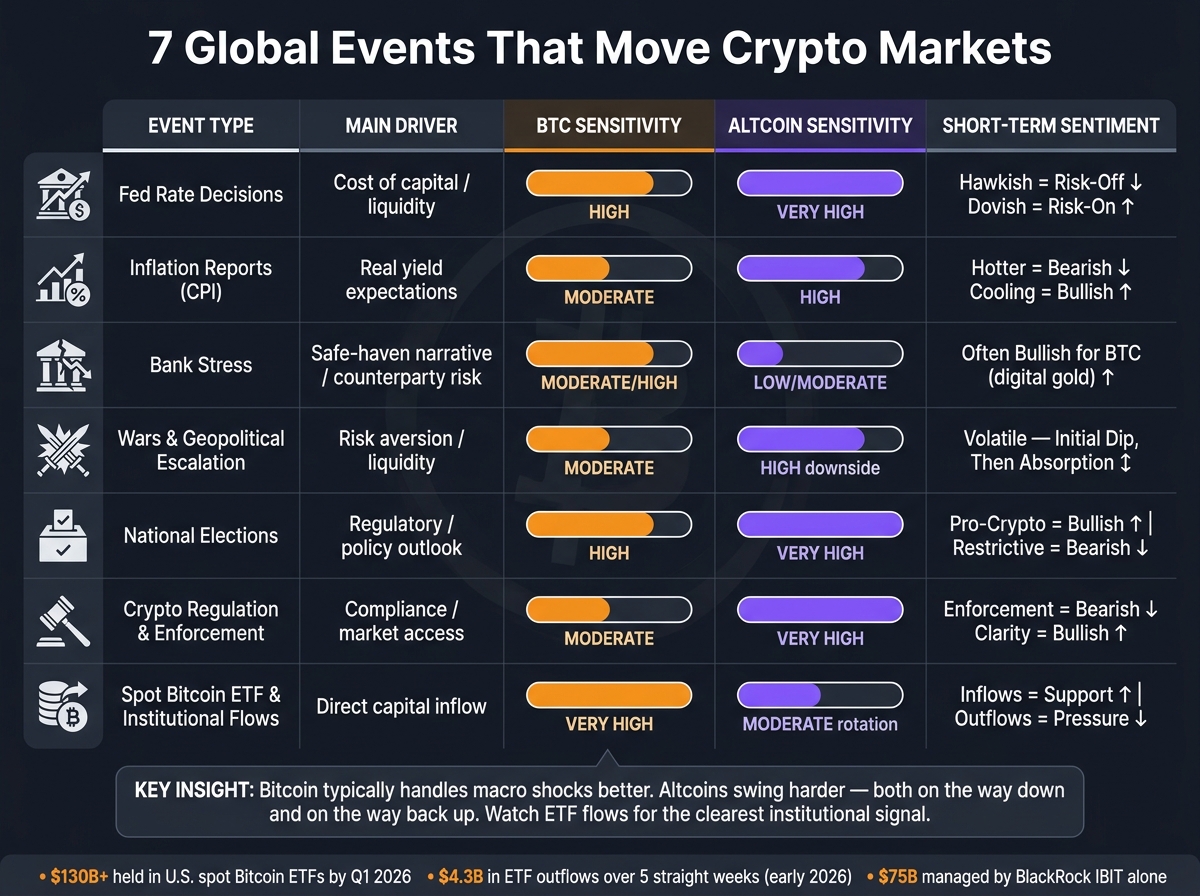
7 Global Events That Move Crypto Markets: Bitcoin vs. Altcoin Sensitivity
These seven events don’t move the market in the same way. If you want the fastest side-by-side view, this table shows how each one tends to affect Bitcoin and altcoins.
| Event Type | Main Driver | Typical BTC Sensitivity | Typical Altcoin Sensitivity | Short-Term Sentiment Direction |
|---|---|---|---|---|
| Fed Rate Decisions | Cost of capital / liquidity | High | Very High | Hawkish = risk-off; dovish = risk-on |
| Inflation Reports (CPI) | Real yield expectations / macro outlook | Moderate | High | Hotter than expected = bearish; cooling = bullish |
| Bank Stress and Financial-System Concerns | Safe-haven narrative / counterparty risk | Moderate/High (resilient) | Low/Moderate (lagging) | Often bullish for BTC (digital gold narrative) |
| Wars and Geopolitical Escalation | Risk aversion / liquidity | Moderate (initial drop) | High (downside) | Volatile; initial dip, then absorption |
| National Elections | Regulatory/policy outlook | High | Very High | Pro-crypto outcome = bullish; restrictive = bearish |
| Cryptocurrency Regulation and Enforcement | Compliance / market access | Moderate | Very High | Enforcement = bearish; clarity = bullish |
| Spot Bitcoin ETF and Institutional-Flow News | Direct capital inflow | Very High | Moderate (rotation) | Inflows = structural support; outflows = pressure |
The broad pattern stays the same: Bitcoin usually handles shocks better, while altcoins swing harder both on the way down and on the way back up. In plain English, altcoins tend to fall more, and they often take longer to bounce back.
Right now, ETF flows give one of the clearest reads on institutional demand. When money moves in, the market usually feels it fast. When flows dry up or reverse, pressure can build just as fast.
There’s one catch, though: these are patterns, not signals. What happens next depends on what the market already priced in, how much leverage is in the system, and where institutional flows are sitting at that moment.
Conclusion
Put it all together, and the message is pretty clear: follow the structure, not just the headline.
These seven events push crypto through the same core levers: liquidity, regulation, access, and risk appetite. Sharp moves right after the news often come from leverage getting reset, not from some sudden collapse in the long-term case. That deeper market structure is why a single headline usually doesn’t flip the bigger trend by itself.
Watch the structure - ETF flows, derivatives positioning, regulatory milestones - not just the headlines.
Once you understand what the market is actually reacting to, the next move gets easier. If you're ready to act on what you've learned, Kryptonim lets you buy crypto directly on an EU-regulated platform with no account creation required and competitive rates.
FAQs
Why does Bitcoin usually react before altcoins?
Bitcoin usually moves first because it’s the most liquid and most widely traded crypto asset. In plain English, it’s often the first place the market shows a shift in risk appetite before altcoins catch up.
Big macro shocks can reprice Bitcoin fast in a 24/7 market. And because many altcoins are still priced through BTC pairs, their U.S. dollar moves often follow Bitcoin’s lead. Leverage and derivatives can push this BTC-first pattern even faster.
How can I tell if a crypto move is real or just a short-term reaction?
Watch what happens after the first burst of news. Real moves usually keep strong volume and price swings for a while after the headline hits. Rumor-fueled pops, on the other hand, often lose steam fast and then snap back.
It also helps to verify the catalyst with trusted, fact-checked sources. Unverified claims on social media can spark short-lived spikes, and derivatives-led moves are best confirmed by what the spot price is doing too.
Which signal should I watch first after major macro news?
After major macro news, the first clue often shows up in derivatives markets, not spot volume. That means it’s worth watching funding rates and basis in perpetual futures.
If funding flips negative after a sharp drop, that can point to crowded shorts. And if the price starts to level off, those short positions may begin to unwind, which can help trigger an early rebound.
A futures premium over spot can also hint that buyers are leaning bullish before that move shows up clearly in spot momentum.