
IMF, BIS, FSB: Crypto Policy Compared
How IMF, BIS, and FSB influence crypto rules: macro risks, bank access, and supervisory standards that shape exchanges and stablecoins.

If you want the short answer: FSB is the clearest sign of coming crypto rules, BIS is the sign for bank access, and IMF is the sign for macro pressure.
I’d read them like this:
- IMF looks at money, capital flows, tax, and legal status
- BIS looks at banks, payments, settlement, and crypto exposure
- FSB looks at licensing, custody, disclosures, and stablecoin rules
For me, the biggest takeaway is simple: these groups do not write U.S. retail crypto rules by themselves, but they still shape what U.S. agencies talk about next. And the article points to a few numbers worth watching: 62% of FSB members reported stablecoin frameworks, and Basel’s bank standard limits some high-risk crypto exposure to 1% of Tier 1 capital.
If you buy crypto, here’s what these policy signals can mean in plain English:
- FSB signals can point to exchange and stablecoin rule changes
- BIS signals can point to tighter bank support for crypto firms
- IMF signals can point to tax, reporting, and cross-border money controls
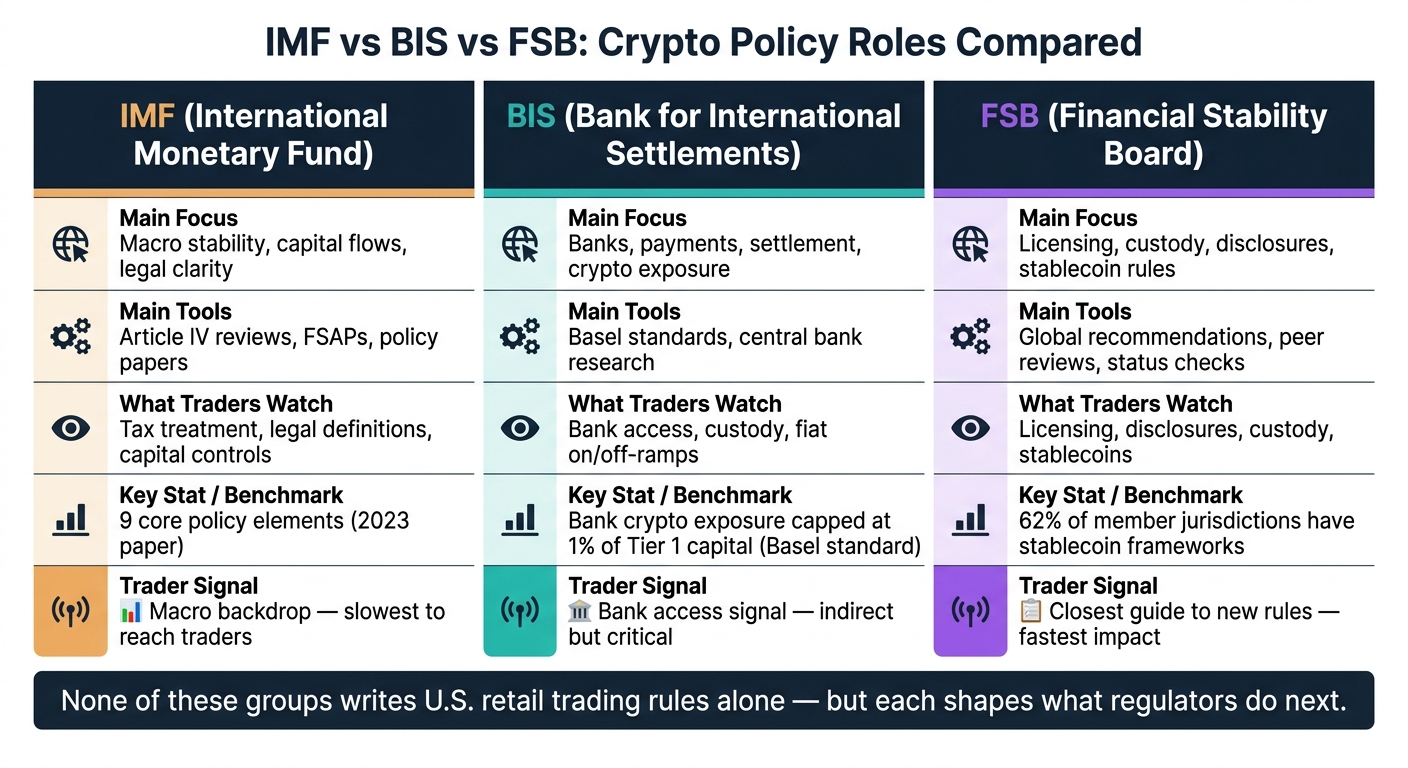
IMF vs BIS vs FSB: Crypto Policy Roles Compared
Quick Comparison
| Institution | Main focus | Main tools | What I’d watch as a trader |
|---|---|---|---|
| IMF | Macro stability | Article IV reviews, FSAPs, policy papers | Tax treatment, legal definitions, capital controls |
| BIS | Banks and payments | Basel standards, central bank research | Bank access, custody, fiat on/off-ramps |
| FSB | Supervision and rule alignment | Global recommendations, peer reviews, status checks | Licensing, disclosures, custody, stablecoins |
So if I see a new paper from one of these groups, I’d first ask: Is this about macro risk, banking links, or market supervision? That one question usually tells me where the market impact may land.
sbb-itb-0796ce6
IMF: Macro Stability, Capital Flows, and Legal Clarity
The IMF looks at crypto through a macro-stability lens: monetary policy, capital flows, and fiscal risk.
The IMF's Main Crypto Policy Goals
In its 2023 policy paper Elements of Effective Policies for Crypto Assets, the IMF laid out nine core policy elements. One of its clearest positions is that countries should not make crypto legal tender.
The reason comes down to monetary sovereignty and policy transmission. If a country gives legal tender status to a volatile, privately issued crypto asset, the central bank can lose some control over the money supply. It can also speed up currency substitution, which makes domestic policy harder to steer.
The paper doesn't stop at legal tender. It also zeroes in on capital flow risks. Crypto can move across borders fast, and those transfers can be hard to trace. In some cases, they may slip around capital flow management measures when local rules don't clearly cover crypto intermediaries or the on- and off-ramp channels people use to move between fiat and crypto.
The IMF also points to fiscal exposure. That includes public-sector holdings, contingent liabilities, and the need for clear tax rules. On top of that, it wants legal certainty around what crypto assets are in the eyes of the law - property, securities, or a payment instrument.
In plain terms, IMF guidance often shows up in areas like:
- Licensing
- Tax policy
- Disclosure rules
- Capital-flow controls
How Article IV Reviews and FSAPs Affect Local Rules
This is where IMF policy starts to turn into country-level pressure. Its views feed into Article IV country reviews and FSAPs, and those processes can shape local debates around licensing, disclosure, agency coordination, and fiscal risk reporting.
El Salvador's 2021 Article IV consultation is a clear case. IMF staff recommended removing Bitcoin's legal tender status and tightening regulation of the Bitcoin ecosystem. When crypto becomes large enough to matter for a country's economy, these reviews can push governments toward tighter licensing, better data collection, and clearer fiscal reporting.
Countries often react by tightening reporting rules, spelling out legal definitions more clearly, and stepping up oversight of on- and off-ramps.
FSAPs go a step further. They look at bank and financial institution exposures, the resilience of payment systems, and whether prudential standards are keeping up with crypto-linked risks. The day-to-day effect is often clearer tax rules, reporting duties, and AML/CFT requirements.
That macro lens differs from the BIS approach, which is more focused on banks, payments, and prudential risk. The IMF sets the macro baseline, while the BIS deals more with the plumbing of the financial system.
BIS: Central Banks, Payments, and Prudential Standards
The BIS has a narrower, more technical role than the IMF. It doesn't write laws. But it still shapes policy through central bank coordination, research, and Basel standards that many regulators end up following.
Put simply, the IMF looks more at macro risk. The BIS looks at the plumbing underneath it.
How BIS Frames Crypto Risks and Payment System Concerns
The BIS pays close attention to cross-border payments, CBDCs, payment systems, and digital money. Those areas matter because they shape payment rails, settlement, and how easily crypto can connect to the banking system.
That's the key point. BIS work often flows into bank-facing rules, not just payment-policy debates.
Why BIS Work Matters for Banks and Trading Access
The BIS is home to the Basel Committee on Banking Supervision (BCBS). The Basel Committee's standards set the prudential baseline that many regulators use in bank supervision.
That indirect influence matters. It can shape bank supervision, custody access, and other rules that decide whether traders can move between cash and crypto without friction. That's what makes the BIS different from the FSB, which sets the broader crypto supervision framework.
FSB: The Global Framework for Crypto Supervision
After the IMF looks at macro risk and the BIS zeroes in on market plumbing, the FSB turns those concerns into rules supervisors can use. The Financial Stability Board's Global Regulatory Framework for Crypto-asset Activities, finalized in July 2023, sets out how jurisdictions should regulate, supervise, and oversee crypto markets and global stablecoin systems. The aim is simple: line up national rules and cut down on regulatory arbitrage.
The FSB's Recommendations for Crypto Markets and Stablecoins
The framework has two tracks: the CA recommendations for crypto-asset activities and markets, and the GSC recommendations for global stablecoin systems. Both tracks push the same core idea across firms, products, and risks.
At the center of the framework are a few basic rules of the road:
- governance with clear accountability
- risk management that covers cybersecurity and AML/CFT
- segregation and safeguarding of client assets
- transparent disclosures
- cross-border cooperation between supervisors
For stablecoins, the FSB adds stricter expectations. Issuers should give users a strong legal claim on the issuer and the reserve assets, plus timely redemption at par in fiat for single-fiat stablecoins. The framework also says recovery and resolution planning should be in place before a stablecoin arrangement launches in a market.
In plain English, this is the baseline for licensing: governance, risk controls, client-asset safeguards, and cross-border reporting. And for traders, these rules can shape which platforms are allowed to list stablecoins, hold client assets, and serve users across borders.
How FSB Monitoring Drives Rulemaking Across Countries
The FSB doesn't just publish recommendations and walk away. It also tracks implementation through thematic peer reviews and surveys of jurisdictions. One review found that while all FSB members reportedly have some laws and regulations for crypto-asset activities, only about 62% have stablecoin frameworks in place.
That gap matters. When reviews flag mismatches or missing rules, jurisdictions come under pressure to tighten platform duties, strengthen stablecoin controls, and improve coordination among supervisors. In that sense, monitoring works like a steady nudge: countries that still lack stablecoin rules don't get much room to sit still.
For U.S. traders, that can mean clearer disclosures, tighter custody rules, and more scrutiny of stablecoins used on trading platforms. There’s overlap here with the IMF and BIS, but each body is pushing from a different direction.
IMF vs. BIS vs. FSB: Where They Overlap and Differ
Now that each institution’s role is clear, the next step is simple: figure out how those roles turn into actual trading rules.
Shared Goals: Stability, Oversight, and Less Regulatory Arbitrage
All three institutions are pushing toward the same broad end goal: a crypto market that doesn’t spill over into the rest of the financial system. They each push for financial stability, cross-border coordination, and less regulatory arbitrage. In plain English, they don’t want firms or users shifting activity to the places with the weakest rules.
Same goal. Different tools.
The IMF looks at crypto through the lens of macro stability. The BIS looks at bank risk and payment-system risk. The FSB looks at supervisory monitoring and pressure on countries to put rules in place.
| Shared Goal | How the IMF Pursues It | How the BIS Pursues It | How the FSB Pursues It |
|---|---|---|---|
| Financial stability | Macro surveillance, Article IV consultations, FSAPs | Central-bank research and prudential analysis | Recommendations and thematic reviews |
| Cross-border coordination | G20 synthesis work and international cooperation elements | Central-bank network discussions | Implementation roadmaps and status reports |
| Reducing regulatory arbitrage | Macro stability and legal clarity push | Bank and payment-system risk oversight | Same risk, same rule |
Key Differences in Mandate, Tools, and Market Impact
The IMF shapes macro policy. The BIS shapes bank and payment oversight. The FSB shapes supervisory rules.
The 2023 IMF-FSB G20 paper draws that line pretty clearly: the IMF focuses on macro risk, while the FSB focuses on supervision.
That split matters for traders because each institution tends to affect a different part of the market.
| Institution | Mandate | Main Outputs | Policy Focus | Trader Impact |
|---|---|---|---|---|
| IMF | Macroeconomic stability, capital flows, surveillance | Article IV consultations, FSAPs, policy papers, G20 synthesis work | Monetary sovereignty, capital flow volatility, tax and legal clarity | Clearer tax rules, tighter capital-flow controls, stronger legal definitions |
| BIS | Central-bank cooperation, payments, prudential research | Research papers, surveys, analytical reports | Payment-system risks, bank exposure, prudential concerns | Access to banking services for exchanges, custody rules, and scrutiny of stablecoin payment rails |
| FSB | Coordinating global financial regulation and supervision | High-level recommendations, implementation roadmaps, thematic reviews | Crypto-asset activities, stablecoins, supervisory consistency | Licensing, disclosure requirements, issuer requirements, and stablecoin restrictions |
What This Means for Retail Traders in Practice
Here’s the part that hits home: global guidance doesn’t affect traders right away. It usually reaches them only after national regulators turn it into licensing, custody, and banking rules.
So when you see a new report or warning, it helps to ask what kind of risk it is talking about.
If the focus is macro stability or capital flows, the IMF is probably the main driver. In that case, the effect is more likely to show up in legal clarity, tax treatment, or tighter capital-flow rules, not in an instant trading ban.
If the focus is bank exposure or payment rails, BIS influence is likely in the background. That often shows up more indirectly, like banks getting more careful about serving crypto firms.
If the focus is exchange licensing, stablecoin governance, or disclosure rules, the FSB is usually the main source. Those changes often reach traders faster because they map more directly to rulebooks.
Put simply, the institution name gives you a clue about what sort of rule may be coming next. Is this about macro risk, banking risk, or supervisory coordination? And is it just guidance, or an actual rule? That’s usually what tells you whether the effect is more likely to hit exchange access, stablecoins, or capital movement.
Conclusion: How to Read IMF, BIS, and FSB Signals
None of these groups writes U.S. retail trading rules on its own. But they still matter. Their work often shapes the guidance that U.S. agencies later turn into domestic policy, whether that's about macro stability, banking access, or supervisory rules.
If you want the fastest clue about what may change next, start with the FSB. Its recommendations tend to move into national rulebooks faster than the others. In fact, 62% of member jurisdictions expected alignment by 2025, and 60% targeted stablecoin alignment. So when the FSB points out gaps in stablecoin governance or exchange disclosures, that's a strong hint about where regulators may look next for traders.
BIS signals are less direct, but they still matter a lot when banking access is on the line. The Basel Committee's crypto standard caps bank exposures to high-risk, unbacked crypto assets at 1% of Tier 1 capital. That can shape which banks are willing to work with exchanges, custody providers, and payment processors.
IMF signals usually show up first at the policy level, not at the trading desk. Its message is broader. It tends to point to macro risks, legal clarity, and the long lead time before rules reach traders.
A simple way to read them:
- FSB = the closest guide to new rules
- BIS = a signal about bank access
- IMF = the macro backdrop
FAQs
Which group matters most for U.S. crypto rules?
In practice, U.S. crypto rules are driven most by FATF-style compliance requirements applied through the U.S. Bank Secrecy Act/FinCEN framework.
That means firms need to meet AML/KYC expectations and handle transaction-level reporting for virtual currencies, including the Travel Rule approach.
How can BIS policy affect my exchange access?
BIS policy can affect exchange access by shaping the technical rules for digital currencies and how they link to current financial systems, especially across borders.
As exchanges follow these rules, you may see more consistent - but at times stricter - data collection and identity checks when moving assets across countries.
Why does the IMF care about crypto legal tender?
The IMF pays close attention to crypto as legal tender because it can affect macroeconomic stability and financial integrity. As more countries and markets adopt digital assets, the IMF backs coordinated regulation to cut risks that could spill into the broader economy.
It also wants to protect consumers, match AML oversight to the level of market risk, and prevent a loss of public trust in digital assets.