
How GDPR Impacts Crypto Exchange Users
EU GDPR rights, deletion limits, breach notification rules, and how exchanges use off-chain storage and cryptography to protect users.

GDPR reshapes how crypto exchanges handle your personal data. If you're an EU user, here’s what you need to know:
- Your rights: You can access, correct, or request deletion of your data under GDPR. Exchanges must respond within one month.
- Data protection vs. blockchain: Blockchain's immutability clashes with GDPR's "right to be forgotten." Exchanges often store data off-chain or anonymize it to comply.
- Non-compliance penalties: Fines can reach $21.4 million or 4% of global revenue. Exchanges also risk losing banking access.
- Security measures: Many exchanges use encryption, off-chain storage, and advanced cryptographic tools to secure your data.
- EU-regulated platforms: Platforms like Kryptonim prioritize transparency, minimal data collection, and strict security practices.
GDPR ensures crypto exchanges respect your privacy, but compliance remains a challenge due to blockchain's permanent nature. Choose platforms that follow these regulations for better data protection.

GDPR Penalties and User Rights for Crypto Exchanges
Key GDPR Rights for Crypto Exchange Users
The General Data Protection Regulation (GDPR) gives crypto exchange users in the EU clear rights over their personal data. These rules apply to any platform serving EU users, ensuring transparency and control over data management practices.
Data Access and Correction Rights
Under GDPR Article 15, you have the right to confirm whether an exchange holds your personal data and request a free copy of it. This copy will include details like the purpose of processing, the types of data collected, and how long it will be stored. If there’s an error in your data, Article 16 lets you demand corrections immediately. Exchanges are required to update your records and typically must respond to such requests within one month.
While your first data copy is free, exchanges can charge a reasonable fee for additional copies.
"The information on the processing of your personal data should be presented in a concise, transparent, intelligible way and drafted in clear and plain language." - European Commission
To exercise these rights, you’ll need to contact the exchange’s Data Protection Officer (DPO), if they have one, and verify your identity. If the exchange doesn’t respond or denies your request, you can escalate the matter by filing a complaint with your national Data Protection Authority or even pursuing legal action.
Next, let’s look at your rights regarding data deletion and consent.
Right to Data Deletion and Consent Management
Article 17, also known as the "right to be forgotten", allows you to request the deletion of your personal data if it’s no longer needed for its original purpose or was processed unlawfully. Since blockchain technology is immutable, exchanges often store sensitive data off-chain. If full deletion isn’t possible, the data must be anonymized to prevent re-identification.
Exchanges have up to one month to respond to deletion requests, though this can be extended by two additional months for complex cases. Even informal requests like "delete my account" are considered formal under Article 17.
These rights also tie into data breach responses, ensuring a robust approach to protecting your information.
Data Breach Notifications
If a data breach occurs, exchanges must notify the supervisory authority within 72 hours. Users are informed without undue delay if the breach poses a high risk to their rights or freedoms. Notifications must clearly outline the breach, its potential consequences, and the steps being taken to minimize harm.
However, if strong protective measures like encryption make the compromised data unreadable, user notifications may not be required. Missing the 72-hour deadline can lead to fines of up to $10.7 million (approximately €10 million) or 2% of global revenues. Severe breaches can result in penalties as high as $21.4 million (approximately €20 million) or 4% of global revenues. Additionally, all breaches must be recorded internally to demonstrate compliance with GDPR regulations.
These notification rules emphasize the importance of safeguarding your personal data and maintaining transparency.
sbb-itb-0796ce6
GDPR Challenges with Blockchain Technology
Blockchain's structure presents a tough puzzle when matched against GDPR requirements. Its core strength - being permanent and tamper-proof - clashes with data protection rules that emphasize user control and flexibility over personal data.
Blockchain Immutability vs. Right to Erasure
One of the biggest sticking points is blockchain's immutability. Once data lands on a blockchain, it’s there for good, which directly conflicts with GDPR Article 17. This rule grants individuals the "right to erasure", meaning they can request their personal data be deleted. Additionally, GDPR’s storage limitation principle requires data to be kept only as long as it’s needed for its original purpose - another challenge for blockchain’s permanent records.
In decentralized systems, figuring out who’s responsible for handling these deletion requests is a major headache. Public blockchains typically lack a clear data controller, making compliance nearly impossible. Failing to meet these erasure requirements can result in steep penalties: up to $21.4 million or 4% of a company’s global annual revenue, whichever is higher.
To address this, the European Data Protection Board issued updated guidelines in April 2025, pushing for solutions to make blockchain GDPR-compliant. Many crypto exchanges now use hybrid systems - storing personal data off-chain in traditional databases while keeping only cryptographic hashes on-chain. This setup allows them to delete personal data while maintaining transaction integrity. Another workaround is encryption key disposal: encrypted data stays on-chain, but deleting the decryption keys makes the data permanently inaccessible.
But the challenges don’t stop there. Blockchain’s pseudonymous nature adds another layer of complexity when it comes to classifying personal data.
Pseudonymity and Personal Data
Blockchain identifiers - like wallet addresses and public keys - are pseudonymous, not anonymous. According to GDPR Article 4, if these identifiers can be tied to a real person through additional data (like KYC records or blockchain analytics), they qualify as personal data. Even transaction patterns and IP addresses can be pieced together to create detailed profiles, potentially identifying individuals. Similarly, hashed emails or encrypted identifiers are still considered personal data if they can be re-identified. This means exchanges must treat all blockchain identifiers as personal data and apply full GDPR protections.
| Data Type | GDPR Classification | Why? |
|---|---|---|
| Wallet Address | Personal Data (Pseudonymous) | Can be linked to real identities via KYC or analytics. |
| Hashed Email | Personal Data (Pseudonymous) | Can be reversed with brute force or if the original data is known. |
| Encrypted Name | Personal Data (Pseudonymous) | Still considered personal data if a decryption key exists. |
| Aggregated Stats | Anonymous Data | Individuals can't be re-identified from the dataset. |
Smart contracts add to the challenge. If they store personal details - like beneficiary information - they face the same erasure issues as the blockchain itself. To avoid these risks, compliant exchanges steer clear of writing raw personal data directly to the blockchain. Instead, they lean on advanced cryptographic techniques, such as Zero-Knowledge Proofs, to validate transactions without exposing identities.
These hurdles underscore the pressing need for creative compliance strategies in the crypto industry.
Compliance and User Data Security on Exchanges
Crypto exchanges face the challenge of balancing strict regulatory requirements with technical limitations. This balance is crucial for ensuring user data security while adhering to legal standards. To address this, many platforms adopt Privacy by Design principles early in the development process. By embedding data protection into the system architecture from the start, they reduce the risk of compliance issues later on. Since blockchain technology is inherently immutable, implementing safeguards at the outset is essential.
Security Measures for GDPR Compliance
To align with GDPR's "right to erasure" while maintaining blockchain's immutability, many exchanges use a hybrid storage system. In this model, sensitive personal data - like names, addresses, and government-issued IDs - is stored off-chain in traditional databases, which can accommodate deletion requests. Meanwhile, cryptographic hashes are kept on-chain to ensure the integrity of transaction records. This setup allows exchanges to honor deletion requests while preserving the trustworthiness of their systems.
Exchanges also employ robust security protocols to protect user accounts. These include:
- Two-Factor Authentication (2FA) and biometric access methods like fingerprint or facial recognition.
- Withdrawal whitelists and anti-phishing codes to prevent unauthorized actions.
- Cold storage solutions, where the majority of user funds are stored offline, or custody services for added security.
Advanced cryptographic tools add another layer of protection. Techniques like Zero-Knowledge Proofs (zk-SNARKs and zk-STARKs) and Multi-Party Computation (MPC) enable exchanges to validate transactions and verify identities without revealing sensitive data. Additionally, exchanges follow data minimization practices, collecting only the information necessary for compliance with Know Your Customer (KYC) and Anti-Money Laundering (AML) regulations. Regular security audits, including third-party tests and certifications like SOC 2 and ISO 27001, help address vulnerabilities and ensure ongoing compliance.
These measures not only safeguard user data but also demonstrate a commitment to meeting regulatory expectations.
GDPR Penalties and Enforcement
Exchanges that fail to implement these protections face serious consequences. Non-compliance can result in hefty fines, operational sanctions like shutdowns, EU-wide blacklisting, and severed banking relationships. In some cases, company executives could face personal liability or even criminal charges for major violations. The European Data Protection Board has made it clear: "technical impossibility does not excuse non-compliance with the GDPR".
Addressing compliance issues retroactively can be significantly more expensive - up to five to ten times the cost of getting it right from the start. Beyond financial penalties, public enforcement actions can inflict lasting reputational harm. To avoid these pitfalls, leading exchanges appoint a Data Protection Officer (DPO) to oversee data strategies and conduct regular Data Protection Impact Assessments (DPIAs) for projects involving personal data.
Benefits of Using EU-Regulated Platforms Like Kryptonim
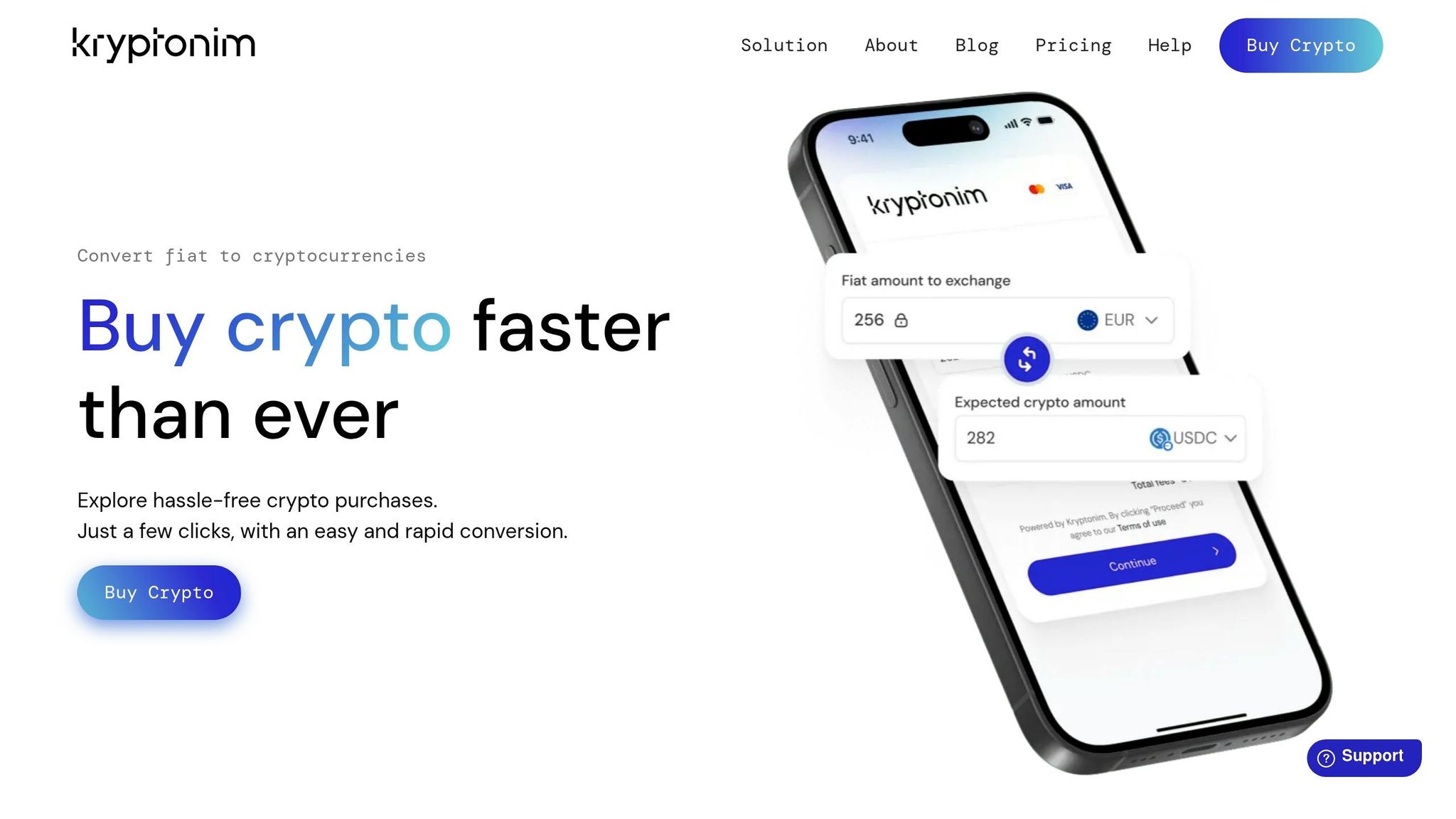
Opting for an EU-regulated platform like Kryptonim offers a level of data protection that’s built into its foundation. Thanks to the Privacy by Design approach, your personal information is safeguarded from the outset, rather than being an afterthought.
Privacy-Focused User Experience
EU-regulated platforms operate under strict transparency rules. They’re required to get your explicit consent before processing any of your data, and they must clearly explain why they need it. Plus, you have the legal right to access your personal data - or even request its deletion if it’s no longer necessary. In the event of a data breach, these platforms are obligated to notify users promptly.
Kryptonim takes privacy a step further with its data minimization practices. For example, the platform allows fiat-to-crypto transactions without requiring you to create an account, which significantly reduces the amount of personal data collected. This approach not only enhances privacy but also limits your exposure to potential risks.
Secure and Simple Transactions
Kryptonim combines these privacy standards with a focus on secure, user-friendly transactions. The platform employs robust security measures to protect your data while ensuring the process remains straightforward. Its design also respects your "right to erasure", ensuring your data can be deleted when no longer needed - all without compromising transaction records.
EU regulations, like GDPR, impose steep penalties for non-compliance - up to $21.4 million or 4% of a company’s global annual revenue. This regulatory framework pushes platforms to maintain high security and transparency standards. For users, this means fast, secure transactions at competitive rates (2% per transaction for EU users), along with the peace of mind that comes with clear legal accountability.
Conclusion
Building trust with any crypto exchange starts with ensuring GDPR compliance. Platforms that adhere to these regulations implement robust security measures and face serious consequences for any violations, which helps safeguard your personal data and promotes accountability.
While blockchain's unchangeable nature complicates the right to data erasure, compliant exchanges tackle this by keeping personal data off-chain. They store only cryptographic hashes on the blockchain, striking a balance between respecting privacy rights and maintaining transaction integrity.
EU-regulated platforms take privacy seriously by incorporating principles like privacy by design, data minimization, and clear legal accountability. For instance, Kryptonim exemplifies GDPR compliance by allowing fiat-to-crypto transactions without requiring account creation. They collect only the minimum necessary data and maintain the high-security standards mandated by EU law, ensuring smooth and secure transactions supported by stringent data protection.
Before choosing a platform, check for valid CASP authorization, the presence of a Data Protection Officer, and transparent data handling policies. These regulations are there to protect you - but their effectiveness depends on selecting platforms that genuinely uphold these standards.
FAQs
Is my wallet address considered personal data under GDPR?
Yes, a wallet address can be classified as personal data under GDPR if it can be connected to an individual. Blockchain data is public, and the possibility of linking wallet addresses to identifiable individuals means they may fall within GDPR's framework for safeguarding personal information.
Can a crypto exchange really delete my data if blockchain records can’t change?
While blockchain records themselves are permanent and unchangeable, crypto exchanges can handle personal data stored off-chain differently. They can either remove or anonymize this off-chain data, such as reference information not embedded in the blockchain. This approach helps address GDPR's "right to erasure" to the extent possible within the constraints of blockchain technology.
What should I do if an exchange ignores my GDPR request?
If an exchange doesn't respond to your GDPR request, you should report the issue to your country's GDPR authority or Data Protection Agency. These organizations have the power to investigate and ensure compliance with data protection regulations. Be sure to include all relevant details about your request and the exchange's response - or their failure to respond - to help with the investigation.