
Crypto Travel Rule Guide for Cross-Border Transfers
Crypto transfers can be held if platforms don't share required sender and recipient identity—learn when Travel Rule checks apply.

Sending crypto abroad can fail even when the wallet address is correct. If a regulated platform is involved, the transfer may be paused or rejected when the sender and recipient details do not match Travel Rule checks.
Here’s the short version: the Travel Rule means crypto platforms may need to collect and share identity data before a cross-border transfer goes through. That can apply when you send to another exchange, and in some cases when you send to your own wallet. In the EU, checks for self-hosted wallets can get tighter above €1,000 (about $1,120 on Sep. 24, 2026, though exchange rates move).
Before I send crypto overseas, I’d keep these points in mind:
- A wallet address alone may not be enough
- Regulated platforms may ask for legal names and account or wallet details
- The sending and receiving platforms may both review the transfer
- Self-hosted wallets can trigger extra proof-of-control checks
- Local rules matter, not just FATF guidance
- Even an on-chain transfer can be held before funds are credited
A simple way to think about it: blockchain moves the asset; platforms move the identity data. If either side is missing required information, the transfer can stall.
Quick comparison
| Transfer type | Travel Rule checks | What I may need to provide | Common hold-up |
|---|---|---|---|
| Platform to platform | Usually yes | Recipient legal name, account details, and other requested data | Name mismatch or missing recipient info |
| Platform to self-hosted wallet | Often yes | Wallet address, recipient details, and proof I control the wallet | Wallet ownership review |
| Self-hosted wallet to self-hosted wallet | Usually outside platform handling | No platform collection if no regulated provider is involved | Not a platform Travel Rule case, but other risks still apply |
If I wanted one takeaway, it would be this: a valid crypto transfer is not always a compliant one. So before sending, I’d check the destination type, both countries’ rules, the platform’s data requests, and whether the provider has a clear process for delays, rejects, and wallet verification.
sbb-itb-0796ce6
What the Crypto Travel Rule Requires
In a cross-border crypto transfer, the Travel Rule requires regulated platforms to collect and share identity details for both the sender and the recipient when the transfer falls under the rule. This comes from FATF Recommendation 16, which applies wire-transfer style compliance to crypto.
The blockchain shows that funds moved. What it does not do is carry the identity data tied to the people on each side of the transfer. That’s the gap the Travel Rule covers: it moves sender and recipient information between regulated platforms.
What Information Is Collected and Shared
The required data usually falls into two buckets.
For the sender, platforms often collect:
- Legal name
- Account number or wallet identifier
- At least one extra identifier, such as a physical address, national ID number, customer ID, or date and place of birth
For the recipient, the minimum is usually:
- Legal name
- Account number or wallet identifier
A wallet address may point to the account, but platforms still collect legal names and other identity details. The exact fields can change based on the country and the type of transfer. Also, the transfer itself and the compliance review are not the same step.
Why Local Law Matters More Than One Global Rule
There isn’t one single worldwide setup for this. FATF sets the base line, but each country sets its own threshold, required data fields, and rules for self-hosted wallets. So a transfer that clears in one jurisdiction may still face extra checks somewhere else.
Before you send, check the sending platform’s rules for the destination country.
Next, check when these rules apply to your transfer.
When the Travel Rule Applies to Cross-Border Transfers
The Travel Rule usually kicks in when a regulated provider is involved on either side of a transfer. The exact threshold, required data, and review steps can change based on the jurisdictions and internal policies of the providers in the transfer. In plain English: what matters most is which regulated providers are involved and where they operate.
Even if you're sending funds to your own account at another regulated provider, Travel Rule checks can still apply.
Once a regulated provider is part of the transfer, the next step is figuring out who is on each side of it.
Platform-to-Platform Transfers
When funds move between two regulated providers, the sending provider passes the required data through a separate compliance channel, not through the blockchain itself. The receiving provider may pause the transfer or ask for more documentation before crediting the funds. Small errors in names, account details, or recipient info can slow things down, so accurate details help avoid delays.
Platform-to-Self-Hosted Wallet Transfers
Transfers to self-hosted wallets still involve checks, but the process is different.
Sending crypto to a self-hosted wallet - one you control directly - does not let you skip compliance checks. The sending provider may still ask for recipient details and may apply extra monitoring, sanctions screening, and proof that you control the wallet.
In the European Union, transfers over €1,000 to or from a self-hosted address require the crypto-asset service provider to take adequate measures to assess whether the customer owns or controls that wallet. That check can be done in a few ways, such as:
- a signed message
- a small test transfer
- another platform-approved method
Before You Send: A Simple Pre-Transfer Check
Before you approve a cross-border transfer, pause and check these four points:
- Identify the regulated party: Is a regulated provider on either side of the transfer?
- Classify the destination: Is it another platform account or a self-hosted wallet you control?
- Check the jurisdictions: Where are the sending and receiving providers based? Cross-border obligations depend on both sides' rules and provider policies.
- Review the requested information: Is the platform asking for sender or recipient details, the receiving provider's details, or proof of wallet control?
If the platform can't explain these checks in plain terms, stop before you approve the transfer.
Who Shares Data and How the Transfer Process Works
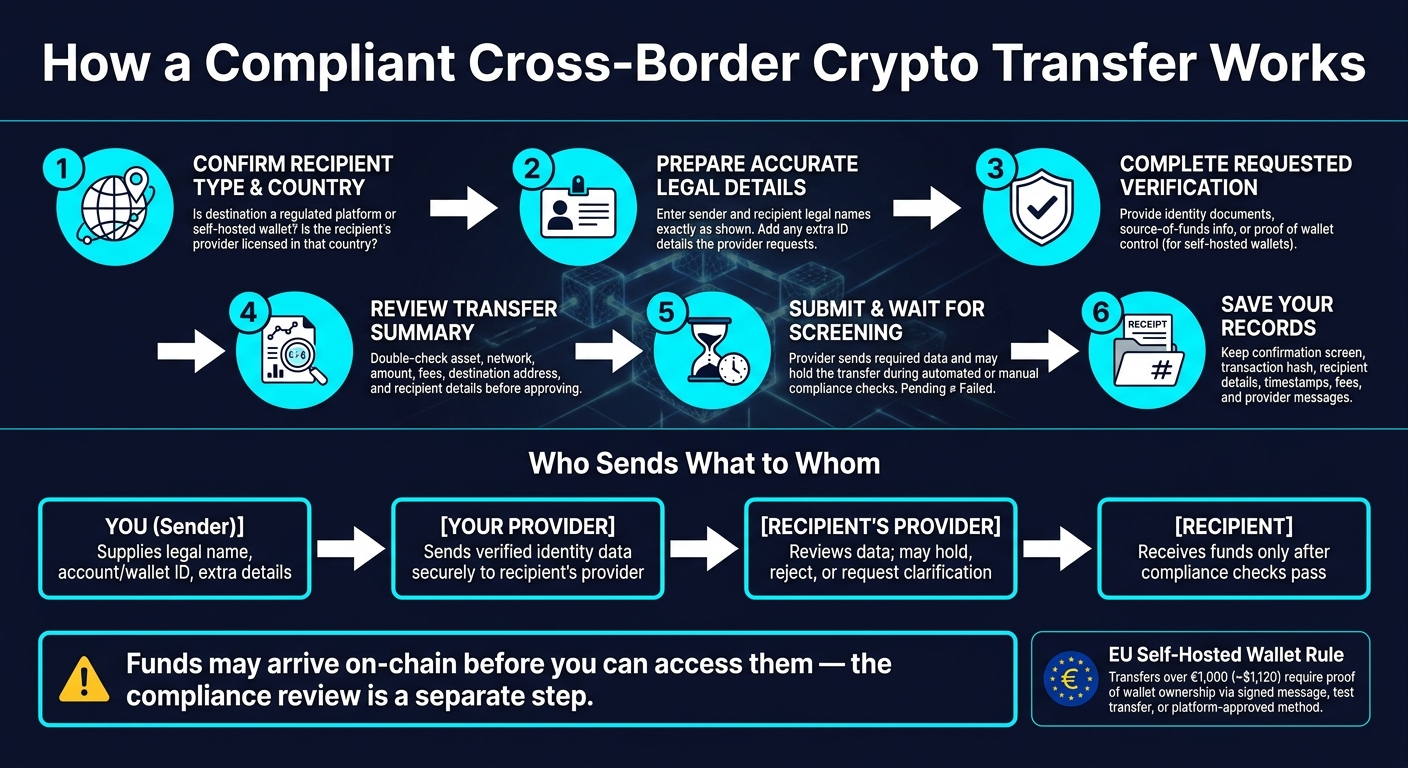
Crypto Travel Rule: Step-by-Step Cross-Border Transfer Process
Once a transfer falls under the Travel Rule, the providers handle the data exchange. The blockchain by itself doesn't do that job.
In a cross-border transfer, four parties are involved: you, your provider, the recipient, and the recipient's provider. You don't send Travel Rule data straight to the recipient. Instead, you give the required details to your provider, and your provider sends that data securely to the recipient's provider as part of the transfer process.
For most users, that means your provider sends verified identity data to the recipient's provider before the transfer settles.
Data Responsibilities by Party
Each party plays a different part in the data flow.
| Party | Information Supplied | Information Received | Action When Data Is Missing |
|---|---|---|---|
| Sender (you) | Legal name, account or wallet ID, and any extra details requested | Transfer summary and confirmation | Resolve the issue through the provider's secure process before approving |
| Your provider | Required sender and recipient data, sent securely to the recipient's provider | Customer information and any response from the recipient's provider | Hold, reject, or request clarification; retain records for authorities |
| Recipient's provider | Acknowledgment or follow-up request | Sender and recipient data accompanying the transfer | Request missing data, reject, suspend, or delay the transfer |
| Intermediary provider | Transfer data relevant to its role | Sender, recipient, and transaction details | Apply its own anti-money-laundering, sanctions, and recordkeeping controls and stop processing when required |
The recipient's provider can hold the transfer until the data checks out. So even if the funds arrive on-chain, that doesn't always mean you can use them right away.
Step-by-Step Cross-Border Transfer Process
- Confirm the recipient type and country: Check whether the destination is a regulated platform account or a self-hosted wallet. Also confirm that the recipient's provider can operate in that country and isn't blocked by sanctions or licensing limits.
- Prepare accurate legal details: Enter the sender's and recipient's legal names exactly as shown. Add any extra ID details the provider asks for.
- Complete any requested verification: The provider may ask for identity documents, source-of-funds details, or - if you're sending to a self-hosted wallet - proof that the wallet belongs to the recipient before processing the transfer.
- Review the transfer summary carefully: Double-check the asset, network, amount, fees, destination address, and recipient details before you approve anything.
- Submit the transfer and wait for screening: Your provider sends the required data and may put the transfer on hold while automated or manual checks run. A pending status doesn't mean the transfer failed.
- Save your records: Keep the confirmation screen, transaction hash, submitted recipient details, timestamps, fees, and any messages from the provider. Those records can help if there's a dispute and keep your files complete.
That's why a platform's compliance workflow matters before you approve a transfer.
How to Check Whether a Platform Follows the Travel Rule
Once you know how Travel Rule data moves, the next step is simple: check the platform before you type in recipient details.
Start with the basics. Look at the platform’s legal entity, jurisdiction, and regulator registration before you send funds overseas. Then check its AML policy, sanctions information, and support contacts through official records, not glossy site copy. If the transfer touches two countries, confirm whether the platform is licensed or registered in both places.
Warning Signs to Watch Before You Approve a Transfer
Some warning signs are easy to miss. The biggest one is a platform saying that cross-border crypto transfers never need identity information. That doesn’t line up with Travel Rule rules.
Other red flags include:
- Requests for passports, private keys, seed phrases, passwords, or other sensitive information through Telegram, WhatsApp, or social media DMs
- Pressure to skip recipient checks or change the recipient name
- No clear explanation of why a transfer could be held or rejected
- No clear process for self-hosted wallets
- No secure way to submit personal data
Compliance can be annoying. That’s normal. Urgency and secrecy aren’t. A platform should also spell out restricted jurisdictions, restricted assets, source-of-funds checks, and appeal steps.
A Platform Review Checklist
Use the table below to review a platform before sending funds abroad. Check each point through official disclosures or a regulator’s public record.
| Review Item | Verified | Unclear | Not Disclosed |
|---|---|---|---|
| Legal entity, jurisdiction, and regulator registration | Entity and registration match an official record | Details present but can't be independently matched | No responsible legal entity or jurisdiction identified |
| Travel Rule disclosure | Platform explains required data, timing, counterparties, and exceptions | Mentions compliance without describing the process | No Travel Rule information available |
| Recipient-data collection | Required recipient and beneficiary information is described | Requests occur but their purpose is unclear | Platform claims recipient data is never needed |
| Self-hosted-wallet handling | Platform explains ownership checks, risk review, or restrictions | Requirements vary without a clear explanation | No procedure described |
| Secure information exchange | Data submitted through authenticated platform or documented secure channel | Security measures described only in general terms | Sensitive data requested through informal channels |
| Transaction records | User receives transfer ID, date, asset, amount, destination, and status | Some records available but incomplete | No reliable receipt or transaction history provided |
A generic compliance statement isn’t enough. Look for the exact details: Which regulator? Which legal entity? What happens if data is missing? How are rejected transfers handled?
Using Kryptonim in a Compliant Purchase Workflow
The same checks apply if you use Kryptonim. Kryptonim is an EU-regulated platform, so Travel Rule checks and identity checks still matter.
Before you buy, confirm that Kryptonim serves your jurisdiction, review the verification steps it requires, and follow its destination-wallet instructions.
Conclusion: Key Checks Before Sending Crypto Overseas
Before you hit send, do one last review. The Travel Rule adds identity data to a transfer that the blockchain itself can't carry. The sending provider collects and sends that data, the receiving provider reviews it, and you need to enter the sender and recipient details correctly. If there's a gap anywhere in that chain, the transfer can get held up.
Before approving any cross-border transfer, check these four things:
- Identify the destination type: Is it a regulated exchange or a self-hosted wallet?
- Confirm both jurisdictions' rules: The sending side and receiving side may not follow the same standards.
- Prepare accurate sender and recipient details: This includes legal names and wallet or account references.
- Complete wallet verification: If the destination is a self-hosted wallet, finish any required verification steps first.
Keep a record of the confirmation, transaction hash, recipient details, submitted documents, and provider messages.
A valid transaction isn't automatically compliant. Turn the pre-transfer checklist into a habit.
FAQs
Does the Travel Rule apply if I send crypto to my own wallet?
Yes. If you send crypto from a regulated platform to your own self-hosted wallet, the Travel Rule still applies.
For transfers over €1,000 (about $1,080), the platform must verify that you own or control the destination wallet too.
That said, direct wallet-to-wallet transfers with no commercial intermediary are exempt from these specific requirements.
Why can a cross-border crypto transfer be delayed after it is sent?
Cross-border crypto transfers can slow down because the Travel Rule may require platforms to collect and share identifying details for both the sender and the recipient. If any of that information is missing or incomplete, the transfer may be suspended, rejected, or sent back.
Delays can also happen during the Sunrise Issue. That’s when a regulated platform interacts with one in a region that hasn’t adopted these standards yet. Other common causes include account type, enhanced due diligence, and plain old technical errors.
How can I tell if a platform follows Travel Rule requirements?
Check the platform’s registration on official national regulator websites or the ESMA registry. It should clearly state that it follows AML and Travel Rule requirements, such as MiCA in the EU or FinCEN registration in the U.S.
Also, look for a clear privacy policy, identity checks (KYC), and plain-language disclosures about how sender and recipient data is collected, shared, protected, and stored on record.