
Crypto-to-Crypto Tax Rules: Beginner Guide 2026
Explains U.S. tax treatment of crypto-to-crypto swaps, how to calculate USD gains/losses, and what records and forms to use.
Yes - if I swap one crypto for another in the U.S., that is usually taxable. I don’t need to cash out to U.S. dollars first. For tax purposes, the IRS usually treats the swap like I sold one asset and bought another at the same time.
Here’s the short version:
- BTC to ETH, ETH to USDC, and many DeFi swaps usually create a taxable event.
- I calculate gain or loss in U.S. dollars using:
- USD value at the time of the swap
- minus my cost basis
- Wallet-to-wallet transfers between accounts I own are usually not taxable.
- My gain is short-term if I held the asset for 1 year or less.
- My gain is long-term if I held it for more than 1 year.
- I need records for:
- date and time
- token amounts
- USD value
- fees
- wallet, exchange, or protocol
- transaction ID or hash
- I usually report taxable swaps on:
A simple example: if I bought a token for $800.00 and later swapped it when it was worth $1,050.00, I have a $250.00 capital gain. The new token then starts with a basis of $1,050.00.
The main point: if I trade crypto for different crypto, I should track it like a sale, not like a simple transfer.
This guide breaks down the tax rule, the math, the records, the forms, and the mistakes that tend to throw beginners off.
How to Calculate Gain or Loss on a Crypto Swap
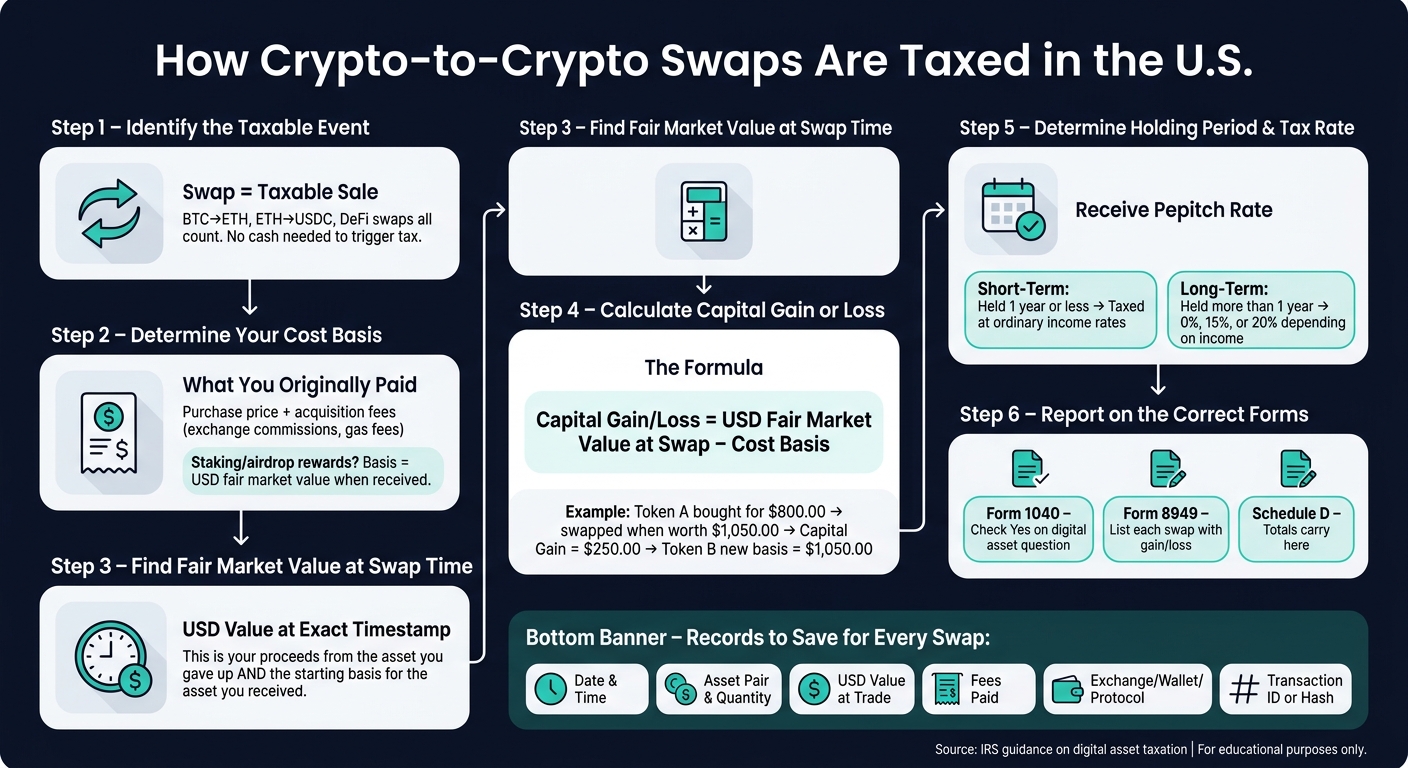
Crypto-to-Crypto Swap Tax Flow: How to Calculate & Report Gains
The math is simple:
Capital gain or loss = the USD fair market value at the time of the swap − the cost basis of the crypto you gave up. Every number needs to be in U.S. dollars, even if no cash changed hands in the trade.
Cost Basis: What You Paid for the Crypto You Gave Up
Your cost basis is the amount you paid to buy the crypto in the first place, plus fees tied to that buy, like exchange commissions, gas fees, or other transaction costs. Those fees count. Leave them out, and your gain looks a bit higher than it should.
If you got the crypto through staking, an airdrop, or payment for services, the rule changes a bit. Your basis is the USD fair market value at the time you received it. In plain English, that means the same amount you reported as ordinary income.
For example, if you received 2 SOL as staking rewards when each SOL was worth $25.00, and you reported $50.00 of income, your basis in those 2 SOL is $50.00 - not zero.
Fair Market Value at the Time of the Trade
Use the USD price at the exact timestamp of the swap. That number does double duty:
- It is the proceeds for the crypto you gave up.
- It also becomes the starting basis for the crypto you received.
This is where consistency matters. If you use mid-market prices for some trades and daily closing prices for others, your records can get messy fast. And later, that can be tough to explain.
Holding Period and Tax-Lot Methods
Your holding period decides whether the gain or loss is short-term or long-term.
If you held the asset for one year or less, the gain or loss is generally short-term and taxed at ordinary income rates. If you held it for more than one year, it is long-term, which usually means the long-term capital gains rates of 0%, 15%, or 20%, depending on your income.
If you own multiple lots of the same token that were bought at different times and prices, you also need to know which units you sold.
FIFO (First-In, First-Out) is the default if you do not, or cannot, specifically identify the units. Under FIFO, the oldest units are treated as sold first. That can lead to bigger gains if those early lots had a low basis.
Specific identification lets you choose the exact units you are disposing of, based on date, quantity, and cost, as long as you document that before the trade. When your records are in good shape, this can cut the gain.
Hypothetical Example in U.S. Dollars
Hypothetical example: You buy Token A for $800.00 (purchase price plus fees). Later, you swap all of Token A for Token B when Token A's fair market value is $1,050.00. Your proceeds are $1,050.00, your cost basis is $800.00, and your capital gain is $250.00 ($1,050.00 − $800.00 = $250.00). Token B now carries a new cost basis of $1,050.00 in your records, which you'll use when you eventually sell or swap it. If you held Token A for more than one year, that $250.00 gain is long-term; if one year or less, it's short-term. Save Token B's $1,050.00 basis for your records.
Save the trade details that back up these numbers.
sbb-itb-0796ce6
Records You Need for Every Token-to-Token Trade
Once you know a swap is taxable, keep the records that show cost basis, proceeds, and holding period.
Minimum Transaction Data to Save
For every token-to-token swap, save the same core details each time: the date and exact time of the trade, including time zone; the asset you sent and the quantity; the asset you received and the quantity; the USD fair market value at the time of the trade; any fees paid and their USD value at trade time; the exchange, wallet, chain, or protocol used; and the transaction ID or hash for on-chain activity or the internal trade ID for exchange trades.
That transaction hash gives you a direct link between your spreadsheet and the blockchain record. It’s a small detail, but it can save a lot of stress later. Store CSV exports in folders by tax year and platform, and use one spreadsheet row per trade.
These records also help you sort out true swaps from simple wallet transfers.
How to Tell Transfers Apart from Disposals
Record same-asset moves between your own wallets as transfers. Record token swaps as disposals. If you mix those up, your tax records can go sideways fast and show gains that never happened.
| Transfer (your own wallets) | Token-to-token swap | |
|---|---|---|
| Tax treatment | Generally non-taxable; basis and holding period carry over | Taxable disposal; gain or loss based on USD FMV vs. cost basis |
| Asset changes? | No - same asset moves to a new address | Yes - outgoing asset is replaced by a different token |
| Reported on Form 8949? | No | Yes |
It also helps to keep a list of the wallet addresses and exchange accounts you control. Then, when funds move between them, you can mark that activity as a transfer in your records.
Once you classify the movement the right way, the purchase receipt becomes the record that supports basis.
Using Purchase Confirmations to Support Basis
For fiat purchases, your basis starts with the original purchase confirmation. That receipt - showing the date, USD amount paid, crypto quantity received, and fees - sets the basis used in your gain or loss calculation.
Here’s a simple example: if you buy 0.2 BTC for $8,000, including $100 in fees, that purchase confirmation sets your basis at $8,000. If you later swap that 0.2 BTC for another token when its fair market value is $9,500, your gain is $1,500.
Save purchase confirmations as PDFs, emails, or screenshots in folders labeled by year. If you ever face an audit, having that confirmation next to the swap’s transaction hash and the USD value at trade time helps show the full basis trail from purchase to disposal.
How Beginners Report Crypto Swaps on U.S. Tax Forms
Once your trade records are in order, the next step is putting those numbers on the right tax forms. For a crypto swap, that usually means Form 1040, Form 8949, and Schedule D.
Form 1040, Form 8949, and Schedule D
These three forms work together.
Start with Form 1040. It includes a digital-asset question. If you sold, exchanged, or otherwise disposed of a digital asset during the year, including swapping one crypto for another, you check "Yes." The IRS explicitly lists "disposed of a digital asset in exchange or trade for another digital asset" as a situation that requires a "Yes" answer. In plain English, a crypto swap is treated as a sale of the coin or token you gave up and a purchase of the one you received. You would check "No" only if you had no sale, exchange, or other disposal during the year.
Next comes Form 8949. This is where you report the USD gain or loss you already worked out for each taxable swap. Put each transaction in the right section:
- Short-term for assets held for one year or less
- Long-term for assets held for more than one year
Then those totals move to Schedule D. That form combines your short-term and long-term gains and losses before the final amount carries to your Form 1040.
Why Every Taxable Swap Must Be Included
This is the part many beginners miss: even small swaps count.
Every token-for-token trade is a taxable disposal and should appear on Form 8949. That includes small trades, stablecoin swaps, and DeFi swaps. If you leave out even one transaction, your total capital gain or loss won't be complete.
That full reporting matters for another reason too. The IRS compares what you file against third-party records. If your totals don't match records from an exchange or broker, that gap can make your return stand out.
Common Beginner Mistakes and Key Takeaways
Mistakes That Lead to Wrong Gain Calculations
Once you understand how swaps are reported, the next problem is avoiding the errors that throw the math off.
The biggest mistakes usually come from misclassifying swaps, ignoring fees, and treating a complex DeFi route like one simple trade. One of the most common beginner errors is assuming that if no cash changed hands, there’s no tax. That’s not how it works. Even a stablecoin hop can trigger a separate taxable event.
Fees trip people up too. Acquisition fees increase your cost basis, while disposal fees reduce your proceeds. If you leave them out, you can overstate gains or understate losses.
DeFi routing adds another layer. A router may split one swap into multiple taxable legs, and each leg can have its own fair market value and cost basis.
Common Mistakes vs. Correct Treatment: A Quick Comparison
The table below shows one of the fastest ways beginners get the rules wrong.
| Beginner mistake | Why it causes problems | Correct treatment |
|---|---|---|
| Assuming DeFi swaps are one event | Misses multiple taxable disposals hidden inside a single router transaction | Document each token-in and token-out leg separately with its own fair market value |
Use these checks before each trade so your Form 8949 totals stay accurate.
Key Points to Remember Before You Trade
Every crypto-to-crypto swap creates two tax events: a sale of what you gave up and a purchase of what you received. Both need to be valued in U.S. dollars at the time of the trade.
Before the details disappear, save:
- Date and time
- Asset pair
- Quantity
- USD value
- Fees
- Transaction ID
FAQs
How do I value a swap if prices move fast?
Use the fair market value of the assets in U.S. dollars at the exact time of the swap. Check the price with a reliable, consistent source.
Record the date, time, and fair market value of both assets. Those details help you calculate capital gains or losses and back up your tax reporting.
What if I can’t prove my cost basis?
If you can’t prove your cost basis, tax authorities may treat it as $0. That can leave you paying capital gains tax on the entire sale price, not just the profit.
Pull together whatever records you have, including:
- Trade confirmations
- Wallet activity
- Transaction hashes
If those records are messy or hard to match up, it’s smart to talk to a tax professional.
Do gas fees count toward crypto swap taxes?
Yes. In a crypto-to-crypto trade, gas fees usually become part of your cost basis or reduce your proceeds. That changes your capital gain or loss.
Transfers between your own wallets are usually non-taxable. But the gas fees tied to those transfers may still count as a taxable disposal. Because of that, it helps to keep detailed records of every fee you pay.