
Crypto Gains vs Losses: Tax Offset Rules
Realized crypto losses only save taxes after sale — net short/long buckets, $3,000 limit, and carryforwards.

If I have crypto gains and losses in the same year, the IRS nets them against each other first. After that, if my total loss is still below zero, I can usually deduct up to $3,000 against ordinary income and carry the rest into future years.
Here’s the short version:
- Selling, trading, or spending crypto can trigger tax.
- Short-term and long-term gains/losses are netted in separate buckets first.
- Short-term losses offset short-term gains first.
- Long-term losses offset long-term gains first.
- Any leftover loss can then offset the other type of gain.
- If total losses are more than total gains, I can usually deduct up to $3,000 per year from ordinary income.
- Extra losses carry forward with no set end date.
- I report disposals on Form 8949, and totals flow to Schedule D.
- A price drop by itself does not help on taxes. I need a realized loss before December 31 for that tax year.
Bottom line: crypto losses can cut taxes, but only after I sell, trade, or spend the asset and apply the IRS netting order. The main things to watch are holding period, the $3,000 limit, and clean records for basis, proceeds, and dates.
Quick Comparison
| Topic | What I need to know |
|---|---|
| Taxable crypto event | Sell for cash, trade crypto, or spend crypto |
| Not taxable by itself | Buy and hold, or move crypto between my own wallets |
| Short-term | Held 12 months or less; taxed at ordinary income rates |
| Long-term | Held more than 12 months; taxed at 0%, 15%, or 20% in many cases |
| Loss offset order | Short-term vs short-term first; long-term vs long-term first |
| Losses over gains | Up to $3,000 can reduce ordinary income |
| Extra loss | Carries forward to later tax years |
| Tax forms | Form 8949 and Schedule D |
I’d read the article as a simple map: what counts as taxable, how gains and losses are netted, where the $3,000 rule fits, and how to spot the final result on IRS forms.
sbb-itb-0796ce6
Short-term vs long-term crypto tax treatment
Once you know a crypto transaction is taxable, the IRS sorts any gain or loss by holding period. After you spot a gain or loss, the next step is simple: 12 months or less means short-term, while more than 12 months means long-term.
How tax rates change by holding period
Short-term gains are taxed at ordinary income tax rates. Based on your total taxable income, that federal rate can go as high as 37%. Long-term gains get the lower long-term capital gains rates, which are usually 0%, 15%, or 20%.
That gap can be a big deal. In some cases, being off by just one day changes the tax rate on your gain. That's why keeping the exact acquisition date for every crypto purchase matters more than many beginners think.
Which losses offset which gains first under IRS rules
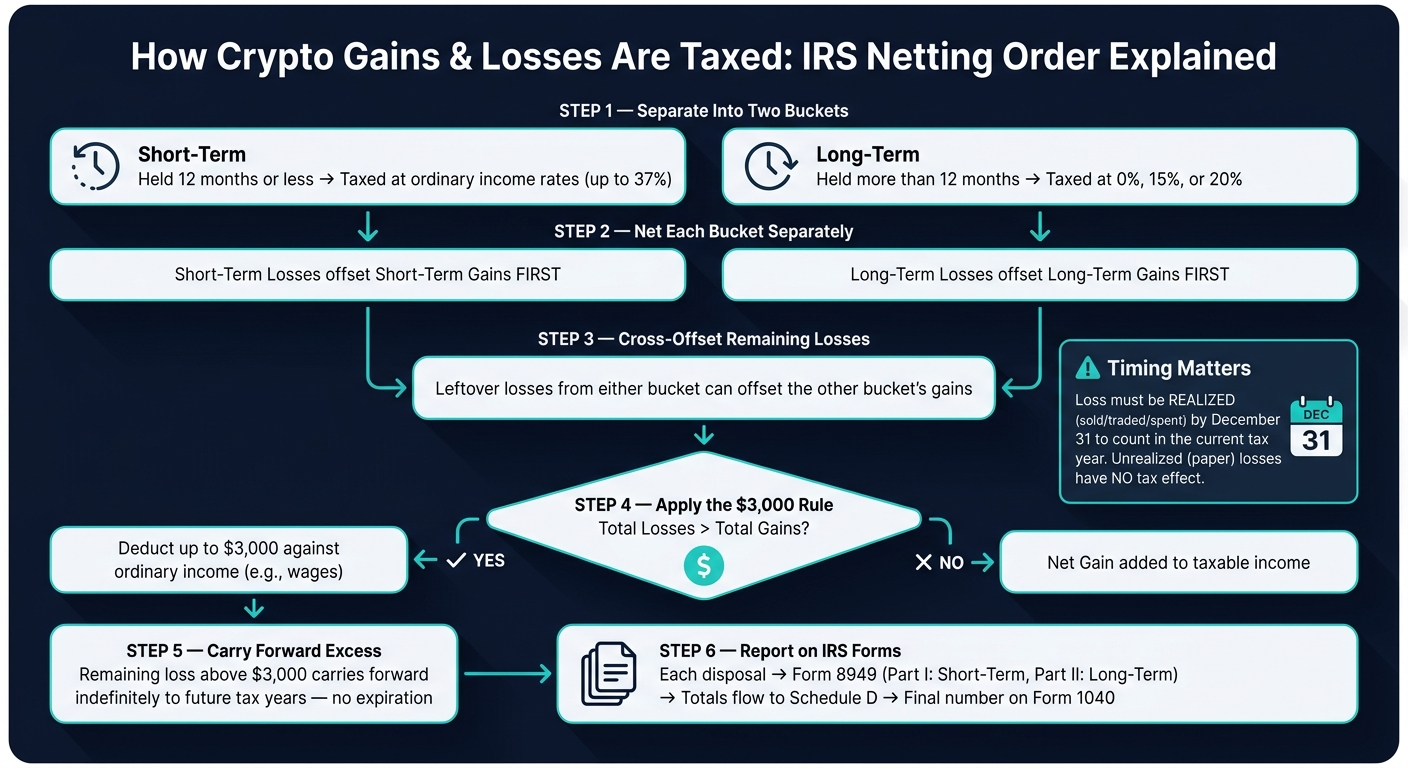
The IRS nets losses in a set order. Short-term losses must offset short-term gains first, and long-term losses must offset long-term gains first. Only after each bucket is netted can leftover losses offset the other bucket.
| Feature | Short-Term | Long-Term |
|---|---|---|
| Holding Period | 12 months or less | More than 12 months |
| Tax Treatment | Ordinary income tax rates | Lower capital gains tax rates |
| First Offset Rule | Short-term losses offset short-term gains first | Long-term losses offset long-term gains first |
That netting result decides how much loss can cut your tax bill.
How crypto losses lower your tax bill
How Crypto Gains & Losses Are Taxed: IRS Netting Order Explained
After the IRS netting rules are applied, realized crypto losses reduce realized gains dollar-for-dollar. If your losses are larger than your crypto gains, they can also offset other capital gains for the same tax year.
From net capital gain to net capital loss: the calculation steps
The process is pretty straightforward: net your short-term results, net your long-term results, and then combine those two numbers to find your final annual capital gain or capital loss.
The $3,000 ordinary income limit and loss carryforwards
If your losses are more than your gains, most individual U.S. taxpayers can deduct up to $3,000 per year against ordinary income, like wages. Any loss left over carries forward with no time limit and can be used to offset future gains or ordinary income in later years.
Here’s what that looks like with a simple example:
| No Crypto Losses | With Crypto Losses | |
|---|---|---|
| Total Capital Gains | $10,000 | $10,000 |
| Total Capital Losses | $0 | $15,000 |
| Net Capital Gain/Loss | $10,000 (Gain) | -$5,000 (Loss) |
| Ordinary Income Offset | $0 | $3,000 |
| Carryforward to Next Year | $0 | $2,000 |
In plain English, a $15,000 loss can wipe out $10,000 in gains, cut ordinary income by $3,000, and leave $2,000 to carry into the next year.
These numbers flow straight into Form 8949 and Schedule D.
How to read crypto tax results on IRS forms
Once your gains and losses are netted, you report them on Form 8949 and Schedule D. Form 8949 shows each transaction one by one. Schedule D adds everything up. After those totals are in place, the filing step is pretty direct.
What goes on Form 8949 and Schedule D

Report each taxable crypto disposal on Form 8949. That includes selling for cash, swapping one coin for another, or spending crypto on goods. For each transaction, record:
- Asset description
- Date acquired and date sold or traded
- Proceeds in U.S. dollars
- Cost basis in U.S. dollars
- Gain or loss
Use Part I for short-term trades and Part II for long-term trades. The totals from Form 8949 then flow to Schedule D, which adds up the year's results. That final number tells you whether you owe tax on gains or can claim a loss deduction.
3 basic end results beginners should know
After Schedule D totals the forms, you'll end up in one of three situations. The table below shows what each result means for your tax return.
| End Result | Schedule D Outcome | Form 1040 Effect | Carryforward |
|---|---|---|---|
| Net gain | Positive total after offsetting all losses. | Increases your total taxable income for the year. | No |
| Net loss up to $3,000 | Negative total of $3,000 or less. | Reduces your ordinary income by the loss amount. | No |
| Net loss over $3,000 | Negative total exceeding $3,000. | Reduces ordinary income by the $3,000 maximum limit. | Yes; the remaining loss carries over to future tax years. |
If you want the plain-English version, it works like this: a net gain adds to taxable income, a net loss of up to $3,000 can lower ordinary income for the year, and a net loss above $3,000 gets split. You use up to $3,000 this year, and the rest moves forward to future tax years.
Tax-loss harvesting vs holding: what to know
Once you understand how gains and losses net out, the next step is deciding whether to sell at a loss now or keep holding. The key point is simple: only realized losses affect your taxes.
Realized losses vs unrealized price drops
An unrealized loss is the paper loss you see when an asset drops in value but you still own it. It doesn't create a tax event. A realized loss happens when you sell or swap the asset. At that point, the loss can offset capital gains or reduce ordinary income. Put plainly: a realized loss can help on your tax return now, while an unrealized loss can't.
For tax purposes, timing matters. The year the loss counts depends on when the disposal happens. In most cases, you need to dispose of the asset by December 31 for it to count in the current tax year. One exception is Section 1256 contracts, which are marked to market at year-end.
The wash sale rule currently applies to stocks and securities, not generally to spot crypto property. It's also smart to keep clean records of your cost basis, sale price, and disposal date. That makes it much easier to support your basis, proceeds, and the timing of the sale if needed.
Summary of the offset rules
In practice, the choice comes down to this: hold the position, or realize the loss.
| Feature | Hold the Position | Realize the Loss |
|---|---|---|
| Tax status | Unrealized loss | Realized (taxable event) |
| Tax effect now | None; no deduction allowed | Offsets gains; if losses exceed gains, up to $3,000 can reduce ordinary income |
| Future-year implications | No tax benefit yet | Excess losses carry forward to future years |
| Timing requirement | N/A | Must be disposed of by December 31 for current-year treatment |
FAQs
How are mixed short-term and long-term losses netted?
First, net gains and losses within the same holding period:
- Short-term losses offset short-term gains
- Long-term losses offset long-term gains
If you still have a net long-term loss after that, you can use it to offset any remaining short-term gains.
If your total capital losses are more than your total capital gains, you may deduct up to $3,000 against ordinary income for the year. Any amount left over carries forward to future tax years.
What records do I need to prove my crypto loss?
Keep organized records for every transaction so you can prove your crypto loss to the IRS. You’ll want documents that show your cost basis and your final proceeds, and it’s smart to hold onto those records for at least seven years.
Your records should include:
- Transaction date
- Activity type
- Quantity
- Fair market value in USD
- Cost basis
- Resulting gain or loss
It also helps to keep supporting documents like trade confirmations, exchange statements, transaction hashes, and wallet addresses.
How does a crypto loss carryforward work next year?
If your total capital losses are higher than your capital gains for the year, you can first deduct up to $3,000 of that net loss against ordinary income.
If there’s still loss left after that, it carries forward with no expiration date. In future tax years, you can use it to offset capital gains or continue deducting it against ordinary income, subject to the same $3,000 yearly limit.