
Ultimate Guide to Crypto Reporting for Cross-Border Payments
Overview of DAC8, CARF, Travel Rule, US Form 1099-DA deadlines, recordkeeping and compliance steps to manage cross-border crypto reporting.

Cross-border crypto payments are facing stricter regulations worldwide. Here’s what you need to know:
-
Key Dates:
- January 1, 2026: EU’s DAC8 Directive starts. Crypto platforms must collect user data for tax reporting.
- January 1, 2025: U.S. brokers began reporting gross proceeds. Cost basis reporting starts January 1, 2026.
- 2027: OECD’s Crypto-Asset Reporting Framework (CARF) begins in 58 jurisdictions.
-
Global Frameworks:
- DAC8: EU-focused, mandates data collection and reporting for crypto transactions.
- CARF: Global standard for automatic crypto tax reporting.
- Travel Rule: Real-time data sharing for AML compliance.
-
User Compliance:
- Keep detailed records (transactions, cost basis, wallet ownership).
- Understand taxable events (sales, swaps, staking rewards) vs. non-taxable events (self-transfers).
- Non-compliance risks include penalties and blocked transactions.
-
Platforms Like Kryptonim:
- Automate compliance by collecting tax data and reporting to authorities.
- Align with DAC8, CARF, and Travel Rule standards.
With regulations tightening, proper record-keeping and compliance tools are essential to avoid penalties and streamline reporting.

Global Crypto Reporting Regulations Timeline 2025-2027
Global Frameworks for Crypto Reporting
Global frameworks like the OECD's CARF, the EU's DAC8 Directive, and FATF's Travel Rule aim to tackle the challenges of crypto's borderless nature. These regulations focus on bridging data gaps and enabling real-time information sharing to curb illicit activities.
"The CARF provides for the automatic exchange of tax relevant-information on crypto-assets and was developed to address the rapid growth of the crypto-asset market and to ensure that recent gains in global tax transparency are not gradually eroded." – OECD
As of early 2025, 63 jurisdictions have committed to adopting CARF, with the first reports anticipated in 2027 or 2028. The EU has taken a quicker approach, with DAC8 coming into effect on January 1, 2026. This directive requires Reporting Crypto-Asset Service Providers (RCASPs) to start collecting data immediately, with the first automatic exchange of information scheduled for September 30, 2027. Non-compliance with DAC8 can result in penalties ranging from $21,000 to $530,000 (EUR 20,000 to EUR 500,000). These frameworks not only aim to improve tax transparency but also push the industry toward stricter compliance.
CARF and DAC8 Requirements
CARF lays the foundation for automatically exchanging tax-relevant information about crypto transactions. It applies to a wide range of digital assets, including stablecoins, e-money tokens, and certain NFTs used for payment or investment. RCASPs, such as exchanges, wallet providers, and brokers, must monitor activities like crypto-to-fiat conversions, crypto-to-crypto trades, retail payments exceeding $50,000, and transfers to external wallets.
DAC8, the EU's version of CARF, extends these reporting obligations to non-EU RCASPs serving EU customers. Such providers must register in at least one EU member state. The directive also enforces strict user compliance: if a user fails to provide the required self-certification after two reminders within 60 days, the RCASP must block the user from conducting reportable transactions. Both CARF and DAC8 require providers to complete due diligence to identify "Reportable Users", determine their tax residency through self-certification, and record asset pricing at the time of transactions to ensure accurate reporting of acquisition values and proceeds. Additionally, the Common Reporting Standard (CRS) has been updated to include Central Bank Digital Currencies (CBDCs) and specific electronic money products, addressing potential reporting gaps.
Travel Rule and FATF Recommendation 16

Alongside these tax measures, the Financial Action Task Force (FATF) has introduced Recommendation 16, widely known as the Travel Rule, to combat money laundering and terrorist financing in crypto transactions. Unlike CARF and DAC8, which focus on annual reporting, the Travel Rule requires real-time data sharing between Virtual Asset Service Providers (VASPs) during cross-border transfers. Under this rule, VASPs must share details about both the sender and recipient - such as names, account numbers, and addresses - for qualifying transactions. The threshold for these requirements is typically set at $1,000. This aligns with CARF's mandate to track transfers to external crypto wallets, creating a combined effort to enhance both tax transparency and anti–money laundering measures. Together, these frameworks ensure that tax obligations and the legitimacy of transaction participants are closely monitored.
Regional Compliance: US, EU, and Beyond
While global frameworks like CARF and the Travel Rule lay the groundwork for crypto reporting, regional regulations take things a step further by introducing unique compliance requirements. These localized rules often reflect the specific priorities of their respective regions, adding another layer of complexity to the global compliance landscape.
In the US, the focus is heavily on tax reporting, particularly through the IRS. IRS Commissioner Danny Werfel emphasized the importance of these efforts, stating:
"These regulations are an important part of the larger effort on high-income individual tax compliance. We need to make sure digital assets are not used to hide taxable income".
Meanwhile, the European Commission has highlighted the need for international collaboration:
"The inherent cross-border nature of crypto-assets requires strong international administrative cooperation to ensure effective tax assessment and collection".
The sections below explore the practical differences between US and EU reporting requirements.
US Reporting Rules for Digital Asset Brokers
In the United States, compliance revolves around Form 1099-DA, a new reporting form designed specifically for digital asset transactions. Starting January 1, 2025, custodial brokers must report gross proceeds from transactions to the IRS. By January 1, 2026, these reports will also need to include cost basis details. These regulations were finalized in June 2024 after the Treasury and IRS reviewed over 44,000 public comments.
To ease the transition, the IRS is offering penalty relief for the 2025 calendar year to brokers who make a "good faith effort" to file Form 1099-DA correctly and on time. However, non-custodial and decentralized brokers are currently excluded from these requirements, with additional guidance expected in the future.
US rules also introduce specific thresholds based on asset types. For instance, stablecoins qualify for optional aggregate reporting if their value remains within 3% of their target currency over any consecutive 10-day period. Additionally, real estate professionals acting as brokers must report the fair market value of digital assets used in property transactions with closing dates on or after January 1, 2026.
In contrast to the US approach, the EU employs a dual framework that intertwines tax transparency with anti-money laundering measures.
EU TFR and Regional Variations
The European Union’s crypto reporting framework consists of two key components: the Transfer of Funds Regulation (TFR) and DAC8. The TFR, effective December 30, 2024, requires immediate sharing of originator and beneficiary information for cross-border transactions. On the tax side, DAC8 mandates that CASPs collect and report essential user data starting January 1, 2026.
Under DAC8, transaction details are reported to national tax authorities, which then exchange this information automatically across all EU member states. The first reporting deadline is set for September 30, 2027, covering transactions from the 2026 calendar year. Beyond the EU, 58 members of the Global Forum on Transparency and Exchange of Information for Tax Purposes have pledged to implement CARF by 2027.
Unlike the US, which currently focuses on custodial platforms, EU regulations cast a wider net. They include providers handling assets issued in decentralized systems. Additionally, providers not governed by MiCA are required to register in at least one EU member state, though registration formats can vary by country.
These regional differences underscore the complexities of navigating cross-border compliance in the crypto space.
Documentation and Due Diligence for Reportable Transactions
Staying compliant with crypto reporting starts with detailed record keeping. While the IRS requires records to be kept for at least three years, many experts recommend extending that to 7–10 years to cover varying audit periods across jurisdictions. This practice lays the groundwork for connecting technical recording requirements with practical due diligence.
For every reportable transaction, certain key details are essential. When dealing with sales or exchanges, you’ll need to log the UTC date and time, the number of units involved, gross proceeds in USD, the cost basis, and any transaction fees. If you receive cryptocurrency as income - whether through staking rewards, airdrops, or payments - record the fair market value in U.S. dollars at the exact time of receipt, as this value determines your cost basis for future transactions. For cross-border transfers between service providers, make sure to document the originator and beneficiary names, along with transaction IDs, as these are often required for reporting.
Self-custody introduces additional complexities. To prove that intra-wallet transfers are non-taxable, you’ll need evidence like signed messages, micro-deposit confirmations, or wallet labels as proof of ownership. Without these records, tax authorities might mistakenly classify these transfers as taxable events. On top of that, U.S. taxpayers must track the highest balance of their foreign crypto accounts during the year. If the total value exceeds $10,000 at any point, filing an FBAR is mandatory.
Regulatory changes are also tightening the documentation process. Starting January 1, 2025, custodial brokers will issue Form 1099-DA, which will report gross proceeds from your transactions. By January 1, 2026, these forms will include cost basis information as well. It’s critical to reconcile the data on Form 1099-DA with your own records. IRS Commissioner Danny Werfel highlighted the importance of third-party reporting:
"Third-party reporting improves compliance. In addition, these regulations will provide taxpayers with much needed information, which will reduce burden and simplify the process of reporting their digital asset activity".
To stay organized, adopt a structured workflow: export raw transaction logs, convert timestamps to UTC, reconcile all transactions, verify their accuracy, and save encrypted copies with standardized filenames such as 2025-ExchangeName-Trades-UTC.csv. This approach not only ensures you’re prepared for audits but also helps avoid common mistakes, like incorrectly treating crypto-to-crypto swaps as non-taxable.
Using Compliant Platforms Like Kryptonim for Secure Reporting
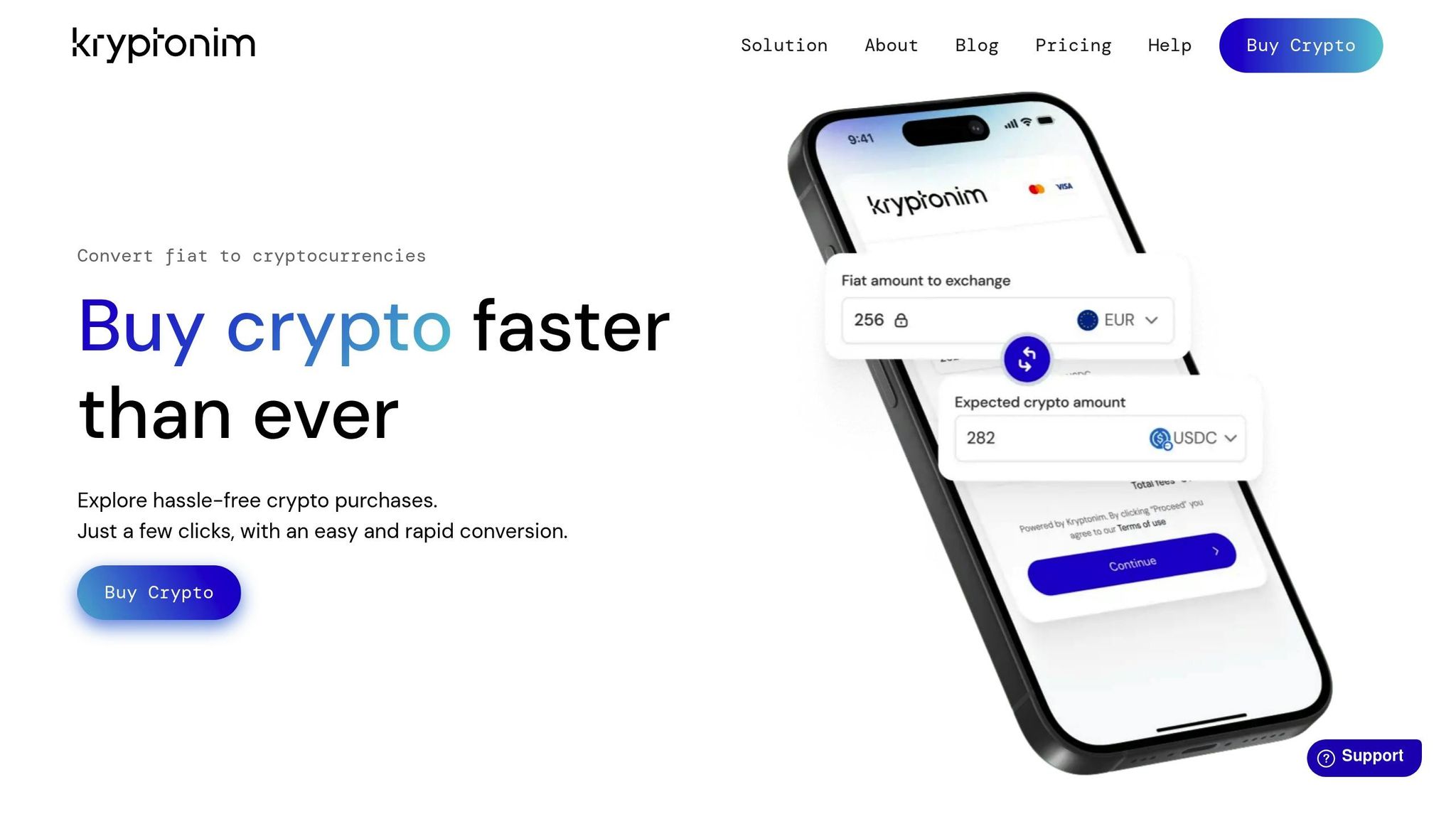
Platforms like Kryptonim, regulated under EU guidelines, offer a streamlined way to handle cross-border crypto reporting. Starting January 1, 2026, Kryptonim will operate as a Reporting Crypto-Asset Service Provider (RCASP). This means they are required to collect your Tax Identification Number (TIN), residential address, and full name to facilitate automatic information sharing between tax authorities. These requirements are part of the OECD CARF and EU DAC8 directives. If you don’t provide your TIN and tax residency details within 60 days (after two reminders), DAC8 mandates the platform to block any further reportable transactions.
One of Kryptonim's standout features is its ability to automatically track and report all transactions. Whether it's crypto-to-fiat exchanges, crypto-to-crypto trades, or transfers to self-hosted wallets, the platform monitors everything throughout the 2026 fiscal year. By September 30, 2027, this data is submitted to national tax authorities, ensuring compliance. Before any data is reported, you'll receive a notification, as required by GDPR. This automation removes the hassle of manual reconciliation, which is often a challenge with decentralized exchanges or self-custody setups. Kryptonim also integrates strong security measures to protect your compliance data while keeping the process smooth.
Security is a key focus. Kryptonim's account-free interface ensures regulatory data is captured without unnecessary complexity, and they offer competitive rates - just 2% per transaction for EU users. The platform employs Multi-Party Computation (MPC) to distribute cryptographic key shares, eliminating single points of failure. Additionally, every transaction generates an immutable audit trail, recording details like authorization and timing. These features, combined with automated tracking, provide a comprehensive and secure compliance solution.
Transparency is another major advantage. Kryptonim operates under the EU's Markets in Crypto-Assets (MiCA) framework, aligning with Travel Rule requirements for cross-border transfers. This means sender and recipient information is automatically shared when needed. By adhering to FATF Recommendation 16, Kryptonim ensures that your cross-border payments meet documentation standards expected by tax authorities. This reduces the burden of record-keeping while keeping you fully compliant with regulations.
sbb-itb-0796ce6
Comparison of Reporting Obligations Across Jurisdictions
Building on the global and regional frameworks discussed earlier, this section dives into the specific reporting obligations each framework imposes. By contrasting global crypto reporting standards, we can better understand the varying compliance requirements. The Crypto-Asset Reporting Framework (CARF), developed by the OECD, has been adopted by 63 jurisdictions and is set to take effect in early 2025. The EU’s DAC8 closely aligns with CARF but enforces stricter penalties, ranging from $21,700 to $543,000 for non-compliance. In contrast, the US IRS focuses its rules on custodial brokers via Form 1099-DA, while the EU’s Transfer of Funds Regulation (TFR) prioritizes anti–money laundering (AML) over tax reporting.
Scope of Frameworks
The scope of these frameworks varies significantly. US regulations broadly define digital assets to include NFTs and stablecoins, treating them as property for tax purposes. CARF and DAC8, on the other hand, cover a wide range of crypto-assets but specifically exclude Central Bank Digital Currencies (CBDCs) and e-money. Notably, the IRS does not require reporting from decentralized or non-custodial brokers. According to the IRS:
"The final regulations do not include reporting requirements for brokers commonly known as decentralized or non-custodial brokers that do not take possession of the digital assets being sold or exchanged".
CARF and DAC8, however, leave room for jurisdictional interpretation, which could extend requirements to include DeFi platforms.
Both CARF and DAC8 set a retail payment threshold of $50,000. In the US, certain stablecoin and NFT transactions fall under minimal thresholds, allowing for aggregate reporting when amounts remain below these limits. Under DAC8, failing to provide a Tax Identification Number (TIN) within 60 days of two reminders results in the suspension of reportable transactions. US brokers, in contrast, use the IRS TIN matching program to verify compliance.
Timing and Implementation
The timing of implementation also highlights key differences. US brokers began tracking gross proceeds on January 1, 2025, with the first Form 1099-DA submissions due in February 2026. Meanwhile, EU providers will start collecting data on January 1, 2026, with the first reports due to national tax authorities by September 30, 2027. The European Commission estimates that DAC8 could generate additional tax revenue between $1.17 billion and $2.60 billion annually. While DAC8 and CARF focus on annual tax reporting, the EU TFR stands out by requiring real-time transaction-level data for AML purposes.
Summary Table: Global Reporting Frameworks
| Feature | CARF (OECD) | DAC8 (EU) | US IRS (1099-DA) | EU TFR |
|---|---|---|---|---|
| Primary Goal | Global Tax Transparency | EU Tax Compliance | US Tax Compliance | AML/CTF |
| Effective Date | 2027 or 2028 | January 1, 2026 | January 1, 2025 | Ongoing |
| First Reporting | 2027 | September 30, 2027 | February 2026 | Real time |
| Retail Threshold | > $50,000 | > $50,000 | De minimis (varies) | Generally $0 |
| DeFi Platforms | Conditional | Conditional | Currently excluded | Included |
| Self-Hosted Wallets | Aggregate reporting | Aggregate reporting | Transfer reporting | Transaction-level data |
| Key Penalty | Varies by jurisdiction | ~$21,700 – ~$543,000 | Standard IRS penalties | Administrative sanctions |
| Due Diligence | Self-certification | Block after 60 days | TIN matching | Identity verification |
This comparison underscores the diverse approaches taken by global and regional frameworks to regulate crypto-assets, each with its unique emphasis on tax compliance, AML, or both.
Steps to Achieve Compliance with Crypto Reporting
To stay compliant with crypto reporting requirements, it’s essential to address immediate obligations and establish solid record-keeping practices for the long term. Start by completing all identity verification steps - such as verifying your ID, address, and source of funds - early on. Submit your Taxpayer Identification Number (TIN) and tax residency details well before tax season to avoid potential account restrictions. These early actions lay the groundwork for identifying taxable events and maintaining accurate records.
Understand the difference between taxable events and non-events. Taxable events include disposals, such as selling cryptocurrency for fiat, swapping one cryptocurrency for another, or using crypto to purchase goods; these transactions trigger capital gains or losses. Income events, like staking rewards, airdrops, and mining earnings, are also taxable. In contrast, self-transfers are non-taxable, provided you maintain proper ownership documentation. For cross-border transactions, ensure compliance with the FATF Travel Rule by keeping detailed records of both originator and beneficiary information.
Keep a detailed records pack for 7–10 years. This should include exports of trading activity from centralized exchanges (CEX), on-chain transaction logs, monthly PDF statements, and a wallet address book with ownership labels. When reconciling records from multiple exchanges or wallets, standardize all timestamps to Coordinated Universal Time (UTC) to ensure consistency when matching transactions to foreign exchange rates. For those using the Specific Identification cost basis method, document which specific crypto units you are selling at the time of the transaction. These practices create a reliable compliance system.
As summarized by industry experts:
"A clean crypto report is built on three pillars: know your obligations (KYC/AML & Travel Rule), identify taxable events vs non-events, and keep complete, versioned records you can reconcile across CEX, DEX, and self-custody."
- US21 Road Market
Once your verification and record-keeping processes are in place, consider using a platform that automates compliance. Tools like Kryptonim simplify data collection and generate audit-ready reports aligned with DAC8 and CARF regulations. These platforms automatically gather necessary reporting data, such as TINs and transaction details, for submission to tax authorities. In the U.S., brokers began using Form 1099-DA for reporting on January 1, 2025, with cost basis reporting slated to start on January 1, 2026.
Conclusion
Cross-border crypto payments are navigating an ever-changing regulatory environment. Key developments like the European DAC8 and the U.S. Form 1099-DA now mandate automatic data sharing. For example, EU authorities plan to exchange 2026 data by the established deadline, with 58 Global Forum members committed to CARF-based exchanges. These regulations lay the groundwork for compliance strategies that businesses and individuals must adopt.
To keep up with these shifts, focus on three essential areas: understanding your KYC/AML obligations, identifying taxable events versus non-events, and keeping detailed records for 7–10 years. Whether you're dealing with staking rewards, cross-chain swaps, or transfers falling under the Travel Rule, maintaining accurate records will make audits far less stressful. In the U.S., where digital assets are treated as property, every disposal requires calculating a capital gain or loss.
Platforms like Kryptonim offer automated solutions by collecting data and producing audit-ready reports that align with DAC8 and CARF requirements. As cost basis reporting becomes mandatory in the U.S. starting January 1, 2026, using compliant tools can significantly ease administrative work and reduce reporting mistakes.
Transparency is no longer optional - regulators are broadening their scope to include not just Bitcoin but also stablecoins, e-money tokens, and specific NFTs. For anyone involved in cross-border crypto transactions, staying ahead means building a dependable, scalable system that can withstand audits and adapt to growing activity.
With the first major DAC8 reporting deadline approaching in September 2027 for the 2026 calendar year, now is the time to establish solid recordkeeping habits and adopt compliant platforms. These steps will help you navigate the evolving crypto regulatory landscape effectively in the years to come.
FAQs
What are the key crypto reporting deadlines in the EU and the US?
In the European Union, the DAC-8 crypto-asset reporting rules are set to come into force on January 1, 2026. Under these rules, Crypto-Asset Service Providers (CASPs) will be required to submit their initial reports to tax authorities in 2027.
Meanwhile, in the United States, a draft bill aimed at regulating the crypto market was introduced on January 13, 2026. However, the exact reporting deadlines for compliance are still pending. Keep an eye out for further updates as more details emerge.
What is the Travel Rule, and how does it affect cross-border crypto transactions?
The Travel Rule mandates that virtual asset service providers (VASPs) gather and share identifying details about both the sender and recipient involved in cross-border cryptocurrency transactions. This regulation kicks in when transactions reach or exceed a specific monetary threshold determined by regulators.
The purpose of the Travel Rule is to strengthen anti-money laundering (AML) measures and curb illegal activities. However, it often brings added verification steps, which could lead to minor delays in transaction processing. Being aware of these requirements can help ensure smoother international crypto transfers while adhering to global compliance standards.
What records do I need to keep for crypto reporting compliance?
To stay on the right side of U.S. tax laws, you need to keep thorough records of every cryptocurrency transaction. The IRS expects you to document all crypto-related activities, including buying, selling, trading, making payments, or transferring assets. For each transaction, you should note the following:
- Date and time of the transaction, recorded in MM/DD/YYYY format
- Type of transaction, such as a purchase, sale, trade, payment, or mining/staking reward
- Amount of cryptocurrency involved, along with wallet or exchange addresses
- Fair-market value in USD at the time of the transaction
- Cost basis, which includes what you originally paid, plus any fees
- Supporting documents, like receipts, trade confirmations, or blockchain transaction hashes
If you hold cryptocurrency in foreign accounts, additional filings like FBAR (FinCEN Form 114) or Form 8938 might apply. Keeping your records well-organized - whether in digital or physical form - can save you a lot of headaches when it comes to tax preparation, audits, or responding to regulatory inquiries.