
Crypto Payment Licenses: Global Rule Map
Global comparison of crypto payment licensing—MiCA passporting vs U.S. MSB/state MTLs and APAC/MENA VASP rules; when fiat triggers PI/EMI.

If I want to grow a crypto payment business across borders, the license stack often decides where I can launch, how long it takes, and how much compliance work I face. In the EU, one CASP approval can open access across about 30 countries when passporting is used. In the U.S., I usually need federal MSB registration plus licenses in almost every state. Outside both, places like Singapore, Hong Kong, the UAE, and the UK each split crypto activity and fiat payments in their own way.
Here’s the short version:
- EU: Crypto activity often fits under MiCA CASP, but fiat collection or payout can still trigger PI or EMI rules.
- U.S.: I need FinCEN MSB registration and then a state-by-state money transmitter path.
- Singapore: Payment licensing is activity-based, and crypto remittance models may need both DPT and money transfer permissions.
- Hong Kong: The VASP/VATP license covers crypto activity, while fiat payment rails stay separate.
- UAE: Dubai’s VARA is one of the clearer routes for crypto payments and remittances, but the rule map still depends on the zone.
- UK: Crypto AML registration is separate from payment or e-money rules, so one approval does not cover the full stack.
A few numbers help frame the market:
- Crypto-powered remittances are estimated at $27.9 billion in 2025
- That is about 4% of the $685 billion sent to low- and middle-income countries
- As of May 4, 2026, the EU had 210 authorized CASPs across 23 countries
- 180 of them, or 86%, were already passporting into other EU member states
For me, the core question is simple: am I only moving crypto on-chain, or am I also touching fiat? That one split changes the whole rule map for remittances, merchant settlement, custody, on-ramps, and payouts.
Quick Comparison
| Region / Market | Main Crypto License Path | Fiat Payment Rights Included? | Cross-Border Reach per Approval | Main Issue for Payment Firms |
|---|---|---|---|---|
| EU | MiCA CASP | No, not by itself | EU passporting | CASP may need PI/EMI support for fiat legs |
| U.S. | MSB + state MTL | In parts, based on state scope | No passporting | State-by-state filings slow rollout |
| Singapore | PSA license with DPT and other permissions | Sometimes, if included in the license scope | National | Volume limits can push firms into MPI |
| Hong Kong | VASP/VATP | No, fiat side stays separate | National | Capital, insurance, and separate payment setup |
| UAE | VARA/DFSA/FSRA path by zone | Depends on activity and zone | Zone or local market | More than one regulator may be involved |
| UK | FCA AML registration + other approvals | No, separate payment/e-money rules apply | National | Split regime for crypto and fiat |
So the takeaway is plain: there is no single global crypto payments license. I have to match the license stack to the payment flow, the countries I want to serve, and whether customer funds move in crypto, fiat, or both.
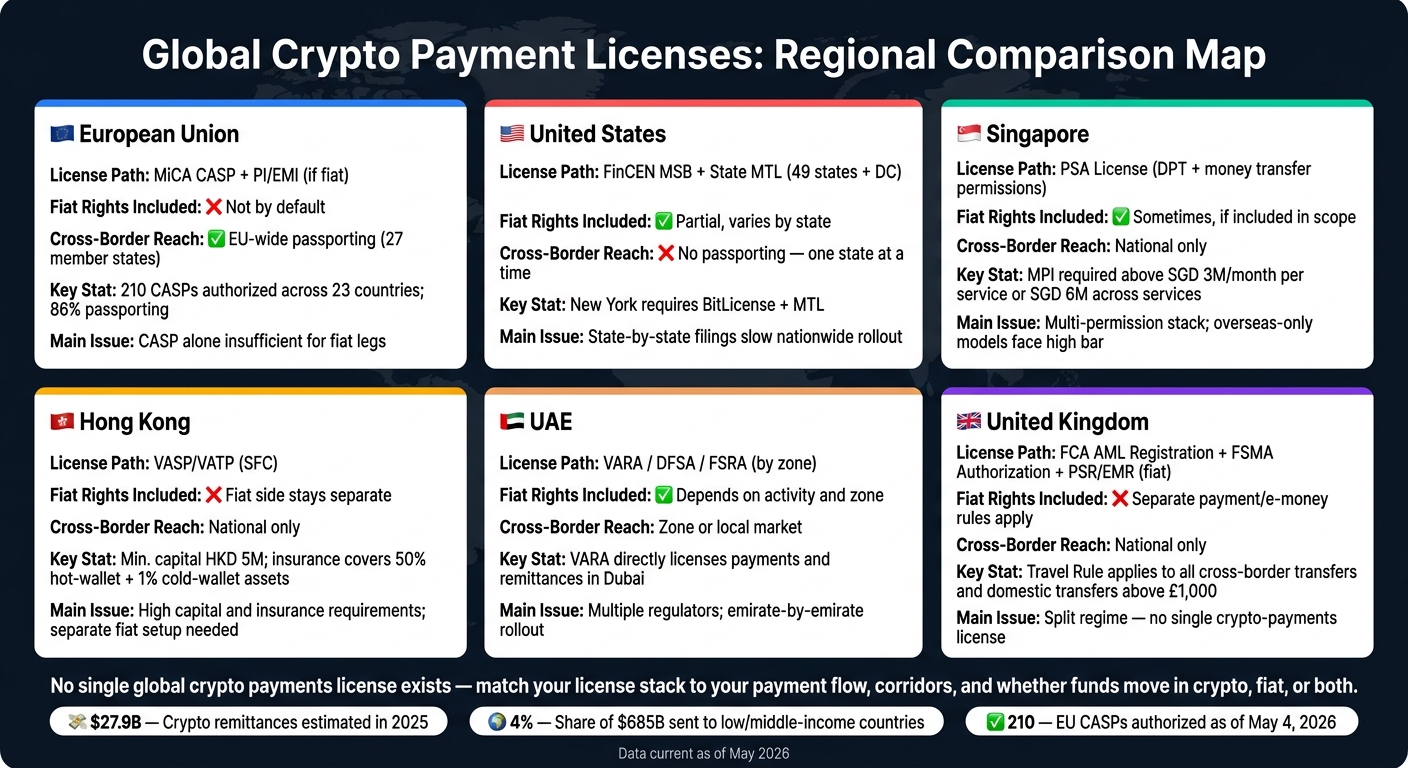
Global Crypto Payment Licenses: Regional Comparison Map
EU Rule Map: MiCA, CASPs, and Payment Institution Overlap
The EU’s crypto payments setup has a few moving parts. MiCA covers the crypto-asset service side. PSD2 and the Electronic Money Directive cover fiat payment rails. So when a provider touches both crypto and fiat, the main issue is simple: where does crypto authorization stop, and where does fiat payment licensing start?
Where MiCA Fits in Payment and Remittance Models
MiCA became fully applicable across the EU on December 30, 2024, and it created a single authorization system for Crypto-Asset Service Providers (CASPs). For payment firms, the CASP services that matter most are:
- custody
- transfer
- crypto-fiat exchange
Those services are especially important for fiat on- and off-ramp activity.
Once a firm is authorized as a CASP in one EU member state, it can passport those services across all 27 member states. That’s a big shift. As of May 4, 2026, 210 CASPs were authorized across 23 countries, and 86% of them - 180 firms - were already passporting into other member states.
MiCA also creates two token categories that matter for payments: E-Money Tokens (EMTs) and Asset-Referenced Tokens (ARTs). EMTs are fiat-linked tokens, so they are the closer match for payments. ARTs show up less often in day-to-day payment use.
One detail matters a lot here: MiCA separates token issuance from service-provider licensing. That means an EMT issuer and a CASP that offers custody or transfer for that same EMT do not fall under the exact same rule set. For remittances and merchant payments, that split is more than a technical footnote. It shapes who needs which approval.
When PI or EMI Licenses Still Apply
MiCA by itself does not cover fiat payment activity. If a business handles fiat at any point, PI or EMI rules may still kick in.
That usually happens when the flow includes things like collecting fiat from users through bank transfer or card, holding balances in payment accounts, sending SEPA payouts to merchant bank accounts, or running remittance models where the off-chain leg is a regulated payment service.
Here’s the practical version. A crypto wallet that stores EMTs and sends on-chain transfers can operate under a CASP authorization. But if that same wallet also offers fiat accounts or bank payouts, it will usually need PI or EMI authorization as well - or it will need to work with a licensed partner.
EU guidance openly allows that partner model. A provider can act as a CASP for custody and on-chain transfers, plug into a third-party EMI or PI for fiat collection and payouts, and use that partner’s passporting rights for cross-border fiat activity. In plain English: one license handles the crypto side, another handles the fiat rails.
EU Comparison Table: CASP vs. EMI vs. PI Roles
| Framework | Main Scope | Cross-Border Reach | Supervisory Focus | Relevance to Merchant Payments & Remittances |
|---|---|---|---|---|
| CASP under MiCA | Custody, exchange, and transfer of crypto-assets | EU-wide access after authorization | Crypto-service authorization, governance, conduct, and operational requirements | Covers on-chain transfers and exchange, but not automatically enough for fiat settlement |
| EMI | Issuance of e-money and related payment services; EMTs are treated as electronic money | EU-wide authorization under e-money rules | Safeguarding, issuance, redemption, and payment services tied to electronic money | Highly relevant for stablecoin-based payment flows, merchant settlement, and payout rails |
| PI | Payment services including transfers, acquiring, and money remittance | EU passporting under payments law | Payment-service conduct, capital, safeguarding, and operational controls | Relevant when a crypto business collects fiat, pays out merchants, or runs remittance flows via fiat rails |
A simple way to think about it: crypto-only flows often need just a CASP license. Once fiat collection or fiat payout enters the picture, PI or EMI licensing usually comes with it. That line stands out even more when you look beyond the EU, where many markets lean on VASP, money transmitter, or MSB models instead.
sbb-itb-0796ce6
VASP Regimes: Payment Rules Outside the EU
Outside the EU, crypto payment licensing is patchy. Providers have to line up their product with local VASP, payment, and AML rules. That split matters most for remittances and merchant payments, where licensing can decide whether a product gets off the ground at all.
Singapore, Hong Kong, the UAE, and the UK: Licensing at a Glance
Singapore uses the Payment Services Act 2019 (PSA). The law licenses the specific activities a firm carries out, including DPT services and, when needed, cross-border money transfer or merchant acquisition. In practice, a crypto remittance platform will often need both DPT and cross-border transfer permissions under one payment-services license.
The license type then turns on volume. Once monthly transaction values go above SGD 3 million for any one payment service, or SGD 6 million across services, the firm must hold an MPI license.
Hong Kong runs a mandatory VASP regime under the Securities and Futures Commission (SFC). The financial bar is not small: minimum paid-up share capital is HKD 5 million, with HKD 3 million minimum liquid capital or 5% of client assets. Retail platforms also have to meet token-admission and insurance rules that cover at least 50% of hot-wallet client assets and 1% of cold-wallet assets. The fiat side is still separate, so payment rails do not come bundled with the VASP license.
The UAE is more of a map than a single rulebook. VARA oversees virtual asset activities in Dubai outside DIFC, the DFSA covers DIFC, ADGM's FSRA handles Abu Dhabi Global Market, and the Central Bank oversees payment tokens and broader payment-system issues. For payment businesses, one point stands out: VARA directly licenses payments and remittances as a regulated virtual asset activity. That makes Dubai one of the clearest routes in the region for crypto payments and remittances.
The UK takes a split approach. Crypto businesses must register with the FCA under money laundering rules for AML/CFT supervision, and any regulated cryptoasset activity also needs FCA authorization under FSMA. If fiat touches the product, separate payment-service or e-money compliance still applies.
Taken together, these four systems show the main non-EU patterns. You see activity-based licensing, stand-alone VASP regimes, multi-regulator oversight, and models where crypto and fiat sit under different rule sets. Singapore and the UAE lean more toward a payment-first setup. Hong Kong and the UK keep crypto activity and fiat rails more clearly apart.
Travel Rule, Capital, and Retail Access Differences
License labels only tell part of the story. The day-to-day compliance load also changes a lot, especially once transfer thresholds come into play.
Travel Rule thresholds vary by market:
- EU: all transfers
- UK: all cross-border transfers and domestic transfers above £1,000
- Singapore: SGD 1,500
- Hong Kong: HKD 8,000
- UAE VARA: AED 3,500
- ADGM FSRA: all transfers
For high-frequency, low-value corridors, that can add a lot of cost. A remittance product built for many small transfers may look fine on paper, then run into heavy screening and data-sharing work once those local thresholds kick in.
Singapore's MAS also keeps a high bar for licensing and generally does not issue a license to firms that serve only overseas customers. Hong Kong pushes up fixed costs for consumer-facing services through its capital and insurance rules. In the UAE, regional coverage may mean dealing with several regulators that each have their own rulebook.
The table below shows how these setups shape payment use cases in practice.
VASP Comparison Table by Jurisdiction
| Jurisdiction | Primary Regulator | License Type | Payment Use Cases Covered | Key Friction Points |
|---|---|---|---|---|
| Singapore | MAS | SPI or MPI (DPT + money transfer permissions) | Crypto remittances, merchant acceptance, custodial wallets | Multi-permission stack; MPI required above SGD 3 million/month; overseas-only models face a high licensing bar |
| Hong Kong | SFC | VASP/VATP license | Crypto trading, custody; payment flows need separate fiat/payment arrangements | HKD 5 million minimum capital; token-admission and insurance requirements |
| UAE (Dubai/VARA) | VARA | VARA license for virtual asset activities, including payments and remittances | Cross-border crypto payments, remittances, merchant services | Multi-regulator landscape; separate rules for DIFC and ADGM; Central Bank oversight for payment tokens |
| UK | FCA | FCA registration (AML) + FSMA authorization (cryptoassets) + PSR/EMR (fiat) | Crypto exchange, custody; fiat legs require separate payment-service compliance | Split regime; no single crypto-payments license |
U.S. and Similar Models: Money Transmitter and MSB Rules
The U.S. doesn't have one crypto payments license. Instead, providers usually need federal MSB registration and state money transmitter licenses. That's the sharp contrast with the EU model, where regulated on-ramp providers use passporting to open access across the bloc.
How the U.S. Licensing Stack Works
At the federal level, businesses that qualify as money transmitters - including many that handle convertible virtual currency (CVC) - must register as Money Services Businesses (MSBs) with FinCEN. FinCEN guidance says CVC administrators and exchangers that transmit or trade for customers are treated as money transmitters. MSB registration is filed on Form 107 within 180 days of starting operations and renewed every two years.
That federal step is lighter than a MiCA authorization process, but it still comes with Bank Secrecy Act duties. In plain English, that means AML, KYC, recordkeeping, SARs, and other required filings.
At the domestic level, growth depends on state approvals, not one national authorization. Forty-nine states and the District of Columbia require money transmitter licensing for businesses that receive and transmit value for customers, including many exchanges, remittance platforms, and stablecoin payment providers. New York goes further. It generally requires a BitLicense plus an MTL for virtual currency businesses serving residents, though there is a carve-out for users paying for goods and services.
What State-by-State Licensing Means for a Nationwide Rollout
A license in one state does not let a company operate in another. Each state runs its own application process and may set separate net-worth, bond, examination, and reporting rules. Most states use the Nationwide Multistate Licensing System (NMLS), but state-specific supplements and disclosures still add work.
For a crypto remittance or merchant settlement product that wants nationwide coverage, licensing order becomes a big part of go-to-market planning. Many companies start in states with clearer crypto guidance and lighter licensing demands, then add tougher jurisdictions as approvals come through. In practice, that often leads to a staggered rollout over months or even years, with companies blocking users in unlicensed states while filings move in parallel across agencies.
Against MiCA and VASP systems, the U.S. stands out for fragmentation, not for a single nationwide approval.
Comparison Table: Money Transmitter vs. MiCA vs. VASP
| Feature | U.S. MSB + State MTL | EU MiCA (CASP) | VASP (e.g., Singapore, Hong Kong) |
|---|---|---|---|
| Licensing authority | FinCEN + state regulators | Single EU member-state regulator | National regulator |
| Market coverage per license | One state only | EU-wide via passporting | National market only |
| Passporting | None | Yes, across the EU | None |
| Rollout complexity | Very high - multiple separate licenses required | Moderate - one authorization can cover the EU market | Low to moderate |
| Regulatory burden | BSA AML, KYC, SARs | Authorization and ongoing compliance | AML/CFT and licensing |
That missing passporting layer makes U.S. expansion slower than a MiCA-based rollout, which is why licensing strategy often shapes the product roadmap for crypto payment businesses operating across borders.
Global Rule Map: Matching Licensing Models to Payment Use Cases
Regional Breakdown: EU, North America, APAC, and MEA
Now that the main licensing models are on the table, here’s how they play out by region.
EU: CASP for crypto, EMI/PI for fiat. Thanks to passporting, this is the most unified route for multi-market growth.
North America: Federal MSB registration plus state-by-state money transmitter licenses. There’s no passporting here, which means a more fragmented setup.
APAC: Singapore has APAC’s most integrated licensing model. Hong Kong splits crypto and fiat into separate tracks, so firms need both VASP and Money Service Operator licenses.
MEA: The UAE still works on an emirate-by-emirate basis, so corridor-by-corridor rollout is the usual path.
These regional patterns help match the license stack to the payment flow.
How to Use This Map for Remittances and Merchant Payments
The right licensing model starts with the way the product works. A short checklist makes the choice easier:
- Need EU passporting for remittances or merchant payouts? Use a MiCA CASP plus EMI/PI.
- Need direct fiat settlement rights? If the product moves fiat into bank accounts or cards, it needs payment or remittance licensing - PI/EMI in the EU, money transmitter licenses in the U.S., and local payment licenses in APAC and MEA.
- Are your corridors global or U.S.-centric? U.S.-focused products usually start with MSB registration and then add state licenses in phases. Asia or MENA corridors tend to work better with a hub model based in Singapore or Dubai.
Key Takeaways and Conclusion
The right license stack follows the payment route, not the product label.
There is no single global crypto payment license. The EU offers the most harmonized path. VASP regimes across APAC and MEA depend on the jurisdiction. And in the U.S., reaching scale takes heavy licensing work.
Licensing shapes go-live speed, banking access, and corridor reach. Get the stack wrong, and expansion can stall the moment the product hits a new market.
FAQs
Do I need both crypto and fiat licenses?
It depends on what your business does and where you operate. Under MiCA, you need to map the crypto-asset services you provide - like custody or exchange - so you can figure out which CASP authorization applies.
There’s another layer too. If your business handles fiat-to-crypto exchange or transfers, you may also fall under fiat-side rules, including PSD2. And if you issue fiat-backed stablecoins, the bar can be higher. In some cases, that can mean authorization as a credit institution or electronic money institution.
What is the fastest region for cross-border launch?
The European Union gives firms the fastest route to a cross-border launch thanks to its passporting system. Get a CASP license in one member state, and you can operate across all 27 EU countries without needing separate local approvals.
If you're looking at single-country options, the Czech Republic is known for a faster timeline of 2 to 5 months. Lithuania usually takes 3 to 6 months.
How do remittances and merchant payments change licensing?
Remittances and merchant payments often come with stricter licensing rules because regulators want closer oversight, stronger consumer protection, and tighter anti-money laundering controls.
Under frameworks like the EU’s MiCA, providers need a CASP license along with identity verification, transaction monitoring, and asset segregation. These rules can apply to both domestic and cross-border payments, and they often remove earlier minimum thresholds for data collection.