
Global Crypto Licensing: Country Comparison
Centralized licensing eases cross-border crypto expansion; fragmented regimes force costly, state-by-state work.

If I had to sum it up in one line: the EU is the simplest path for multi-country access, the U.S. is the hardest to piece together, and Singapore plus the UAE sit in the middle with tighter local rule sets.
If you want to compare crypto licensing across the EU, UK, U.S., Singapore, and UAE, I’d focus on four things right away:
- What the license lets you do
- How much capital you need
- AML/CFT work
- How customer protection is handled
The article’s main point is simple: one-system markets cut friction, while split systems add cost, time, and filing work. The EU’s MiCA gives one route across 27 member states. The UK has an AML registration path now, with a broader FSMA regime due on 10/25/2027. The U.S. mixes FinCEN with state money transmitter licenses, and 49 states plus D.C. generally require state licensing, with Montana as the exception. Singapore uses the PSA and FSM Act, and some firms may need two licenses. The UAE is split between Dubai VARA and Abu Dhabi ADGM.
A few numbers tell the story fast:
- EU MiCA capital: €50,000, €125,000, or €150,000 depending on service
- UK FSMA PMRs: from £75,000 to £750,000
- Singapore base capital: SGD 100,000 for SPI and SGD 250,000 for MPI
- UAE capital: often from about AED 1,000,000 to AED 50,000,000, or about $150,000 to $10,000,000 in ADGM cases
- U.S.: no single federal capital floor for FinCEN MSB status, but state rules can add net worth and bond demands
Quick take: if you want one approval for many markets, the EU stands out. If you want U.S. users, expect state-by-state work. If you want an Asia base, Singapore is strict but clear. If you want the UAE, your choice often comes down to Dubai retail vs. Abu Dhabi institutional.
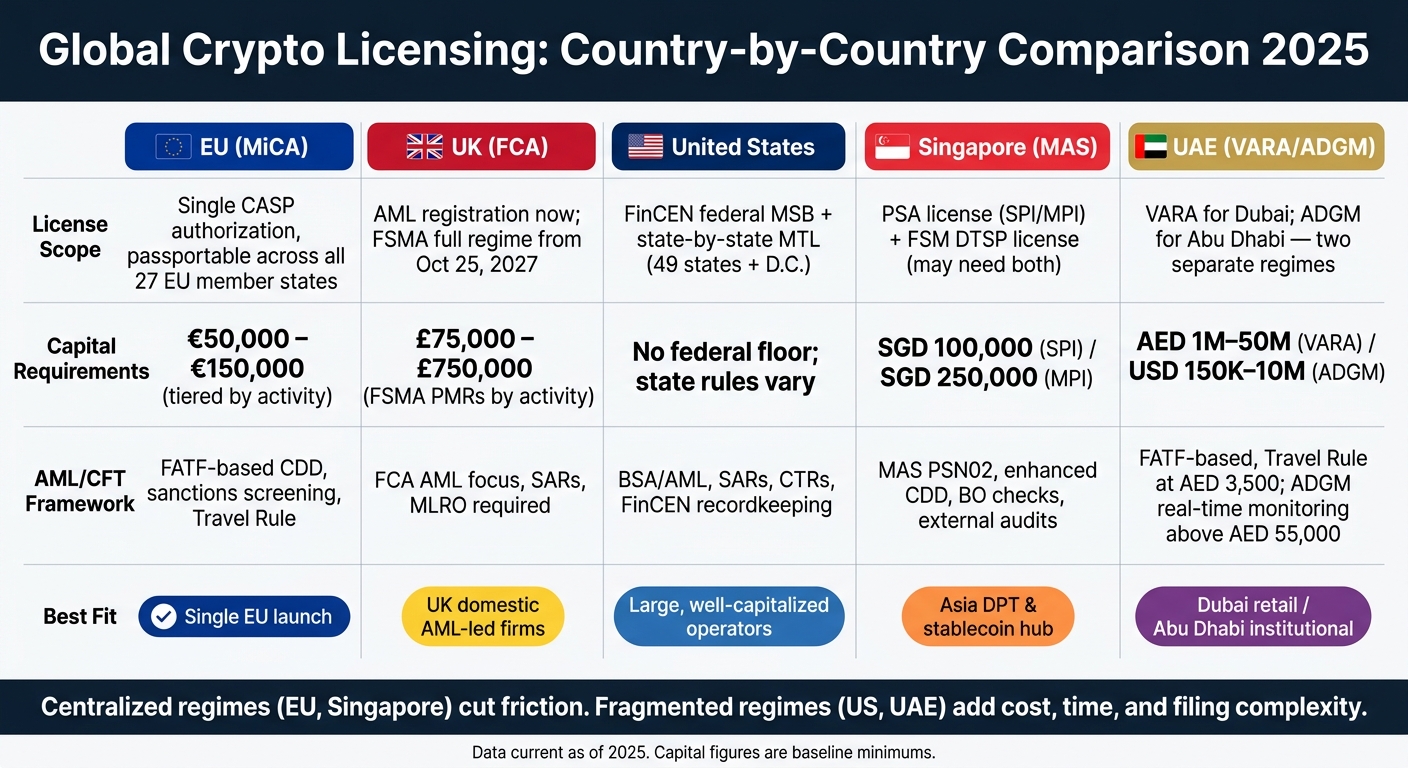
Global Crypto Licensing: Country-by-Country Comparison 2025
Quick Comparison
| Jurisdiction | License scope | Capital baseline | AML/CFT load | Customer protection |
|---|---|---|---|---|
| EU (MiCA) | One CASP approval can cover the EU through passporting | €50,000–€150,000 + overhead test | FATF-based checks, sanctions, Travel Rule | Disclosures, asset segregation, complaints, cyber controls |
| UK (FCA) | AML registration now; broader FSMA scope later | MLR: none stated; FSMA: £75,000–£750,000 | Strong FCA AML focus, SARs, MLRO | Promotions rules, risk warnings, conduct controls |
| U.S. | Federal + state split | No single FinCEN floor; state rules vary | BSA/AML, SARs, CTRs, recordkeeping | Mostly state- and product-led |
| Singapore | PSA for payment services; FSM for DTSP work | SGD 100,000 or SGD 250,000 | Tight MAS AML rules, BO checks, audits | Risk disclosures, client asset segregation, payout limits |
| UAE | VARA in Dubai; ADGM in Abu Dhabi | Often AED 1,000,000–AED 50,000,000 or $150,000–$10,000,000 by case | FATF-based rules, Travel Rule | VARA leans retail; ADGM leans institutional |
So if I were screening markets fast, I’d use this rule: pick an EU-regulated on-ramp provider for reach, the UK for a local-first plan, the U.S. for scale if you can handle state filings, Singapore for an Asia hub, and the UAE for a Dubai-or-Abu Dhabi model.
sbb-itb-0796ce6
1. European Union (MiCA)
MiCA, Regulation (EU) 2023/1114, is the EU’s single framework for crypto-asset issuance, public offers, trading admission, and CASP authorization. It entered into force on June 29, 2023. The rules for ARTs and EMTs started applying on June 30, 2024, and the CASP regime followed on December 30, 2024. In plain English, that gives firms one EU-wide route to market instead of forcing them to chase separate licenses country by country.
Once a CASP gets authorized by the national competent authority in its home member state, it can offer services across the EU through passporting. It does not need to file for a separate license in each market. MiCA covers a broad set of services, including custody, exchange of crypto-assets for funds or for other crypto-assets, operation of trading platforms, execution of orders, transfer services, portfolio management, and investment advice. A firm has to spell out exactly which of these services it plans to offer when it applies for authorization.
To qualify, the business must be an EU legal entity with a registered office, sound management, and at least one director who lives in the EU. That’s the basic entry ticket.
The funding rules are tiered based on what the firm does:
- €50,000 for execution and advice
- €125,000 for custody and exchange
- €150,000 for trading platforms
MiCA also says firms must hold the higher of that fixed amount or one-quarter of the previous year’s fixed overheads. So the minimum capital isn’t just a box-ticking exercise. If operating costs climb, the funding bar can climb with them.
On AML/CFT, CASPs are treated as obliged entities. That means they must run customer due diligence, monitor transactions on an ongoing basis, screen against sanctions lists, and apply Travel Rule controls for crypto transfers. Oversight works on two levels: national competent authorities authorize CASPs, while ESMA and EBA set EU-level standards. EBA also takes the lead for ART and EMT issuers.
User protection sits near the center of the regime. MiCA requires clear, nonmisleading disclosures, safeguarding and segregation of client assets and funds, cybersecurity and resilience controls, and complaint-handling procedures. For a fiat-to-crypto platform like Kryptonim, that places it in the exchange-of-crypto-assets-for-funds category. So its onboarding, disclosures, and asset-safeguarding setup need to line up with MiCA’s rules.
The UK takes a more domestic path, with less passporting and a narrower authorization route.
2. United Kingdom (FCA Regime)
The UK uses a two-track setup.
One track is AML registration under the Money Laundering Regulations. The other is an incoming FSMA authorization regime for a broader set of crypto activities. And unlike the EU, the UK does not offer crypto passporting.
Under the MLR route, cryptoasset exchange providers and custodian wallet providers that offer certain cryptoasset services in the UK must register with the FCA. Here, the FCA oversees firms for AML/CTF purposes. That means firms need the core controls you’d expect, including:
- CDD
- transaction monitoring
- sanctions screening
- SARs
- an MLRO
This MLR registration does not come with prudential capital requirements. It also does not allow firms to carry on regulated investment activities.
The incoming FSMA regime goes much further. It will cover trading platforms, dealing, arranging deals, safeguarding, stablecoin issuance, and staking. The FCA’s permanent minimum capital requirements, or PMRs, are tied to the activity involved:
| Activity | Permanent Minimum Capital |
|---|---|
| Arranging or dealing as agent | £75,000 |
| Safeguarding, staking, or operating a qualifying cryptoasset trading platform | £150,000 |
| Issuing a qualifying stablecoin | £350,000 |
| Dealing as principal | £750,000 |
If a firm carries on more than one activity, it must hold the highest PMR that applies, plus overhead and risk-based add-ons. The new FSMA-based regime is expected to take effect on October 25, 2027.
Licensing is only one part of getting into the market. In the UK, financial promotions rules also shape how firms can reach consumers. The UK’s cryptoasset financial promotions regime has applied since October 8, 2023.
A crypto promotion must fit within one of four lawful routes:
- communicated by an FCA-authorized firm
- approved by an authorized section 21 approver
- communicated by an FCA-registered cryptoasset business relying on the Article 73ZA exemption
- covered by another applicable exemption
All promotions must carry prominent risk warnings and be
"clear, fair and not misleading."
There’s a catch here that matters a lot in practice. If UK consumers can access the promotion and act on it, the regime applies no matter where the firm is based. So even a firm outside the UK can run straight into these rules. That makes UK promotions law a separate barrier from MLR registration or FSMA authorization.
3. United States (Federal and State Framework)
The U.S. does not have one single crypto licensing authority. It runs on two tracks at the same time: federal oversight and state-by-state licensing. In practice, many firms have to meet both sets of rules.
At the federal level, FinCEN sets the starting point. If a business accepts and transmits convertible virtual currency (CVC), or buys or sells it for fiat or other CVC, it will generally be treated as a Money Services Business (MSB) and must register with FinCEN, usually within 180 days of starting operations. That registration triggers Bank Secrecy Act (BSA) duties, including a written AML/CFT program, a designated compliance officer, transaction monitoring, SAR and CTR filings, and detailed recordkeeping. These rules can also reach foreign firms that serve U.S. customers at scale, even if they do not have a physical U.S. presence. FinCEN registration does not set a federal minimum capital rule. In the U.S., capital pressure tends to come from the states.
The SEC and CFTC then layer on product-specific oversight. The SEC claims jurisdiction when a token is a security, while the CFTC treats assets like Bitcoin and Ether as commodities and oversees related derivatives markets, along with some spot-market fraud and manipulation matters. A 2026 Memorandum of Understanding (MOU) between the two agencies put that coordination into formal terms where their authority overlaps. So if a business offers spot trading, derivatives, or yield products, it may end up dealing with both regimes at once.
At the state level, the picture gets even more fragmented. Almost every state and D.C. require a money transmitter license (MTL) for value transmission. Montana is the exception. Each state sets its own net worth floors, surety bond amounts, permissible investment rules, plus its own compliance documents and consumer-protection standards. That means the licensing path can shift a lot depending on where a company operates.
New York is the clearest example of a tougher state model. Its BitLicense, under 23 NYCRR Part 200, carries a $5,000 application fee and a long list of crypto-specific rules tied to custody, cybersecurity, and listing standards. More broadly, user protection in the U.S. is still driven mainly by state rules and product type, not by one unified federal system. Enforcement risk is high, so firms need to think beyond filing paperwork and weigh how agencies are likely to review the business.
That fragmented model stands in sharp contrast to Singapore's centralized licensing approach.
4. Singapore (MAS PSA and FSM Regime)
Singapore runs crypto under a centralized setup led by the Monetary Authority of Singapore (MAS), mainly through the Payment Services Act 2019 (PSA) and the Financial Services and Markets Act 2022 (FSM Act). In simple terms, the system splits crypto work into two buckets: payment services and digital token services. Each bucket has its own rules.
Under the PSA, MAS uses two license tiers for payment service providers: Standard Payment Institution (SPI) for smaller operators and Major Payment Institution (MPI) for firms that go above those limits.
| Feature | SPI | MPI |
|---|---|---|
| Monthly transaction threshold | Below SGD 3,000,000 for any single service; below SGD 6,000,000 across two or more services | No cap |
| Daily e-money float | Below SGD 5,000,000 | No cap |
| Minimum base capital | SGD 100,000 | SGD 250,000 |
| Prudential intensity | Lower | Higher |
Crypto-related activities like exchange, transfers, and custodial wallets fall under digital payment token (DPT) services. If a firm offers DPT services, it must follow MAS Notice PSN02. That brings tighter AML/CFT duties, including enhanced customer due diligence, beneficial ownership checks, transaction monitoring, and external audit review of controls.
The FSM Act adds another layer for digital token firms. Businesses carrying out digital token services in or from Singapore, including for overseas customers, need a separate DTSP license, and that rule took effect on June 30, 2025. DTSPs must comply with FSM-N27 and FSM-N28, along with Singapore's broader AML laws.
MAS also expects firms to deal plainly with customer risk. That includes disclosures on token volatility and counterparty risk, segregated client assets, and limits on cash payouts above SGD 20,000.
That means a firm doing both payment services and digital token services may need two licenses: a PSA license and an FSM DTSP license. MAS also expects a permanent Singapore office and local governance. That includes at least one executive director who is a Singapore citizen, permanent resident, or Employment Pass holder.
Compared with the UAE, this is a more centralized model rather than a segmented one.
5. United Arab Emirates (VARA and ADGM)
The UAE takes a two-track approach to crypto oversight. Instead of one national setup, Dubai and Abu Dhabi each run their own system side by side. So the rulebook that applies to a firm comes down to where it operates and what it does.
In Dubai, VARA was set up under Dubai Law No. 4 of 2022. It covers Dubai mainland and most Dubai free zones, but not the Dubai International Financial Centre (DIFC). VARA licenses eight activities: advisory, broker-dealer, custody, exchange, lending and borrowing, management and investment, transfer and settlement, and issuance.
In Abu Dhabi, ADGM sits on Al Maryah Island and works under an English common law system through the Financial Services Regulatory Authority (FSRA). It issues a Financial Services Permission (FSP) for regulated activities such as operating a multilateral trading facility (MTF), providing custody, brokerage, and asset management.
Here's the side-by-side view:
| Feature | VARA (Dubai) | ADGM (Abu Dhabi) |
|---|---|---|
| Authorization type | Activity-specific VASP license | Financial Services Permission (FSP) |
| Activity scope | Eight VA categories | Virtual assets, fiat-referenced tokens, digital securities, and derivatives/funds |
| Market focus | Retail and consumer-facing platforms | Institutional and B2B |
| Legal framework | UAE federal and Dubai law | English common law |
| Capital requirements | AED 1,000,000–4,000,000; exchanges: ~AED 5,000,000; large platforms: up to ~AED 50,000,000 | USD 150,000–2,000,000; major trading or custody platforms: ~USD 10,000,000 |
| AML travel rule threshold | AED 3,500 (~$953) per transfer | AED 3,500 (~$953) per transfer; real-time monitoring of large transfers above AED 55,000 |
| User protection focus | Retail disclosures, asset segregation, and custody safeguards | Institutional conduct rules, market abuse controls, and suitability assessments |
Even with two separate systems, both regimes still rest on the same FATF-based compliance baseline. Both apply FATF-based AML/CFT rules and the UAE travel rule. VARA requires firms to share originator and beneficiary information for covered transfers. ADGM applies its AML Rulebook to virtual asset firms and tracks large transfers in real time.
The split becomes clearer when you look at the kind of business each regime is built for. VARA is the closer fit for consumer-facing exchanges and lending. ADGM makes more sense for institutional custody or an MTF. Put simply, the choice is often between Dubai's retail reach and Abu Dhabi's institutional focus.
Pros and Cons of Each Licensing Model
This summary stacks each model side by side across scope, capital, AML, and user-protection load. The main idea is pretty simple: some regimes make expansion easier, while others make you work through more cost, paperwork, and time before you can scale.
| Jurisdiction | Key Pros | Key Cons | Best Fit |
|---|---|---|---|
| EU (MiCA) | Passportable authorization across all EU member states; clear activity-based rules; strong consumer and market integrity framework | Higher capital, documentation, and governance burdens; limited DeFi/NFT coverage | Single-EU launch |
| UK (FCA) | Clear AML/CTF supervision; credibility with banks and institutional partners; focused regulatory perimeter | FCA registration does not automatically provide FSCS or Financial Ombudsman coverage; no EU passportability after Brexit | UK domestic AML-led firms |
| US (Federal + State) | Access to the largest single-country crypto user base; mature state regimes such as New York | Fragmented state-by-state licensing; no unified federal spot crypto law | Large, well-capitalized operators |
| Singapore (MAS PSA) | Clear activity-based licensing; strong AML/CFT regime; customer asset segregation in trust accounts; trusted Asian financial hub | High capital and governance demands; tight AML expectations; transition timelines can be demanding for incumbents | Asia hub for DPT and stablecoin firms |
| UAE (VARA / ADGM) | Dedicated virtual-asset frameworks; VARA suits retail-facing platforms; ADGM suits institutional and custody businesses; FATF-aligned AML baseline | Two separate regimes add structural complexity; no single nationwide licensing path | Retail in Dubai; institutional in Abu Dhabi |
The tradeoff at the center of all this is straightforward: centralization cuts friction, while fragmentation adds cost and delay.
The EU (MiCA) works well for firms that want one launch point and access across the bloc. That’s a big plus. The catch is the heavier lift on capital, governance, and documentation, plus narrower treatment of DeFi and NFTs.
The UK (FCA) is a better match for firms with a domestic UK focus and a strong AML-first model. It can also help with bank and institutional relationships. But there’s no post-Brexit EU passport, and FCA registration on its own does not mean FSCS or Financial Ombudsman coverage.
The US offers the biggest single-country crypto market, which is hard to ignore. At the same time, the state-by-state setup can turn licensing into a long, expensive grind. It tends to suit firms with deep funding and the patience to deal with a split system.
Singapore makes sense for firms that want a high-trust Asian base, especially in DPT and stablecoin activity. The rules are clear, and the AML/CFT bar is high. That said, the capital and governance load is not light, and transition periods can be tough for existing operators.
The UAE gives firms a choice between two different lanes. VARA is often the better fit for retail-facing activity in Dubai, while ADGM lines up more naturally with institutional and custody models in Abu Dhabi. The downside is obvious: two regimes mean more structural complexity, not less.
So the business model often decides the jurisdiction as much as the rulebook does. Singapore fits firms seeking a high-trust Asian base; the UAE fits firms choosing between Dubai retail reach and Abu Dhabi institutional depth.
Conclusion
Across the EU, UK, U.S., Singapore, and UAE, the core tradeoff is centralization vs. fragmentation.
That decision comes down to scope, capital, AML/CFT duties, and user protection.
MiCA gives firms a single authorization route across the EU, with a clear capital and compliance setup. The UK takes a domestic, AML-led path, but it doesn't offer EU passporting. The U.S. gives you the biggest single-country market, but there's a catch: state-by-state licensing and no unified federal framework. Singapore stands out as a high-trust, activity-based hub in Asia, with strict AML/CFT expectations. And in the UAE, the setup is split between VARA's retail-facing Dubai model and ADGM's institutional Abu Dhabi focus.
For global expansion, the best fit is the regime that lines up with your target users and how much licensing complexity you're willing to take on.
FAQs
Which region is easiest for multi-country expansion?
The European Union is usually the easiest place to expand across multiple countries because MiCA sets one shared framework.
That matters for a simple reason: once a CASP is authorized in one of the 27 member states, it can use MiCA’s passporting regime to operate across the EU without getting a separate license in each country.
For companies planning cross-border growth, this can make expansion much simpler. It can also help streamline operations and cut compliance costs.
Do I need more than one license in the U.S. or Singapore?
In the U.S., usually yes. Crypto businesses often need to register as a Money Services Business (MSB) with FinCEN. On top of that, they may also need state-level Money Transmitter Licenses (MTLs).
That’s where things get more complicated. A company isn’t just dealing with one federal framework. It may need to handle licensing state by state, which can make compliance a lot harder.
In Singapore, the Payment Services Act sets out a clear framework under MAS. But it doesn’t involve the same multi-license setup across internal jurisdictions that businesses run into in the U.S.
How should I choose between Dubai and Abu Dhabi?
Choose the regulator based on where you plan to operate. In Dubai, crypto activity falls under VARA. In Abu Dhabi, it falls under ADGM.
Both sit within the UAE’s broader rule set. That includes added scrutiny for transactions above AED 3,500 (about $950.00).
So the main decision comes down to fit: which authority lines up better with your operating goals and compliance needs.