
How Long Does It Take to Buy Crypto and Receive It?
How payment method, identity verification and blockchain confirmations affect how long a crypto purchase takes.

Buying crypto isn't instant. The time it takes depends on three main factors: payment method, exchange processing, and blockchain confirmation. Here's a quick breakdown:
- Account Setup: Verifying your identity can take 2 minutes to 48 hours, depending on document quality.
- Payment Processing: Debit/credit cards are fast (5–15 minutes), while ACH transfers take 1–3 business days.
- Exchange Processing: Orders are processed in seconds to 20 minutes.
- Blockchain Confirmation: Bitcoin takes 30–60 minutes; Ethereum, 3–6 minutes; Solana, under 15 seconds.
For the fastest results, use a debit card and a quick blockchain like Solana. If cost is a concern, ACH transfers are cheaper but slower. Always check for potential withdrawal holds, as some methods may delay transferring crypto to your wallet.
Step-by-Step Transaction Timeline
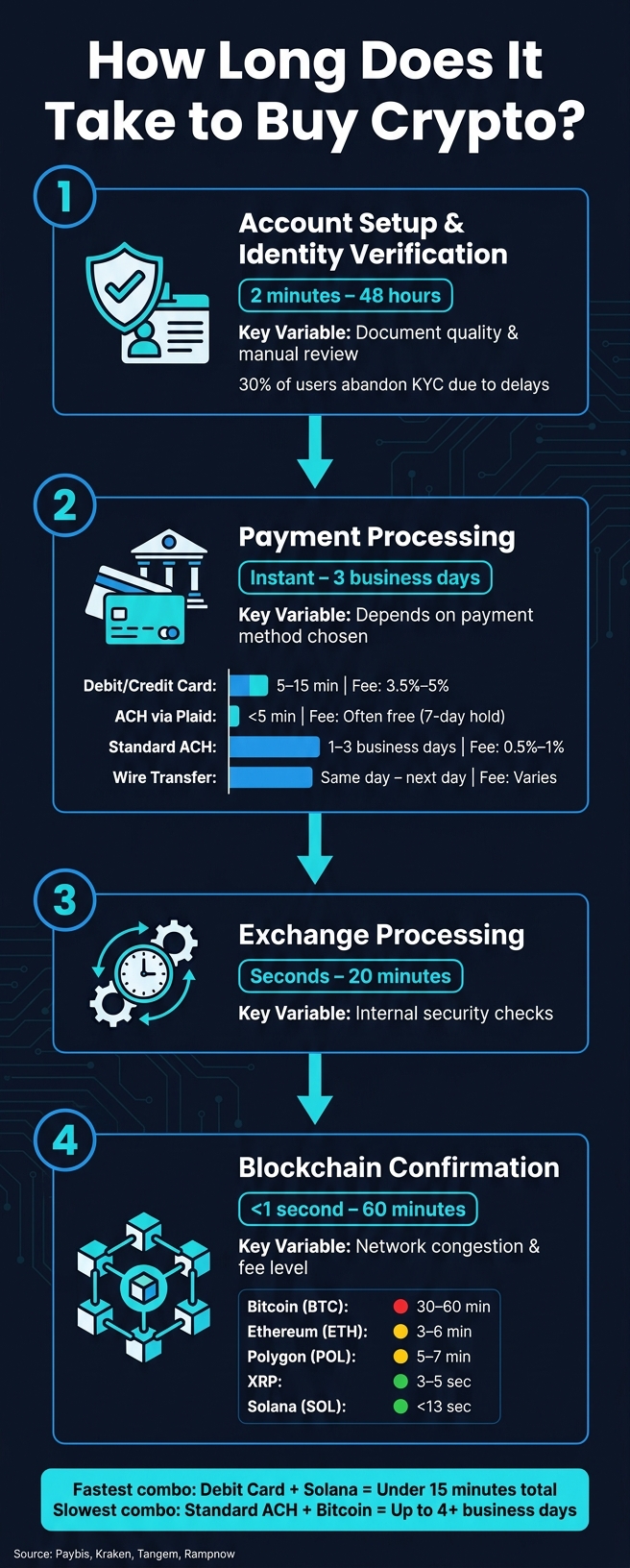
How Long Does It Take to Buy Crypto? Full Transaction Timeline
Buying crypto isn't a one-and-done action - it’s a series of steps, each with its own timing. Let’s break down how the process typically unfolds.
Account Setup and Verification
The first step is creating and verifying your account. Most platforms will ask for a government-issued photo ID and a selfie. If your documents are clear, automated systems can verify your details in as little as 2–5 minutes. However, if the documents are blurry or incomplete, the process could stretch to 24–48 hours.
Paul Afshar, Chief Marketing Officer at Paybis, explains:
"Identity verification (KYC) is the single biggest variable in first-time swap speed."
Once your account is verified, the speed of your crypto purchase will depend heavily on the payment method you choose.
Payment Processing Times
Your payment method plays a major role in how quickly your transaction moves forward. Debit cards and mobile wallets like Apple Pay or Google Pay process payments almost instantly. On the other hand, bank transfers (ACH) are slower but often cost less. ACH transfers generally take 1–3 business days to clear. For example, a transfer made on a Friday might not settle until Tuesday. After your payment clears, the exchange quickly processes your order.
Exchange Processing and Blockchain Confirmation
Once your payment is approved, the exchange processes your order. This step usually takes anywhere from a few seconds to 20 minutes, depending on internal security checks. Afterward, the transaction is sent to the blockchain, where it waits for confirmation by miners or validators.
Here’s a quick look at the typical timeframes for each stage:
| Stage | Typical Timeframe | Key Variable |
|---|---|---|
| Identity Verification | 2 minutes – 24 hours | Document quality; manual review |
| Payment Processing | Instant – 3 business days | Payment method used |
| Exchange Processing | Seconds to 20 minutes | Internal security checks |
| Blockchain Confirmation | 1 – 60 minutes | Network congestion and fee level |
On the Bitcoin network, transactions usually require 3–6 confirmations, which can take 30–60 minutes under normal conditions. Ethereum transactions, by contrast, are confirmed in about 1–5 minutes. If you’re using a debit card on a fast blockchain like Solana, the entire process - from clicking “buy” to having crypto in your wallet - can take less than 15 minutes. Knowing how these steps work can help you better estimate the total time it’ll take for your crypto to arrive.
sbb-itb-0796ce6
How Payment Methods Affect Transaction Speed
The payment method you choose plays a big role in how quickly cryptocurrency reaches your wallet. Knowing the differences can help you make smarter decisions, especially when balancing speed and cost. Here's a closer look at how various payment options impact transaction times and fees.
Credit and Debit Cards
Using a card is the quickest way to buy crypto. In most cases, your purchase is processed in 5–15 minutes, and if you're a returning user with a verified account, it can take less than a minute. This speed makes cards ideal for urgent transactions.
However, this convenience comes at a price. Debit card fees generally range from 3.5% to 4.5%, while credit card fees can climb to 3.9% to 5.0% or more. For comparison, bank transfers typically cost less than 1%. As Rajesh from Rampnow explains:
"Payment methods fall into two categories: low-cost bank transfers (0.5–1.0%) that require planning ahead, or high-cost instant options (3.5–5.0%) for urgent needs." - Rajesh, Rampnow
Cards are best for smaller purchases or situations where waiting isn't an option. To avoid extra fees or delays, check with your bank to ensure the transaction isn't classified as a cash advance, which can slow things down and add costs.
Bank Transfers
Bank transfers, such as ACH, are a more affordable option, with fees typically between 0.5% and 1.0%. But the tradeoff is speed - ACH transfers can take 1 to 3 business days to clear. This delay can be risky in volatile markets, as the price of your chosen cryptocurrency might change significantly before your funds are available.
Wire transfers (FedWire) are a faster alternative, often settling within the same day or the next business day. However, they are less common for everyday crypto purchases and may come with fees depending on your bank. If timing is critical but you'd like to avoid card fees, other instant options might be worth considering.
Instant Payment Options
Some platforms offer faster bank-based payment methods that combine the low cost of bank transfers with the speed of card payments. In the U.S., ACH via Plaid is a popular choice, with deposits typically processed in under 5 minutes and funds available for immediate trading. However, these deposits often come with a withdrawal hold of up to 7 days. As Kraken explains:
"The estimated processing time for ACH deposits through Plaid is up to five minutes. Once credited to your account, deposits are available instantly for trading."
For quick trading, instant bank integrations like Plaid are a solid option. But if you need immediate access to transfer crypto to a private wallet, a card purchase might still be the better choice, despite the higher fees.
Here’s a quick comparison of payment methods to help you decide:
| Payment Method | Speed | Typical Fees | Withdrawal Hold |
|---|---|---|---|
| Debit Card | 5–15 minutes | 3.5%–4.5% | Immediate |
| Credit Card | 5–15 minutes | 3.9%–5.0%+ | Immediate |
| ACH (Plaid) | < 5 minutes | Often free | Up to 7 days |
| ACH (Standard) | 1–3 business days | 0.5%–1.0% | Varies |
| Wire (FedWire) | Same day or next business day | Varies by bank | Varies |
Blockchain Network Confirmation Times
After completing payment and exchange processing, the blockchain's confirmation speed becomes the final factor in determining how long it takes for crypto to reach your wallet. This process is measured in confirmations, with each confirmation representing a new block added to the chain after your transaction's block. The more confirmations a transaction has, the more secure it becomes, reducing the risk of reversal. Your wallet will only receive the funds once the transaction has gained enough confirmations on the blockchain.
Bitcoin Confirmation Times
Bitcoin's confirmation process is a key factor in understanding potential delays. The network is designed to add a new block approximately every 10 minutes. Most platforms require 3 to 6 confirmations to credit your account, which translates to a wait time of 30 to 60 minutes. The standard of 6 confirmations is particularly important because, at that point, reversing the transaction would require an attack costing around $12.50 billion.
"Bitcoin's protocol targets a new block every 10 minutes... no matter how high you set your fee, you will still have to wait for the next block to open." - Tangem Blog
Faster Blockchain Networks
Not all blockchains operate at Bitcoin's pace. Ethereum, for instance, creates a new block roughly every 12 seconds, with most transactions fully confirmed within 3 to 6 minutes. Solana is even quicker, with a block time of just 0.4 seconds and the ability to handle over 65,000 transactions per second, leading to confirmations in mere seconds. XRP, on the other hand, requires only one confirmation, typically settling in 3 to 5 seconds. However, even the fastest networks can experience delays during periods of heavy traffic.
Here's a comparison of confirmation times across different networks:
| Network | Avg. Block Time | Typical Confirmations | Total Confirmation Time |
|---|---|---|---|
| Bitcoin (BTC) | ~10 minutes | 3–6 blocks | 30–60 minutes |
| Ethereum (ETH) | ~12 seconds | 12–35 blocks | 3–6 minutes |
| Solana (SOL) | ~0.4 seconds | 1–32 blocks | <1–13 seconds |
| XRP | ~3.5 seconds | 1 block | 3–5 seconds |
| Polygon (POL) | ~2 seconds | 127–200 blocks | ~5–7 minutes |
How Fees and Priority Levels Affect Confirmation Speed
Blockchains operate like a fee auction. Miners and validators prioritize transactions based on the fees attached to them - higher fees mean higher priority. Imagine a bus with limited seats: when demand is high, the driver fills the seats with passengers willing to pay the most.
To make this easier, most wallets offer Slow, Standard, and Fast priority options, which automatically calculate the necessary fee based on network congestion. On Ethereum, you can also add an extra tip (introduced with EIP-1559) to move your transaction to the front of the line. If your transaction gets stuck, Bitcoin wallets with Replace-by-Fee (RBF) allow you to resubmit it with a higher fee, while Ethereum offers a similar solution through nonce replacement.
One important detail: Bitcoin fees are calculated based on the transaction's data size in vBytes, not the dollar amount being sent. This means that a smaller transaction with multiple inputs can sometimes incur higher fees than a larger, more consolidated transfer.
Tips for Faster Crypto Purchases
If you're eager to speed up your crypto transactions, these practical tips can help you avoid common bottlenecks and streamline the process.
Have Your ID Documents Ready
One of the biggest hurdles for first-time crypto buyers isn't the blockchain - it's the identity verification process. In fact, 30% of users abandon the KYC (Know Your Customer) process before completing their first purchase due to unnecessary delays and friction. Having your documents ready beforehand can save you time and frustration.
Here’s what you’ll need:
- A valid government-issued photo ID (passport, driver’s license, or state ID).
- A current proof of address, such as a utility bill or bank statement issued within the last 3 months.
Make sure the name on both documents matches exactly. For example, if your ID says "Robert" but your bank statement says "Bob", your verification could be rejected.
For a smoother experience, use your smartphone to upload documents instead of a desktop webcam. Smartphone cameras are better suited for the optical character recognition and liveness checks that exchanges require.
"The fastest path is usually the mobile app because camera and liveness checks are easier to complete there." - Ubneo Editorial Team
When capturing your ID, use natural, indirect light to avoid glare. If you're submitting digital bank statements, upload the original PDF files instead of screenshots. With everything prepared, most platforms can complete basic verification in just 5 to 15 minutes.
Pick the Right Payment Method
Once your identity is verified, the next step is choosing a payment method that aligns with your speed and cost priorities. Payment methods play a huge role in determining how quickly you can complete your purchase.
- Debit and credit cards: These are the fastest options, typically processing in seconds to 15 minutes. Apple Pay and Google Pay offer similar speeds since they rely on the same card payment infrastructure.
- Wire transfers: Ideal for larger purchases over $5,000, domestic wire transfers settle in 1 to 4 hours and allow immediate withdrawals since the funds are irreversible.
- Standard ACH transfers: These are the most cost-effective but take longer, making them better suited for planned purchases.
Here’s a quick comparison of popular payment methods:
| Payment Method | Purchase Speed | Withdrawal Hold | Typical Fee |
|---|---|---|---|
| Debit/Credit Card | Seconds | 5–7 days | 3%–5% |
| Apple/Google Pay | Seconds | 5–7 days | 3%–5% |
| Wire Transfer | 1–4 hours | None | $10–$35 flat |
| Standard ACH | 1–3 business days | 7–10 days | 0%–1% |
Once your funds are deposited, use a market order to buy crypto instantly at the current price. This avoids delays that can occur with limit orders, which require specific price conditions to be met.
Track Your Transaction on a Blockchain Explorer
After placing your order, tracking your transaction in real-time can offer clarity and peace of mind. Blockchain explorers provide detailed insights that go beyond the generic "pending" status shown in most wallets.
To track your transaction:
- Copy your TXID (transaction ID) from your exchange history.
- Paste it into the right blockchain explorer for your network:
- Etherscan for Ethereum
- Solscan for Solana
- mempool.space for Bitcoin
The explorer will show the number of confirmations your transaction has received. This helps you see exactly how close you are to meeting the threshold required by your exchange to credit your balance.
If your transaction appears stuck in the mempool, you may need to take action. On Bitcoin, for instance, you can use Replace-by-Fee (RBF) to resubmit the transaction with a higher fee, but this only works if RBF was enabled in your wallet before sending the transaction. For large transfers, consider sending a small test amount first and confirming it on the explorer before sending the full amount.
"Pending is a status, not a verdict. The transaction is in process, delayed, or competing for inclusion. It is not the same thing as lost." - DEXTools
Conclusion: What Affects Crypto Transaction Times
When it comes to how quickly you receive your crypto, three key factors come into play: your payment method, the speed of identity verification, and the blockchain network being used. Each of these can introduce delays, and the slowest step usually dictates the overall transaction time.
Payment methods are a major factor in transaction speed. As David Rabinowicz puts it:
"'Instant' depends almost entirely on the rails you're using, not on how clever the exchange's UI is."
This highlights how crucial your choice of payment method is for a fast transaction.
The blockchain network itself also matters. Different blockchains operate at different speeds. Some can process transactions in seconds, while others may take much longer. Together, these two factors shape how predictable and efficient your crypto transactions will be.
Finally, the platform you choose ties everything together. For example, Kryptonim simplifies fiat-to-crypto purchases with no account requirements, transparent pricing (2% for EU users and 4% for others), and quick verification to cut down on delays. By combining a fast payment method with a responsive blockchain network, you can ensure a smoother and more reliable transaction process.
FAQs
Why can I trade crypto before I can withdraw it to my wallet?
When trading cryptocurrency, you can start right away since platforms often allow you to use your funds’ purchasing power even before the payment is fully processed. However, moving your funds to an external wallet isn’t as quick. This step involves additional processes, such as waiting for blockchain confirmations or completing bank transfers, which can take a few days.
Typical delays might happen due to pending ACH transfers or security measures. For instance, using a new device, updating your password, or certain payment methods could trigger temporary holds.
What should I do if my crypto transfer is stuck on “pending”?
If your crypto transfer is stuck on "pending", start by checking its status on a block explorer using the transaction ID (TXID). If a TXID is available, the delay is probably caused by network congestion or low transaction fees. In this case, you can either wait for it to process or, if supported, use options like "speed up" or "replace-by-fee" to prioritize it. However, if there’s no TXID, it likely means the exchange is still processing the transaction internally.
How many confirmations do I need before my wallet shows the crypto?
The number of confirmations needed for a transaction varies depending on the cryptocurrency and the rules set by your wallet or platform. These confirmations are crucial as they ensure the transaction is both secure and final.
For instance:
- Bitcoin usually requires 3–6 confirmations, which can take about 30–60 minutes.
- Ethereum might need anywhere from 12 to 35 confirmations.
- Other networks have their own specific requirements.
Be sure to check the policies of the platform you're using, as these confirmation times cannot be sped up.