
Debit vs. Bank Transfers: Speed for Crypto Buyers
Compare debit cards, ACH and wire transfers for buying crypto — speed, fees, limits, and which method fits your needs.
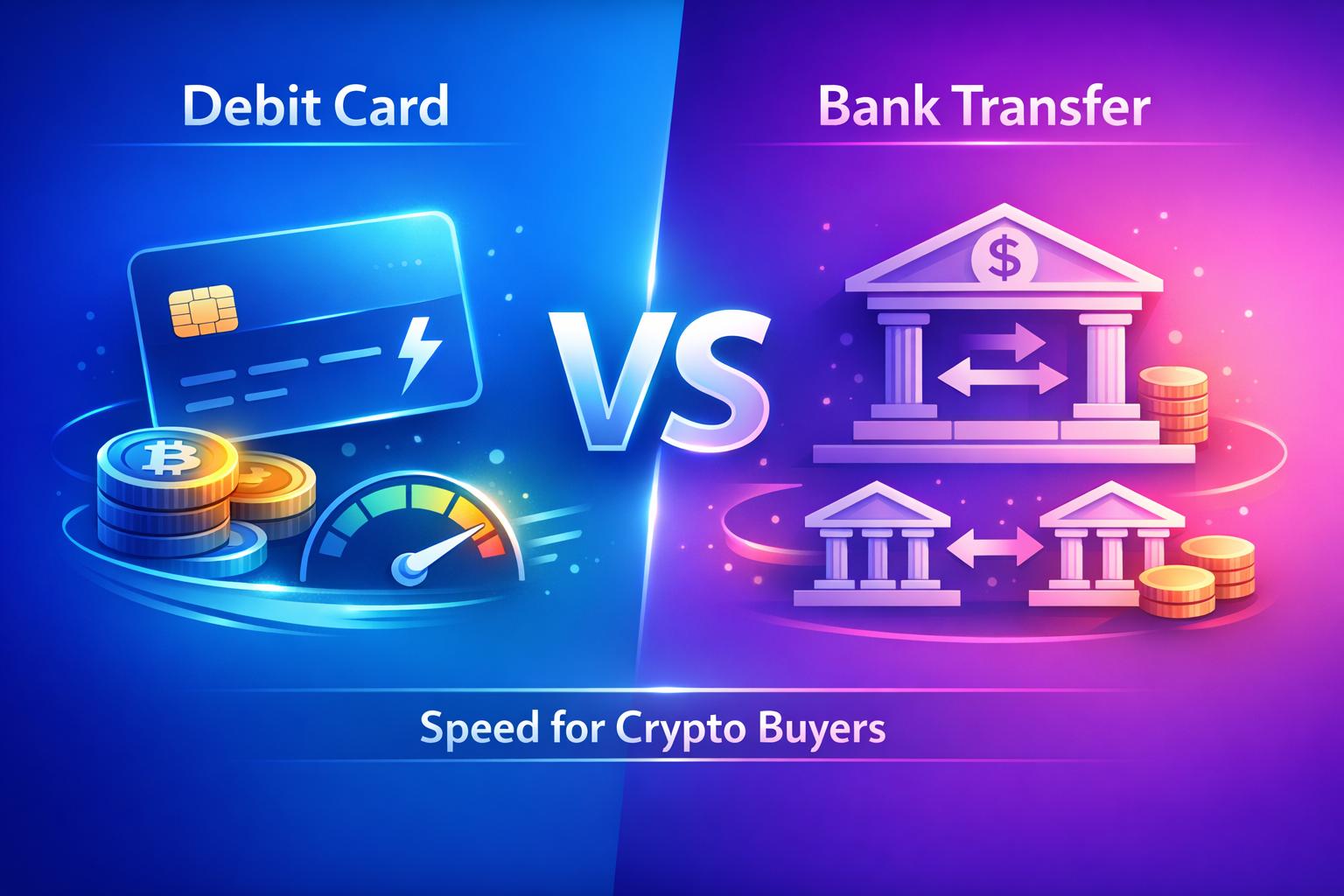
When buying cryptocurrency, the payment method you choose directly impacts how quickly you can act in the market. Here’s a quick breakdown:
- Debit cards are the fastest option, with transactions typically completed in under 15 minutes. Perfect for time-sensitive trades but come with higher fees and lower daily limits.
- ACH bank transfers take 1–5 business days to settle but are free or low-cost, making them ideal for planned or recurring investments.
- Wire transfers are faster than ACH (1–3 business days) and support larger transactions, but they come with bank fees.
Quick Comparison
| Payment Method | Processing Time | Daily Limits | Fees | Best For |
|---|---|---|---|---|
| Debit Card | Instant to 15 minutes | ~$1,000 | 3.49%–3.75% | Fast, small purchases |
| ACH Transfer | 1–5 business days | ~$100,000 | Free or minimal | Planned, recurring investments |
| Wire Transfer | 1–3 business days | Typically unlimited | $15–$30 per transfer | Large, urgent transactions |
If speed is your priority, debit cards are the way to go. For larger or cost-sensitive purchases, bank transfers (ACH or wire) are better suited. Always verify your account details beforehand to avoid delays.

Crypto Payment Methods Comparison: Debit Cards vs ACH vs Wire Transfers
How Debit Card Payments Work for Crypto Purchases
Using a debit card to buy cryptocurrency involves direct API connections with major card networks like Visa and Mastercard. This setup allows for real-time authorization and automated fraud detection, bypassing the extra steps often associated with traditional bank transfers. The result? A much faster and more seamless purchasing process.
Here’s how it works: you pick your cryptocurrency, enter the amount you want to buy, and provide your debit card details - including the 16-digit number, expiration date, CVV code, and billing zip code. The platform’s payment processor then securely verifies your card and checks for sufficient funds via an API connection.
To ensure quick delivery, many platforms keep crypto reserves and use smart wallet systems. Once your payment clears, the cryptocurrency is immediately transferred to your wallet. Since debit cards are directly linked to your bank account, settlements happen faster compared to other payment methods.
Processing Times for Debit Cards
One of the standout features of debit card transactions is their speed. Most transactions are completed within 1–5 minutes. On some platforms, the entire process - from entering your card details to receiving your crypto - can take as little as 60 seconds. For example, exchanges like Coinbase and Kraken list debit cards as "Instant" payment methods. Even the identity verification process is quick, with automated KYC systems often completing checks within 2–3 minutes. This means that first-time buyers can go from signing up to owning crypto in under 10 minutes. However, several factors can impact how quickly your transaction is processed.
Factors That Affect Debit Card Speed
A few key elements can influence how fast your transaction goes through:
- Pre-verification: Completing identity verification ahead of time can save you from delays, especially during periods of high market activity.
- Payment APIs: Platforms using advanced services like Plaid or Stripe enable instant verification, while manual processes can slow things down.
- Bank Security Protocols: Some banks may require you to manually authorize the transaction on their website. If this step isn’t completed quickly, the transaction could expire.
- Name Matching: If the name on your debit card doesn’t exactly match your account on the exchange, it might trigger a review that adds 1–3 days to the process.
Benefits of Using Debit Cards for Crypto Purchases
Debit cards offer a blend of speed and convenience that’s hard to beat. Unlike bank transfers, which are limited to business hours and don’t process on federal holidays, debit card transactions can be completed 24/7 - even on weekends and holidays. They’re also a great option for smaller purchases, with many platforms allowing you to start with as little as $30. For higher amounts, some platforms let you spend up to $1,000 without full verification, while verified users often enjoy daily limits of up to $20,000.
Mobile apps further enhance the experience by offering faster transaction processing and features like biometric login for added convenience. If you’re looking to make time-sensitive purchases, the combination of speed, accessibility, and ease of use makes debit cards an excellent choice.
sbb-itb-0796ce6
How Bank Transfers Work for Crypto Purchases
Bank transfers allow you to move U.S. dollars directly from your bank account to a crypto exchange wallet, enabling you to buy cryptocurrency. The process starts with completing identity verification (KYC) on the exchange. Once verified, you link your bank account, either through a secure service like Plaid or by manually verifying your details.
After your account is connected, you can choose between two transfer types: ACH transfers or wire transfers. With ACH transfers, the exchange "pulls" funds from your account, while wire transfers require you to "push" funds from your bank. Once you initiate the transfer, there’s a waiting period while the funds settle. Some exchanges offer "Instant Deposits", letting you start trading immediately while the transfer clears in the background. However, withdrawals remain restricted until the settlement is finalized.
A key difference between bank transfers and debit card payments lies in their processing. ACH transfers are processed in batches that clear periodically throughout the day, typically every four hours on business days. Wire transfers, on the other hand, are processed individually and settle much faster. Understanding these nuances is essential, as transfer times can directly impact your ability to act on market changes.
One major advantage of bank transfers is that they’re irreversible, unlike card payments, which can be disputed through chargebacks. This adds a layer of security to transactions. Additionally, they create a clear, traceable record of funds, which is especially useful for tax purposes. For wire transfers, it’s important to include the unique reference or memo code provided by the exchange to ensure your funds are applied correctly. Next, let’s dive into the processing times and the factors that can influence them.
Processing Times for Bank Transfers
ACH transfers generally take 4–5 business days to fully clear and settle. While some platforms allow you to start trading immediately after depositing funds via ACH, withdrawals are restricted until the settlement period ends. This makes ACH the slowest option when it comes to accessing your funds.
Domestic wire transfers are much faster, usually processing within one business day if initiated before your bank’s cutoff time, which typically falls between 2:00 PM and 5:00 PM ET. For international wire transfers (SWIFT), the timeline extends to 1–5 business days due to intermediary bank processing and varying regulations. These transfers often pass through multiple banks, each operating within its own business hours.
It’s also worth noting that weekends and federal holidays can delay processing. For example, a transfer initiated on a Friday evening won’t begin processing until the next business day. As a result, a 5-business-day ACH transfer could stretch to 7–10 calendar days, depending on when it’s initiated.
Factors That Affect Bank Transfer Speed
Several elements can impact how quickly your bank transfer is processed:
- Batch Processing: ACH transfers are grouped into batches and settled periodically, which can slow down processing times.
- Bank Cutoff Times: Transfers initiated after your bank’s daily cutoff - usually between 2:00 PM and 5:00 PM ET - won’t start processing until the next business day.
- Verification Requirements: For new accounts or larger transactions, banks may conduct extra security checks, adding 1–3 business days to the timeline.
- Cross-Border Transfers: International transactions often require coordination across time zones. Countries with strict anti-money laundering (AML) rules or economic sanctions may also require additional documentation, further delaying the process.
- Intermediary Fees: Transfers involving intermediary banks can incur fees ranging from $10–$25, along with currency exchange markups of 2%–5%.
Benefits of Using Bank Transfers for Crypto Purchases
Bank transfers come with several advantages, particularly for those making larger crypto purchases. ACH transfers are free, making them a cost-effective option for regular investments. While wire transfers do involve bank fees - typically $15–$30 - they allow for much higher transaction limits, often $100,000 per day or more, and offer faster processing.
Another benefit is that bank transfers are irreversible, providing added security for transactions. They also generate a clear and traceable record, which can be invaluable for tax reporting. Wire transfers, in particular, are ideal for urgent, high-value trades. Though they come with higher fees, they can settle on the same day for domestic transfers if submitted before the cutoff time, making them a great option for time-sensitive transactions. With this understanding of bank transfers and their benefits, we’ll now explore how their speed compares to debit card payments.
Debit Cards vs. Bank Transfers: Speed Comparison
The payment method you choose can significantly impact how quickly you can purchase cryptocurrency. Debit card transactions are processed in under 15 minutes, locking in the current price at the time of purchase. On the other hand, ACH transfers usually take 1–5 business days to settle, although some platforms allow you to start trading before the funds are fully cleared. Wire transfers fall somewhere in between, typically processing within 1–3 business days.
While debit cards offer unmatched speed, they come with lower daily limits and higher fees. Each payment method has its own unique cost and limit structure, which is summarized in the table below.
"Using a debit card allows you to complete a trade instantly. You will be able to withdraw your crypto after 15 minutes."
Speed Comparison Table
| Payment Method | Typical Processing Time | Fastest Processing | Daily Limits | Primary Advantage |
|---|---|---|---|---|
| Debit Card | Instant to 15 minutes | Instant | Low (≈ $1,000/day) | Speed and convenience |
| ACH Transfer | 1–5 business days | Same-day (if supported) | High (≈ $100,000/day) | Low to no cost |
| Wire Transfer | 1–3 business days | Same-day if sent before cutoff | Typically unlimited | High limits and reliability |
When to Use Debit Cards vs. Bank Transfers
Choosing the right payment method depends on how quickly you need to invest and the size of your transaction.
Debit cards are perfect for situations where speed is critical. If you need to act quickly to lock in a price or respond to market changes, they’re the go-to option. However, they’re best suited for smaller purchases - usually under $1,000 - where convenience outweighs the higher fees.
For planned investments or recurring purchases, ACH transfers are a more cost-effective choice. They’re ideal for strategies like dollar-cost averaging, where keeping fees low is more important than immediate access. Just keep in mind that ACH transfers initiated after 5:00 PM ET will typically begin processing the next business day.
Wire transfers are a strong choice for larger transactions that exceed debit card limits but still require faster processing than ACH transfers. If you initiate a domestic wire before 3:00 PM ET, you can often secure same-day or next-business-day access to funds. This makes wire transfers particularly useful for time-sensitive, high-value trades.
Conclusion: Selecting the Right Payment Method for Your Needs
When it comes to buying crypto, the right payment method often depends on your priorities - speed or cost. Debit cards process transactions in just 2–20 minutes, making them perfect for locking in prices during volatile market swings. On the other hand, ACH transfers take 1–5 business days, making them better suited for larger, planned purchases.
The trade-off? Debit cards come with fees ranging from 3.49% to 3.75%, while ACH transfers are typically free. For smaller, time-sensitive trades, the speed of debit cards can justify the higher fees. But if you're dollar-cost averaging or making a significant investment, the lower costs of ACH transfers might be worth the wait.
Platforms like Kryptonim simplify the debit card process by skipping account registrations and delivering crypto directly to your wallet in as little as 2–20 minutes. With support for over 25 currencies (including USD, EUR, and GBP) and a low transaction minimum of $10 equivalent, it’s a convenient option for those who have already completed their verifications.
To avoid any hiccups, make sure your account verification is complete ahead of time.
Ultimately, the choice boils down to your goals. Need speed? Go with debit cards. Looking to save on fees? ACH transfers are the way to go.
FAQs
What’s the difference in speed and cost between using a debit card and a bank transfer to buy cryptocurrency?
When you use a debit card to buy crypto, transactions are processed almost instantly - usually within minutes. This makes it a convenient option if you're in a hurry. On the flip side, bank transfers like ACH (common in the U.S.) are much slower, taking about 3–5 business days to complete. Wire transfers are a bit faster, typically settling in 1–3 business days.
However, speed comes at a cost. Debit card transactions often carry higher fees, ranging from 2% to 4% or even more. In contrast, bank transfers are much easier on your wallet. ACH transfers are often free, while wire transfers usually come with a flat fee, generally between $20 and $50.
So, if speed is your priority, debit cards are the way to go. But if you're looking to save on fees, bank transfers are the smarter choice.
What’s the difference between wire transfers and ACH transfers for large crypto purchases?
Wire transfers offer quicker processing times and can handle significantly larger amounts compared to ACH transfers, though they usually come with steeper fees. In the U.S., domestic wire transfers generally settle within 1–3 business days, while ACH transfers may take 4–5 business days. Wire transfers also stand out for their lack of transaction amount limits, whereas ACH transfers often impose daily caps, such as $100,000 per day.
For purchasing large amounts of cryptocurrency, wire transfers are a better choice due to their speed and higher transaction limits, even if they cost around $25 per transaction plus any additional bank charges. On the other hand, ACH transfers are more affordable - sometimes even free - but their slower processing times and lower limits make them ideal for smaller or less time-sensitive transactions. Kryptonim supports both wire and ACH transfers, ensuring fast and secure fiat-to-crypto transactions, all without the need for an account.
What affects how quickly debit card transactions process when buying cryptocurrency?
Debit card payments are among the quickest ways to purchase cryptocurrency, often completing in just minutes - or even instantly. However, a few factors can impact how fast the process unfolds:
- Card issuer approval: Your bank needs to authorize the transaction. In some cases, they might perform extra checks, like fraud prevention or anti-money laundering reviews, which could lead to minor delays.
- Card type: Cards with features like Visa Fast Funds or Mastercard Send tend to process payments faster compared to standard debit cards that follow traditional settlement timelines.
- Verification status: If your account is newly verified, the platform might place temporary holds on transactions, which could slow things down.
- Transaction size: Larger purchases sometimes require additional review steps, which might take extra time.
Kryptonim streamlines this process by leveraging fast payment systems, allowing most debit card transactions to go through securely and in just a few minutes.